Whether to Choose a Himalayan or a Solid Persian
Choosing between a Himalayan and a solid Persian often comes down to one visible difference: the Himalayan has a pale body with darker color on its face, ears, legs, and tail, while a solid Persian has an even coat color. But the coat pattern is only part of the decision. Both need regular grooming, thoughtful health screening, and a home prepared for a longhaired cat.
What separates a Himalayan from a solid Persian
The pointed coat pattern is the clearest difference
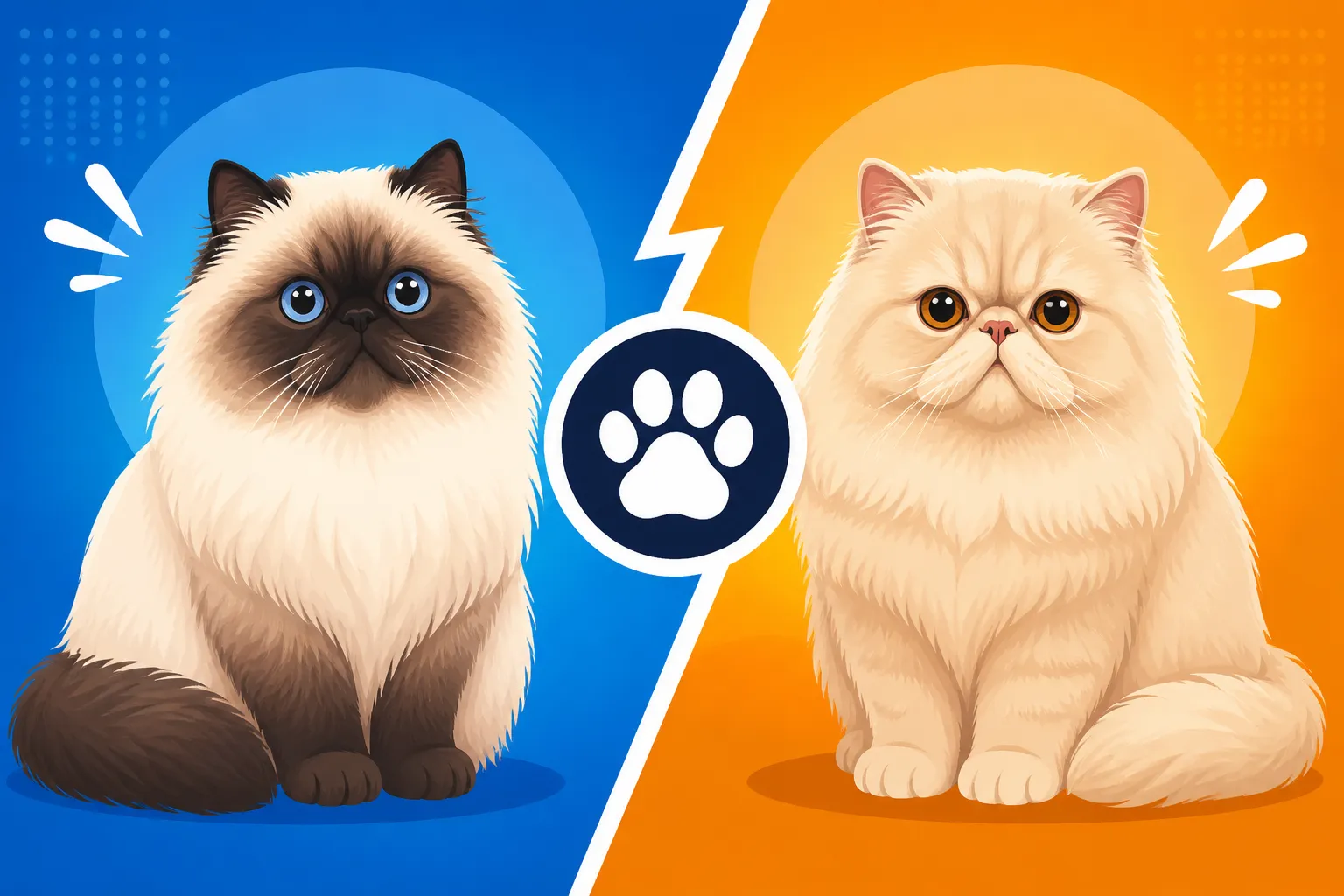
A Himalayan is essentially a Persian with the colorpoint pattern. The body coat is usually lighter, while cooler areas of the body develop darker “points.” Those points can appear in several colors, including seal, blue, chocolate, lilac, flame, and tortie. A solid Persian, by contrast, has a coat that is one color throughout rather than a contrasting mask and darker extremities.
That contrast may change as a Himalayan grows. Kittens are often born very pale, and their points become easier to see over time. The pattern is influenced by temperature-sensitive pigment: cooler areas tend to grow darker fur. A Himalayan’s points may deepen with age or become more noticeable after a shaved patch grows back. The color distinction is a useful visual clue, but it does not tell you whether a particular cat is healthy or well bred.
Registry terminology can also make the comparison confusing. Some organizations treat the Himalayan as a Persian division or variety, while others recognize the Himalayan separately. So a cat may be called a Himalayan by its breeder even if its paperwork uses a Persian category. For the background, see Why the Himalayan Is a Persian With the Point Gene and What Your Himalayan’s Certificate Actually Says.
Their body type and care needs are often very similar
Both cats generally have long, dense coats that can mat close to the skin if they are not combed regularly. Their coats may look soft and glamorous, but a quick pass over the top does not necessarily reach the undercoat, where tangles can form. A solid Persian’s coat can hide mats just as effectively as a Himalayan’s.
Face shape is not determined by coat color alone. Some Himalayans and some solid Persians have a more moderate profile, while others have a flatter face. If you are comparing kittens, look at each one’s face and breathing rather than assuming the breed label tells you everything. Quiet breathing at rest, clean skin folds, and comfortable movement are more useful signs than an especially flat profile.
For either cat, daily coat care is a realistic part of ownership, not an occasional beauty routine. A comb should reach down through the coat in manageable sections, particularly around the armpits, belly, ruff, and hindquarters. The Daily Comb a Himalayan Cannot Skip offers a practical look at why this routine matters. Many of the same grooming principles apply to a solid Persian.
Comparing the everyday experience
Coat care, face care, and cleaning
Both cats need routine brushing or combing, but the exact workload depends on the individual coat, the cat’s tolerance for grooming, and how consistently the owner keeps up with it. A Himalayan’s pale body coat can make tear tracks or food stains stand out, while a solid Persian’s coat color may make some marks less obvious. That is a difference in visibility, not proof that one cat is cleaner or needs less care.
Face care can also vary from cat to cat. Some cats have watery eyes or folds that need gentle cleaning and careful drying. Others have relatively little staining. Coat color may affect how noticeable dried tear marks look, but eye discharge should not be dismissed as a cosmetic issue if it changes suddenly, smells unpleasant, or comes with redness, squinting, or discomfort. For more on the routine, read Why the Eye Routine Is a Standing Himalayan Expense.
A helpful way to compare the grooming commitment is to imagine a normal weekday, not a perfect weekend. Can you fit in a calm combing session and a quick face check when you are tired or running late? If not, consider whether another household member can help or whether you can arrange professional grooming when needed. Chewy can be a convenient place to look for basic supplies such as combs, wipes, and shallow bowls, but choose products carefully and follow your veterinarian’s advice around the eyes.
Temperament, activity, and household fit
There is no dependable personality rule that says every Himalayan is quieter or every solid Persian is more affectionate. Individual temperament is shaped by the cat’s genetics, early handling, health, and environment. Both may enjoy calm company and familiar routines, but one cat may seek a lap while another prefers to sit beside you on the sofa.
A cat’s comfort with your household matters more than the label. A busy home with young children, frequent visitors, or a lively dog may be a poor match for a cat that wants quiet and predictable handling. Ask the breeder or rescue caregiver how the particular cat responds to everyday noise, gentle handling, grooming, and being left alone. If you are considering a Himalayan, Who the Himalayan Actually Suits can help you think through the lifestyle match.
Play needs should be judged individually, too. Many Persian-type cats enjoy short play sessions with a wand toy or a treat puzzle, then return to a favorite resting spot. A flat-faced cat may find vigorous play or warm rooms uncomfortable, so watch for panting, distress, or unusual fatigue and stop activity if you see it. Do not choose based on a promise that a particular coat pattern guarantees a certain personality.
| Decision point | Himalayan | Solid Persian |
|---|---|---|
| Coat appearance | Light body with darker points | One main coat color |
| Eye color expectation | Blue eyes are characteristic of the pointed pattern | Eye color varies with coat color and lineage |
| Grooming | Regular combing; face care may be needed | Regular combing; face care may be needed |
| Health priorities | Screen the individual cat’s eyes, breathing, kidneys, teeth, and overall health | Screen the individual cat’s eyes, breathing, kidneys, teeth, and overall health |
| Best reason to choose | You specifically love the point pattern and are ready for coat and face care | You prefer a single-color coat and are ready for the same general longhair commitment |
Health and breeder questions matter more than coat color
Look at the individual cat’s face and breathing
A Himalayan is not automatically less healthy than a solid Persian, and a solid coat does not make a Persian free of breed-related concerns. The face profile and the health of the individual line deserve more attention than the coat pattern. Ask to meet the cat in person when possible, and watch how it breathes while resting and after gentle play.
Look for comfortable, quiet breathing rather than persistent noisy breathing, open-mouth breathing, or obvious effort. Check whether the eyes are clean and open, whether the skin around the nose is dry and healthy, and whether the cat can eat comfortably. A kitten that seems unusually tired or struggles during ordinary activity needs a veterinary assessment, not an explanation based only on its breed.
These observations are not a substitute for veterinary care, but they can help you ask better questions. Request the cat’s medical history and ask what screening has been done in its family. A responsible breeder should be willing to discuss health concerns plainly rather than focusing only on eye color, coat pattern, or show appearance. For a broader checklist, see What Nobody Tells You Before Buying a Himalayan.
Ask for clear records, not just reassuring claims
Ask what health testing applies to the parents and what documentation is available. For Himalayans, buyers commonly ask about testing for polycystic kidney disease and eye health, while also discussing breathing, dental, and general veterinary history. Similar questions are sensible when buying a solid Persian, because a different coat color does not erase shared Persian-type health considerations.
Request records that identify the cats tested, the tests performed, and the results. A verbal assurance that “the line is healthy” is not as useful as documentation you can review with your veterinarian. If the breeder cannot provide records, ask why and consider whether you are comfortable proceeding. Which Two Certificates a Himalayan Breeder Owes You and Which Papers a Himalayan Buyer Should Insist On are useful starting points for understanding what to ask for.
Also ask about the kitten’s own veterinary visits, vaccinations, parasite prevention, and any concerns noted during examinations. A good breeder should welcome reasonable questions and give you time to decide. Be cautious if you are pressured to pay quickly, discouraged from asking about health, or told that a particular coat color guarantees better health or temperament.
How to make the choice that fits your home
Choose by care routine and individual needs
Start with the practical question: are you genuinely comfortable with regular grooming? Both cats can develop painful mats if combing is skipped, and a long coat can collect debris around the hindquarters. If you want a cat whose coat needs little maintenance, neither a Himalayan nor a solid Persian is likely to be the easy-care choice you have in mind.
Next, consider how much face care you can manage. Some cats need only occasional cleaning, while others have watery eyes or folds that require a consistent routine. Use gentle products appropriate for cats, avoid putting cleaners directly into the eye, and ask a veterinarian about persistent staining or discharge. Chewy may help you find everyday grooming and feeding supplies, but a product listing cannot determine what is suitable for a cat with an eye or skin problem.
Finally, decide whether the pointed pattern is important enough to guide your choice. If you love the Himalayan’s mask and blue eyes, that is a perfectly good reason to look for one—as long as you also evaluate health, temperament, and care needs. If you prefer an even coat color, a solid Persian may be the more appealing match. Neither choice is inherently better for every household.
Compare the cats in front of you
When possible, meet more than one cat and observe them in a calm setting. Ask to see the kitten or adult cat move around, eat, and interact with people. If you are choosing a kitten, ask how the breeder supports early grooming practice and whether the kitten has been handled gently around its face and paws. A kitten that has had calm, positive exposure to combing may be easier to care for than one whose routine begins only after going home.
Consider the adult cat, too. A rescue or retired breeding cat may already have a settled personality and established grooming preferences, which can make it easier to understand what daily life will be like. Ask what food the cat eats, what grooming it tolerates, whether it has known medical concerns, and how it reacts to other animals or visitors. When you bring a cat home, keep familiar routines where possible and introduce new rooms, people, and pets gradually.
If the choice still feels close, write down your priorities: coat color, tolerance for grooming, face shape, activity level, health records, and compatibility with your household. Give the greatest weight to health and fit, not the coat pattern that photographs best. The right cat is the one whose needs you understand and can meet, whether its coat is pointed or solid.
Disclaimer
This article is for general informational purposes only and does not constitute professional advice. Laws, prices and regulations vary by location and change over time. Consult a qualified professional for guidance on your specific situation.