Whether a Himalayan Beats a Solid Persian on Points
It’s a question that often pops up in conversations among cat enthusiasts, especially those who love the majestic, long-haired breeds: can a Himalayan cat truly "beat" a solid Persian in a cat show? This isn't just idle chatter; it touches on the very identity of the Himalayan and how it's judged within the highly competitive world of pedigreed cats. For many owners, understanding these distinctions helps make sense of their cat’s heritage and potential, particularly when navigating the intricate rules of various cat registries.
The Himalayan's Standing in the Cat Fancy: Are They Persians or Their Own Breed?
Before we can even begin to talk about "beating on points," we absolutely have to get clear on how the Himalayan is officially recognized by different cat registries. This is where a lot of the confusion stems from, and honestly, it’s a source of ongoing debate among breeders and fanciers alike! It’s not just semantics; it directly impacts how a Himalayan competes and what kind of paperwork you’ll get for your beautiful furball.
For decades, there's been a divergence in how major cat organizations classify the Himalayan. On one side, you have the Cat Fanciers' Association (CFA), which is a powerhouse in the cat world. Back in 1984, CFA made a pivotal decision that changed the game for Himalayans. They decided to fold the Himalayan into the Persian breed as a "colorpoint division." What this means, in plain terms, is that if your cat is registered with CFA, on paper, it's a Persian – specifically, a Colorpoint Persian. This decision was a big deal, and it's something many long-time Himalayan lovers still discuss. For a CFA-registered Himalayan, the judging standard it faces is the Persian standard, with specific allowances and requirements for its unique color points and brilliant blue eyes. This means that a Himalayan is judged directly against all other Persians, regardless of their color, on the core Persian traits like head shape, body type, coat quality, and eye set. You can dive deeper into this fascinating history by reading Why CFA Merged the Himalayan With the Persian.
Then, on the other side of the coin, you have organizations like The International Cat Association (TICA) and others which still recognize the Himalayan as its own distinct breed. This offers a different competitive path, where Himalayans might compete in their own breed classes, or if they compete against Persians, the judging criteria might be interpreted with more emphasis on their unique point pattern. This difference in classification is fundamental because it dictates who your Himalayan is competing against and under what specific rules. If you're ever looking at getting a kitten, asking a breeder which registry they use and how the cat is classified can tell you a lot about its lineage and show potential. Knowing that TICA Still Registers the Himalayan as a Breed of Its Own can be really helpful when you're doing your research and looking at pedigrees.
So, when someone asks if a Himalayan can "beat" a solid Persian on points, the very first question we need to ask is: under which registry are we talking? If it's CFA, then the Himalayan is a Persian, and it absolutely competes directly against solid Persians, and any other color or pattern of Persian, for the same "points" and titles. If it's another registry that still considers them a separate breed, the competition structure could be different, though often they still share many common standards with their Persian cousins.
Deciphering "Beating on Points": How Show Judging Works
When we talk about a cat "beating" another cat "on points" in a show, we're not talking about the color points on a Himalayan's face, ears, legs, and tail. Instead, "points" here refers to the numerical score a judge gives a cat based on how well it conforms to its breed standard. Every breed has a detailed written standard that outlines the ideal characteristics for that cat – from the shape of its head and ears, to the length and texture of its coat, the color and shape of its eyes, and even its overall body condition and temperament. Judges award points for how closely a cat matches this ideal, and they deduct points for any faults or deviations from the standard.
For a Himalayan, especially in a registry like CFA where it’s a division of the Persian, it is judged against the overall Persian standard, with specific provisions for its color and eye attributes. The Persian standard is incredibly detailed, allocating points for various features. For instance, a significant portion of the points might be dedicated to the "head" (roundness, doming, short nose, small ears set low), another large chunk to "body" (cobby, heavy boned, short legs), and then "coat" (long, flowing, correct texture). Lastly, there are points for "color and pattern" and "eye color." For a Himalayan, those last two categories are where its unique traits come into play, but they still have to nail all the Persian characteristics first. You really need to understand What the Persian Standard Asks of a Himalayan to appreciate the challenge.
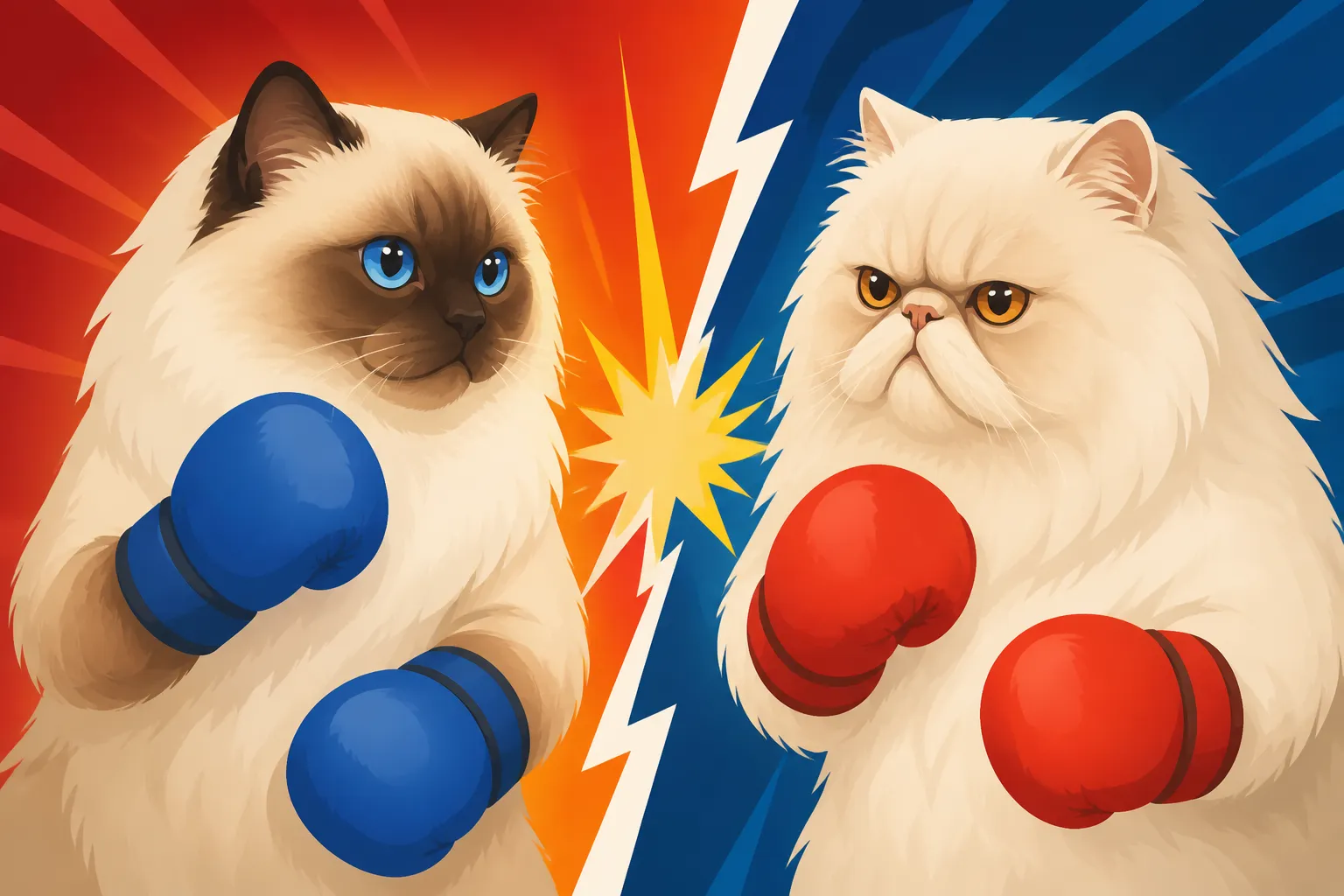
Let's say a judge is evaluating a class of Persians that includes both solid colors (like a black or white Persian) and Himalayans. The judge will look at the total package. A Himalayan with an exceptionally perfect Persian head, a wonderfully cobby body, and a luxurious, well-maintained coat, along with clear, deep blue eyes and well-defined, contrasting points, could absolutely outscore a solid Persian that has some minor structural flaws or a less impressive coat, even if its solid color is rich and even. Conversely, a Himalayan with weak point definition, or tear staining that mars its delicate facial features, or a less than ideal Persian body type, could easily be beaten by a solid Persian that exemplifies the breed standard in all its glorious monochromatic perfection. Owners dedicate immense effort to maintaining that pristine appearance, including investing in quality food.
The key takeaway here is that "beating on points" isn't about one type of Persian being inherently superior to another. It's about how individual cats, on a given day, stack up against a comprehensive breed standard. A well-conditioned, genetically sound Himalayan with excellent conformation to the Persian standard and stunning points and eyes has every chance of earning top honors. It truly is about the individual cat's quality and presentation.
Key Differences in Appearance: Himalayan vs. Solid Persian in the Ring
While both Himalayans and solid Persians share the same fundamental body and head type according to the CFA standard, their distinct appearances mean judges look for different specific qualities within the color and pattern categories. These nuances can absolutely affect how a cat scores in the ring.
First and foremost, the Himalayan is defined by its colorpoint pattern. This means it has darker coloration on its extremities – the "points" – which include the mask, ears, legs, and tail, while the body remains a much paler shade. And, of course, those striking, intensely blue eyes are non-negotiable for a Himalayan. For a Himalayan to do well, the contrast between the points and the body color needs to be clear and distinct. A muddy or poorly defined transition can be a fault. The point color itself must be even and true to its designated shade, whether it's seal, blue, chocolate, flame, lilac, or one of the other recognized point colors. A judge will scrutinize the depth of color in the points, looking for richness and uniformity. For instance, a Seal Point should have very dark, seal-brown points that contrast sharply with a pale cream or fawn body. Maintaining this contrast often involves careful temperature management and diet, which can be an ongoing commitment for owners.
Solid Persians, on the other hand, are judged on the evenness and depth of a single color across their entire body. For a solid black Persian, the ideal is a dense, jet black coat right down to the roots, with no rusty tones, white hairs, or shading. For a solid white Persian, it's about pure, unblemished white. The intensity and uniformity of their chosen color are paramount. They don't have the challenge of contrast but rather the challenge of absolute consistency. Their eye color, typically copper or deep blue (for whites), must also be correct and intense.
Consider the practicalities for a judge. A Himalayan's pale body coat can sometimes show small imperfections more readily, like tear staining. Even though tear staining is common in many flat-faced breeds, it can be particularly noticeable on a creamy Himalayan body, and judges will certainly take presentation into account. While a solid Persian might also experience tear staining, it might be less conspicuous on a darker coat. Similarly, while both types of Persians need meticulous grooming, a Himalayan's point pattern can sometimes make minor matting or discoloration harder to hide in certain areas. This is why daily grooming and attention to facial hygiene are absolutely critical for a Himalayan competing in shows. Using the right products and having a consistent routine is key. Sometimes, owners even trim a Himalayan's Britches Without Turning It Over to keep them pristine.
Ultimately, both a Himalayan and a solid Persian need to be exceptional examples of the Persian breed standard in terms of their structure and temperament. However, the Himalayan also carries the additional burden and beauty of its colorpoint pattern and blue eyes, which must be flawless and meet the specific criteria for its division. A Himalayan that truly excels in all aspects of the Persian standard and perfectly expresses its unique colorpoint traits has a very strong chance of taking top honors, proving that it can indeed "beat" a solid Persian that might fall short in other areas.
| Trait Category | Himalayan (Colorpoint Persian) | Solid Persian | Impact on Judging |
|---|---|---|---|
| Body Type | Cobby, heavy boned, short legs (same as all Persians) | Cobby, heavy boned, short legs (same as all Persians) | Equally crucial for both; major faults are highly penalized. |
| Head Type | Round, broad, domed, small ears low-set (same as all Persians) | Round, broad, domed, small ears low-set (same as all Persians) | A cornerstone of the Persian standard; dictates overall face structure. |
| Coat | Long, thick, soft, flowing (same as all Persians), with emphasis on contrast | Long, thick, soft, flowing (same as all Persians), with emphasis on uniformity | Both need immaculate grooming; poor condition is a fault. |
| Color | Distinct dark points (mask, ears, legs, tail) contrasting sharply with a pale body. | Rich, even, dense color across entire body (e.g., solid black, white, red, cream). | Himalayan judged on contrast and point clarity; Solid judged on color uniformity and richness. |
| Eye Color | Intense, vivid blue, large, round, full. | Varies by color (e.g., brilliant copper for solids, deep blue for whites). | Himalayan's blue eyes are a defining feature and must be perfect. |
| Faults | Poor point contrast, muddy body color, visible tear staining. | Fading color, white hairs, uneven shading, poor eye color. | Specific faults related to their unique color patterns are penalized. |
Beyond the Ribbons: What Every Owner Needs to Know for a Healthy, Happy Cat
While the excitement of show rings and ribbons is certainly part of the pedigreed cat world, for most of us, the true "win" is having a healthy, happy cat curled up on our lap. Whether your Himalayan is destined for stardom or simply to be the most adored family member, ensuring their well-being is paramount. And let's be honest, a healthy cat looks better, too!
Himalayans, like their Persian ancestors, can be prone to certain health challenges that every owner needs to be aware of. Polycystic Kidney Disease (PKD) is one such genetic condition that was prevalent in Persian lines and, by extension, in Himalayans. Thankfully, with genetic testing, responsible breeders are working hard to eradicate this. It's crucial that you get Which Two Certificates a Himalayan Breeder Owes You and insist on seeing clear test results for both parents. Early diagnosis and management are key, and regular vet check-ups are non-negotiable. Knowing Why a Himalayan's Kidneys Are Checked Before Sedation is also vital if your cat ever needs surgery.
Their magnificent long coats require daily attention. If you skip a day, you might find yourself battling mats, especially in those tricky spots like under the armpits or in their britches. A good quality steel comb and a consistent routine are your best friends here. Neglecting the coat can lead to painful skin issues and, in severe cases, require professional grooming under sedation, which is an expense and a stressor no one wants. Investing in good grooming tools and establishing a routine from kittenhood is an investment in your cat's comfort and your peace of mind.
And then there's the famous flat face. While adorable, it comes with a responsibility to keep those eyes and nose folds clean and dry. Tear staining is common, and if left unchecked, it can lead to skin irritation or even infection. A gentle daily wipe with a soft cloth and warm water is usually all it takes, but sometimes special solutions are needed. Always consult your vet if you notice excessive discharge or redness. These daily routines are part of The Morning Face Routine Every Himalayan Needs. For feeding, their flattened faces mean they often struggle with deep bowls; wider, shallower dishes are usually best. Brands like Chewy offer a wide variety of specialty bowls and feeders designed for brachycephalic breeds, making mealtime much more comfortable for your feline friend.
Considering the potential for specific breed-related health issues, robust pet insurance can be a real lifesaver. Companies like Healthy Paws offer comprehensive plans that can help cover unexpected vet bills, giving you peace of mind that you can always provide the best care without financial strain. It’s always smart to research different providers and understand what their policies cover, especially regarding hereditary conditions. Many owners also look into high-quality fresh food diets, believing that good nutrition supports overall health, coat quality, and can help manage weight. A well-balanced diet can definitely impact everything from energy levels to the luster of their coat, which in turn contributes to their overall well-being.
Ultimately, whether your Himalayan wins Best in Show or simply "Best Lap Warmer," their health and happiness are what matter most. A well-cared-for Himalayan, with a shiny coat, clear eyes, and a purr-fect temperament, is truly a champion in every sense of the word.
Disclaimer
This article is for general informational purposes only and does not constitute professional advice. Laws, prices and regulations vary by location and change over time. Consult a qualified professional for guidance on your specific situation.