Why Some Owners Move From a Himalayan to an Exotic Shorthair
A Himalayan can be a wonderful companion and still leave an owner worn down by daily combing, tear cleanup, and the constant worry of mats forming out of sight. Some people who love the Persian look decide an Exotic Shorthair may fit their routine better. This guide explains what changes, what does not, and how to decide whether a shorter coat is enough.
Why Himalayan owners consider an Exotic Shorthair
The coat can turn affection into a daily job
Himalayans have long, dense coats that can tangle close to the skin, especially beneath the legs, around the armpits, at the chest, and behind the ears. A cat may look fluffy and tidy on top while a small knot is quietly tightening underneath. That is why grooming is not just an occasional beauty routine: regular, careful combing helps catch tangles before they become painful mats.
For owners who enjoy grooming, the routine can be a pleasant daily ritual. For others, it becomes a source of guilt and frustration. A missed session during a busy week can mean a difficult comb-out on the weekend, while a cat who dislikes being handled may turn a simple task into a struggle. The practical demands behind The Daily Comb a Himalayan Cannot Skip can be a major part of the decision to choose a shorthaired cat instead.
An Exotic Shorthair has a short, plush coat that is generally easier to maintain than a Himalayan’s long coat. That can mean fewer tangles and less time spent separating fur with a comb. It does not mean no grooming: the coat still sheds, and occasional brushing can help remove loose hair. People considering the switch should think of it as reducing one substantial chore, not eliminating all coat care.
The Persian look may still be the appeal
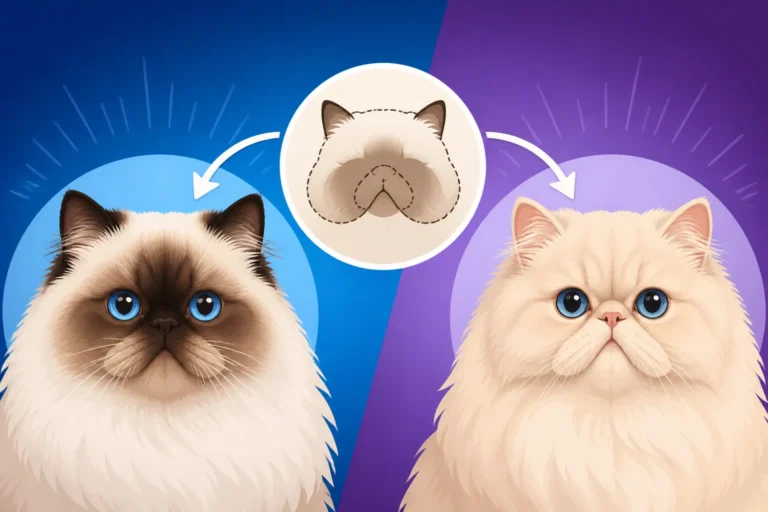
Many owners are drawn to Himalayans because of their round head, large eyes, compact build, and calm, home-centered presence. An Exotic Shorthair shares much of that Persian-type appearance and can feel familiar to someone who loves the Himalayan’s general look but struggles with its coat. That resemblance is often the emotional bridge between the two breeds.
There are differences, of course. Himalayans have pointed coloring, with darker fur on cooler areas such as the face, ears, legs, and tail. Exotic Shorthairs come in a broad range of colors and patterns, and a short coat changes the overall impression: the body shape and face may look similarly round, but the long ruff and flowing outline are gone. If the colorpoint pattern is the part an owner most cherishes, an Exotic Shorthair may not feel like a direct replacement.
The breeds also have different coat routines, but their faces can be quite similar. Some Exotic Shorthairs have very short muzzles, while others have a less extreme profile. A shorter coat does not automatically mean easier breathing, cleaner eyes, or fewer facial-care needs. Before choosing, it helps to consider Why a Himalayan’s Face Is Flat and a Ragdoll’s Is Not and What a Persian Standard Asks of a Himalayan, especially if the cat’s face and comfort matter as much as its coat.
What changes and what stays the same
A short coat still needs routine care
The most obvious difference is the coat’s length, but it is useful to be specific about what that changes in everyday life. An Exotic Shorthair is less likely to develop the long, tight mats common in a Himalayan’s undercoat. Brushing is usually simpler, and owners may find it easier to keep the coat looking neat without a lengthy session.
| Everyday consideration | Himalayan | Exotic Shorthair |
|---|---|---|
| Coat length | Long and dense | Short and plush |
| Tangle and mat risk | Can be substantial without regular combing | Usually lower, though loose fur still needs attention |
| Routine grooming | Frequent, thorough combing | Regular brushing and basic coat checks |
| Facial care | May need frequent eye and face cleaning | May also need eye and face cleaning, depending on facial shape |
| Color pattern | Colorpoint pattern | Many colors and patterns |
| Persian-type appearance | Round, compact, often longhaired | Round, compact, shorthaired |
The comparison is a guide, not a guarantee. Coat density, facial shape, age, health, and the individual cat’s tolerance for grooming all affect the work involved. An Exotic Shorthair with a very flat face and persistent eye discharge may still need daily face cleaning. The central difference is that the short coat reduces the long-hair combing burden; it does not erase the rest of a cat’s care routine.
A practical way to picture the change is to imagine a morning when the cat has been sleeping on a warm blanket and then eating breakfast. With a Himalayan, the owner may check the coat for tangles, comb problem areas, wipe the face, and make sure food has not clung to the ruff. With an Exotic Shorthair, the coat check may be quicker, but the owner may still need to wipe the face or inspect the skin. Keeping a few suitable grooming supplies together—whether bought locally or from a retailer such as Chewy—can make either routine easier to follow.
The face and health questions do not disappear
People sometimes assume that switching to a shorthaired breed will solve every maintenance issue associated with a Himalayan. That is too broad an expectation. Exotic Shorthairs are closely related to Persians and share a similar general body type. Depending on the individual cat’s facial structure, eye watering, facial folds, and breathing comfort may still deserve attention.
That matters because owners often have more than one reason for considering a move. Perhaps the coat is difficult to manage, but the cat also snores, has recurring eye discharge, or becomes uncomfortable in warm weather. A short coat may reduce grooming time, but it does not by itself address those concerns. A prospective owner should ask about the kitten’s parents, facial profile, breathing, eye history, and veterinary care rather than choosing by coat alone.
For a Himalayan owner comparing breed traits, Why a Himalayan Is Confused With a Ragdoll can help clarify how appearance overlaps between longhaired cats without making them interchangeable. The Persian connection is also useful context: Why an Exotic Shorthair Has a Himalayan’s Face Without the Coat explains why the two breeds can look related while presenting very different grooming demands.
How to decide whether the switch fits your life
Separate coat frustration from the rest of the relationship
Before deciding to move on from the Himalayan, take a moment to identify exactly what is becoming difficult. Is it the daily combing? Mats that form despite your efforts? The time needed to wipe the face? A cat who resists handling? Or a mismatch between your schedule and the amount of care the cat needs? Naming the problem helps you judge whether an Exotic Shorthair would actually address it.
If the main issue is long-coat maintenance, a shorthaired cat may be a sensible direction. If the main issue is eye discharge, a flat face, or a cat’s discomfort during grooming, a different coat length may not solve the underlying concern. It may be worth talking with a veterinarian or a qualified groomer about whether the current routine can be adjusted. Sometimes a better comb, shorter sessions, and gradual handling practice can make care less stressful for both cat and owner.
It is also worth considering what you would miss. Some people love the Himalayan’s full coat, distinctive points, and dramatic ruff even while finding the upkeep tiring. Others realize that their strongest attachment is to the Persian-like face and companionable presence, not the length of the coat. Those are different situations, and neither one is wrong. The decision becomes clearer when you distinguish the feature you love from the chore you cannot sustain.
Compare the care routine you can realistically maintain
A breed choice is easier to live with when it matches the routine you can reliably provide, not the routine you hope to have someday. If you are choosing an Exotic Shorthair, ask the breeder or rescue about the specific cat’s grooming needs and facial care. Spend time observing the cat at rest and during ordinary movement. Listen for noisy breathing and notice whether the eyes are persistently watery or irritated. A short video can be useful, but it cannot replace seeing the cat in person or discussing its health history.
It is also helpful to prepare your home before bringing a cat in. Set up a brush, nail trimmers, washable bedding, shallow food and water dishes if needed, and a comfortable place where the cat can retreat. A retailer such as Chewy can be one way to compare basic supplies, but product choice should follow the cat’s needs rather than a promise that a particular tool will solve every problem. If you already own Himalayan grooming supplies, some may still be useful, though a dense long-coat comb may not be the main tool you reach for with a shorthaired cat.
Think about the full life of the cat, too. A kitten may be easier to introduce to handling, but an adult cat’s temperament and established care habits are easier to observe. A rescue Exotic Shorthair may have a known personality and routine, while a kitten’s adult coat and facial development are still ahead. For additional context on long-term ownership, What Nobody Tells You Before Buying a Himalayan is useful even if you are considering another breed, because many of the practical lessons about time, daily care, and choosing responsibly apply broadly.
Making a thoughtful transition
Plan for the cat you have, not just the breed you want
Moving from a Himalayan to an Exotic Shorthair does not have to mean that the Himalayan was the wrong cat or that the owner failed. Sometimes a person’s work schedule, health, household, or tolerance for grooming changes. Acknowledging that honestly is kinder than allowing frustration to build until care becomes inconsistent.
If you are rehoming a Himalayan, be candid about its routine, coat condition, eye care, behavior, and medical history. A prospective caregiver needs to know what daily maintenance involves before agreeing to take the cat. Share veterinary records and explain which grooming approaches the cat accepts or dislikes. A careful transition gives the Himalayan a better chance of settling into a home prepared for its needs.
If you are keeping your Himalayan while considering an Exotic Shorthair in the future, avoid assuming the two cats will automatically share routines or get along. Introductions should be gradual, with separate resources and safe spaces at first. A calm, deliberate introduction matters more than the fact that both cats have a Persian-like appearance. Temperament varies between individuals, and a new cat should not be expected to replace the relationship you already have with your Himalayan.
Make the choice with realistic expectations
A move to an Exotic Shorthair can be a good fit for someone who loves a round-faced, Persian-type companion but wants to spend less time dealing with long hair. It is not a shortcut to a maintenance-free pet. The coat is shorter, but grooming, nail care, eye checks, enrichment, routine veterinary care, and attention to comfort remain part of responsible ownership.
The fairest comparison is not “difficult cat versus easy cat.” It is “which set of needs can I meet consistently?” A Himalayan’s coat can demand substantial hands-on care. An Exotic Shorthair may ease that particular burden, while still requiring thoughtful attention to its face, skin, and general wellbeing. Meeting an individual cat before making a decision—and asking specific questions about health and daily care—helps replace assumptions with a realistic picture.
If your main goal is fewer mats and shorter grooming sessions, the difference may feel meaningful. If you are hoping to avoid all facial care or health considerations associated with a Persian-type cat, a short coat alone may disappoint you. Choose for the whole animal, not just the length of its fur. A retailer such as Chewy may help you assemble basic supplies once you know what the cat needs, but the more important preparation is understanding the routine you are agreeing to provide.
Disclaimer
This article is for general informational purposes only and does not constitute professional advice. Laws, prices and regulations vary by location and change over time. Consult a qualified professional for guidance on your specific situation.