Which Breeds Took the Point Gene From the Himalayan
A pointed coat can make a cat look unmistakably Himalayan, but the pattern does not belong to one breed. The Himalayan carries a temperature-sensitive color gene associated with Siamese ancestry, and breeders have used Himalayan and Persian lines in some other breeds. Here’s how to tell genuine Himalayan influence from breeds that developed pointed coats through separate lineages.
What the Himalayan Point Gene Actually Is
The Himalayan did not invent the point pattern
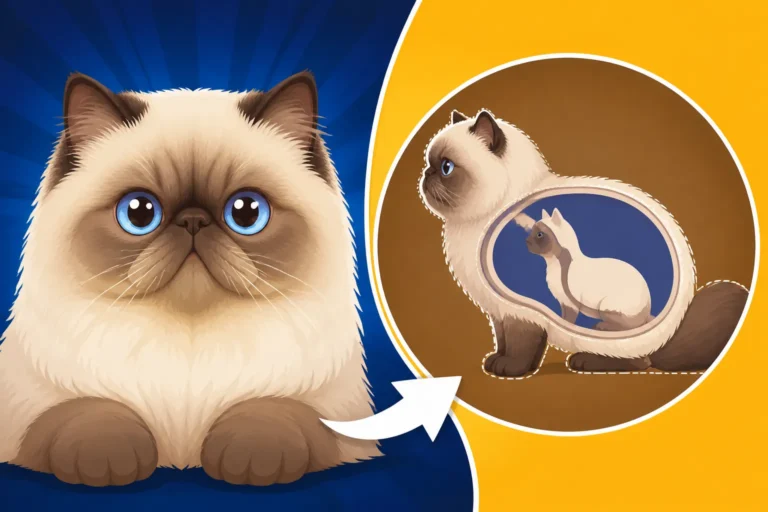
The Himalayan is essentially a Persian-type cat with the colorpoint pattern: a pale body and darker color on cooler areas such as the face, ears, feet, and tail. That pattern comes from a temperature-sensitive form of the tyrosinase gene, commonly called the colorpoint or Himalayan gene. The gene affects pigment production: cooler parts of the body develop more color, while warmer areas remain lighter.
The pattern was already associated with Siamese cats before the Himalayan breed was developed. Breeders combined Siamese and Persian cats, then selected for Persian features and the pointed coat. So when someone says another breed “got the point gene from the Himalayan,” that may describe a particular breeding line—but it does not mean the Himalayan originated the gene.
For more on the breed’s appearance and ancestry, see Why a Himalayan Is a Persian With the Point Gene. The distinction matters because the same coat pattern can appear in different breeds through different breeding histories.
A cat generally needs two copies for classic points
The classic colorpoint pattern is recessive. A kitten typically needs to inherit a copy of the relevant allele from each parent to show the familiar pointed coloring. A cat with just one copy may carry the allele without having a full Himalayan-style pattern, and can pass it to offspring.
That is why two cats that look solid-colored can sometimes produce pointed kittens if both carry the allele. It also explains why a pointed kitten does not automatically prove that one parent was a Himalayan. The allele may have been carried unnoticed through generations of cats with other coat colors.
The inheritance pattern is explained further in Why a Himalayan Needs Two Copies of the Point Gene and How a Persian Can Carry the Himalayan Gene Hidden. A pedigree can help trace ancestry, but a cat’s appearance alone cannot identify precisely where its colorpoint allele entered the family tree.
The pattern is shared, but the route into a breed may differ
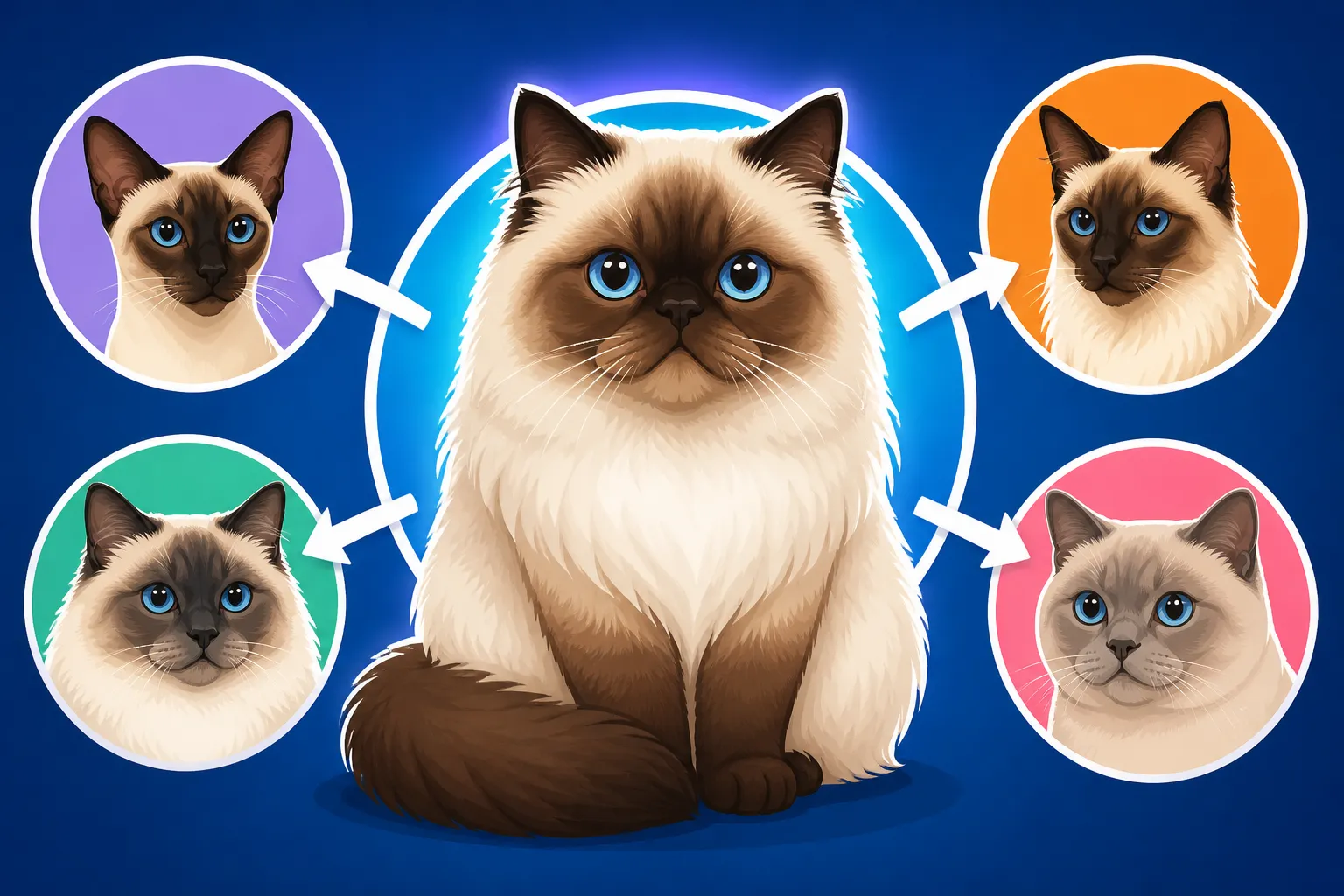
Breeds can share the same basic genetic pattern without sharing a recent Himalayan ancestor. Some pointed cats descend from Siamese or other established pointed lines. Others may have received colorpoint ancestry through Himalayan or Persian breeding. In some breeds, pedigrees and accepted outcrosses vary by registry and individual line.
That makes “which breed took the gene from the Himalayan?” a question with two answers. Persian Colorpoint cats and some Exotic Shorthair lines have a clear connection to Himalayan or colorpoint Persian breeding. Other pointed breeds may look similar but have a separate history.
Breeds With a Close Himalayan or Persian Connection
Persian Colorpoint cats
The closest answer is the colorpoint Persian, often called a Himalayan in everyday conversation. These cats combine Persian type and coat with the pointed pattern. Depending on the registry, the Himalayan may be treated as a separate breed, a Persian division, or a color pattern within the Persian breed. The label on a pedigree can therefore differ even when the cat’s appearance and background are closely related.
This is less a case of an unrelated breed borrowing a gene and more a case of breeders establishing and maintaining a pointed Persian population. The Himalayan’s role was central in developing the recognizable Persian-like colorpoint cat, and the relationship continues in how these cats are bred and classified.
If the paperwork is confusing, What a Colorpoint Division Means for a Himalayan explains why the same cat may be described differently by different organizations. The registry split is about classification, not a change in the cat’s genes.
Exotic Shorthairs
Exotic Shorthairs are closely related to Persians, and some lines have been bred in colors and patterns associated with colorpoint Persians. Because Himalayan cats are part of the Persian family in many breeding contexts, Himalayan or colorpoint Persian ancestry can be relevant to the development of pointed Exotic Shorthair lines.
But it is safest not to assume that every pointed Exotic Shorthair got its pattern directly from a Himalayan. A pointed coat tells you which genetic pattern the cat expresses; it does not, by itself, reveal the exact breed or ancestor that supplied the allele. That takes a pedigree or reliable breeding records.
This is an example of why the word “took” can oversimplify breed history. Breeders may use related cats and approved outcrosses over time, while registries set their own rules about which crosses count and how resulting kittens are recorded. Why a Himalayan and a Persian May Be Mated offers more context on how those related breeding lines can overlap.
Some other breeds may have Himalayan influence in particular lines
A few breeds have been developed or maintained using wider pools of cats, and Persian or Himalayan ancestry may appear in some individual pedigrees. That does not mean the entire breed got its point gene from Himalayans, or that all registries accept the same crosses. The answer may depend on the country, registry, and specific breeding program.
| Breed or group | Relationship to Himalayan-type points | What to keep in mind |
|---|---|---|
| Persian Colorpoint or Himalayan | Directly associated with pointed Persian breeding | The name and registration category vary by registry |
| Exotic Shorthair | Closely related to the Persian; pointed lines may connect with colorpoint Persian ancestry | A pointed coat alone cannot confirm a Himalayan ancestor |
| Ragdoll | Pointed, but its pattern is not generally attributed to the Himalayan as a breed-wide source | Its foundation history is separate and should not be reduced to Himalayan ancestry |
| Birman | Pointed, with its own established breed history | Its pattern predates the modern Himalayan breeding program |
| Balinese and Colorpoint Shorthair | Pointed cats associated with Siamese lines | Their pointed coats do not require Himalayan ancestry |
| Tonkinese | Has a mink pattern associated with different combinations of Siamese- and Burmese-type color alleles | Mink is not simply the Himalayan pattern |
The table describes broad breed histories, not every individual cat. For a particular kitten, the breeder’s pedigree and registry documentation are more informative than coat color alone.
Pointed Breeds That Did Not Simply Get the Gene From Himalayans
Birman and Ragdoll histories should be treated separately
Birmans have a pointed coat and a history of their own. Their characteristic white gloves are an additional feature and distinguish them visually from the Himalayan. The shared pointed appearance does not establish that Birmans descended from Himalayan cats.
Ragdolls are also pointed, but their breed history is distinct. Ragdolls can have colorpoint, mitted, or bicolor patterns, and their large build and coat are not enough to prove Himalayan ancestry. It is more accurate to say that the breeds share a pointed pattern than to say one took it from the other.
For a useful comparison of one key distinction, see Why a Birman Has White Gloves and a Himalayan Does Not. The visual similarities can be striking, especially in pale kittens, but pattern, markings, breed history, and pedigree all matter.
Siamese-derived breeds often carry points through another route
Balinese cats and Colorpoint Shorthairs are closely associated with Siamese breeding. Their pointed coats do not need to come through the Himalayan. The Siamese connection is especially important because it helps explain why the Himalayan’s pattern resembles that of several breeds whose histories are otherwise different.
Tonkinese cats add another layer. Their mink coat pattern is associated with a different combination of color alleles than the classic pointed pattern. A Tonkinese may look darker across the body than a Himalayan, but that difference is not simply a matter of age or grooming.
When comparing breeds, focus on both the pattern and its known lineage. What a Himalayan Gives Up Once Its Points Are Dark discusses how the pointed pattern changes the cat’s appearance over time, while Which Other Animals Carry the Himalayan Pattern gives a broader look at how similar temperature-sensitive patterns occur beyond domestic cat breeds.
Appearance is not a reliable ancestry test
A cream-colored body with dark ears and tail can make a cat look Himalayan, but coat pattern is only one clue. A cat may be pointed without having Himalayan ancestry, and a cat may carry the relevant allele without showing points at all. Even eye color, while often blue in classic pointed cats, does not establish a specific breed history.
If you are buying a kitten, adopting a cat, or documenting a breeding line, ask for the pedigree and the names of the registries involved. For a registered kitten, check that the breed or variety is recorded consistently across its paperwork. A seller’s casual use of “Himalayan” may describe the cat’s appearance rather than its formal registration.
How to Check Whether a Breed’s Points Came From the Himalayan
Start with a pedigree, not the coat pattern
A pedigree is the practical place to begin if you want to know whether a particular cat has Himalayan ancestry. Look for breed names and registered parents across several generations, and ask the breeder to explain any outcrosses or unusual entries. If the cat is registered under a Persian colorpoint category rather than as a separate Himalayan, that may reflect the registry’s classification rather than a different genetic pattern.
A pedigree can show that Himalayan or Persian cats appear in the line, but it does not always explain which ancestor supplied a particular allele. For that, breeders may use genetic testing alongside documented parentage. The test can indicate whether a cat carries a colorpoint-associated variant; it cannot replace a pedigree as a record of breed ancestry.
If papers use unfamiliar terminology, Why TICA Kept the Himalayan Separate and How the Himalayan Changed Persian Breeding provide background on why registry descriptions and breeding histories do not always line up neatly.
Ask what a breeder means by “Himalayan influence”
When a breeder says a breed “took the point gene from the Himalayan,” ask whether they mean the breed’s general history or a specific cat’s ancestry. Those are different claims. A breed may have accepted Himalayan or Persian outcrosses in some lines, while other lines may trace their points to Siamese-derived cats or another source.
Useful follow-up questions include:
- Which registry recognizes the cat, and what breed or color category appears on its papers?
- Can the breeder show the kitten’s pedigree and explain any outcrosses?
- Are they describing a confirmed ancestor, a genetic test result, or simply the cat’s appearance?
- Does the breed’s registry permit the crosses being discussed?
Clear answers help separate documented ancestry from marketing shorthand. A pointed coat is beautiful, but it is not a family tree.
Keep the genetic claim narrower than the visual claim
The most reliable way to put it is this: Himalayan breeding helped establish and spread the pointed Persian look, and Himalayan or colorpoint Persian ancestry is relevant to Persian Colorpoints and some Exotic Shorthairs. Other pointed breeds—including Birmans, Ragdolls, Balinese, and Colorpoint Shorthairs—have histories that should not automatically be attributed to Himalayans.
The point gene is shared biology, not a breed’s exclusive property. A cat can inherit the same basic pattern through more than one route, and a breed’s coat does not tell the whole story. When ancestry matters, use a documented pedigree and breed-specific history rather than appearance alone.
Disclaimer
This article is for general informational purposes only and does not constitute professional advice. Laws, prices and regulations vary by location and change over time. Consult a qualified professional for guidance on your specific situation.