How Heavy a Himalayan Tom Finishes
A full-grown Himalayan tom commonly weighs around 9 to 12 pounds, though a larger-framed male may be healthy outside that range. The number on the scale alone can be misleading: a thick Persian coat hides the waist and ribs, and a naturally cobby body can look heavy even when it is in good condition. This guide explains what to expect and how to judge your cat’s weight more usefully.
Typical adult weight for a Himalayan tom
Why 9 to 12 pounds is a useful guide, not a rule
Himalayan males are usually sturdily built, with a compact body, short legs, and substantial bone. That cobby shape can make a healthy tom seem heavier than a leaner, longer-bodied cat of the same weight. As a broad guide, many adult males fall around 9 to 12 pounds, but the right weight for an individual depends on his frame, muscle, age, and overall condition.
Some Himalayan toms may weigh more and still be healthy, while a smaller male may carry excess fat at a lower number. A breeder’s description of a kitten’s parents can offer context, but it cannot set a precise target for every cat. The best reference is your own cat’s body condition over time, assessed with your veterinarian.
Breed descriptions can help explain the Himalayan’s compact build. For more context, see Why the Himalayan Is Described as Cobby and How Heavy a Full Grown Himalayan Gets. The figures in breed descriptions are starting points—not a substitute for looking at the cat in front of you.
When a tom has finished growing
A Himalayan may reach much of his adult height and length before his body looks fully mature. His chest may broaden, muscle may develop, and his long coat may become fuller as he grows. That gradual change can make it hard to decide whether he has finished growing just by looking at him.
Rather than expecting a particular weight at a particular birthday, ask your veterinarian to track his growth and body condition during routine visits. A young cat who is steadily gaining weight as his frame develops is different from an adult who begins gaining weight after his growth has levelled off. Neutering, activity, food portions, and individual development can all affect the pattern.
A fluffy coat also creates a visual illusion: a Himalayan can look dramatically larger without carrying extra fat. Weighing him regularly and keeping a simple record is more reliable than judging from photographs or comparing him with another cat. For a broader look at development, read How Long a Himalayan Takes to Finish Its Coat and Points.
Why the coat makes weight hard to judge
The Himalayan’s Persian-style coat can conceal the outline of his body, especially around the chest, sides, and hindquarters. You may notice that your cat looks rounder, but that alone does not show whether the change comes from a fuller coat, normal growth, or extra body fat.
Feel is more useful than appearance. With gentle pressure, you should generally be able to feel the ribs beneath a light covering, without having to press hard or dig through the coat. From above, there should usually be some waist behind the ribs; from the side, the abdomen should not hang heavily. These are practical clues, not a diagnosis, so ask your vet to demonstrate what a healthy condition feels like on your cat.
| What you notice | What it may suggest | What to do |
|---|---|---|
| Ribs are easy to feel but not sharply visible | Often consistent with a suitable body condition | Keep measuring portions and recheck at routine visits |
| Ribs are difficult to feel through the coat and body | Possible excess fat, though coat and build can confuse the picture | Ask your veterinarian to assess body condition |
| A marked waist and prominent ribs or spine | Possible underweight condition or illness | Arrange a veterinary check, especially if weight loss is new |
| A sudden change on the scale | Could reflect fluid, illness, diet, or measurement differences | Repeat the measurement consistently and contact your vet if it persists |
How to tell whether your Himalayan tom is overweight
Use your hands as well as your eyes
Start by standing your cat on a stable surface and viewing him from above. Look for a slight narrowing behind the ribs rather than a uniformly round outline. Then view him from the side. A modest abdominal tuck may be present, although long fur can make this difficult to see.
Next, feel gently along the ribs and spine. You are not trying to count every bone; you are checking whether the ribs are reasonably easy to locate beneath the coat. If you have to press firmly before finding them, or if the waist is difficult to identify by touch, ask your veterinarian to check his body condition. A clinic can help distinguish a naturally broad, muscular tom from one carrying excess fat.
Do not rely on a single clue. A loose belly flap, for example, does not automatically mean a cat is overweight, and a narrow-looking face does not prove he is lean. The coat, posture, age, and body structure all affect what you see. A hands-on assessment is especially helpful with a breed whose long fur can hide gradual changes.
Keep a weight record that means something
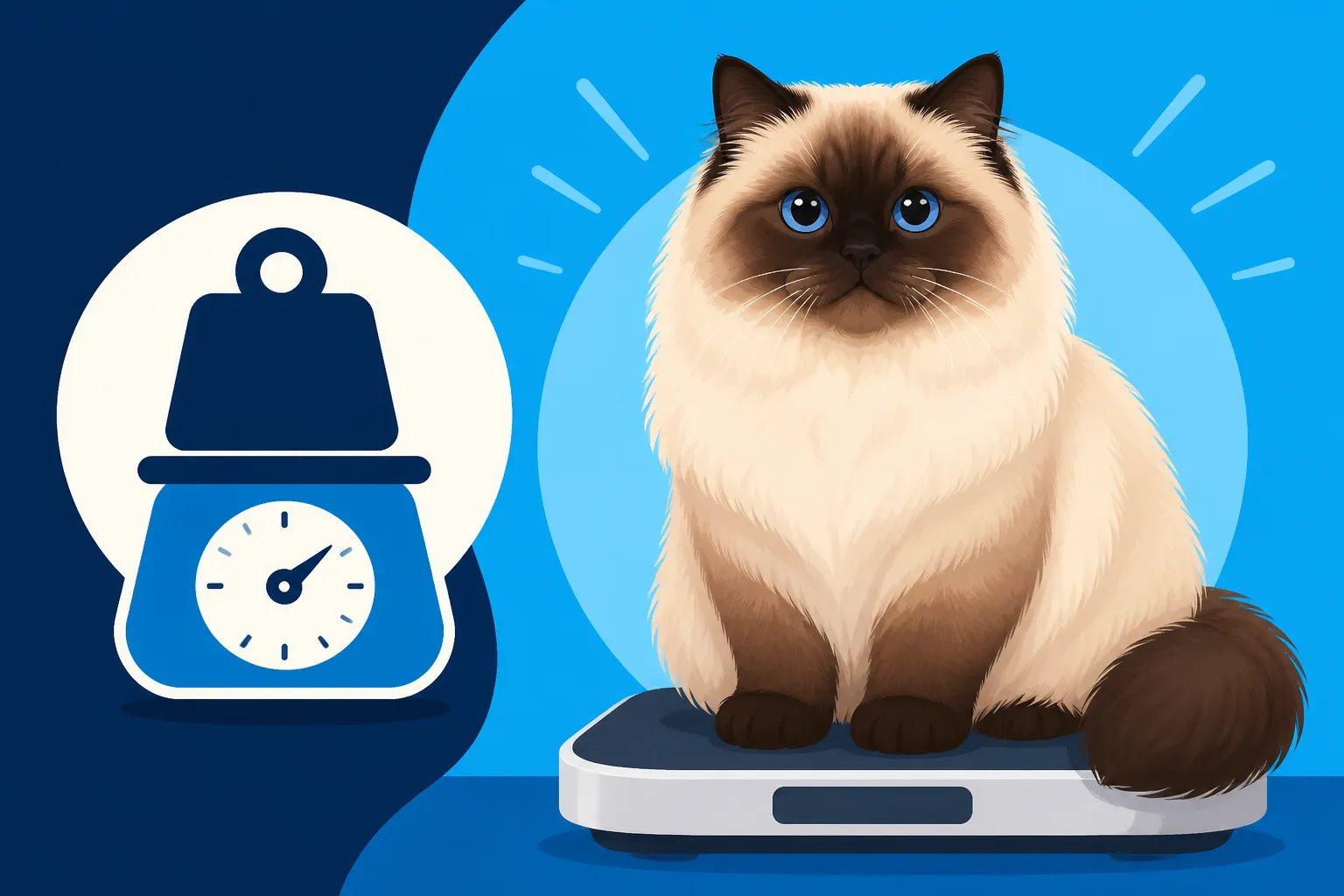
Use the same scale and similar conditions each time. For example, weigh your cat at roughly the same time of day, before a meal if practical, and record the result rather than relying on memory. If you cannot get a steady reading with him alone, weigh yourself holding him and then subtract your own weight. A pet or baby scale may be easier for a kitten or a cat who tolerates being placed on a platform.
A kitchen scale can work for small objects but is generally unsuitable for an adult cat unless it is designed to support his size safely. Pet scales and other weighing supplies are available through retailers such as Chewy; whatever you choose, make sure the surface is stable and large enough for your cat to stand comfortably. If a home weighing session turns into a struggle, stop and ask your veterinary clinic whether they can help with regular weigh-ins.
Write down the date, weight, and any relevant changes, such as a new food, reduced activity, or a recent illness. One number rarely tells the whole story, but a pattern can reveal gradual gain or loss that is easy to miss under a dense coat.
Know when weight change needs a veterinary check
A planned, gradual change under veterinary guidance is different from unexplained weight loss or gain. Contact your vet if your Himalayan’s weight changes noticeably without an obvious reason, or if the change comes with reduced appetite, vomiting, increased thirst, lethargy, or difficulty grooming. A cat may be unwell even when his coat still looks plush and his face seems unchanged.
Weight can also affect daily comfort. An overweight Himalayan may struggle to reach the hindquarters and keep the coat clean, or may become less willing to move around. For related guidance, see How to Feel a Himalayan’s Spine Through Its Ruff and Why an Overweight Himalayan Cannot Reach Its Britches. If he is losing weight, do not assume he simply needs a more calorie-dense food; the cause should be checked.
What affects a Himalayan tom’s finished weight
Frame, age, and muscle
Two healthy males can weigh different amounts because their frames and muscle mass differ. One may be compact and broad through the chest, while another has a smaller build. A weight that suits one cat may not suit the other, even if they are the same age and breed.
Age matters too. A growing cat has different needs from a mature adult, and an older cat may lose muscle even if the scale does not change much. That is one reason a veterinarian may consider body condition and muscle condition alongside weight. If your cat seems less sturdy, has trouble jumping, or changes how he walks, mention it at his next visit rather than treating the scale as the only measure.
Neutering can change energy needs and appetite for some cats. It does not mean weight gain is inevitable, but it is a sensible time to review portions and activity with your vet. Follow the feeding directions for your cat’s food as a starting point, then adjust based on his health, body condition, and veterinary advice.
Food portions, treats, and activity
Portions can creep upward when several people feed the cat, food is left out all day, or treats are given without being counted. A cat who spends much of the day sleeping may not use as much energy as a more active pet, so the same serving that worked earlier in life may no longer suit him.
Measure meals rather than estimating them by eye. If you use treats during grooming or play, include them in the day’s overall food allowance. A wide, shallow dish can make eating more comfortable for a flat-faced cat, but the bowl itself does not determine how much he needs. For practical feeding considerations, see How Much a Cobby Himalayan Gets in a Weighed Meal and Why a Cobby Himalayan Gains on a Portion Another Cat Burns.
Activity should be comfortable and suited to your cat. Short sessions with a wand toy, food puzzles he can use, and opportunities to move between resting spots can help keep him engaged. Avoid trying to make a heavy cat exercise intensely or restricting food abruptly. If weight loss is appropriate, your veterinarian can help set a safe plan and monitor progress.
Health conditions and medication
Not every change in weight is about portion size. Dental discomfort may make eating difficult; nausea or other illness can reduce appetite; and some health conditions can affect weight even when a cat appears to eat normally. A medication change may also alter appetite or activity. If the number on the scale moves unexpectedly, consider the whole picture rather than simply cutting food.
Tell your veterinarian when the change started and whether you have noticed differences in drinking, litter-box habits, grooming, or play. Bring your weight record if you have one. That timeline can be more useful than trying to remember whether the change began “a while ago.”
Regular checkups help establish what is normal for your individual cat. The vet can assess his body condition, review his diet, and decide whether testing is appropriate. The goal is not to make every Himalayan tom weigh the same; it is to understand what is healthy for yours and to notice changes early.
A practical routine for tracking your tom’s weight
Make weighing calm and repeatable
Choose a quiet place and let your cat investigate the scale before you try to weigh him. If the platform is unfamiliar, place a towel or thin mat on it for grip, provided that doing so does not interfere with the reading. Reward calm behaviour with attention or a small treat, and end the session if he becomes frightened or struggles.
For a cat who will not stand still, the hold-and-subtract method can work: weigh yourself, then weigh yourself while holding him, and subtract the first number from the second. It may take a few tries to get a stable reading. Use the same approach each time, because switching scales or methods can make small differences look like a real trend.
Chewy may be one place to look for pet-care supplies, including a suitable scale, but the important part is choosing equipment that is stable and easy to use. A veterinary clinic can also advise on a practical weighing routine if your cat is anxious or difficult to handle.
Record more than pounds
Alongside each measurement, note whether you can feel his ribs, whether his waist is easier or harder to find, and whether his grooming or activity has changed. A brief note such as “same appetite, less play” gives the number context. You do not need a complicated spreadsheet; a notebook or phone note is enough.
Bring the record to routine appointments. If the clinic’s reading differs from yours, ask whether the difference could come from the scale, timing, or recent food and water. A consistent trend matters more than an isolated small variation.
It can also help to take occasional photographs from above and from the side, using the same angle and lighting. Photos cannot replace a hands-on body-condition check, but they may help you spot a gradual change that is hard to notice day to day.
Set a healthy target with your veterinarian
If your cat seems overweight or underweight, ask the vet to assess his body condition and discuss a suitable target. Avoid choosing a goal simply because it matches a breed chart or another Himalayan in your home. Your cat’s frame, age, muscle, and health history should guide the plan.
For weight reduction, gradual adjustments are safer than sudden food restriction. Your veterinarian can recommend an appropriate feeding approach and tell you how often to recheck progress. If your cat is already at a healthy weight, the plan may simply be to maintain his routine and watch for changes.
Chewy can be a convenient retailer for some feeding and care supplies, but use your veterinarian’s advice to decide what your cat actually needs. Buying a different food or a new measuring tool is not a substitute for checking persistent weight change. Your tom’s healthy finished weight is the one that fits his own body and can be maintained comfortably.
Disclaimer
This article is for general informational purposes only and does not constitute professional advice. Laws, prices and regulations vary by location and change over time. Consult a qualified professional for guidance on your specific situation.