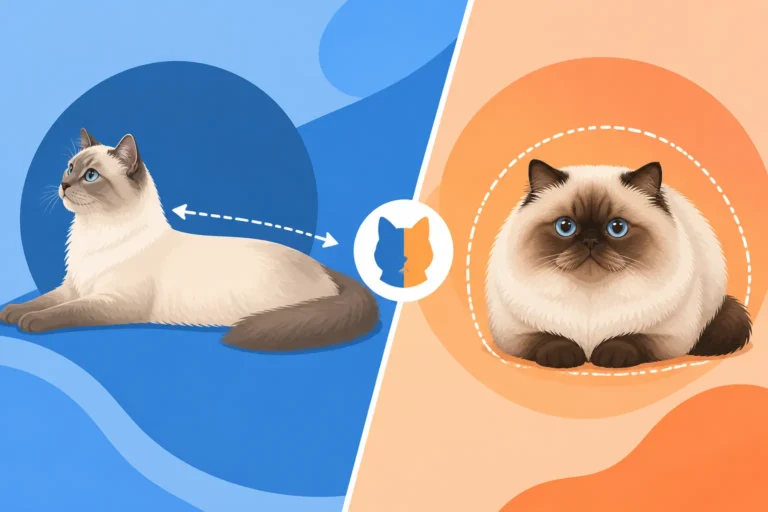
How a Himalayan Compares to a Birman as a Pet
A Himalayan and a Birman can look similar at first glance: both may have blue eyes, pale bodies, darker points, and long coats. The day-to-day experience can be quite different, though. This guide compares their grooming, activity, temperament, and potential care needs so you can picture which cat is more likely to fit your home and routine.
The main differences between a Himalayan and a Birman
Coat pattern and appearance
Both breeds can have colorpoint coats, where the face, ears, legs, and tail are darker than the body. A Himalayan is a Persian-type cat with the colorpoint pattern. Its coat is long and full, and its body is typically compact and cobby. Its facial profile may be noticeably flat, although the degree varies from cat to cat. If you are curious about how the pointed coloring is inherited, Why a Himalayan Needs Two Copies of the Point Gene explains the basic genetics.
A Birman is also a longhaired, blue-eyed colorpoint cat, but its signature white “gloves” on the paws set it apart. Those white markings are part of the breed’s defining look, not just a common variation in coat color. The contrast is especially noticeable on a darker-pointed Birman. For a closer look at the difference, see Why a Birman Has White Gloves and a Himalayan Does Not.
In photos, the breeds can be easy to confuse, particularly when a Birman is sitting still with its coat spread around it. Looking at the face, body shape, and paws usually helps: Himalayans have a Persian-like build and face, while Birmans generally have a less flattened profile and distinctive white feet. The related guide Why a Himalayan Is Confused With a Ragdoll covers another common mix-up involving pointed, blue-eyed cats.
Temperament is a tendency, not a promise
Himalayans are often described as calm, affectionate companions who enjoy familiar routines and comfortable resting spots. Many like being near their people without constantly demanding attention. A Himalayan may settle beside you on the sofa rather than follow you through every room, though individual cats can be more active or more social than the stereotype suggests.
Birmans are also typically people-oriented, but some owners find them more likely to trail after family members or join in with household activity. That does not mean every Birman is outgoing or every Himalayan is reserved. Early experiences, age, health, and personality all matter. When meeting a cat, look at how it responds to ordinary handling and new sounds, not only whether it approaches you immediately.
Either breed can make a devoted indoor companion. The better fit depends less on a breed label and more on the kind of companionship you want: a cat who may be content nearby, or one who may be more inclined to participate in what you are doing. Ask a breeder or rescue caregiver about the individual cat’s habits, comfort with handling, and response to visitors.
Grooming and everyday care
A Himalayan’s coat takes consistent attention
A Himalayan’s long, dense coat can tangle close to the skin, especially in areas where fur rubs together, such as under the front legs, behind the ears, and around the hindquarters. A quick pass over the top of the coat may make it look tidy while leaving small knots underneath. Regular, thorough combing is a more reliable way to catch tangles early. The Daily Comb a Himalayan Cannot Skip goes into the routine in more detail.
Face care is another regular task for many Himalayans. A flat face can leave the eyes prone to watering, and moisture or debris may collect around the eyes and facial folds. The routine should be gentle: use a clean, soft material and follow your veterinarian’s advice if you see irritation, unusual discharge, odor, or persistent redness. The guide Why a Himalayan’s Face Needs Cleaning Every Morning explains why this small daily habit can matter.
It helps to make grooming familiar before a cat is fully grown. Start with short, calm sessions, reward cooperation, and stop before the cat becomes overwhelmed. Keep a suitable comb and basic cleaning supplies where you can reach them easily. If you are ordering household pet supplies from Chewy, check that grooming tools are appropriate for a long, dense coat and that any eye-care product is suitable for use near a cat’s eyes.
Birmans still need grooming, but the routine may feel different
A Birman’s coat is long, but many owners find it less prone to dense matting than a Himalayan’s coat. That can make maintenance feel more manageable, but it is not a reason to skip brushing. Combing helps remove loose hair, catches knots before they tighten, and gives you a regular chance to check the skin.
Pay attention to friction areas, including behind the ears, under the legs, and around the tail and hindquarters. A Birman’s coat can still tangle, particularly during shedding or if the cat has been ill, is older, or has difficulty grooming itself. If brushing is new to your cat, introduce it gradually rather than waiting until a knot needs to be removed.
Both breeds benefit from a predictable routine. A quiet table or other stable surface, a gentle touch, and short sessions can make grooming less stressful. Chewy can be one place to compare comb styles and other basic supplies, but the right tool depends on the cat’s coat and tolerance; ask a groomer or veterinary team for guidance if you are unsure.
Activity, personality, and life at home
How much interaction each cat may want
Himalayans are often a good match for people who enjoy a quieter home and can offer regular company without expecting a highly athletic cat. Many appreciate gentle play, attention, and a comfortable place close to their family. Keep play sessions short and watch for signs that your cat needs a break, particularly in warm rooms or during energetic activity.
Birmans are also affectionate, and some are more likely to follow people from room to room or stay involved in family routines. That can appeal to someone who wants a companion that is often close by. Still, a cat’s behavior is individual; a reserved Birman or a playful Himalayan is entirely possible. Ask about observed behavior rather than choosing based only on a breed description.
For either breed, make the home inviting without relying on high jumps. Low, stable resting spots and accessible toys can encourage movement at the cat’s pace. A Himalayan may be less inclined to climb than a more athletic cat, while a Birman may show more interest in exploring. Neither tendency is a substitute for watching how the particular cat moves and plays.
Household routine and indoor living
A calm indoor environment can suit both breeds. Set up predictable feeding and play times, a clean litter area, and several comfortable resting places. Himalayans in particular may appreciate routine, but a Birman can also be unsettled by abrupt changes. If you are bringing either cat into a new home, give it a quiet room at first and let it explore gradually.
Consider the household’s temperature and activity level, too. A long coat can make warm conditions uncomfortable, and a flat-faced Himalayan may have additional reasons to avoid strenuous activity or overheating. Provide shade, fresh water, and a cool place to rest. If you are deciding whether your living space is suitable, Why an Apartment Suits a Himalayan offers useful context on the breed’s home environment.
Both breeds should be kept safely indoors or given access to a secure enclosure rather than allowed to roam freely. Indoor life reduces exposure to traffic, predators, and other hazards. It also makes it easier to notice changes in eating, grooming, breathing, or activity—small details that can be harder to track when a cat spends much of its time outside.
Health considerations and choosing the right match
Why a Himalayan may need extra face and breathing attention
A Himalayan’s Persian-like facial structure can influence daily care. Depending on the individual cat’s features, a flatter face may be associated with watery eyes, difficulty keeping the face clean, or noisy breathing. A snore can be part of an individual cat’s usual pattern, but new or worsening breathing sounds, open-mouth breathing, or visible effort to breathe should be taken seriously and discussed promptly with a veterinarian.
The appearance of the face alone does not tell you exactly how healthy a cat is. When meeting a Himalayan, listen to its breathing while it is resting and moving gently, and ask about any history of eye or airway concerns. You can also ask how the breeder assesses facial structure and what veterinary care the kitten has received. A good conversation should make room for specific questions rather than relying on assurances that a certain look guarantees good health.
A Birman’s facial structure is generally less flat, so the same face-related concerns may be less prominent, but no breed is free of health needs. Any individual cat can develop medical problems. A pre-adoption veterinary exam and a clear account of known health history are sensible steps for either breed.
Comparing the practical commitment
The everyday difference is often less about which cat is “easier” and more about which routine you can reliably maintain. A Himalayan is likely to ask more of you in coat care and may need extra attention to the face. A Birman still needs regular combing and ordinary preventive care, but some households may find its grooming demands easier to fit around a busy week.
| Consideration | Himalayan | Birman |
|---|---|---|
| Coat care | Frequent, thorough combing; dense fur can mat | Regular combing; coat still needs knot checks |
| Face care | May need routine attention around watery eyes and facial folds | Usually less face-focused care, though individual needs vary |
| Typical build | Compact, cobby, Persian-like | Medium-to-large, generally less flat-faced |
| Markings | Colorpoint pattern, without the Birman’s required white gloves | Colorpoint pattern with distinctive white gloves |
| Activity | Often enjoys calm play and comfortable resting spots | May be more inclined to follow family activity, though cats vary |
| Best first question | Can you keep up with coat and face care? | Does this cat’s individual temperament suit your household? |
Before choosing, think honestly about the boring parts as well as the charming ones. Can you make time for grooming when you are tired? Is someone home often enough to provide company? Can you manage veterinary visits and respond if a health concern comes up? Chewy may help you find routine supplies such as a suitable comb or litter, but the central decision is whether the care schedule fits your real life.
Questions to ask before adopting or buying
Ask how the cat behaves during grooming, whether it accepts handling around its face and paws, and what it is like when left alone for a normal workday. If you are considering a Himalayan, ask specifically about breathing, eye watering, and the cat’s facial profile. For either breed, request the available veterinary records and ask what the current caregiver has noticed about appetite, movement, and social behavior.
If you are considering a kitten, ask what early handling and grooming experiences it has had. If you are considering an adult, ask about established habits rather than assuming that a new home will quickly change them. Adult cats can be especially appealing when you want a clearer picture of their personality, coat-care tolerance, and energy level.
The most useful match is the cat whose needs you can meet consistently, not simply the one whose appearance you prefer. A Himalayan may suit you if you love a Persian-like companion and are comfortable with regular coat and face care. A Birman may suit you if you want a pointed, blue-eyed longhair with white-gloved paws and a grooming routine that may feel less intensive. For more perspective on the Himalayan’s daily maintenance, read Whether a Himalayan Suits Someone Who Cannot Comb Daily.
Disclaimer
This article is for general informational purposes only and does not constitute professional advice. Laws, prices and regulations vary by location and change over time. Consult a qualified professional for guidance on your specific situation.