Why a Himalayan Contract Bans Breeding Back to a Siamese
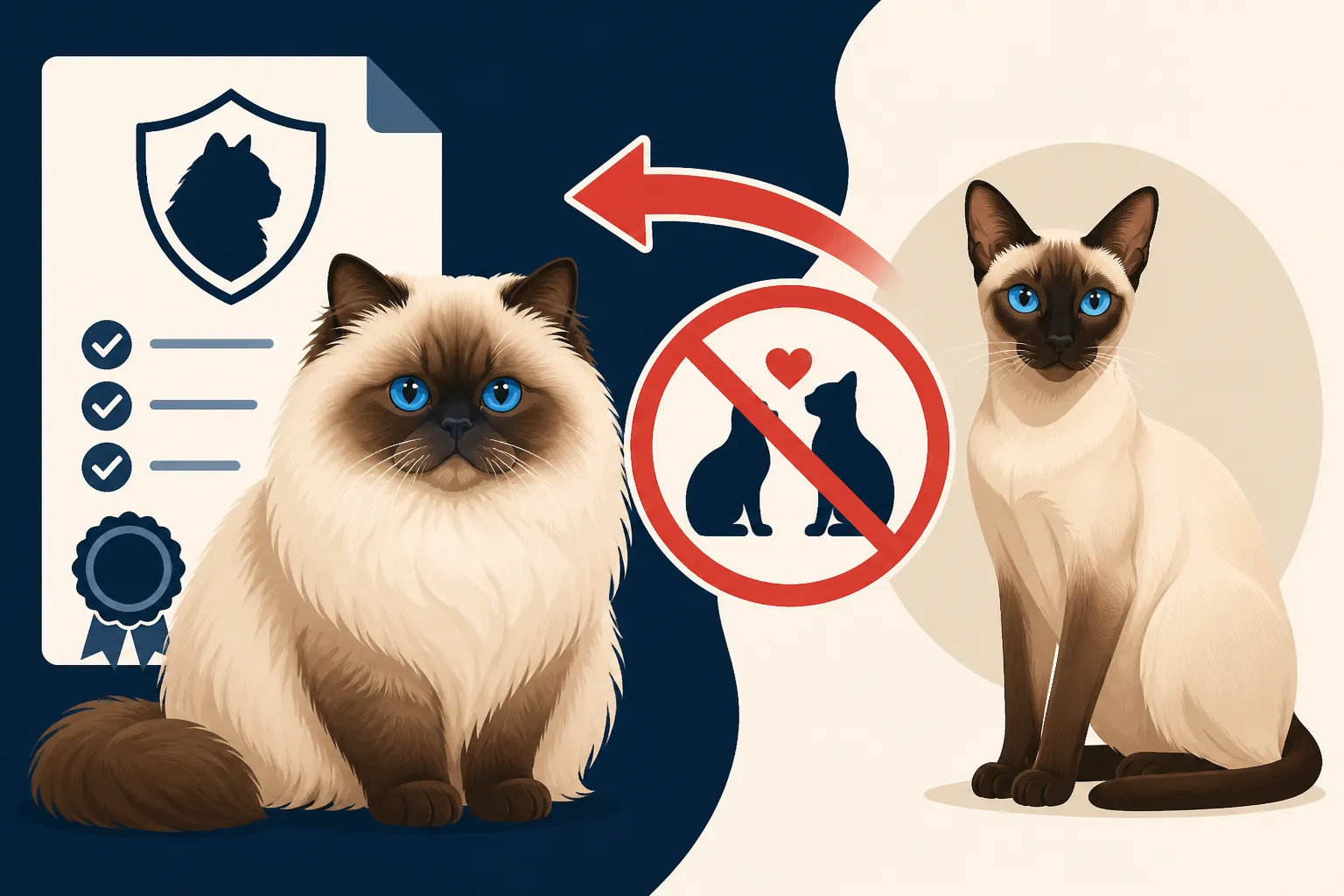
It’s a truly perplexing moment when you’re pouring over a breeder’s contract for your future Himalayan companion, excitedly imagining your life with this fluffy, blue-eyed beauty, and then you hit a clause that makes you scratch your head: a strict prohibition against breeding your cat back to a Siamese. You might think, "Wait, aren't Himalayans part Siamese? What's the big deal?" This common clause often stems from a deep-seated understanding of breed standards and the careful genetic work that went into creating the Himalayan as we know it today. This guide will walk you through the historical and genetic reasons behind this breeding prohibition, helping you understand why such a specific restriction is crucial for maintaining the beloved traits of the Himalayan cat.
Understanding the Himalayan's Unique Lineage
To truly grasp why breeding back to a Siamese is a no-go in the Himalayan world, we need to take a little trip back in time and understand just how these magnificent cats came to be. The Himalayan isn't some ancient breed that just appeared; it was deliberately created, a true testament to selective breeding.
The Original Cross and Genetic Goals
Imagine a group of dedicated geneticists and breeders with a vision: to combine the striking colorpoint pattern and brilliant blue eyes of the Siamese with the luxurious long coat and cobby body of the Persian. This wasn't just a whimsical idea; it was a scientific endeavor. The initial crosses between Siamese and Persians were famously undertaken at universities, most notably by Clyde Keeler and Virginia Cobb at Harvard in the 1930s. The explicit goal was to graft the "Himalayan pattern," characterized by dark points (ears, face, paws, tail) and a lighter body, onto a cat that otherwise looked like a Persian. This groundbreaking work was even documented in scientific papers, marking a pivotal moment in cat breeding. If you're curious about the origins, you might find it fascinating to read about The Himalayan Was Made at Harvard in the 1930s.
The early breeders weren't just throwing cats together; they were carefully tracking genetic traits, looking for specific combinations. They were essentially trying to prove that the colorpoint gene from the Siamese could be isolated and introduced into a different breed without losing the other desirable characteristics of that breed. It was a long process, involving multiple generations of careful selection, weeding out individuals that didn't meet the emerging ideal. The challenge was immense: getting the best of both worlds without the less desirable traits of either.
The Himalayan's Dual Heritage
When you look at a Himalayan today, you’re seeing a living embodiment of this dual heritage. They possess the unmistakable Persian body type – cobby, short-legged, with a broad head and small, rounded ears – wrapped in that glorious long, flowing Persian coat. Yet, their stunning blue eyes and the distinctive point coloration are pure Siamese influence. It's this delicate balance that defines the breed.
The magic lies in how the genes interact. The colorpoint gene, inherited from the Siamese, is temperature-sensitive. This means the cooler extremities of the cat develop darker pigment, while the warmer parts of the body remain lighter. This creates the beautiful contrast that Himalayans are known for. However, breeders worked tirelessly to ensure that while this striking pattern was present, the underlying structure and temperament remained predominantly Persian. This meant selecting cats that retained the quiet, docile nature of the Persian, rather than the more vocal, energetic traits often associated with the Siamese. They were aiming for a specific type, and that type leaned heavily into the Persian physical standard, simply "dressed up" in Siamese colors.
The Purpose of Breeding Contracts in Responsible Cat Ownership
Breeding contracts might seem like a lot of legal jargon, but they are a cornerstone of responsible breeding practices. They're not just there to protect the breeder; they're fundamentally about protecting the health, welfare, and integrity of the breed itself, and by extension, your new feline family member.
Protecting Breed Standards and Health
A well-crafted breeding contract is a commitment to the future of the breed. It ensures that the efforts of generations of dedicated breeders to establish and refine the Himalayan's unique characteristics are not undone by accidental or uninformed breeding. Breed standards, set by organizations like the Cat Fanciers' Association (CFA) or The International Cat Association (TICA), are detailed blueprints of what an ideal cat of that breed should look and behave like. For Himalayans, this means a particular body type, head shape, coat texture, eye color, and a specific range of point colors. You can learn more about What the Persian Standard Asks of a Himalayan to understand these details.
Beyond aesthetics, these contracts are vital for health. Responsible breeders invest significant time and resources into health testing their breeding cats for genetic conditions common in their lines. For Himalayans, this often includes testing for Polycystic Kidney Disease (PKD) from their Persian heritage and Progressive Retinal Atrophy (PRA) which also came down the Persian side. The contract often stipulates that any offspring will not be bred in a way that could reintroduce or propagate these known genetic issues, or dilute the success of the rigorous testing programs.
Spay/Neuter Clauses and Breeding Restrictions
The most common clause you'll encounter in a pet-quality kitten contract is the requirement for spaying or neutering by a certain age. This is absolutely standard practice and designed to prevent accidental litters, reduce the number of homeless animals, and minimize health and behavioral issues in the individual cat. Intact males can roam and spray, while intact females can experience heat cycles that are stressful for both them and their owners.
Beyond the basic spay/neuter, breeding contracts for Himalayans often contain very specific restrictions on who the cat can be bred to, if breeding rights are even granted (which is rare for a pet-quality cat). The prohibition against breeding back to a Siamese is a prime example of this. It's not about being restrictive for restriction's sake; it's about preserving the breed's distinct identity and the careful genetic balance achieved over decades. Breeders have worked hard to get to a point where the Himalayan is a stable breed, consistently producing kittens that meet the desired standard. Introducing a full Siamese back into the line would be like hitting the "reset" button on years of selective breeding, potentially reintroducing traits that were painstakingly bred out.
Why Breeding Back to a Siamese Undermines the Himalayan Standard
This is where the rubber meets the road. The core of the issue isn't just a preference; it's about safeguarding the established characteristics that make a Himalayan a Himalayan. Reintroducing a Siamese directly into a Himalayan line after all the effort to differentiate them would be counterproductive.
Diluting Persian Type and Coat Quality
The Himalayan is defined by its Persian type. This means the heavy boning, the cobby (compact and stocky) body, the short, sturdy legs, and most importantly, the lavish, flowing long coat. When the Himalayan was developed, the goal was to get that gorgeous Siamese point pattern onto a Persian. If you were to breed a modern Himalayan back to a pure Siamese, you would inevitably start pulling back in Siamese physical traits.
You'd see kittens with lankier bodies, longer legs, and significantly less dense and shorter coats. The double, luxuriant coat of the Persian, which requires a significant amount of daily combing, is a hallmark of the Himalayan. A Siamese cross would dilute this coat quality, producing something thinner, perhaps even single-coated, losing the majestic ruff and britches that are so characteristic. It would essentially be a step backward, erasing the Persian "canvas" that the Siamese coloring was intended to adorn. Breeders have worked to achieve a distinct look, and reintroducing Siamese genes would simply blur those lines.
Impact on Facial Structure and Body Conformation
Beyond the coat, the facial structure and overall body conformation are critical. Himalayans are renowned for their round heads, full cheeks, and often a distinctly "flat" or "peke-face" profile, inherited from their Persian ancestors. This profile, while sometimes associated with health concerns if too extreme, is a key part of the breed's identity and judges look for it in the show ring. However, some breeders aim for a "doll face" profile, which still maintains the Persian roundness but with a more prominent nose, often thought to have fewer breathing issues. Regardless of the specific facial type, the roundness and breadth are decidedly Persian.
A Siamese, on the other hand, has a wedge-shaped head, large ears, and an elegant, slender body. Breeding back to a Siamese would gradually introduce these features into the Himalayan line. You'd lose the roundness of the head, the small, low-set ears, and the stocky build. Instead, you'd get cats with more angular faces, larger ears, and a more svelte, athletic physique – essentially, a Siamese-like cat with a slightly longer coat, rather than a Persian with point coloration. This would completely deviate from what the breed standard calls for. It would take away from the very essence of what makes a Himalayan visually distinct.
Undesirable Reintroduction of Siamese Temperament and Voice
It's not just about looks; temperament plays a huge role in breed identity. Persians are generally known for being calm, sweet-natured, and quiet lap cats. While Himalayans inherited some of the Siamese's vocalization, they are typically less boisterous than their Siamese cousins. They might engage in charming chirps and soft trills, but they generally lack the loud, insistent "meow" or "yowl" that Siamese are famous for. This is part of their appeal: a beautiful, interactive cat that isn't overwhelmingly chatty. You can actually delve deeper into Why a Himalayan Talks More Than the Persian It Descends From.
Breeding a Himalayan back to a Siamese risks reintroducing that much louder, more demanding vocal tradition. You might also find a shift towards a more active, high-energy personality, which, while delightful in a Siamese, is not what Himalayan owners typically expect or desire. The Himalayan was intentionally bred to combine the visual appeal of the Siamese pattern with the placid, affectionate demeanor of the Persian. Undoing that careful balance by introducing more Siamese temperament traits would alter the fundamental "personality" of the breed, leading to cats that no longer fit the established and cherished behavioral profile of a Himalayan.
The Role of Registries and Breed Clubs in Maintaining Standards
Breed registries and clubs are the guardians of purebred cats. They set the standards, maintain pedigrees, and generally ensure that breeding practices uphold the integrity of each recognized breed. Their rules and guidelines are a major reason these contracts exist.
CFA's Integration of the Himalayan into the Persian
The Cat Fanciers' Association (CFA), one of the oldest and largest cat registries, has a particularly interesting history with the Himalayan. For many years, the Himalayan was recognized as a separate breed. However, in 1984, CFA made a significant decision to integrate the Himalayan into the Persian breed, classifying it as a "Colorpoint Persian" division. This decision fundamentally shaped how many breeders approach the Himalayan today. It meant that from CFA's perspective, a Himalayan is a Persian, simply with a specific color pattern. This solidified the expectation that Himalayans should conform to the Persian standard in every way except for their color and eye color.
This integration reinforces why breeding back to a Siamese is unacceptable. If a Himalayan is considered a Persian, then introducing Siamese genes would be like breeding a Persian to a completely different breed, which would be an absolute no-no for maintaining purebred Persian lines. The goal became to breed the best Persian possible, adorned with points. This structural commitment from CFA means that any deviation from the Persian body and head type is seen as a fault, and breeding to a Siamese would almost guarantee such deviations. For more on this historical change, check out Why CFA Made the Himalayan a Persian Division in 1984.
TICA's Separate Recognition and Why It Matters
Not all registries followed CFA's lead. The International Cat Association (TICA), another prominent global registry, continues to recognize the Himalayan as a separate and distinct breed. While TICA also maintains rigorous breed standards, their separate classification allows for a slightly different emphasis, though the core ideal of a Persian-type cat with Siamese points remains consistent. Even with separate recognition, the underlying principle holds true: the Himalayan has its own specific standard, carefully developed over decades.
Whether recognized as a division of Persian or a separate breed, the consensus among responsible breeders in both CFA and TICA is that the Himalayan has reached a point of stability. Its distinct characteristics have been carefully established. Reintroducing Siamese genetics would disrupt this stability, leading to offspring that do not consistently meet either registry's definition of a Himalayan. The specific "type" (body, head, coat) has been painstakingly established, and throwing Siamese genes back into the mix would inevitably lead to a regression, producing cats that fall short of the established standard, regardless of which registry's paperwork you're holding. You can explore TICA Still Registers the Himalayan as a Breed of Its Own for a comparative perspective.
Potential Genetic Health Risks of Uncontrolled Cross-Breeding
Beyond maintaining breed aesthetics and temperament, breeding contracts and their restrictions are also crucial for managing genetic health. Uncontrolled cross-breeding, especially "breeding back" to an ancestral breed like the Siamese, can inadvertently introduce or exacerbate health problems.
Reintroducing Undesirable Genes
When breeders work on a specific line, they are meticulously tracking and, ideally, eliminating known genetic health issues. Both Persians and Siamese breeds have their own sets of predispositions. Himalayans, inheriting genes from both, naturally inherit two disease lists. For example, Persians are known for Polycystic Kidney Disease (PKD), a serious genetic condition. Responsible Himalayan breeders use DNA tests to ensure their breeding stock is clear of the PKD gene. Similarly, certain eye conditions or cardiac issues might be more prevalent in one parent breed than the other. You can read about Every Himalayan Inherits Two Disease Lists, Not One to understand the full scope.
If you were to breed a Himalayan back to an untested Siamese, you risk reintroducing a host of unmanaged genetic issues. The Siamese, while generally robust, has its own unique set of genetic predispositions, such as Progressive Retinal Atrophy (PRA) or certain forms of cardiomyopathy. By going "backwards" in the breeding process, you bypass years of selective breeding designed to reduce these risks within the established Himalayan lines. An irresponsible cross could effectively "undo" the careful health screening and genetic improvements made by generations of dedicated breeders, potentially leading to sicker kittens and a setback for the entire breed's health. This is why a reputable breeder will always emphasize the importance of genetic testing and detailed pedigrees.
Maintaining Genetic Diversity Within the Himalayan Lines
It might seem counterintuitive to restrict breeding choices in the name of genetic diversity, but in a carefully managed breed program, it makes sense. Reputable breeders are already working to maintain genetic diversity within the established Himalayan and Persian lines through careful outcrossing to approved Persians or different Himalayan lines. This ensures a broad gene pool while still adhering to the breed standard.
Introducing a purebred Siamese at this stage doesn't broaden the gene pool in a beneficial way for the Himalayan; rather, it introduces a completely different set of genetic blueprints that are no longer aligned with the Himalayan's established identity. It risks creating a genetic "mishmash" that dilutes the very traits breeders have strived to consolidate. Imagine trying to bake a very specific cake recipe, and then suddenly adding a cup of flour for a different type of bread – it would fundamentally alter the outcome in an undesirable way for the original cake. The goal is to evolve the Himalayan within its established genetic framework, not to revert to its foundational components in an uncontrolled manner.
Here's a quick comparison of the primary desired traits and why breeding back to a Siamese would be counterproductive:
| Trait Category | Desired Himalayan Trait (Persian Influence) | Undesired Siamese Trait (Reintroduced by Breeding Back) |
|---|---|---|
| Body Type | Cobby, heavy boned, muscular, short legs | Svelte, tubular, slender, long legs |
| Head Shape | Round, broad, full-cheeked, small ears | Wedge-shaped, large ears, often pointed muzzle |
| Coat Type | Long, flowing, dense double coat | Short, fine, single coat |
| Temperament | Calm, placid, affectionate, generally quiet | Active, inquisitive, highly vocal, demanding |
| Vocalization | Soft chirps, trills, moderate meow | Loud, insistent "yowl" or "meow" |
| Eye Shape | Large, round, full | Almond-shaped, oriental |
What a Responsible Himalayan Breeder's Contract Entails
So, if you’re looking to welcome a Himalayan into your home, understanding a responsible breeder's contract is key. It's not just a piece of paper; it’s a detailed agreement reflecting ethical breeding practices and a commitment to the cat’s well-being.
Key Clauses to Look For in a Contract
When you review a contract, beyond the outright ban on breeding back to a Siamese, you should expect to see several other vital clauses. Naturally, a spay/neuter agreement is almost always present for pet-quality kittens, often with a deadline. Many contracts will also include a health guarantee, outlining the breeder's responsibility should genetic or congenital health issues arise within a specified timeframe. This guarantee often covers serious conditions like PKD, a disease that can affect Himalayan cats due to their Persian lineage. Knowing How to Spot a Himalayan Breeder Who Skips the PKD Test is a critical skill for prospective owners.
Furthermore, look for clauses about the cat's living conditions, often requiring the cat to be an indoor-only pet for its safety and health. There might be stipulations about returning the cat to the breeder if you can no longer care for it, rather than rehoming it yourself, which ensures the cat doesn't end up in a shelter. Contracts will also detail the registration status of your kitten, indicating whether it comes with papers from a recognized registry like CFA or TICA, and what those papers actually say. It’s worth understanding What Your Himalayan's Certificate Actually Says to decipher its lineage. For example, some pedigrees might list the cat as a "Colorpoint Persian" rather than "Himalayan" depending on the registry.
The Importance of Breeder Communication
A contract, no matter how detailed, is only as good as the relationship and trust you build with your breeder. A truly responsible breeder wants you to succeed as a Himalayan owner. They will be transparent about their breeding practices, openly discuss the health testing performed on their breeding stock, and be available to answer your questions before and after you bring your kitten home. Don't be shy about asking for copies of health clearances for both parents, including PKD test results and, if applicable, eye clearances.
They should also be upfront about the costs involved, from the initial purchase price—which can vary widely depending on factors like point color and pedigree, sometimes leading to a premium for a Why a Doll Face Himalayan Commands a Premium—to the ongoing care expenses. A good breeder will educate you on the specific needs of the Himalayan, from its extensive daily grooming routine to its dietary requirements, and even its unique personality traits. They understand that while a contract is legally binding, the best outcome comes from a well-informed and committed owner. Always remember that open communication with your breeder is your best resource for ensuring a long, happy, and healthy life for your Himalayan.
Disclaimer
This article is for general informational purposes only and does not constitute professional advice. Laws, prices and regulations vary by location and change over time. Consult a qualified professional for guidance on your specific situation.