How to Tell a Himalayan From a Colorpoint Exotic Shorthair
A blue-eyed, colorpoint cat with a round face can be hard to identify at a glance, especially when both Himalayans and Colorpoint Exotic Shorthairs have Persian-like features. The clearest clue is usually the coat: one is longhaired, the other shorthaired. This guide explains what to compare, why the names can vary, and what to check before choosing or identifying a cat.
Start with the coat, not the face
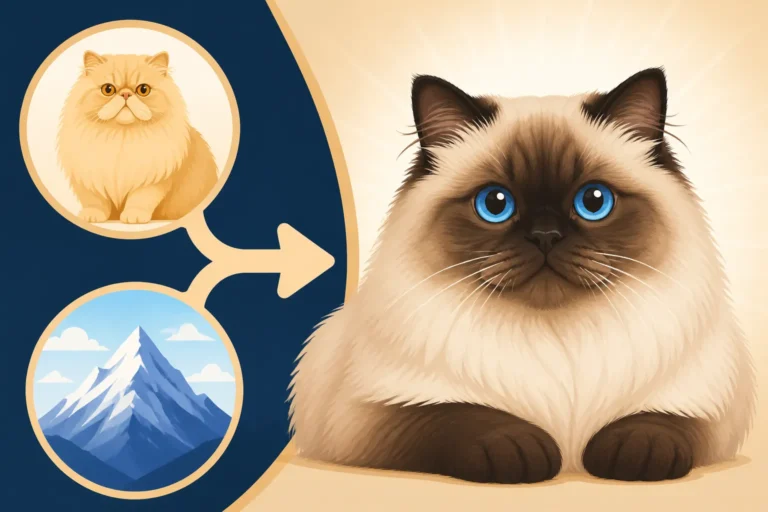
A Himalayan has a long, flowing Persian coat
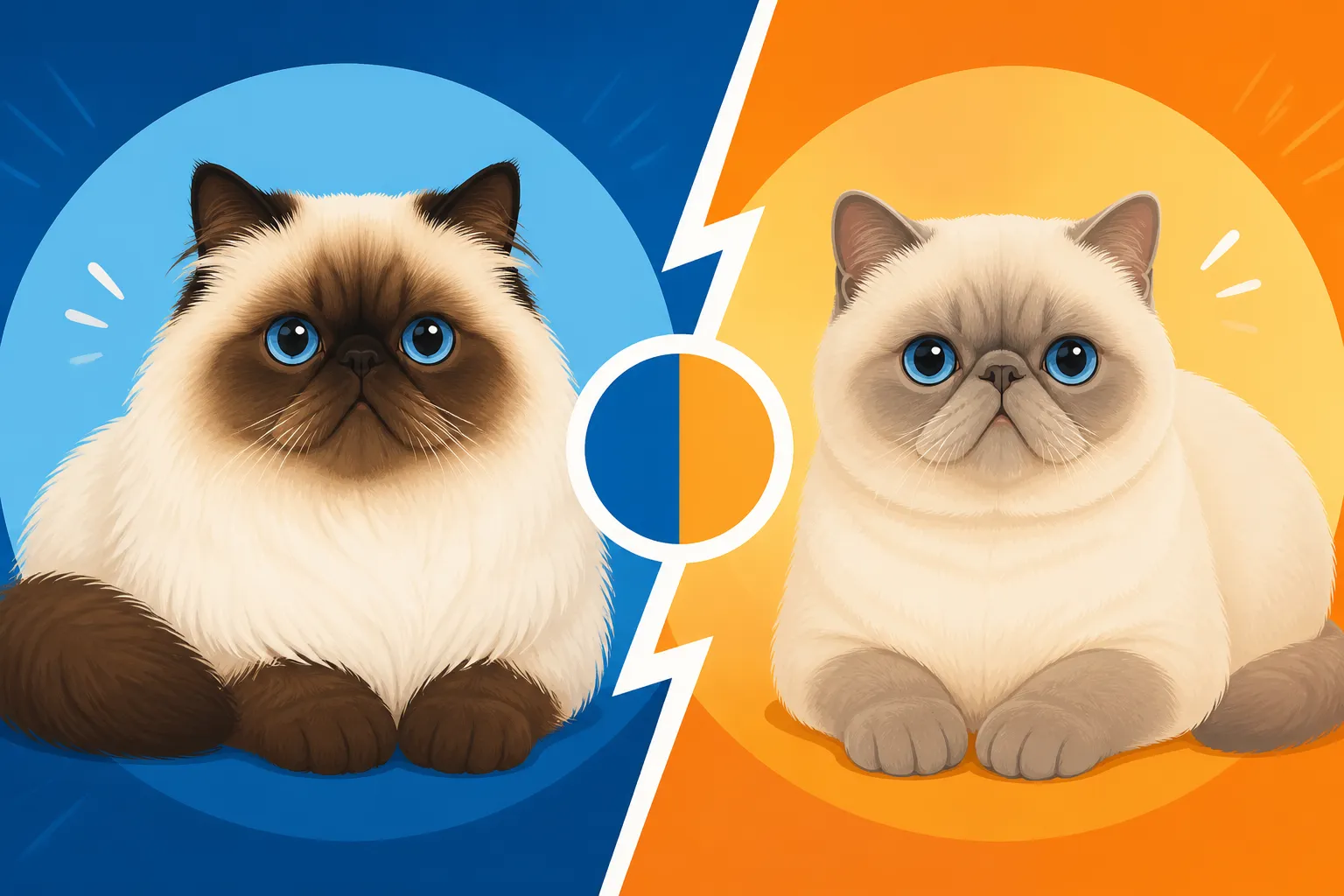
The most obvious difference is length and texture. A Himalayan has a long, dense coat that forms a ruff around the neck, feathering on the legs, and a plume-like tail. Its fur can look especially full around the chest and hindquarters, though coat density and length vary from cat to cat.
That luxurious coat needs regular attention. Hair can tangle beneath the arms, around the britches, and behind the ears even when the top layer looks tidy. If you’re comparing an adult cat, look at the tail and the fur around the legs as well as the body; a full coat is easier to judge there than in a carefully groomed headshot. For a closer look at the coat’s upkeep, see The Daily Comb a Himalayan Cannot Skip.
A Colorpoint Exotic Shorthair has a short, plush coat
A Colorpoint Exotic Shorthair has the same broad, rounded look often associated with Persians, but its coat is short and dense. It tends to sit close to the body and feel plush, rather than falling in long strands. The tail is usually covered in short fur instead of forming the long plume typical of a Himalayan.
“Shorthaired” doesn’t mean “no grooming.” Exotics shed, and their thick coats benefit from regular brushing, especially during shedding seasons. But a short-haired cat generally won’t need the same daily comb-through that prevents mats in a Himalayan’s long coat. If you’re shopping for routine grooming supplies, Chewy is one place owners may look for a suitable comb or brush; choose a tool that works with the cat’s coat rather than assuming one brush fits both.
The distinction between a Himalayan and a Colorpoint Exotic Shorthair is closely related to the difference between the longhaired Himalayan and the shorthaired Persian type. Why an Exotic Shorthair Has a Himalayan’s Face Without the Coat explains that resemblance in more detail.
| Feature | Himalayan | Colorpoint Exotic Shorthair |
|---|---|---|
| Coat length | Long, with a full ruff and tail plume | Short, dense, and plush |
| Grooming needs | Frequent combing to prevent tangles and mats | Regular brushing to manage shedding |
| General build | Rounded, cobby, and Persian-like | Rounded, cobby, and Persian-like |
| Point pattern | Darker face, ears, legs, and tail | Darker face, ears, legs, and tail |
| Eye color | Blue is expected with the point pattern | Blue is generally associated with the point pattern |
| Naming and registration | Depends on the registry | Depends on the registry and pedigree |
A haircut can make coat length harder to judge
A clipped or recently shaved Himalayan may temporarily resemble a shorthaired cat. That can happen when the coat is severely matted or when an owner chooses a shorter trim for practical reasons. In that situation, check whether the hair is growing back longer, whether the tail is becoming plumed again, and whether the cat’s paperwork identifies its breed or division.
A photo can also be misleading. A young kitten may not yet have the full coat of an adult, while grooming and camera angles can make a short coat appear longer or a long coat look close-cropped. When possible, see the cat in person and ask for pictures of its coat at different ages. For a Himalayan kitten, How Long a Himalayan Keeps Adding Coat offers useful context about how its coat develops.
Compare the color pattern and physical features
Both cats can have the Himalayan point pattern
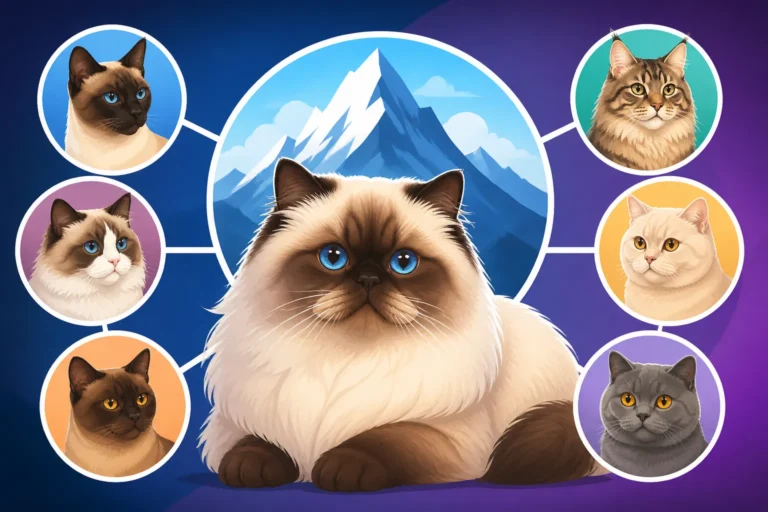
Colorpoint describes a pattern in which the body is lighter and the cooler areas—typically the face, ears, legs, and tail—are darker. That pattern can appear on either a long or short coat. The darker areas are often called points, and the exact shade varies: seal, blue, chocolate, lilac, flame, and lynx patterns are among the examples associated with colorpoint cats.
The pattern alone won’t tell you whether a cat is a Himalayan or a Colorpoint Exotic Shorthair. Both can have blue eyes, dark facial markings, and pale bodies. The point gene is also associated with temperature-sensitive pigment production, which is why a cat’s extremities are usually darker than its warmer central body. Why a Himalayan Is a Persian With the Point Gene explains the relationship between the Himalayan look and colorpoint genetics, while Which Point Colors the Standard Lists for a Himalayan explores the recognized color vocabulary.
Their faces can look remarkably alike
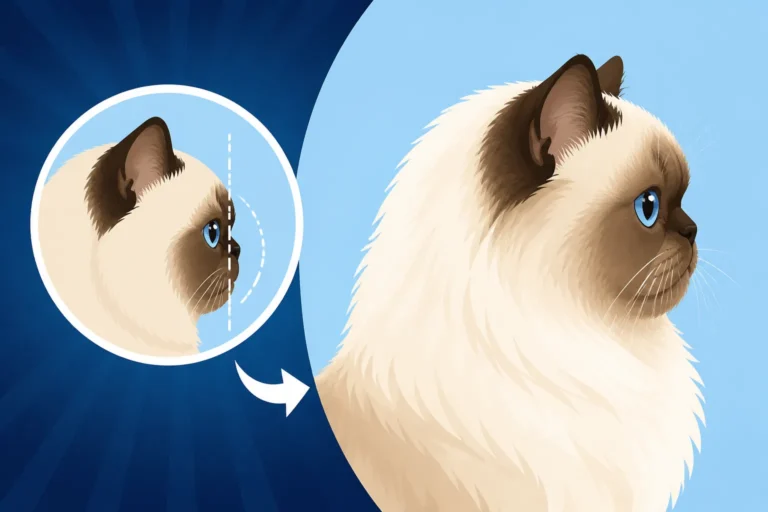
Both cats may have a round head, large round eyes, a short nose, small ears, and a sturdy, low-slung body. A Himalayan’s face can be flatter or more visibly muzzled, and the same is true of Exotics. Face shape varies between individual cats and breeding lines, so it is not a reliable shortcut for telling the two apart.
This is where people often get stuck: they expect the Himalayan to have one unmistakable face and the Colorpoint Exotic another. In practice, a close-up can leave you with more questions than answers. Compare the coat over the whole body, especially the tail and legs, then use reliable pedigree information to confirm what the cat is. For the broader comparison with another familiar Persian type, see How to Tell a Himalayan From a Persian.
Color and face shape do not establish a cat’s registration
The labels can be confusing because registries don’t all organize breeds and color divisions in the same way. Some associations treat the Himalayan as a separate breed, while others place Himalayans within a Persian division. Exotic Shorthair classifications and accepted color patterns also depend on the registry.
As a result, “Colorpoint Exotic Shorthair” may be used to describe an Exotic Shorthair with a point pattern, but the exact wording on official paperwork can differ. The cat’s appearance can suggest its type; it cannot confirm how a particular registry records it. How a Himalayan Is Registered by TICA Today gives one example of how registry terminology can differ from everyday usage.
Check the name, pedigree, and breeder records
Ask which registry issued the papers
If you’re considering a kitten, ask the breeder which registry the cat is recorded with and what exact breed or division appears on its registration documents. A breeder’s listing may use a familiar or descriptive name, while the official paperwork uses a different category. That doesn’t automatically mean anything is wrong, but you should understand the distinction before placing a deposit or making a decision.
Ask to see the paperwork, not just a social media post or a handwritten description. Check that the registered name, date of birth, parent information, and color description are consistent across the documents you receive. What a Himalayan Buyer Should Ask About Registration is a helpful starting point if the paperwork uses terminology you haven’t encountered before.
Use the pedigree to clarify ancestry and coat type
A pedigree can help explain why a cat looks the way it does, but it should be read alongside the registry’s rules. Ask whether the cat is registered as a Himalayan, Persian, or Exotic Shorthair, and whether the coat length and colorpoint pattern are reflected in the records. If a seller uses “Himalayan” and “Colorpoint Exotic” interchangeably, ask them to explain what each term means in that specific context.
It’s also reasonable to ask for information about the parents. A litter can include kittens whose coats develop differently, and a cat’s colorpoint pattern may become more noticeable as it matures. Whether a Himalayan Can Be Bred to a Persian provides background on breed relationships, but the individual cat’s actual pedigree and registration remain the best way to verify its documented identity.
Evaluate health and care needs separately from the label
Breed identification matters, but it doesn’t replace an individual health assessment. Look for clear breathing, comfortable movement, clean eyes and ears, and a coat without mats or irritated skin. Ask for veterinary records and find out what routine care the cat is already accustomed to. If you’re adopting an adult, ask whether it tolerates combing, face cleaning, and nail trims—those everyday habits can make a real difference in how manageable care feels.
A Himalayan’s long coat usually makes coat maintenance a more frequent commitment than an Exotic’s short coat. Both types may need attention to their eyes, teeth, weight, and breathing, particularly when they have very flat faces. If you’re buying supplies, Chewy may be one option for finding basics such as grooming combs or pet-safe cleaning products, but check product labels and ask your veterinarian before using anything near a cat’s eyes. Routine grooming can also help you notice changes in the skin that might otherwise be hidden beneath thick fur.
Make the distinction in everyday situations
When you’re identifying an adult cat
Start by looking at the coat on the tail, legs, chest, and body. A Himalayan will typically have longer, flowing fur, a pronounced ruff, and a feathered tail. A Colorpoint Exotic Shorthair will usually have a short, plush coat and a tail without long feathering.
Then consider the points and face, but treat them as supporting details rather than proof. A pale body with darker extremities and blue eyes is consistent with a colorpoint cat, but it doesn’t distinguish the longhaired Himalayan from the shorthaired Exotic. If the cat has been clipped, is very young, or has an unusual coat, paperwork and breeder or rescue records may be more useful than appearance alone.
When you’re choosing between the two
Think about the kind of care you can comfortably keep up with. If a daily combing routine fits your life and you enjoy maintaining a long coat, a Himalayan may suit you. If you prefer a short, plush coat that still needs brushing but is less prone to long-hair mats, a Colorpoint Exotic Shorthair may be a better match. Neither coat is maintenance-free, and individual cats may differ in temperament and tolerance for handling.
Ask the breeder or rescue to describe the actual cat rather than relying on breed stereotypes. A cat’s comfort with grooming, play style, and response to a busy home matter just as much as the label. You can also check whether the cat has been introduced to face cleaning and combing, particularly if it has a flat face or long coat. Chewy may carry some everyday grooming essentials, but the first step is choosing tools that suit the cat and introducing them patiently.
When the name remains unclear
If the cat’s appearance and paperwork seem to disagree, ask the registry or the breeder to clarify how the cat is classified. A long-haired, pointed cat may be described as a Himalayan in everyday conversation, yet its official registration can use another designation. Likewise, a shorthaired, pointed cat may be marketed as a Colorpoint Exotic even when its registration lists only Exotic Shorthair with a color description.
The practical rule is straightforward: coat length is the strongest visual clue; registration records are the strongest evidence of the official name. Color, eye color, and facial shape can help you understand the cat’s appearance, but they cannot settle the naming question by themselves. If you are buying, take time to review the records and ask direct questions before you commit.
Disclaimer
This article is for general informational purposes only and does not constitute professional advice. Laws, prices and regulations vary by location and change over time. Consult a qualified professional for guidance on your specific situation.