Which Point Colors the Standard Lists for a Himalayan
A Himalayan’s point color can look straightforward until you compare a breeder’s description, a registry standard, and a kitten whose markings are still developing. This guide explains the point colors commonly listed for Himalayans, how the names describe coat patterns, and why recognition can depend on the registry and the exact color combination.
What a Himalayan point color describes
Himalayans have a pale body coat with darker coloring on the cooler parts of the body, usually the face, ears, legs, feet, and tail. Those darker areas are called points. A point-color name describes their color, while terms such as “lynx” or “tortie” describe additional patterns within the points.
The Himalayan’s colorpoint pattern is temperature-sensitive: cooler areas of the body tend to grow darker fur. That is why a kitten may be very pale at first and why the coat can change as the cat matures. For more on that mechanism, see How Temperature Decides a Himalayan’s Point Color and Why Every Himalayan Kitten Is Born Almost White.
The main point colors
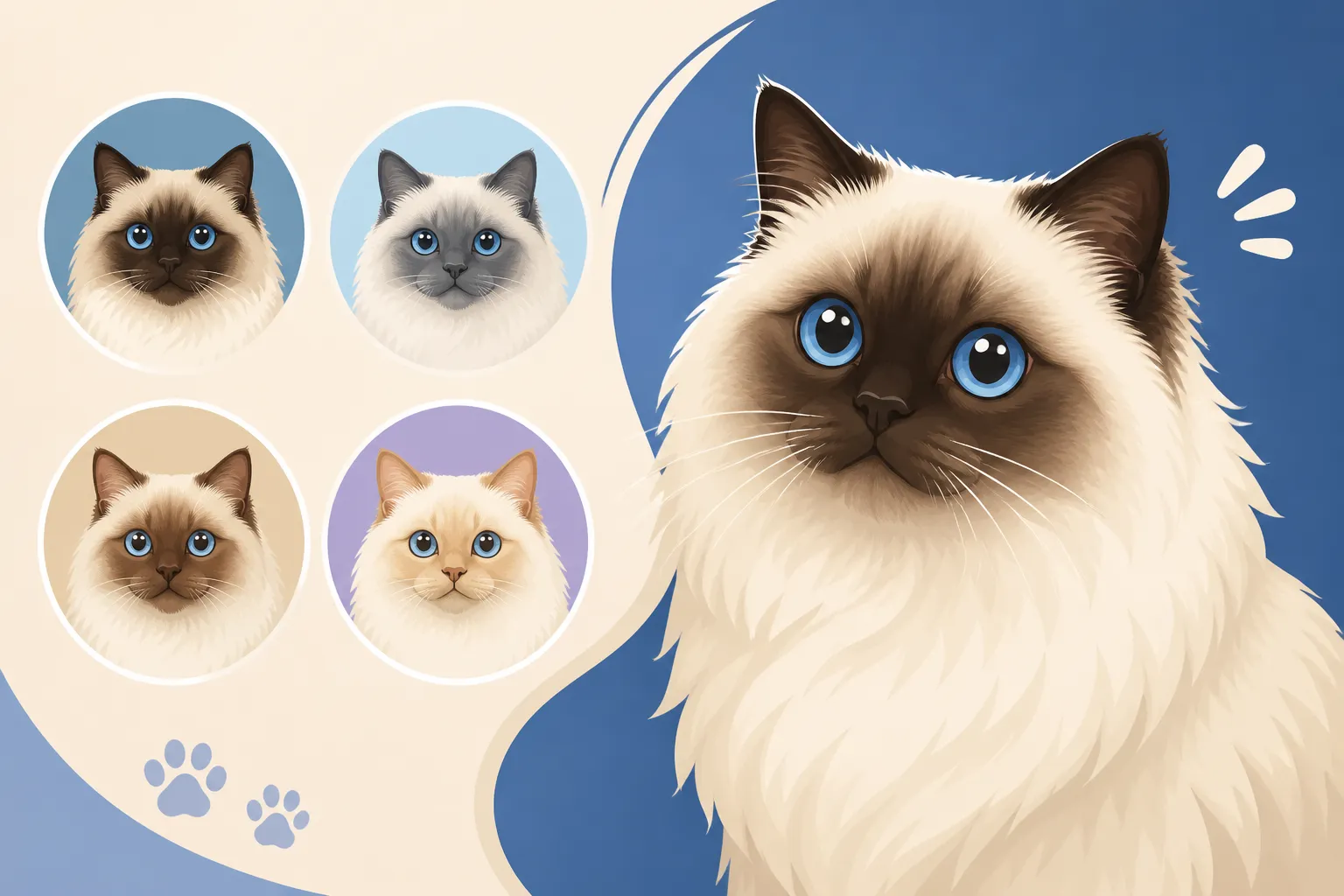
The familiar solid point colors are seal, blue, chocolate, lilac, flame, and cream. The names can be a little misleading if you imagine them as simple blocks of color. Each describes a particular shade, and the difference between two colors may be easiest to see in good natural light or by comparing the points rather than the body coat.
- Seal point: Dark brown to nearly black-brown points, often with a warm, pale body coat.
- Blue point: Cool slate-blue or gray points, usually paired with a lighter-looking body.
- Chocolate point: Warm milk-chocolate or brown points.
- Lilac point: Pale, cool-toned gray with a pinkish or lavender cast.
- Flame point: Orange-red points, sometimes with tabby markings visible in the color.
- Cream point: Softer, paler buff or cream points, generally less vivid than flame.
These labels are useful starting points, not a promise that every cat’s coat will look identical. Shade, contrast, age, lighting, and the cat’s individual pattern all affect what you see. A seal point might look dramatically dark beside a cream body, while a lilac point may be subtle enough that its cool tone is more obvious in daylight than under a warm lamp.
Mixed and patterned points
Some Himalayans have more than one color or a visible pattern within their points. A tortie point has patches or mingling of two colors, commonly including red or cream with another point color. A blue-cream point, for example, combines blue-gray and cream tones. Tortie patterns are often irregular, so two cats with the same general label can have very different-looking faces and legs.
“Lynx point” refers to tabby striping or markings in the points. A lynx-point Himalayan may have stripes on the face, legs, or tail, alongside the color associated with its point. The full description can combine both elements, such as seal lynx point: “seal” identifies the base point color, and “lynx” identifies the pattern. If you are checking a specific pattern, Whether a Lynx Point Himalayan Is Recognized and Whether a Tortie Point Belongs in the Himalayan Division address two common questions.
Not every registry uses exactly the same terminology or accepts every combination in the same way. It is helpful to separate three questions: what the cat looks like, what color name a breeder or seller uses, and whether a particular registry recognizes that color for its records or show classes.
How standards and registries affect the list
There is not always one universally worded list that applies to every Himalayan in every registry. Himalayan classification differs among cat associations. For example, CFA places Himalayans within the Persian breed structure, while TICA registers the Himalayan separately. That difference can affect how paperwork and color categories are presented, even when the cat itself has the same coat.
For a broader explanation of the registry distinction, see Why TICA Kept the Himalayan Separate and How the Himalayan Is Registered by CFA Today. If you are buying a kitten or considering a show, check the rules of the specific association involved rather than relying on a general online color list.
What “recognized” means in practice
A color can be easy to identify in everyday conversation but still need a more precise name on registration papers. Standards and registration systems use defined categories so that cats can be recorded and judged consistently. A breeder might describe a kitten using a familiar color label, while the registry’s paperwork uses a formal category or places the cat in a broader division.
Recognition also does not mean that every example of a color will look the same, or that color alone determines show quality. Judges consider the cat according to the applicable standard, including the points, body coat, and overall presentation. How a Himalayan’s Points Are Judged explains why the shade is only one part of the evaluation.
If you are looking at a kitten listing, ask which registry the breeder uses and how the kitten’s color is recorded there. A retailer listing, adoption description, or social media post—including one you happen to see while browsing Chewy—can use everyday color names without establishing show eligibility or official registration. The seller should be able to explain the paperwork behind the description.
Why color names can vary between descriptions
Several factors can make a color label feel uncertain. A kitten’s points may not yet be fully developed, a photograph may distort the shade, or a seller may use a familiar name loosely. A pale kitten can be difficult to identify precisely before its markings deepen, and mixed patterns may be easier to recognize as the coat matures.
Lighting matters, too. Indoor bulbs can make blue points appear warmer or make subtle lilac points look gray. Phone cameras may brighten a pale coat until the contrast disappears. When comparing photos, look for pictures taken in natural light and ask for images of the face, ears, feet, and tail. Those areas usually give a clearer idea of the points than the body coat alone.
For kittens, avoid treating an early description as a final verdict if the points are still emerging. How a Himalayan Kitten’s Points Darken Month by Month covers the gradual development, while How a Himalayan’s Point Color Is Recorded is useful if you need to understand how a color name appears in records.
A practical guide to common color descriptions
The table below is a plain-language guide, not a substitute for a registry’s current standard. It can help you make sense of breeder conversations and kitten descriptions before you verify the formal classification with the relevant association.
| Description | What you may see on the points | What to keep in mind |
|---|---|---|
| Seal point | Deep brown to very dark brown | Often creates strong contrast against a pale body coat |
| Blue point | Slate or blue-gray | The “blue” label means a diluted gray tone, not bright blue fur |
| Chocolate point | Warm brown | Usually lighter and warmer in tone than seal |
| Lilac point | Pale gray with a cool or pinkish cast | Can be subtle and lighting-sensitive |
| Flame point | Orange or red-toned markings | Some cats show tabby-like detail in the points |
| Cream point | Soft buff or pale cream | Often lower in contrast than flame |
| Tortie point | Two colors, often with red or cream mixed in | The placement of patches can vary from cat to cat |
| Lynx point | Tabby striping within the points | Usually paired with a base point-color name |
| Blue-cream point | Blue-gray and cream tones | A mixed-color description, rather than a single solid shade |
When a color is described with two terms, read them as separate clues. “Blue lynx” tells you the base color and the pattern. “Blue-cream” indicates a mixture of tones. The order and exact wording can depend on the registry or the person describing the cat, so ask for the official color entry if the distinction matters for registration or showing.
Color and contrast are not the same thing
Point color identifies the shade, but contrast describes how clearly the points stand apart from the body coat. A Himalayan may have a recognized point color yet show a softer or stronger contrast than another cat with the same color label. A pale body coat is part of the classic appearance, but age, coat condition, and environmental temperature can influence how the overall coloring reads. See Why a Himalayan’s Body Coat Should Stay Light for more about that distinction.
A photo can make contrast especially hard to judge. Shadows may darken the body, while bright exposure can wash out the points. If you are evaluating a kitten, compare several images and, where possible, meet the cat in person. Ask whether the breeder’s color identification is provisional or already recorded, and whether the description refers to a base shade, a pattern, or both.
Color should also be kept in perspective when choosing a pet. A striking point pattern may catch your eye, but health information, temperament, care needs, and the quality of the breeding program matter far more to a cat’s everyday wellbeing. For questions about what to ask when reviewing documentation, What a Himalayan Buyer Should Ask About Registration is a useful next read.
How to identify and confirm a Himalayan’s point color
You do not need to be an experienced breeder to make a useful first assessment. Start by looking at the points in consistent lighting, then treat the color name as a description to verify—not as a conclusion based on one photograph. This is particularly helpful when a kitten is young or has a mixed pattern.
Look at the right areas
Examine the face mask, ears, tail, legs, and feet. These are the areas where point coloring is usually most visible. The body coat may be so pale that it offers little help in distinguishing one point color from another. Try to notice whether the points look warm brown, cool gray, reddish, or mixed, and whether there are clear stripes or patches.
If a color seems ambiguous, compare the cat’s coat in indirect daylight rather than direct sun or under strongly tinted indoor lighting. Direct sun can wash out detail, and warm bulbs can change how gray or cream tones appear. A clear set of photos from multiple angles is more useful than a single close-up of the face.
Avoid judging a kitten’s final color from newborn photographs. The points develop over time, and the body and markings can change as the kitten grows. Even an adult’s coat may look different after clipping or shaving because newly grown fur can be darker. The broader pattern is explained in How a Shaved Patch Regrows Darker on a Himalayan.
Ask for the registry wording when it matters
If you are buying a kitten, requesting papers, or planning to enter a cat in a show, ask the breeder for the exact registered color and the name of the registry. You can also ask whether the color description is based on an official record or is the breeder’s current visual assessment. Those are not always the same thing, especially before a kitten’s points have fully developed.
A clear answer should make the distinction easy to understand: the cat’s everyday description, its recorded color, and the standard or registry that applies. If the answer is vague, ask for a copy of the relevant paperwork or for the breeder to explain how the color is entered. You are not being difficult; you are making sure that the label means what you think it means.
For a pet home, a precise show classification may not matter much. But understanding the color can still help you compare descriptions, follow how the kitten’s coat changes, and avoid assuming that a retail or adoption label is an official designation. Chewy and other retailers may use familiar wording in product or pet listings, but a listing is not a substitute for a breeder’s registration record. When color is just one part of your decision, it is usually more useful to focus on the cat’s care and health needs than on whether its points match a particular shade perfectly.
Disclaimer
This article is for general informational purposes only and does not constitute professional advice. Laws, prices and regulations vary by location and change over time. Consult a qualified professional for guidance on your specific situation.