Why the Himalayan Borrowed a Rabbit’s Name
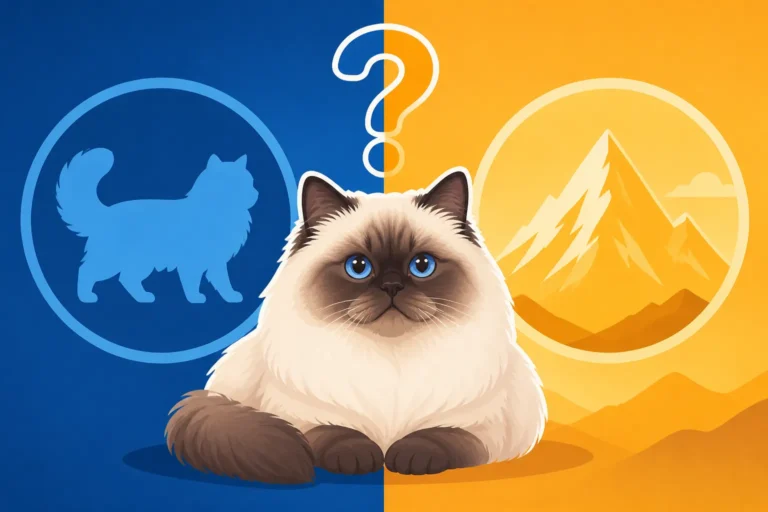
A Himalayan cat’s name sounds as if it should point to a mountain range, but the name actually comes from a rabbit with a remarkably similar coat pattern. That small bit of naming history explains why the breed’s dark ears, face, paws, and tail stand out against a pale body—and clears up a common misconception about where Himalayan cats came from.
The name came from a rabbit’s coat pattern
What a Himalayan rabbit looks like
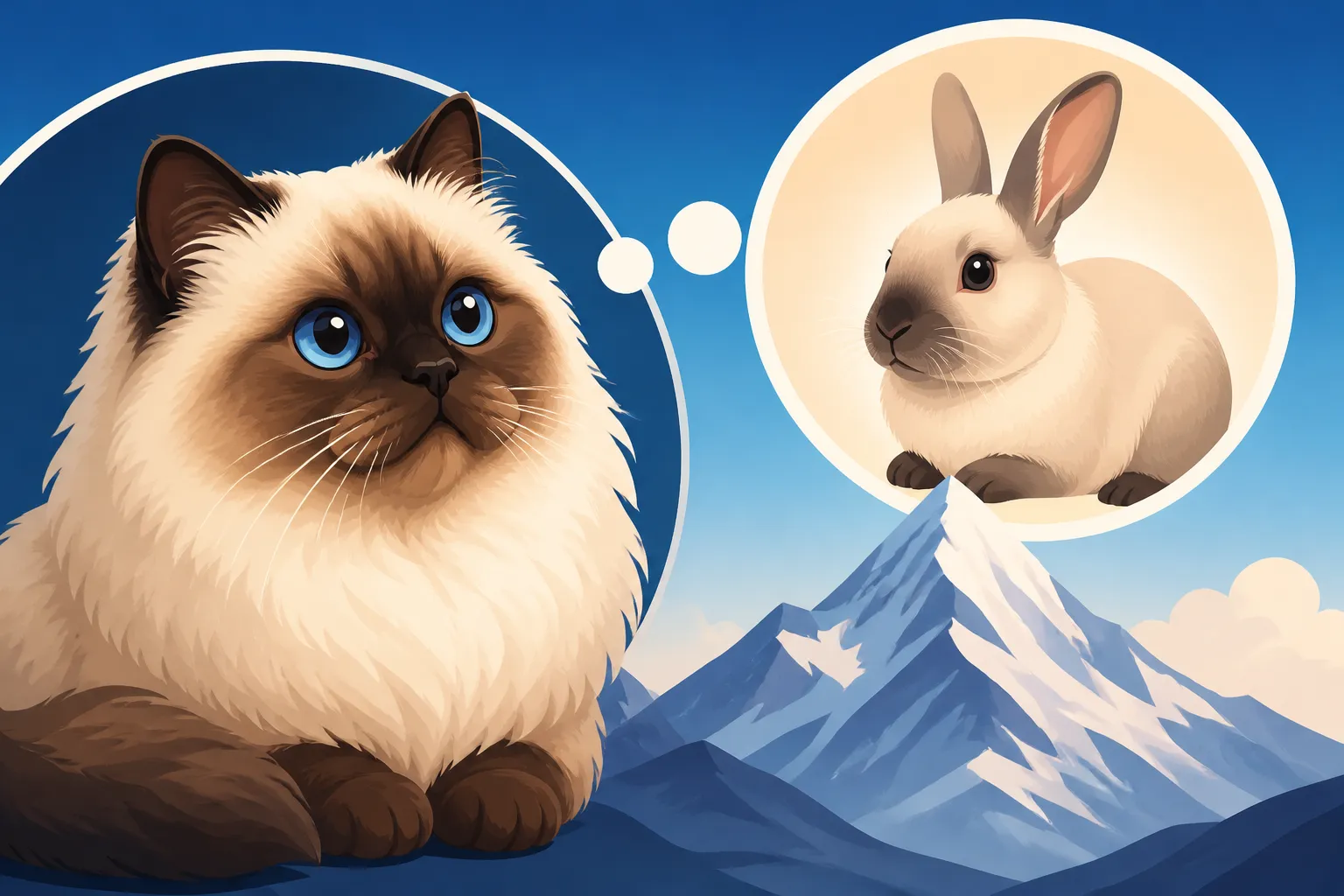
The Himalayan rabbit is known for a distinctive pattern: a light-colored body with darker markings on the nose, ears, feet, and tail. Those markings make it look strikingly similar to a colorpoint cat. The resemblance is visual, not a sign that cats and rabbits are closely related or share a recent family history.
The rabbit’s name was already associated with this recognizable pattern before “Himalayan” became the familiar name for the pointed Persian-type cat. Early cat breeders used the term because it offered a handy description for a pale animal with dark extremities. In other words, the name described what the cat looked like rather than where it lived or where its ancestors originated.
That distinction matters because the word “Himalayan” can easily suggest a geographic origin. A cat with the name is not, simply by virtue of that name, a mountain-dwelling species or a cat native to the Himalayas. The naming connection is to the rabbit’s coat pattern. For a closer look at the rabbit side of the story, see Which Rabbit Shares the Himalayan Pattern.
Why the cat’s markings brought the rabbit to mind
On a Himalayan cat, the darker color usually appears on the face mask, ears, legs, feet, and tail. The body coat is lighter, though its exact shade varies among cats and point colors. When breeders saw that arrangement, the rabbit offered an intuitive comparison: light body, dark points, instantly recognizable silhouette.
The comparison works especially well because the markings occur on the cooler parts of the body. A cat’s extremities and face tend to be cooler than its core, and temperature influences pigment production in colorpoint coats. The result is a pattern that can look almost painted on, even though it develops through the cat’s biology. How Temperature Decides a Himalayan’s Point Color explains why those cooler areas become darker.
The rabbit comparison is useful, but it can also be taken too literally. Himalayan cats and Himalayan rabbits are different animals with different breeding histories. They share a striking pattern, not an identity. The name is a descriptive hand-me-down, rather like using a familiar visual reference to explain a color or shape.
What the pattern means biologically
A temperature-sensitive colorpoint coat
The pointed pattern is connected to a temperature-sensitive form of pigment production. In simplified terms, the pigment-producing process works more effectively in cooler areas of the body than in warmer areas. That is why a cat’s ears, paws, tail, and face are often darker than its torso.
A Himalayan kitten is usually born very pale because it develops in the warmth of the mother’s body. As it grows and its extremities experience cooler temperatures, the points gradually become more visible. The timing and depth of the color can vary, so a young kitten may look much lighter than the adult cat it will become. Why Every Himalayan Kitten Is Born Almost White walks through that change.
This is also why a Himalayan’s coat can shift over time. A cool environment may contribute to deeper coloring across the coat, while a shaved or clipped patch may grow back darker than the surrounding fur. These changes can surprise owners who expect the coat to stay exactly the same shade from kittenhood onward. The visual pattern has a biological explanation; it is not a dye-like marking applied by breeders.
The colorpoint pattern is often associated with blue eyes in Himalayan cats. That blue-eyed appearance is part of the breed’s recognizable look, but it is separate from the rabbit-inspired name. The label tells you about the coat pattern’s resemblance to a rabbit, not every inherited trait that contributes to a Himalayan’s appearance. For more on the pattern’s genetics, see Which Gene Makes a Himalayan Pointed.
Similar appearance does not prove identical inheritance
It is tempting to assume that because cats and rabbits can display a similar arrangement of pale bodies and dark extremities, they must carry the same specific genetic change. That conclusion would go further than the resemblance supports. Different species can develop similar-looking traits through related biological mechanisms without sharing the exact same mutation or inheritance story.
In both cases, temperature-sensitive pigment production helps explain why cooler body regions can become darker. But cats and rabbits belong to different species and have their own genetic histories. A matching visual effect does not make them close relatives, and it does not mean the cat inherited its coat from a rabbit.
This is a useful distinction whenever a breed name comes from an animal, place, or familiar object. Names can preserve an old comparison without describing precise scientific ancestry. Here, “Himalayan” is a name rooted in resemblance: the cat’s pattern called to mind the rabbit’s pattern, so the association stuck. If you want to explore how the same general pattern appears elsewhere in nature, see Which Other Species Show the Himalayan Pattern.
| Question | What the name or pattern tells you | What it does not tell you |
|---|---|---|
| Why “Himalayan”? | The cat’s coat resembles the pattern seen on a Himalayan rabbit | That the cat came from the Himalayan mountains |
| Why are the points darker? | Cooler body areas support darker pigment development | That the markings were added or dyed |
| Why is a kitten so pale? | Its point color develops as it grows and its extremities cool | That it will remain nearly white as an adult |
| Do cats and rabbits share the same pattern? | They can show a similar light-body, dark-point appearance | That they are close relatives or carry an identical genetic change |
How the name became attached to a cat breed
From a coat description to a breed name
The Himalayan cat was developed through deliberate breeding that combined Persian and Siamese traits. The aim was to bring the Siamese colorpoint pattern into a cat with Persian type, including a long coat and a rounded, substantial build. The name “Himalayan” gave people a convenient way to refer to the resulting pointed cat.
The early work was part of an effort to understand how coat traits were inherited, not simply a campaign to give cats memorable names. Researchers and breeders were interested in how a pointed coat could appear alongside Persian-like features. The cat’s history therefore includes both a practical breeding goal and a scientific interest in inheritance. Why Harvard Crossed a Persian With a Siamese to Make the Himalayan explores that background.
As breeding programs continued, “Himalayan” became familiar as the name for the pointed Persian-type cat. Naming conventions later differed among registries and countries, which is why a buyer may see the same general type described in more than one way on registration documents. Some systems treat the Himalayan as its own breed; others place it within a Persian category or division.
That paperwork variation does not undo the rabbit connection. The coat resemblance explains the name’s origin, while registries reflect later decisions about how cat breeds and varieties are organized. To understand the historical research behind the breed, What the 1936 Paper Said About the Himalayan Cross offers a related angle.
Why the name can be confusing today
People often assume breed names are literal maps. A cat called a Turkish Angora, for example, may prompt questions about Turkey; a Himalayan name naturally leads people to picture the Himalayas. But breed names can arise from many sources: a place, a breeder, a historical label, or a simple resemblance to another animal.
In the Himalayan’s case, the rabbit association is the important clue. The name is not evidence that the cat evolved in a mountain climate, nor that its ancestors were wild cats from that region. It also does not mean the breed was named after a wild Himalayan animal. The most direct explanation is that breeders saw a familiar pointed pattern and borrowed the rabbit’s name for it.
Registry terminology adds another layer of confusion. A family may bring home a cat everyone calls a Himalayan, while its formal paperwork uses a Persian-related classification. That can feel contradictory, especially when the cat’s appearance is unmistakably colorpoint. It is usually a difference in classification language rather than a disagreement over the animal’s visible pattern. How the Himalayan Is Registered by TICA Today and How the Himalayan Is Registered by CFA Today explain how those naming systems can differ.
What the rabbit connection means for owners
The name is a helpful clue, not a care instruction
Knowing why the cat borrowed the rabbit’s name can make the coat easier to understand, but it does not tell you how to care for the cat. The rabbit comparison does not indicate that Himalayan cats need special care because of a shared species trait. Their grooming, feeding, activity, and veterinary needs relate to their own build, coat, face shape, and health history.
For example, the long Persian-type coat needs regular attention to prevent tangles and mats. The pointed coloring does not make the coat self-cleaning, and the light body fur may show tear staining or dirt more visibly than a darker coat. A daily combing habit can be more useful to an owner than memorizing the history of the name—though understanding that history does make the markings more interesting.
The pattern can also change with age and temperature. An owner who notices a darker coat after a cold season or a dark patch where fur was clipped may wonder whether something is wrong. Often, those changes fit the way colorpoint coats respond to temperature and regrowth. Still, sudden skin changes, irritation, or other signs of illness deserve a veterinarian’s attention rather than being dismissed as coat color. Why a Himalayan’s Points Deepen Every Year It Lives covers the gradual changes many owners notice.
A name that tells a small but memorable story
The rabbit connection is a reminder that breed names often carry little snapshots of how people first understood an animal. Someone saw a pale body, dark points, and a familiar pattern, then reached for a name that made the appearance easy to describe. Over time, that comparison became part of the cat’s identity.
So when someone asks whether Himalayan cats come from the Himalayas, the simplest answer is no—not because the name is meaningless, but because it points to the coat pattern rather than a place. The name recalls the Himalayan rabbit, whose markings offered an early visual comparison. The cat’s own story is tied to Persian and Siamese breeding, colorpoint genetics, and the history of how registries classify pointed longhaired cats.
That explanation also keeps two ideas separate: where a breed’s history developed and what its name evokes. The Himalayan’s name is a borrowed label. Its coat is the real source of the connection, and its distinctive points are what made the comparison memorable in the first place.
Disclaimer
This article is for general informational purposes only and does not constitute professional advice. Laws, prices and regulations vary by location and change over time. Consult a qualified professional for guidance on your specific situation.