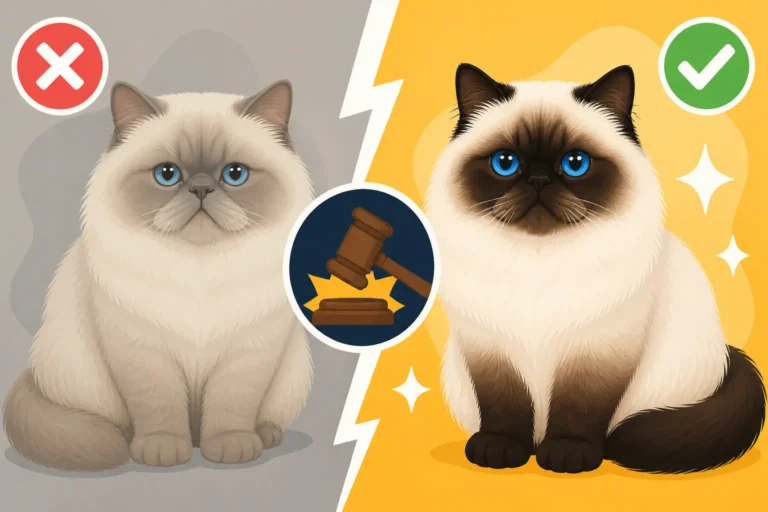
Whether ACFA Treats the Himalayan Separately
If you are comparing Himalayan kittens and find that one registry calls the cat a Himalayan while another files it with Persians, the paperwork can feel needlessly confusing. ACFA generally treats the Himalayan as a distinct breed for its own breed identity and standards. Here’s what that means, how it differs from other registries, and what to check before you rely on a cat’s papers.
Does ACFA Treat the Himalayan as a Separate Breed
The short answer
Yes. The American Cat Fanciers Association, commonly called ACFA, recognizes the Himalayan as a breed in its own right rather than simply using “Himalayan” as a color division within the Persian breed. That distinction matters most when you are looking at breed standards, registration descriptions, or show information: ACFA’s framework gives the Himalayan a separate identity.
“Separate,” though, does not mean the cat is unrelated to Persians. Himalayans have a Persian body type and long coat, along with the colorpoint pattern associated with the Siamese side of their history. Their appearance is why another registry may group them with Persians even when ACFA names them separately. The classifications describe how an organization organizes and judges cats; they do not change the animal in front of you.
If you have seen differing descriptions on a pedigree, a breeder’s website, or a show entry, you are not necessarily looking at a mistake. Registry systems are not fully uniform. One organization may use “Himalayan” as a breed name, while another may place the same kind of cat under a Persian heading or division. For more background, see Why the Himalayan Is Named After a Rabbit and Why a Himalayan Is a Persian With the Point Gene.
What “separate” means in practice
A separate breed listing gives the Himalayan its own recognizable place in ACFA’s breed framework. It can affect how a cat’s breed is described in ACFA-related records and how a fancier understands the cat’s identity within that system. It does not mean that ACFA considers the Himalayan’s heritage entirely separate from Persian ancestry, or that every registry uses the same name.
It is also useful to distinguish breed recognition from the exact way a show is organized. A registry’s breed standards and its show rules are related, but they are not interchangeable. If you plan to exhibit a cat, confirm the current show schedule and entry instructions with the organization or show staff. A general statement that ACFA recognizes Himalayans separately does not, on its own, answer every question about a particular class, division, or competition.
For someone choosing a pet, the practical effect is usually smaller than the terminology makes it sound. The registry label is relevant if you want to register, exhibit, or document the cat’s ancestry. It does not determine whether the cat is affectionate, whether its coat needs daily combing, or whether its facial structure calls for extra care. Those questions depend on the individual cat and its health and breeding background—not merely on the word printed in a registry category.
How ACFA’s Classification Compares With Other Registries
Why the labels differ
Cat registries make their own decisions about breed names and categories. Their systems developed at different times and do not have to match one another. As a result, the same pointed longhair may be described as a Himalayan by one organization and connected to a Persian division by another. A registry’s choice of label is an administrative and show-organization decision, not a claim that the cat’s appearance or ancestry changes between organizations.
CFA is a familiar example of a different approach: it places the Himalayan within the Persian framework rather than treating it as a fully separate breed in the same way ACFA does. That distinction is part of a broader history of changing classification, and it can be surprising when a breeder speaks naturally of a Himalayan while the paperwork uses a Persian-related label. Why CFA Made the Himalayan a Persian Division in 1984 explains the history behind that particular arrangement.
TICA has its own classification system, too. Its approach should be checked against the specific registration or show context you care about rather than assumed to mirror ACFA or CFA. A helpful starting point is How TICA Registers the Himalayan Today. If the question is whether different labels affect an owner or buyer, Whether the Registry Split Affects a Himalayan Buyer offers a related perspective.
| Registry context | How the Himalayan may be described | What to keep in mind |
|---|---|---|
| ACFA | Recognized as a distinct breed identity | Check ACFA records and rules for the exact registration or show question |
| CFA | Included within the Persian framework | A Persian-related label does not necessarily mean the cat is not commonly called a Himalayan |
| TICA | Uses its own breed classification and registration system | Confirm the organization’s current wording for the specific document or event |
| Breeder or pet listing | May use “Himalayan” as the familiar breed name | A listing is not a substitute for official registration paperwork |
The table is a general comparison, not a guarantee that every record or show document will use identical wording. A cat’s registration depends on the registry that issued the document, the rules that apply to that cat, and the information submitted when it was registered.
Why two honest sources may sound inconsistent
Imagine that you are speaking with a breeder who calls a kitten a Himalayan, then later see a pedigree where a different registry uses a Persian-related designation. It is understandable to wonder whether the breeder misrepresented the kitten. Often, the discrepancy reflects registry terminology rather than a disagreement about the cat’s coat pattern or lineage.
The same issue can arise when a cat is discussed in a show setting. A show catalog may follow the organizing registry’s categories, while a breeder’s own website uses the name familiar to pet buyers. If you are trying to confirm whether the cat is eligible for a particular event, ask which registry issued its papers and check that event’s entry rules. Do not infer eligibility from a casual breed description alone.
This is why reading the actual document matters. The registered name, breed field, and issuing organization tell you more than a social-media post or sales listing. For a closer look at the wording that can appear on documents, see How the Himalayan Is Registered by CFA Today and What a Colorpoint Division Means for a Himalayan.
What ACFA Recognition Means for Buyers and Owners
Registration is not the same as a health guarantee
ACFA’s separate recognition tells you how the organization classifies the breed. It does not, by itself, prove that a specific kitten has been health tested, that its parents have complete records, or that a breeder follows good practices. Those are separate questions, and they deserve direct answers no matter which registry name appears on the paperwork.
When speaking with a breeder, ask which registry the kitten is registered with and request to see the documents rather than relying on a verbal description. If the breeder mentions more than one registry, ask which papers have already been issued and whether any additional registration is possible under that organization’s rules. Clear answers should include the name of the registry and the actual record supporting the claim.
Also ask about the kitten’s parentage and health history in plain language. Breed recognition is not a substitute for veterinary records or appropriate testing. For health-related questions, a useful companion topic is Every Himalayan Inherits Two Disease Lists, Not One. The point is not to assume a problem, but to understand that a registry label alone cannot tell you everything you need to know about an individual cat.
What to check on the paperwork
Start by confirming the issuing organization. A document from ACFA should be interpreted according to ACFA’s rules; a CFA or TICA document should be interpreted according to that organization’s system. The registry name is important because two documents can use different breed wording without necessarily contradicting each other about the cat’s identity.
Next, compare the registered details with the kitten or cat you are considering. Check the registered name, identifying details, parent information, and any transfer or ownership information relevant to you. If something is missing, misspelled, or unclear, ask the breeder or issuing organization how it can be corrected. Avoid making assumptions based on an online profile when the official paperwork is available.
Finally, make sure the paperwork matches your purpose. If you simply want a companion, the registry label may be less important than the cat’s temperament, health records, and the care it needs. If you want to show or breed the cat, the precise registry rules become much more important. What a Himalayan Buyer Should Ask About Registration and Whether a Himalayan Can Be Registered With Two Bodies are useful related topics when you are sorting through those details.
How to Confirm the Classification for Your Situation
Ask a precise question
A broad question such as “Is this a real Himalayan?” can lead to vague answers, especially because the term is used differently across organizations. Instead, ask: “Which registry issued this cat’s papers, and what breed does that registry record?” If you are considering showing the cat, add: “Which class or category would apply under the rules for this event?”
Those questions keep the conversation focused on verifiable details. A responsible breeder should be able to tell you which registry they use and show relevant records. If they use a breed name in advertising that differs from the wording on the pedigree, ask them to explain the difference. A clear explanation is more useful than treating one label as automatically correct and another as automatically suspicious.
If you are already holding paperwork, read the document as a record from a particular registry—not as a universal definition that every organization must follow. How to Read the Breed Line on a Himalayan Pedigree can help you understand why the breed field may not match the wording you have seen elsewhere.
Check the organization’s own rules
For a purchase, transfer, or pet registration, consult the registry that issued—or would issue—the record. For competition, consult the organization running the show and confirm how it handles entries, breed names, and eligibility. Rules and forms can be updated, so checking the relevant organization directly is safer than relying on a breeder’s recollection or an old post.
If you are comparing registries, keep the questions separate: Does the organization recognize the Himalayan as a distinct breed? How does it describe the cat on its records? What requirements apply to registration or show entry? The answer to one does not automatically answer the others. A registry may recognize the breed while applying particular documentation or event rules.
The straightforward takeaway is that ACFA treats the Himalayan as a distinct breed identity, while other registries may organize the same kind of cat differently. That difference can explain inconsistent paperwork language without making the cat itself any less Himalayan. For the decision that matters to you, verify the issuing registry, read the actual documents, and check the specific rules for registration or showing.
Disclaimer
This article is for general informational purposes only and does not constitute professional advice. Laws, prices and regulations vary by location and change over time. Consult a qualified professional for guidance on your specific situation.