Why the Himalayan Is Named After a Rabbit
It’s a name that conjures images of snow-capped peaks and chilly mountain air, isn't it? When you first hear "Himalayan cat," your mind might immediately go to the majestic mountains, perhaps imagining these gorgeous felines scaling icy slopes. But here’s a little secret that often surprises new owners: the Himalayan cat doesn't actually hail from the towering Himalayas. So, if not from the mountains, why on earth is this beautiful, long-haired breed named after them? This guide is going to clear up that common misconception and take you on a journey through the surprising genetic connection that truly inspired the Himalayan cat’s distinctive name.
The Curious Case of the Colorpoint Gene
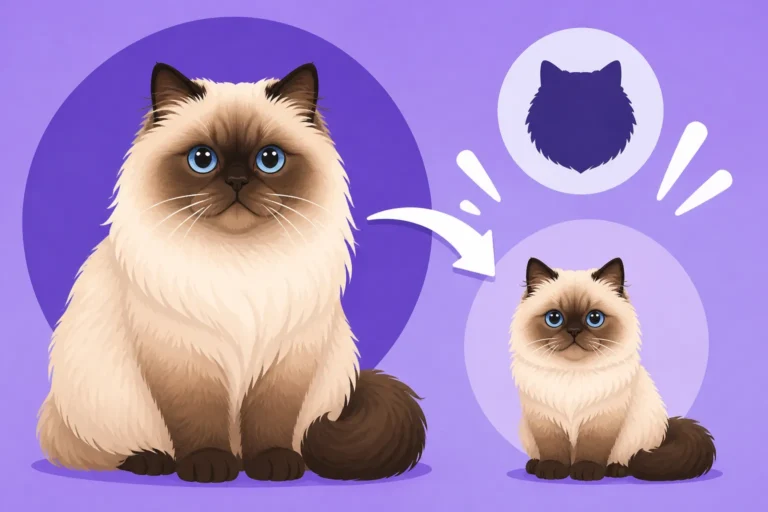
The striking appearance of a Himalayan cat — that pale body contrasted sharply with darker "points" on its ears, face, paws, and tail — is one of its most captivating features. It’s what makes them so instantly recognizable and utterly charming. But this isn't just a random color pattern; it's the visible manifestation of a very specific genetic trait, one that is shared by more animals than you might think.
Not from the Mountains, But a Temperature-Sensitive Gene
The name "Himalayan" doesn't refer to a geographic origin for the cat breed itself. Our beloved Himalayans were actually developed much closer to home, through careful breeding programs in the United States and Britain, primarily in the 1930s and 1950s. The real secret behind their name lies in the unique gene that creates their famous coat pattern. This gene is responsible for what we call "colorpoint" coloration, and it's fascinating because it's temperature-sensitive.
What does that mean, exactly? Well, the gene produces an enzyme that's crucial for pigment development, but this enzyme only works effectively in cooler temperatures. In the warmer parts of the cat's body – the core trunk – the enzyme is essentially inactive, resulting in a pale, creamy, or even pure white coat. However, on the cooler extremities – the ears, nose, paws, and tail – the enzyme can do its job, depositing pigment and creating those rich, dark points. It's a natural marvel that gives each Himalayan its signature look. You can truly see How Temperature Decides a Himalayan's Point Color by observing how their coat changes. This is also Why Every Himalayan Kitten Is Born Almost White; their whole body is warm inside the mother's womb, so the pigment production is suppressed until they are exposed to cooler air after birth.
How the Siamese Contributed the Gene
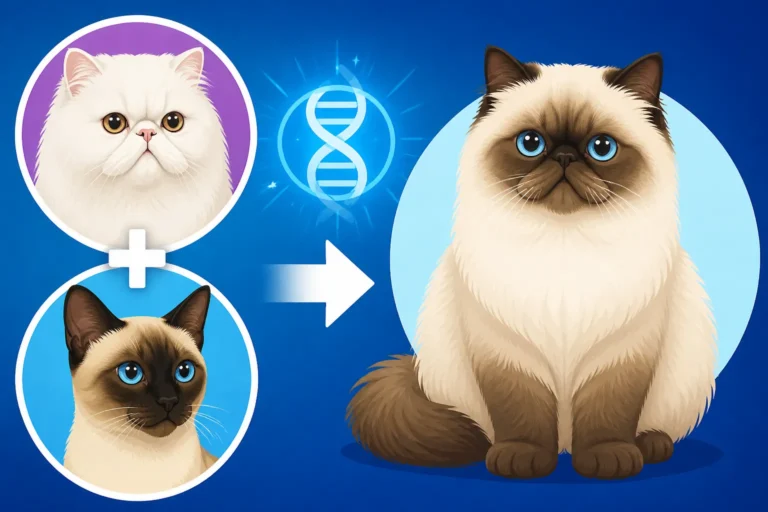
To understand the Himalayan cat, you really have to understand its ancestry. It’s not a spontaneously occurring breed but a deliberate creation, a beautiful blend of two very distinct feline worlds: the majestic Persian and the vocal, elegant Siamese. It was the Siamese side of the family tree that brought the crucial colorpoint gene into the mix.
Siamese cats are, of course, the original poster children for colorpoint coloration in the feline world. Their striking dark points against a light body are what made them famous. Breeders aspiring to create a long-haired cat with this same captivating pattern embarked on a journey of selective breeding. They carefully crossed Persian cats, known for their luxurious long fur and cobby build, with Siamese cats, known for their points and their distinct vocalizations. The goal was to combine the best of both worlds: the Persian's plush coat and serene demeanor with the Siamese's brilliant blue eyes and distinctive color pattern. Without the Siamese, there would be no points on our Himalayans. Indeed, What the Siamese Side Gave a Himalayan Besides Points extends beyond just the coat, influencing aspects of their temperament and voice too. The development of the breed itself is a testament to dedicated breeders, beginning with early efforts captured in papers like The 1936 Paper That Started the Himalayan.
The Rabbit That Shares the Name and the Pattern
This brings us to the core of our mystery: the rabbit. Long before the Himalayan cat was officially recognized and named, there was another animal species already famous for sporting the exact same temperature-sensitive colorpoint pattern.
Introducing the Himalayan Rabbit
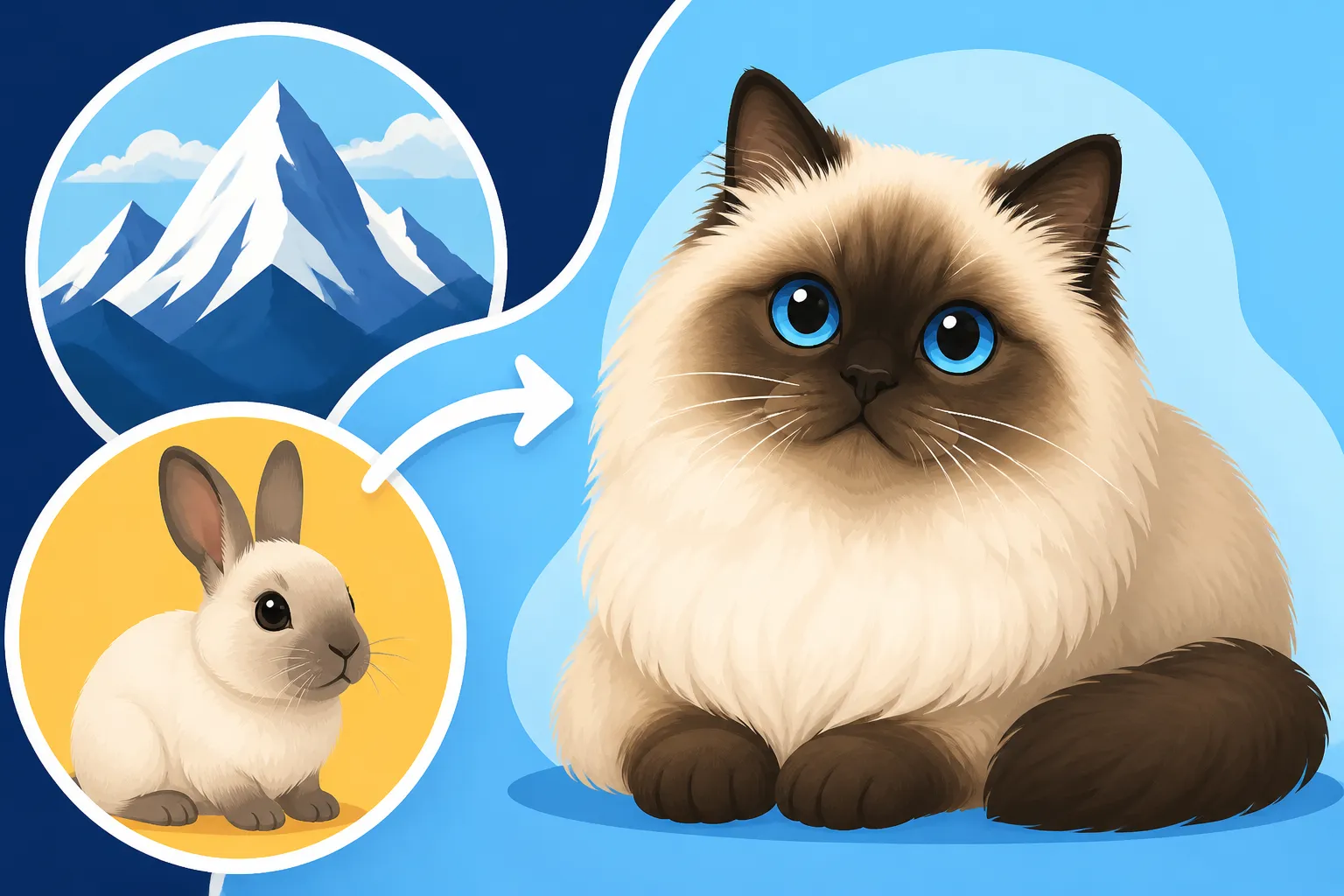
Yes, the Himalayan cat is, in fact, named after the Himalayan rabbit! This ancient breed of rabbit is one of the oldest and most easily recognized, primarily due to its distinct coloration. Just like the cats we adore, Himalayan rabbits have a pure white body with clearly defined dark brown or black points on their ears, nose, feet, and tail. Their eyes are often ruby red, adding to their unique charm. These rabbits have been admired for their beauty for centuries, and their distinctive pattern was a well-known phenomenon in the animal breeding world long before anyone started intentionally creating a pointed Persian cat.
Imagine the delight and recognition when early cat breeders, having achieved their goal of a long-haired, pointed cat, saw the undeniable parallel to these elegant rabbits. It was a perfectly fitting and wonderfully descriptive name that immediately conveyed the cat’s most defining physical characteristic. The visual similarity is so strong that once you see a picture of a Himalayan rabbit, the name for the cat breed makes perfect, immediate sense.
The Genetic Link Between Them
The reason both Himalayan cats and Himalayan rabbits share this stunning pattern isn't just a coincidence of appearance; it's a testament to the universality of certain genetic traits across different species. Both animals possess a variation of the tyrosinase gene, often referred to as the C-locus gene, which is responsible for pigment production.
In both species, this specific genetic mutation results in a temperature-sensitive enzyme. This enzyme, as we discussed earlier, is critical for melanin production (the pigment that gives fur its color), but it only functions correctly in cooler body temperatures. The parts of the body that are naturally cooler – the extremities – therefore develop darker pigment, while the warmer core remains light. It’s the exact same biological mechanism at play, leading to the same visually striking result. This shared genetic quirk is truly fascinating and highlights how similar mechanisms can produce parallel beauty across the animal kingdom. Which Other Animals Carry the Himalayan Pattern goes even further into this widespread genetic trait.
Early Breeders and the Naming Convention
The journey to establish the Himalayan cat as a recognized breed was a meticulous process of selective breeding, driven by a vision to combine specific traits. The naming was a critical part of solidifying its identity.
A Naming Inspired by Visual Similarity
When pioneers like Clyde Keeler and Virginia Cobb at Harvard University first began their experimental crosses between Persians and Siamese in the 1930s, they weren't necessarily setting out to create a new breed for public recognition. Their initial work, as detailed in The Himalayan Was Made at Harvard in the 1930s, was more about studying genetic inheritance. However, as these early "colorpoint Persians" or "Siamese-Persians" started to emerge, their distinctive pattern became impossible to ignore.
It was this striking visual parallel to the well-known Himalayan rabbit that provided the perfect nomenclature. The breeders saw the white body, the dark mask, ears, paws, and tail – the mirror image of the rabbit. It wasn't just a convenient label; it was an accurate, instantly understandable description that honored a recognized standard of beauty in the animal world. This naming choice helped to immediately convey the breed's most unique physical attribute to anyone familiar with the rabbit breed. It was a smart and evocative decision that stuck.
When the Name "Himalayan" Gained Traction
While the initial crosses happened earlier, it was individuals like Marguerita Goforth in the United States and various breeders in Britain and Canada in the 1950s who truly dedicated themselves to refining the Himalayan breed and pushing for its official recognition. They worked tirelessly to standardize the look, ensuring the cats consistently produced the desired Persian conformation with the Siamese colorpoints.
As these breeding programs gained momentum, the informal names like "colorpoint Persian" gradually gave way to the more specific and widely adopted "Himalayan." The name helped carve out a distinct identity for these cats, even as they were often still intertwined with Persian registries. For example, Why CFA Merged the Himalayan With the Persian in 1984 shows that even after gaining its own footing, the breed's identity remained closely tied to its Persian heritage in some organizations. Yet, the name "Himalayan" persisted in popular culture and among many breeders, celebrating that unique rabbit-like coat pattern that was its hallmark.
Other Animals Sporting the Himalayan Pattern
The fascinating thing about the Himalayan pattern isn't just that it appears in cats and rabbits; it's a genetic blueprint that can be found across a surprisingly diverse array of creatures. It underscores a fundamental principle of genetics: similar genes can lead to similar expressions, even in very different animals.
Beyond Cats and Rabbits
You might be surprised to learn that the Himalayan pattern isn't exclusive to our feline friends and their lagomorphic namesakes. This very same temperature-sensitive gene has been observed in other mammals as well, creating similarly striking colorpoint variations.
For instance, certain strains of mice and rats also exhibit the Himalayan pattern. You'll see them with light bodies and darker extremities, just like the cats and rabbits. Even some guinea pigs can display this trait. In each case, the underlying mechanism is the same: an enzyme that's sensitive to temperature, dictating where pigment can and cannot be produced. It’s a vivid example of convergent evolution at a genetic level, where similar environmental pressures (or simply the presence of a beneficial mutation) lead to the same outcome across unrelated species. This consistency across species truly cements the logic behind naming the cat for the rabbit; it's a recognition of a shared biological marvel.
The Science Behind the Temperature-Sensitive Enzyme
Let's dive a little deeper into the science, because it's truly remarkable. The enzyme we've been discussing is called tyrosinase. This enzyme is crucial for the production of melanin, which is the pigment responsible for color in hair, skin, and eyes. In most animals, tyrosinase functions efficiently throughout the body, leading to an even coat color (unless other genes are at play for patterns like tabby or calico).
However, in animals with the Himalayan gene, there's a specific mutation in the tyrosinase gene. This mutation causes the tyrosinase enzyme to become thermolabile – meaning it's highly sensitive to temperature. It works perfectly fine at cooler temperatures, typically below about 95°F (35°C), but it becomes inactive or works very poorly at warmer body temperatures.
So, in the warm core of the cat, rabbit, or mouse, the enzyme can't do its job, and no pigment is produced, resulting in pale fur. But on the cooler parts of the body, like the ears, nose, paws, and tail – which are naturally a few degrees cooler than the body's core – the enzyme kicks into gear, producing melanin and leading to the development of dark points. It's a beautifully simple yet profound genetic trick that paints these animals in such a distinctive way. This also explains Why a Shaved Patch Grows Back Dark on a Himalayan – the regrowing fur experiences the cooler external temperature more directly.
| Species | Pattern Description | Underlying Genetic Cause |
|---|---|---|
| Himalayan Cat | Light body, dark points (ears, face, paws, tail), blue eyes | Temperature-sensitive tyrosinase enzyme |
| Himalayan Rabbit | White body, dark points (ears, nose, feet, tail), ruby eyes | Temperature-sensitive tyrosinase enzyme |
| Himalayan Mouse | White body, dark points (ears, nose, feet, tail) | Temperature-sensitive tyrosinase enzyme |
| Siamese Cat | Light body, dark points (ears, face, paws, tail), blue eyes | Temperature-sensitive tyrosinase enzyme |
| Birman Cat | Light body, dark points, white "gloves" on paws | Temperature-sensitive tyrosinase enzyme + white spotting gene |
Living with a Pointed Beauty: Care Considerations
Understanding the genetic basis of your Himalayan's coat isn't just a fun fact; it actually has practical implications for their care and how you perceive their changing appearance over time. That temperature-sensitive gene influences more than just their initial coloring.
Maintaining That Pristine Pale Body Coat
Because the Himalayan's pale body coat is a result of that temperature-sensitive enzyme being less active in warmer areas, environmental factors can definitely play a role in how bright or dark their body coat appears. A Himalayan living in a consistently warmer climate, or even just a very warm home, might have a slightly darker overall body shade than one kept in a cooler environment. Conversely, a cat kept in a colder house will likely have deeper, more extensive points and a very crisp, pale body.
Maintaining that pristine, light body coat also involves regular grooming. Himalayan cats, with their luxurious How Long a Himalayan's Coat Actually Grows and dense undercoat, are prone to matting and require daily attention. Mats can trap heat against the body, potentially causing a shaved patch underneath to grow back darker. You’ll want to invest in good quality grooming tools, perhaps found on sites like Chewy, to keep their long fur free of tangles and their body coat looking its best. Proper bathing, though infrequent, also helps remove oils and debris that can Why a Himalayan's Pale Body Coat Yellows over time, particularly if their diet or environment contributes to staining.
Understanding the Deepening of Points with Age
One of the most charming characteristics of a Himalayan is how their points develop and deepen throughout their lives. When they are kittens, they are typically born almost entirely white, and their points begin to appear and darken over the first few weeks and months. But the process doesn't stop there.
As a Himalayan matures, its points naturally continue to darken and often spread a little further. This is partly due to the gradual, cumulative effect of lower temperatures over time. An older Himalayan, especially one that has spent many winters curled up by a window, might have points that are much more extensive and darker than they were when they were a young adult. This deepening of color adds to their distinguished appearance. It's truly incredible to see Why a Himalayan's Points Deepen Every Year It Lives, transforming from a stark contrast to a more blended, rich palette.
Even everyday activities can influence this. For example, if your Himalayan loves to sleep with its head draped over the edge of its bed or a cushion, that part of its face might be slightly cooler and thus develop a deeper mask. This natural progression means your cat's appearance will evolve, always retaining its core beauty but becoming even more magnificent with age. Just make sure to provide plenty of cozy, comfortable spots – perhaps even a heated bed for an older kitty, though be mindful of overheating – that you can find easily on Chewy. And remember, the depth of color can be influenced by diet too; ensuring your Himalayan gets high-quality food, which you can conveniently order from Chewy, can contribute to a healthy, vibrant coat.
Disclaimer
This article is for general informational purposes only and does not constitute professional advice. Laws, prices and regulations vary by location and change over time. Consult a qualified professional for guidance on your specific situation.