Whether a Himalayan Is Related to the Ragdoll
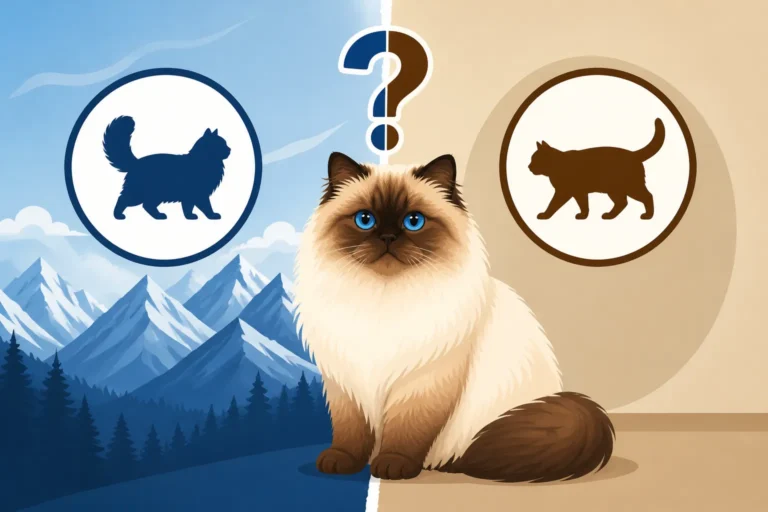
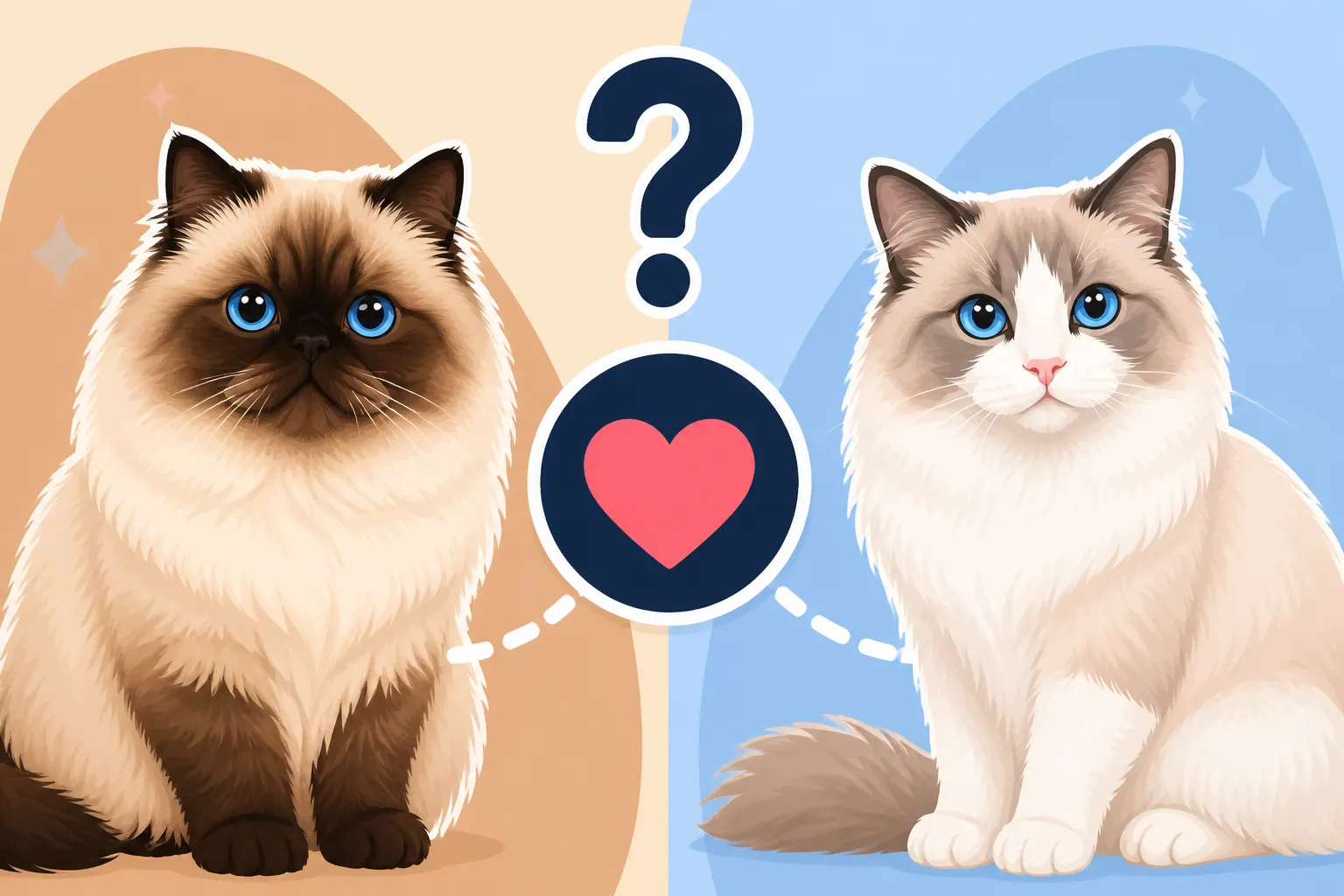
If a Himalayan and a Ragdoll both have blue eyes, pale coats, and darker faces, it is easy to assume one breed came from the other. They do share a pointed color pattern, but that resemblance does not establish close family ties. This guide separates their documented breed histories from the genetic trait they have in common, then explains how to tell the cats apart.
Are Himalayan cats and Ragdolls related?
They share a look, not a documented direct ancestry
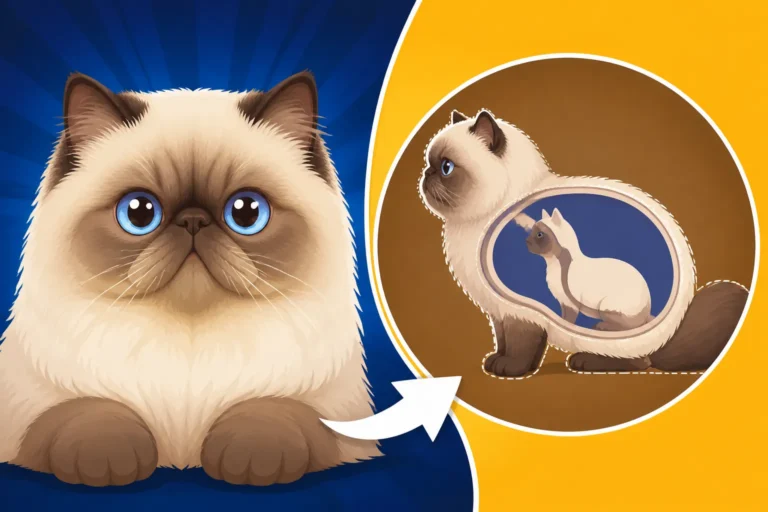
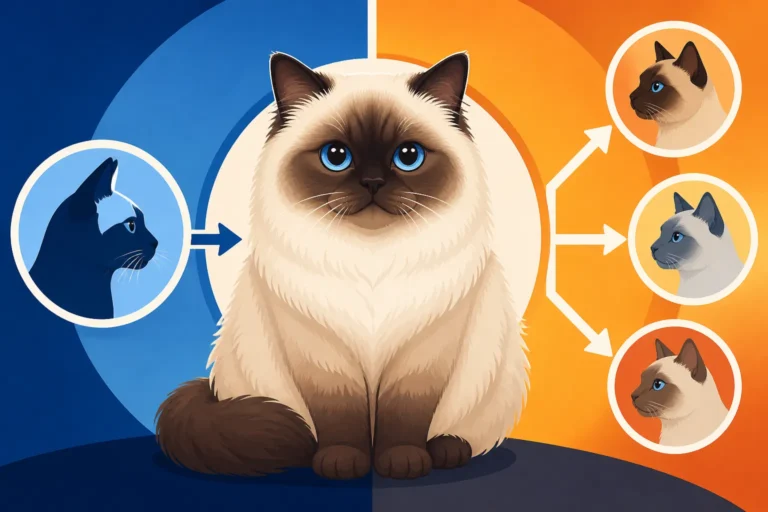
A Himalayan is generally understood as a Persian-type cat with the colorpoint pattern. The breed’s development involved crossing Persians with Siamese cats, then selecting for the Persian’s long coat and body type alongside the Siamese-associated points. The history is covered in Why Harvard Crossed a Persian With a Siamese to Make the Himalayan and Why a Himalayan Is a Persian With the Point Gene.
Ragdolls are a separate breed developed in the United States in the 1960s. Their early breeding history is associated with Ann Baker and a foundation cat named Josephine, followed by a developing line of cats selected for the Ragdoll’s size, coat, coloring, and temperament. The precise background of some early cats is not fully documented, so claims that Ragdolls descend directly from Himalayans should be treated cautiously. There is no established breed history showing that the Ragdoll was created from the Himalayan.
That distinction can get blurred because breed histories sometimes mention similar-looking cats or breeds with overlapping features. A shared appearance, a similar name for a coat pattern, or an uncertain detail in an early pedigree is not the same as evidence of direct descent. In practical terms, Himalayans and Ragdolls are separate breeds with different recorded development.
They do share the pointed color pattern
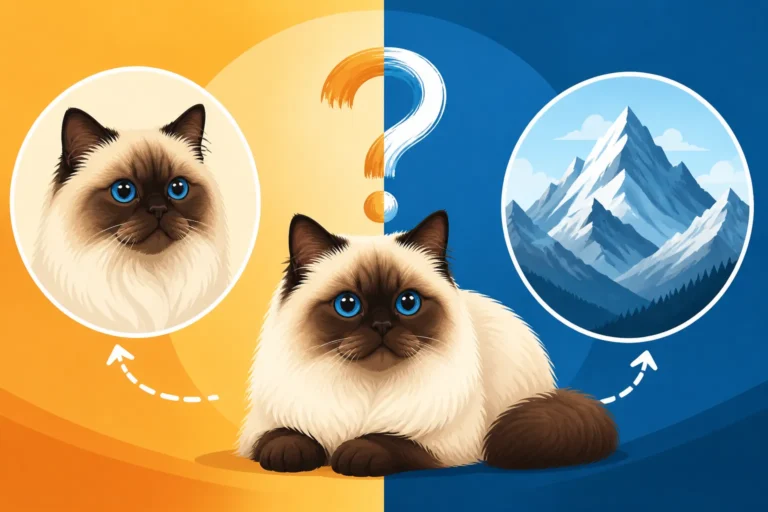
The strongest connection between the breeds is their pointed coloring. In a pointed cat, pigment develops more strongly in the cooler parts of the body, such as the face, ears, legs, and tail. The warmer trunk usually remains paler. The pattern is temperature-sensitive and is associated with blue eyes.
The colorpoint gene is found in multiple cat breeds, so its presence in both a Himalayan and a Ragdoll does not mean those cats belong to the same family line. It is more like a shared inherited feature that can appear in different breeds. A Himalayan’s pointed appearance is part of its Persian-type breed identity; in a Ragdoll, points are one of the breed’s recognized coat patterns.
| Feature | Himalayan | Ragdoll |
|---|---|---|
| Breed background | Persian-type cat developed with Siamese-associated points | Separate breed developed in the United States |
| Shared feature | Pointed coat pattern and blue eyes | Pointed coat pattern and blue eyes |
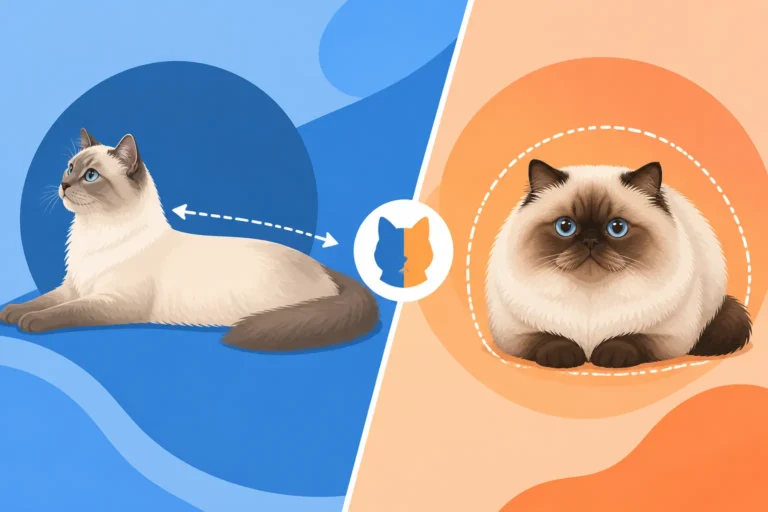
| Typical build | Compact, rounded, and cobby | Larger, longer-bodied, and more substantial |
| Coat | Long, dense Persian-type coat | Semi-long coat, often with less dense undercoat |
| Common distinguishing feature | Persian-style head and short muzzle, though facial profiles vary | Larger frame and distinctive pattern options, including mitted and bicolor |
Both cats can be affectionate companions, and individuals vary widely. The table describes common breed traits, not a guarantee about any particular cat.
Why do people mistake one for the other?
Blue eyes and dark points create an immediate resemblance
When people see a longhaired cat with a pale body, dark face and tail, and blue eyes, they often identify it by the overall color pattern before noticing the body shape or coat texture. That quick impression is understandable: the shared points are visually striking, and a fluffy coat can make two cats look even more alike in a photo.
The resemblance is especially strong in pictures taken from the front, where it may be hard to judge body length, head shape, or the way the coat lies. A kitten’s colors can also look less defined than an adult’s, making identification from a casual photo less certain. The pointed coat develops over time, as explained in How a Himalayan’s Points Are Judged.
There are differences in the range of coat patterns, but color alone is not a reliable shortcut to ancestry. Ragdolls are commonly associated with colorpoint, mitted, and bicolor patterns. Himalayans are recognized for point colors on a Persian-type cat. There can be variation in how breed organizations describe and register these cats, so a label in an informal listing may not tell you the whole story.
Body shape and coat texture offer better clues
A Himalayan typically has the compact, rounded look associated with Persians: a broad body, short legs, and a full coat that can make the cat appear even rounder. The face varies among individual cats and breeding lines. Some have a more moderate profile, while others have a flatter one. For more on the contrast in body shape, see Why a Ragdoll Is Longer and a Himalayan Rounder.
Ragdolls are generally larger and longer-bodied, with a substantial frame. Their coat is semi-long and can look full around the neck and tail, but it often lies differently from the thick Persian-type coat of a Himalayan. Coat condition, age, season, and grooming can all affect what you see, so one feature should not decide the identification by itself.
A useful way to compare the two is to look at the whole cat rather than just the face or color: body length, leg length, head shape, coat density, and pattern. Even then, appearance can only suggest a breed. A pedigree or reliable records are what support a claim that a cat belongs to a particular breed.
What their shared pattern does and does not tell you
The colorpoint gene is not a family tree
The pointed pattern explains why the two breeds can look related without establishing that they share close ancestry. A genetic trait can occur in many populations. Its presence in two breeds shows that the trait is part of both breeds’ genetic makeup; it does not, on its own, show when or how one breed descended from another.
It helps to separate three questions: Does the cat have points? What breed does its documented pedigree identify? And what is known about that breed’s development? The first question can often be answered by looking. The others require records and a clear account of the cat’s lineage.
The same distinction matters when reading online breed descriptions. Retailer listings, adoption posts, and search results may use familiar labels to describe a cat’s appearance. A Himalayan-looking cat is not automatically a registered Himalayan, and a blue-eyed pointed cat is not automatically a Ragdoll. Breed labels on shopping or information sites, including Chewy, can help someone find general breed-related information, but they should not be treated as proof of a cat’s pedigree.
Blue eyes are part of the pointed look in both breeds
Blue eyes are closely associated with the colorpoint pattern because of how pigment develops in these cats. That familiar blue-eyed appearance adds to the impression that Himalayans and Ragdolls are closely connected. It is still a shared trait rather than evidence of direct descent. The Himalayan’s breed standard and eye requirements are discussed in Why Only Blue Eyes Are Allowed on a Himalayan.
Eye color alone also cannot confirm breed identity. When you are assessing a cat, consider its records, body type, coat, and overall characteristics together. If the question matters for a breeder agreement, registration, or health history, ask for the original documentation rather than relying on a photo or a verbal description.
A cat’s appearance does not determine every health concern, either. Breed-associated risks and recommended screening are separate questions from whether two breeds are related. If you are researching a Himalayan’s background, Which Diseases a Himalayan Inherits From Each Parent Breed explains why its Persian and Siamese influences are relevant to health discussions. A Ragdoll’s health history should be assessed on its own terms rather than assumed to match a Himalayan’s.
How to identify a cat without relying on a guess
Check pedigree and registration records
If you are considering a kitten or an adult cat advertised as a Himalayan or Ragdoll, ask the breeder or organization what documentation supports that description. A pedigree can show recorded ancestors, while registration paperwork identifies how a particular organization classifies the cat. The wording may differ between registries, so it is worth asking what the document means rather than assuming every organization uses the same breed label.
You can also ask for the parents’ names and records, and for an explanation of how the litter’s breed designation was determined. A careful breeder should be able to discuss the parent cats and provide relevant records without relying solely on a kitten’s coloring. For a broader checklist, see What a Himalayan Buyer Should Ask About Registration.
Be alert to listings that make a confident breed claim but offer no supporting information. A photo may show a pointed longhaired cat, but it cannot establish a pedigree. Likewise, searching a retailer such as Chewy for a breed name may turn up general care products or educational material, but product categories do not verify ancestry. When a specific breed identity matters, prioritize records from the breeder or registry.
Compare traits, then confirm with records
For a first visual comparison, look at the cat’s build and coat as well as its coloring. A compact, round-bodied cat with a dense Persian-style coat may fit the general Himalayan type. A larger, longer-bodied cat with the characteristic Ragdoll appearance may fit the Ragdoll type. But breed traits overlap, and individual cats do not always match a simple description.
If the cat is a rescue or its paperwork is missing, it may be most accurate to describe it as a pointed longhaired cat rather than assigning a breed with certainty. That is not a slight to the cat; it is simply an honest distinction between appearance and documented ancestry. A veterinarian or knowledgeable breed organization may help you understand physical traits, but appearance alone cannot reconstruct an undocumented pedigree.
For day-to-day care, use the cat in front of you as your guide. A long coat may need regular combing whether the cat is a Himalayan, a Ragdoll, or a mixed-breed companion. Chewy and other pet-supply retailers may offer grooming tools, but choose a comb and routine based on the cat’s coat condition and tolerance, not just a breed label. If the coat mats or the cat resists handling, a groomer or veterinarian can help you plan a comfortable approach.
The most accurate answer is that Himalayans and Ragdolls are not established as directly related breeds, even though they share the pointed pattern, blue eyes, and a longhaired appearance. Their distinct breed histories and typical body types are more useful clues than color alone. If you are deciding what a particular cat is, use appearance as a starting point and documentation as confirmation.
Disclaimer
This article is for general informational purposes only and does not constitute professional advice. Laws, prices and regulations vary by location and change over time. Consult a qualified professional for guidance on your specific situation.