Why an Exotic Shorthair Has a Himalayan’s Face Without the Coat
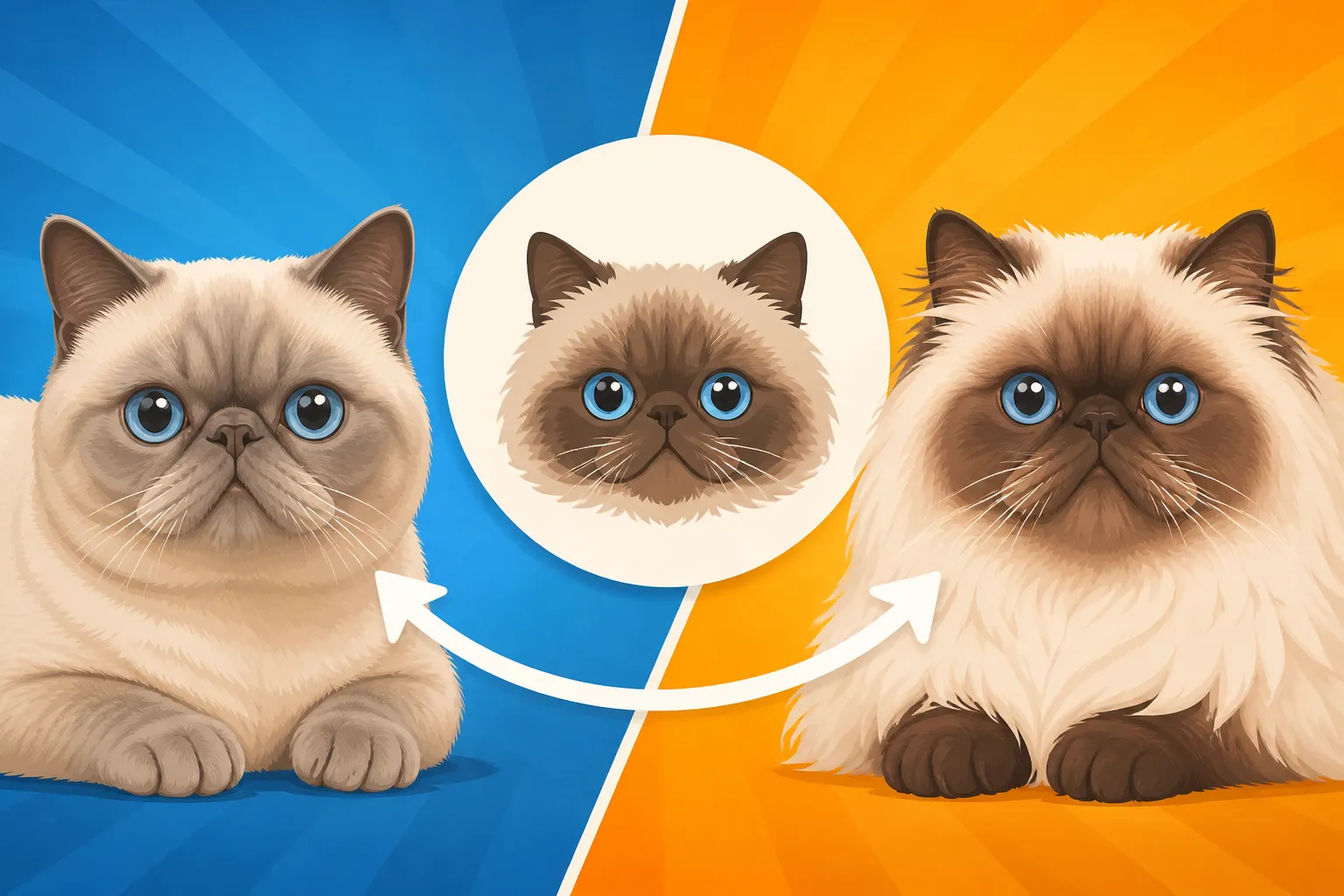
It's easy to look at an Exotic Shorthair and a Himalayan cat and be struck by their incredible similarities, particularly that distinct, endearing flattened face. Yet, you're also immediately aware of their most obvious difference: one boasts a flowing, luxurious long coat, while the other sports a surprisingly plush, yet short, dense fur. This guide is here to untangle that fascinating genetic connection, explaining precisely why the Exotic Shorthair shares the Himalayan's iconic facial structure, but without the extensive grooming demands of a long coat.
The Himalayan's Legacy: A Foundation for the Flattened Face
The Himalayan cat, with its stunning color points and magnificent long fur, holds a special place in the history of feline breeding. But beyond its undeniable beauty, the Himalayan played a foundational role in establishing a specific facial type that would later be shared by other breeds, most notably the Exotic Shorthair. This journey began with a very deliberate, scientific intention, long before the Himalayan was recognized as a breed in its own right.
The Genesis of the Himalayan Look
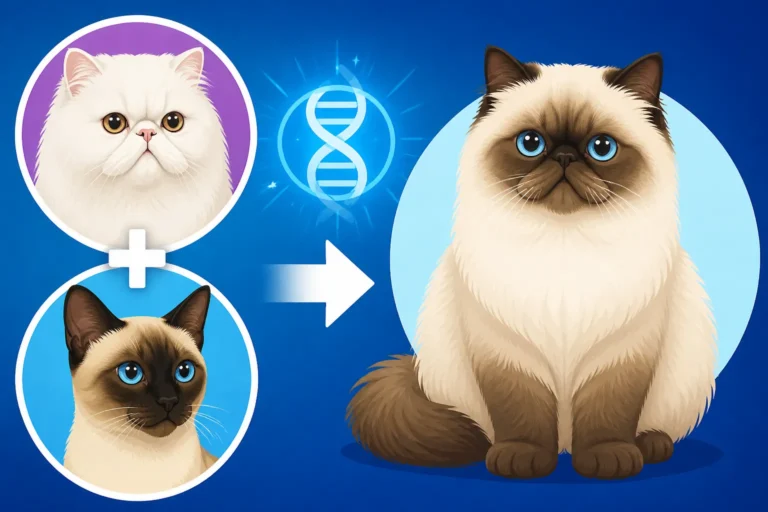
Imagine the meticulous work of breeders and geneticists back in the 1930s. Their goal wasn't just to create a pretty cat; it was to understand how specific traits were inherited. The Himalayan was essentially created by crossing a Persian, renowned for its luxurious coat and often distinctive facial structure, with a Siamese, known for its striking blue eyes and point coloration. The very first crosses that eventually led to the Himalayan were attempts to bring the Siamese 'point' gene into the Persian gene pool, but these experiments also inadvertently emphasized certain Persian features. You can read more about this fascinating origin story in The Himalayan Was Made at Harvard in the 1930s.
Over generations, as breeders worked to stabilize the point coloration and the Persian coat type, they also selected for the round, expressive eyes and the shortened, flattened muzzle that is characteristic of the modern Persian. The Himalayan, being essentially a colorpoint Persian, inherited and further solidified this 'brachycephalic' (short-headed) facial structure. This wasn't always the extreme 'Peke face' we sometimes see today, but the preference for a rounder head and a shorter nose was firmly established in the breed's development.
What the Himalayan Cat Brought to Breeding
The Himalayan, through its development, served as a crucial genetic bridge. It proved that the colorpoint gene could be successfully combined with the Persian's long, flowing coat and cobby body type. More than that, it brought a robust genetic package that included the predisposition for that distinctive flattened face. Every trait, from the lush fur to the endearing personality and yes, the specific head shape, was being carefully woven into the breed standard.
This meant that when other breeders looked to introduce or enhance certain traits in their developing lines, the Himalayan became a valuable resource. It wasn't just about the color; it was about the entire "Persian package" – including the face. So, when the idea arose to create a cat that had the Persian's charm and looks, but with a more manageable coat, the Himalayan's genetic blueprint for facial structure was already a well-established and successful model. It really set the stage for what was to come.
Understanding the Exotic Shorthair's Origins
The Exotic Shorthair is often lovingly referred to as "the lazy person's Persian," and for good reason! This breed offers all the charm, placid temperament, and distinctive facial features of a Persian or Himalayan, but wrapped in a coat that demands significantly less daily grooming. To understand how they ended up with a Himalayan's face, we need to delve into their own unique, yet interconnected, history.
The Happy Accident of the Shorthaired Persian
The story of the Exotic Shorthair isn't quite as deliberate as the initial scientific quest that brought us the Himalayan. Instead, it was more of a "happy accident" that occurred in the late 1950s and early 1960s. American Shorthair breeders, aiming to improve the body type and eye color of their own lines, began outcrossing to Persians. The goal was to introduce the Persian's heavy bone, round head, and rich eye color into the American Shorthair, which at the time was perhaps a bit too lean and angular for some tastes.
However, these crosses produced kittens that, while possessing the desired body and head shape, also inherited the Persian's distinctive flattened face. And, quite unexpectedly, some of these kittens also carried a gene for a short, dense coat. These short-haired offspring from Persian-American Shorthair crosses were, in essence, Persians with short hair. They had the round heads, broad faces, small ears, and large, round eyes that were so characteristic of the Persian type – and by extension, the Himalayan's face – but without the flowing mane. Recognizing the potential for a new breed, these unique cats were eventually given their own classification: the Exotic Shorthair. It truly highlights how quickly certain genetic traits, like facial structure, can be passed on and become dominant in a new lineage.
Early Breeding Goals and Facial Structure
Once the potential for the Exotic Shorthair was recognized, breeders began to refine the lines. Their primary goal was to create a cat that mirrored the Persian standard in every way except coat length. This meant actively selecting for the Persian's cobby body, short, thick legs, and most importantly, that brachycephalic facial structure. They wanted the same large, round, expressive eyes, the small, rounded ears set low on the head, and the short, broad nose that creates the 'peke-face' or 'doll-face' look. What a Doll Face Himalayan's Profile Measures touches on these facial characteristics.
The genetic foundation for this facial type was already well-established within the Persian and Himalayan lines they were drawing from. By continuously breeding for these specific aesthetic traits, the Exotic Shorthair quickly developed a face that was virtually indistinguishable from its long-haired cousins. It really was about isolating the "Persian look" and combining it with a short coat, rather than reinventing the wheel. This intense focus on conformation meant that any health considerations related to the flattened face, which were already present in the parent breeds, would naturally be carried over to the Exotic Shorthair.
The Shared Genetic Blueprint for Facial Type
It's truly fascinating how genetics work, isn't it? When you see an Exotic Shorthair next to a Himalayan, their faces often look like mirror images, despite their very different fur. This isn't a coincidence; it's a direct result of their shared genetic heritage and the specific traits that breeders have diligently selected for over decades.
Inheriting the Brachycephalic Trait
The key to understanding their shared face lies in the term "brachycephalic." This refers to a head shape characterized by a short, broad skull, which results in a flattened face. This trait is common in certain dog breeds (like Pugs and Bulldogs) and, critically, in the Persian cat and its colorpoint variant, the Himalayan. When Exotic Shorthairs were developed by crossing Persians with American Shorthairs, they inherited the genes responsible for this brachycephalic structure directly from their Persian ancestors. It wasn't something new that developed in the Exotic Shorthair; it was a handover of existing genetic information.
Breeders of both Himalayans (as a division of Persians) and Exotic Shorthairs aimed for a consistent "type." This meant seeking out cats with a very specific look: a round head, full cheeks, a short, broad nose, and large, round eyes set far apart. This type became highly prized in the show ring, and continuous selection for these characteristics cemented the brachycephalic trait in both breeds. This is why when you look at the profile of a show-quality Exotic Shorthair, you'll see the same deep stop between the forehead and the nose, and the same broad, strong jaw as you would in a show-quality Himalayan. In essence, the Exotic Shorthair got its face because breeders explicitly wanted the "Persian face" in a short-haired cat. This pursuit of a particular aesthetic often leads to traits becoming more pronounced, as can be seen in Why Show Himalayans Drifted Toward the Flatter Face.
Why the Same Facial Challenges Persist
Because the Exotic Shorthair inherited the same brachycephalic facial structure as the Himalayan and Persian, it naturally comes with a similar set of anatomical challenges. These aren't necessarily "problems" for every individual cat, but they are common considerations that owners need to be aware of. The shortened nasal passages, for instance, can lead to noisy breathing, especially when the cat is excited or warm. This is why you might hear an Exotic Shorthair snore or make little snorting sounds, much like a Himalayan. How a Vet Grades a Himalayan's Nostrils delves into this in detail.
Another common issue is tear staining. The flattened face often means that the tear ducts are either kinked or too short, preventing proper drainage of tears. These tears then spill over onto the fur around the eyes, leading to those familiar reddish-brown stains, particularly noticeable on lighter-colored cats. Dental overcrowding is also a frequent concern. The jawbone is shortened, but the cat still has the full complement of teeth, leading to them being tightly packed, rotated, or misaligned. This can contribute to dental disease earlier in life. How a Shortened Jaw Crowds a Himalayan's Teeth explains this problem well. Owners of both breeds quickly learn that regular veterinary check-ups and specialized care are essential to manage these inherited characteristics, and they often find great products to assist with these issues on sites like Chewy.
The Crucial Difference: Coat Length and Its Impact
While the facial similarities between a Himalayan and an Exotic Shorthair are striking, their coats represent the single most significant difference between the two breeds. This difference, though seemingly superficial, has profound implications for daily care, lifestyle, and even how a cat interacts with its environment.
The Convenience of the Shorter Coat
For many potential cat owners who adore the Persian/Himalayan look but dread the thought of daily, intensive grooming, the Exotic Shorthair is an absolute dream come true. Their short, dense, plush coat is incredibly easy to maintain by comparison. It's often described as feeling like velvet or a thick teddy bear. This coat, while thick, doesn't tend to mat or tangle with the same ferocity as a Himalayan's long, fine hair. A weekly brush is usually sufficient to remove loose hairs and keep the coat in pristine condition, a stark contrast to the daily commitment required for a long-haired Persian or Himalayan.
This ease of grooming translates into more time for play and cuddles, and less time wrestling with a comb or dealing with frustrating mats. It also means less loose hair around the house, which is a major bonus for many families. For someone with a busy schedule or who simply prefers not to spend a significant portion of their day on grooming, the Exotic Shorthair offers the beautiful aesthetics without the high-maintenance upkeep. It truly is the epitome of "low-maintenance luxury" in the feline world, something many pet parents prioritize when considering a new family member.
Grooming Realities: Himalayan vs. Exotic Shorthair
Let's get real about grooming for a moment. Owning a Himalayan cat means committing to a serious daily routine. Their long, flowing double coat, with its fine texture, is a magnet for tangles, mats, and dander. If you miss a day, or even a few hours, you can quickly find yourself dealing with stubborn knots, particularly in areas like the armpits, behind the ears, and in the "britches" around their hind legs. Many owners find themselves on first-name terms with their groomer or vet for lion cuts or sedated dematting sessions because the task can become overwhelming. What Daily Combing Costs a Himalayan Owner in Time isn't just about money; it's about the time and dedication involved.
An Exotic Shorthair, on the other hand, requires a far more relaxed approach. A quick brush a few times a week with a slicker brush or a good quality steel comb – easily found at a pet supply store like Chewy – is generally all that's needed to keep their coat healthy and shed-free. This doesn't mean no grooming, mind you. They still shed, and regular brushing helps to distribute natural oils and prevent excessive hair ingestion, which can lead to hairballs. But the difference in time commitment and potential for coat catastrophes is vast. For those who adore the Persian face but aren't prepared for the extensive coat care, the Exotic Shorthair truly delivers a much more manageable experience.
Living with an Exotic Shorthair: Perks and Considerations
Bringing any pet into your home is a big decision, and it's essential to understand the unique characteristics and needs of the breed you choose. Living with an Exotic Shorthair is often a delightful experience, but their shared facial structure with Himalayans means some specific care routines and considerations are important for their well-being.
Daily Care for a Flat-Faced Shorthair
Just like their long-haired Himalayan cousins, Exotic Shorthairs need daily facial care. Their large, round eyes and flattened noses mean that tears often don't drain properly through the tear ducts. Instead, they well up and spill over, leading to tear stains and sometimes dampness in the nose folds. This dampness, if not managed, can become a breeding ground for yeast or bacterial infections, causing skin irritation and an unpleasant odor.
Therefore, a crucial part of their daily routine involves gently wiping their faces, especially around the eyes and nose fold, with a soft, damp cloth or specialized pet-safe wipes. Many owners find reliable facial wipes or tear stain removers readily available from online pet supply stores such as Chewy. It's not a lengthy process, but it needs to be consistent to keep them clean, comfortable, and healthy. Think of it as a quick morning splash and wipe for your feline friend. Additionally, because of their shortened jaws, dental hygiene is paramount. Regular tooth brushing with a pet-specific toothpaste, ideally starting from kittenhood, can help mitigate future dental issues. Why a Himalayan Needs Dentals Earlier Than a Siamese offers valuable insights that apply equally to Exotic Shorthairs.
Health Implications of the Shared Facial Structure
While the Exotic Shorthair's short coat offers grooming advantages, it doesn't eliminate the health considerations that come with their brachycephalic face. These cats share many of the same potential health challenges as Himalayans and Persians due to their inherited facial structure. Respiratory issues can be a concern, ranging from mild snoring to more significant breathing difficulties if their nostrils are too narrow or their soft palate is too long. They may overheat more easily in warm weather or during strenuous play because they can't cool themselves as efficiently through panting.
Another significant inherited concern is Polycystic Kidney Disease (PKD). This is a genetic condition prevalent in Persian lines, from which both Himalayans and Exotic Shorthairs descend. Responsible breeders will genetic test their breeding cats for PKD to ensure they are not passing on this gene. If you are considering an Exotic Shorthair, always ask for proof of PKD testing for the parents. Which Two Certificates a Himalayan Breeder Owes You is a relevant read here. Other concerns might include eye issues like entropion (inward-rolling eyelids) or excessive tearing leading to skin irritation. Regular veterinary check-ups are essential to monitor for these conditions and address them promptly. Knowing these potential issues ahead of time helps you provide the best possible care for your beloved flat-faced companion.
| Feature | Himalayan Cat | Exotic Shorthair Cat |
|---|---|---|
| Coat Length | Long, flowing, luxurious double coat | Short, dense, plush double coat |
| Grooming Needs | Daily, intensive combing to prevent mats | Weekly brushing, much easier maintenance |
| Facial Structure | Brachycephalic (flat-faced) | Brachycephalic (flat-faced) |
| Eye Shape | Large, round, expressive blue eyes (point gene) | Large, round, expressive eyes (various colors) |
| Temperament | Sweet, docile, quiet, affectionate lap cat | Sweet, docile, playful, affectionate lap cat |
| Ancestry | Persian x Siamese (colorpoint Persian) | Persian x American Shorthair |
| Health Concerns | Respiratory, dental, tear staining, PKD | Respiratory, dental, tear staining, PKD |
Deciding Between a Himalayan and an Exotic Shorthair
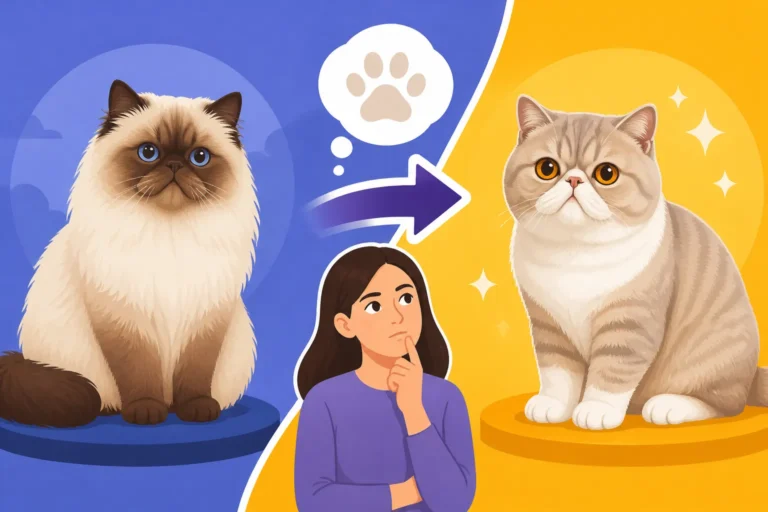
Choosing between a Himalayan and an Exotic Shorthair can be a delightful dilemma, especially if you're drawn to that beautiful, distinctive flat face. Both breeds offer immense love and companionship, but their subtle differences, primarily concerning their coats, can make one a better fit for your lifestyle than the other. It's about aligning your expectations with their needs.
What a Prospective Owner Should Consider
The most obvious factor is, of course, the coat. Are you prepared for the daily commitment of grooming a long-haired cat? A Himalayan's magnificent coat requires significant time and effort to keep it free of mats and looking its best. If the thought of daily brushing, dealing with occasional tangles, and potential professional grooming appointments fills you with dread, then the Exotic Shorthair is likely your ideal choice. Their easy-care coat is a major draw for busy individuals or those who simply prefer a more hands-off approach to grooming. You can learn more about finding the right fit for your home by reading Who the Himalayan Actually Suits.
Beyond grooming, consider your personal preferences for their look. Both share the sweet, docile temperament and the distinctive facial features, but the overall aesthetic is different. Do you dream of a cat with a cloud-like mane and flowing tail, or do you prefer the sleek, plush look of a teddy bear? Think about the climate you live in as well. A Himalayan's dense, long coat can make them more susceptible to overheating in warmer environments, whereas the shorter coat of an Exotic Shorthair might offer a slight advantage in terms of comfort in heat, though both brachycephalic breeds need to be kept cool.
Finding Reputable Breeders for Either Breed
Regardless of whether you choose a Himalayan or an Exotic Shorthair, finding a reputable breeder is paramount. A responsible breeder will prioritize the health and temperament of their cats above all else. They will be transparent about their breeding practices, health testing, and the lineage of their kittens. For both breeds, this means asking about genetic testing for Polycystic Kidney Disease (PKD). A good breeder will be able to provide clear documentation that their breeding cats are PKD negative. Which Two Tests Belong on Every Himalayan Pedigree is an excellent resource for understanding what to look for.
A reputable breeder will also be keen to educate you about the breed's specific needs, including facial care, potential health considerations, and temperament. They will likely ask you questions about your lifestyle to ensure their kittens are going to suitable homes. Avoid breeders who sell kittens too young, don't allow you to visit their cattery, or seem unwilling to discuss health clearances. A well-bred kitten, whether Himalayan or Exotic Shorthair, comes from a breeder who has invested time, effort, and care into ensuring their cats are healthy, well-socialized, and truly exemplify the best qualities of their respective breeds. They might even recommend specific products for care, perhaps even mentioning a trusted retailer like Chewy.
Disclaimer
This article is for general informational purposes only and does not constitute professional advice. Laws, prices and regulations vary by location and change over time. Consult a qualified professional for guidance on your specific situation.