How Many Himalayan Point Colors Exist
A Himalayan’s dark ears, mask, paws, and tail can come in several colors, but the answer to “how many” depends on whether you count color alone or include patterns such as lynx and tortie. This guide explains the commonly recognized point-color groups, how their names differ, and why a kitten’s coat may change as it grows.
How many Himalayan point colors are there
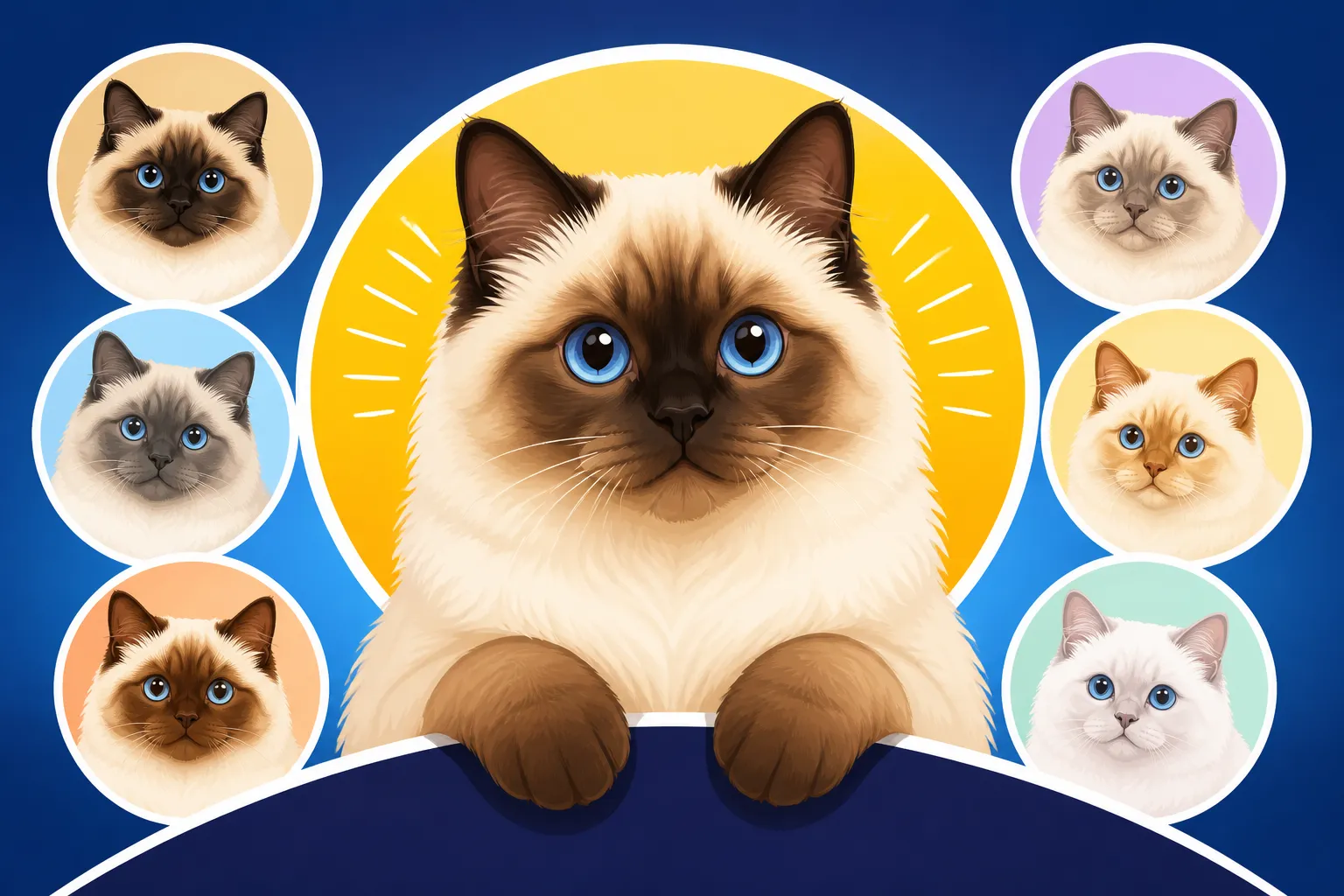
There are ten commonly listed base point-color categories: seal, blue, chocolate, lilac, flame, cream, tortie, blue-cream, chocolate-tortie, and lilac-cream. That is a useful starting count, not a universal total for every registry or color list.
The number grows when you include lynx pattern variations. A seal lynx, for example, has tabby markings in its darker points, while a seal point does not. Some lists count those as additional varieties; others describe lynx as a pattern layered over a color. That’s why one breeder may give a different count from another without either necessarily using the word “color” incorrectly.
The ten commonly listed base colors
| Base point color | Typical appearance on the points |
|---|---|
| Seal | Deep brown to nearly black |
| Blue | Slate blue or cool gray |
| Chocolate | Warm milk chocolate |
| Lilac | Pale, pinkish gray |
| Flame | Orange to red |
| Cream | Soft, pale buff |
| Tortie | A mix of two colors, often with red or cream |
| Blue-cream | Blue-gray mixed with cream |
| Chocolate-tortie | Chocolate mixed with red or cream |
| Lilac-cream | Lilac mixed with cream |
These names describe the colored areas, or “points,” rather than the whole coat. A seal point Himalayan, for instance, usually has a light body with darker brown coloring on its face, ears, legs, and tail. Point shades can look different in person from how they appear in a photo, especially under warm indoor lighting.
Some names describe a single color, while others describe a mixture. Tortie points show patches or flecks of color rather than one even shade. The pattern can vary from cat to cat, so two kittens in the same litter may both be called tortie point but have noticeably different markings.
If you’re comparing a kitten’s possible color with a registry’s list, check the exact terms used by that registry. Which Point Colors the Standard Lists for a Himalayan offers a closer look at how formal color lists are organized.
Why some lists count more than ten
Lynx is the main reason lists can go beyond the ten base categories. A lynx point has visible tabby markings in its points, such as stripes on the legs or a more clearly patterned face. The underlying color still matters: a cat might be described as a blue lynx point or a seal lynx point.
In everyday conversation, people may call each combination a separate color. Under a more precise description, the cat has a point color plus a pattern. This distinction is useful when you are reading a breeder’s description, comparing registry terminology, or trying to identify a kitten. Whether a Lynx Point Himalayan Is Recognized explains why recognition can depend on the registry and its rules.
Tortie and lynx can also make color descriptions feel more complicated. A tortie point has multiple colors in its points; lynx describes tabby patterning. Some combinations may be listed separately, while others may be described using both a color term and a pattern term. So “ten base colors” is a clean count of common color groups, while a total that includes patterns is necessarily broader.
For a simple answer, say that Himalayans have ten commonly listed base point-color categories, with more named varieties when pattern combinations are included. For a specific cat, use the color description on its registration or breeder paperwork rather than assuming every list counts the same way.
What the point colors look like
A Himalayan’s points are the darker areas on the face, ears, legs, and tail. The body coat is generally lighter, though its exact shade and contrast can differ. The point color is easiest to judge in good natural light, and even then, a young kitten’s coloring may not have finished developing.
The main color families
Seal, chocolate, and blue points are often easier to distinguish once the coat has developed. Seal points tend toward dark brown, chocolate points look warmer and lighter, and blue points have a cooler gray cast. Lilac points are typically paler still, with a soft gray-pink impression rather than a deep, dark point.
Flame and cream are warm-toned colors. Flame points can appear orange or red, while cream points are much more muted. A bright phone flash or yellow household lighting can exaggerate or wash out these differences, so it helps to compare photographs taken in similar lighting rather than relying on a single image.
Tortie varieties are less uniform because their points contain a mix of colors. One cat may show clear patches, while another has smaller flecks spread through the darker areas. Whether a Tortie Point Belongs in the Himalayan Division can help clarify how that pattern is treated in breed listings.
The names can sound like a promise of a particular shade, but they are categories, not paint chips. Coat contrast, age, lighting, and the individual cat all influence what your eye sees. A breeder can describe a kitten’s expected color, but a very young kitten may not yet show its finished appearance.
Lynx pattern is not simply another color
Lynx refers to tabby-style markings, not a single shade. A blue lynx point, for example, combines a blue-gray point color with visible tabby patterning. The stripes may be easiest to spot on the legs and tail, while the facial pattern can be more subtle or change in appearance as the kitten grows.
A quick visual check can be misleading. Long fur can blur the edges of markings, and a kitten’s developing coat may not show the same contrast as an adult’s. When comparing cats, look at the points in consistent light and consider the written description alongside the appearance. How a Himalayan’s Points Are Judged explains why point color and pattern are considered separately in evaluation.
For buyers, it is also worth asking how the breeder records the color. A clear description is more useful than a vague label such as “rare” or “special.” How a Himalayan’s Point Color Is Recorded covers the kind of wording you may see on a cat’s records.
Why a Himalayan’s points change as it grows
Himalayans have a temperature-sensitive color pattern. Cooler areas of the body tend to develop darker fur, while warmer areas tend to remain paler. This is why the ears, face, paws, and tail are usually the most noticeably colored parts of the coat.
Kittens begin pale and develop their points
Many Himalayan kittens are born very pale, with little obvious contrast between the body and the points. Their color develops over time, so the kitten you see early on may look quite different from the adult it becomes. The face, ears, paws, and tail can gradually become more defined.
That change can make color identification uncertain in a young kitten. A breeder may have a well-informed estimate based on the parents and the kitten’s emerging coat, but the final appearance takes time to become clearer. Ask what the color is expected to be and how certain that description is, rather than treating an early photograph as definitive.
A kitten’s points may not develop evenly. One area might darken before another, and the body coat may remain pale while the tail or ears become more obvious. This is normal variation in how the pattern appears, not evidence that the cat belongs to a different point-color group. Why Every Himalayan Kitten Is Born Almost White and How Temperature Decides a Himalayan’s Point Color explain the pattern’s development in more detail.
Age, warmth, and coat changes affect appearance
A Himalayan’s color can deepen with age, and changes in coat growth can make the points look different too. Shaved or clipped areas may regrow darker because the new fur grows at a cooler part of the body. The effect can be striking when a pale area is clipped and then comes back in a noticeably deeper shade.
The room temperature can also influence how dark the coat appears over time. This does not mean an owner should try to manage a Himalayan’s color by keeping the home unusually cold. Comfort, safe indoor temperatures, and access to cool resting places matter more than trying to create a particular shade.
If you’re maintaining a pale body coat, regular grooming helps you see the actual color and condition of the fur. A steel comb, a suitable grooming surface, and gentle handling can make coat checks easier. Chewy carries a range of cat grooming supplies, but choose tools for the cat’s coat and your vet or groomer’s guidance rather than selecting a brush based only on a product label. For related color changes, see Why a Shaved Patch Grows Back Dark on a Himalayan.
Choosing and identifying a point color
Color can be part of the appeal when you choose a Himalayan, but it should not be the only thing you assess. A striking mask or an unusual color name does not tell you whether a cat is healthy, comfortable, or well cared for. Give yourself time to ask about the kitten’s background and to understand what the color description actually means.
Questions to ask a breeder
Ask the breeder to explain the kitten’s color in plain language: which areas are expected to darken, whether the points have a pattern, and whether the final shade is still developing. You can also ask how the color is recorded on the kitten’s paperwork and whether the registry uses that same term.
Request photos taken in natural light if you’re comparing kittens remotely. A short video can help you see the kitten moving, but lighting and camera settings still affect coat color. If the color is important to you, compare more than one image and ask the breeder to point out the face, legs, and tail rather than relying on a single close-up.
Be cautious if a seller leans heavily on “rare color” language but cannot explain the kitten’s records or background. A color description should be specific and consistent, not a substitute for clear answers about the cat. Why a Rare Point Color Raises a Himalayan’s Price discusses why color labels can affect buyer expectations.
Keep color in perspective
A Himalayan’s points are fun to notice, but daily care is part of living with the breed. Long fur needs regular combing, and many Himalayans also need routine attention to their face and eyes. If you are putting together basic supplies, Chewy is one place to compare grooming tools and cat-care essentials; check that any product is appropriate for a longhaired cat and safe to use around the face.
When in doubt about stains, irritation, or a sudden coat change, ask a veterinarian rather than assuming it is just a color variation. A damp or discolored area can have causes unrelated to the point pattern. Chewy’s educational materials may help you prepare general care questions, but a veterinarian is the right person to assess an individual cat’s health.
The most useful takeaway is to separate three things: the base point color, any pattern such as lynx or tortie, and the registry’s preferred wording. Once those are clear, the different counts make sense. There are ten commonly listed base point-color categories, while the number of named combinations increases when patterns are included.
Disclaimer
This article is for general informational purposes only and does not constitute professional advice. Laws, prices and regulations vary by location and change over time. Consult a qualified professional for guidance on your specific situation.