Whether a Solid Himalayan Can Exist
A Himalayan with a darkening coat can start to look almost uniform in color, so it’s understandable to wonder whether a truly solid-colored Himalayan can exist. The key is the difference between a cat’s genetic pattern and the way its coat looks: a Himalayan is a colorpoint cat, even when age, temperature, or coat changes make its markings harder to see.
What “solid” means in a Himalayan’s coat
Solid color is a pattern, not just a shade
In cat coat descriptions, “solid” usually means the coat has one overall color without a distinct pattern such as tabby stripes or colorpoint markings. It does not simply mean that the cat looks dark, or that its body fur appears more evenly colored than it did as a kitten.
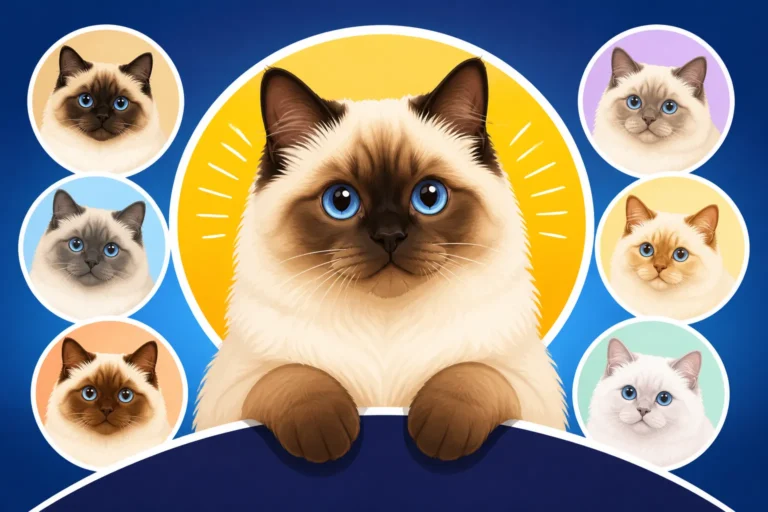
A Himalayan’s defining pattern is colorpoint: the body is generally paler, while the face, ears, legs, and tail—the points—are darker. The exact shade can vary, and the contrast may become subtle, but those darker areas are still part of the cat’s colorpoint pattern. That’s why “solid Himalayan” is usually an informal description of appearance, not an accurate description of the breed’s coat pattern.
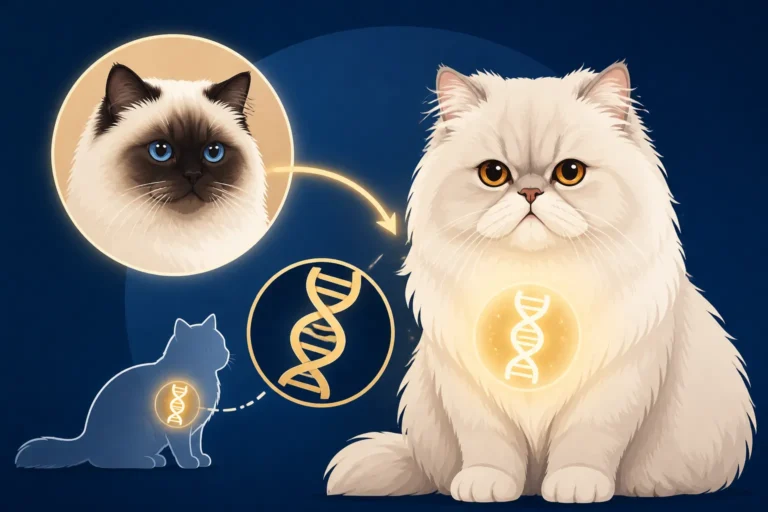
The underlying genetics are the reason. The Himalayan pattern comes from a temperature-sensitive form of pigment production, which is why cooler parts of the body tend to grow darker fur. For more detail on that distinction, see Why a Himalayan Is a Persian With the Point Gene and Why a Himalayan Needs Two Copies of the Point Gene.
Can a Himalayan look solid?
Yes, a Himalayan can look nearly solid at a glance. The body coat may darken as the cat matures, and the contrast between the body and the points may become less obvious. A dark seal-point cat, for example, may have a deep brown mask and a body coat that is no longer a bright, creamy white. In some lighting, the whole cat may appear to be one dark shade.
But looking solid is not the same as being genetically solid. If the face, ears, legs, and tail remain darker than the body—even slightly—the cat still shows the colorpoint pattern. The boundaries can be especially hard to see in a mature cat with a heavily darkened coat or in a room with warm, dim lighting.
A practical check is to compare several areas in natural daylight. Look at the body fur between the shoulders and along the sides, then compare it with the face mask, ears, and tail. A difference may be faint, but a consistent pattern of darker points against a lighter body suggests a colorpoint coat rather than a solid one.
Why the word gets used loosely
Owners, shelters, and online listings may use “solid” casually to describe a Himalayan whose coat has darkened or whose points blend into the body color. It may be an attempt to describe what the cat looks like, rather than a claim about its genetics or pedigree.
That loose wording can cause confusion for potential adopters or buyers. Someone searching for a solid-colored cat might expect one uniform coat, while someone advertising a “solid Himalayan” may simply mean a Himalayan with very low contrast. If coat pattern matters to you, ask for clear photos of the cat’s face, body, legs, and tail in natural light, and ask how the description was determined.
Why a Himalayan’s color can become less distinct
Temperature affects where darker fur grows
The point pattern develops because pigment production is affected by temperature. Cooler parts of the body tend to grow darker fur, while warmer areas tend to remain paler. That’s why the face, ears, paws, and tail are often the most noticeable points on a Himalayan.
A cat’s surroundings and body temperature can influence how pronounced the contrast looks. A Himalayan kept in a cooler environment may develop a darker-looking coat than one living in a consistently warm home. This doesn’t mean the cat has changed from colorpoint to solid; the pattern is still there, though its contrast may shift. How Temperature Decides a Himalayan’s Point Color explains this relationship in more depth.
The same principle helps explain why shaved or clipped areas can regrow darker. A newly regrown patch may look surprisingly different from the surrounding fur, which can make the coat seem uneven or almost solid in places. That appearance is a coat-color effect, not evidence that the cat has lost its Himalayan pattern.
Age and coat changes can blur the contrast
Many Himalayan kittens begin life with very pale coats. Their points become more visible as they grow, and their final appearance develops over time. A young kitten that looks nearly white may later show clear points; an adult may darken further and seem less sharply marked than it once did. For a closer look at that development, see Why Every Himalayan Kitten Is Born Almost White and How Many Years a Himalayan’s Points Take to Finish.
Coat condition can also affect what you see. Long fur, loose undercoat, mats, and seasonal shedding can make the body and points blend together. A clean, carefully combed coat may reveal contrast that was hard to notice beneath loose fur. If you’re comparing photos, try to use images taken in similar lighting and with the coat in similar condition.
It’s also normal for a Himalayan’s appearance to change after clipping, surgery, or other coat regrowth. A clipped patch can grow back darker, and that patch may create an impression of a single, inconsistent color. The pattern is still best judged across the whole cat, not from one patch of fur.
Colorpoint varieties are not the same as solid coats
Himalayans may have different point colors, and some point patterns include additional markings. A lynx point, for instance, has tabby-style markings within the colored points. A tortie point can show mixed colors in the points. These variations affect the look of the markings, but they do not turn the coat into a solid pattern. See Which Point Colors the Standard Lists for a Himalayan and Whether a Lynx Point Himalayan Is Recognized for related details.
| What you notice | What it may mean | Does it make the cat solid? |
|---|---|---|
| Dark face, ears, legs, and tail against a pale body | Typical colorpoint contrast | No |
| Body coat has darkened with age | Reduced contrast between body and points | No |
| A clipped patch regrows darker | Local coat-color change during regrowth | No |
| Tabby markings appear in the points | Lynx-point pattern | No |
| No clear point pattern, but the cat is called a Himalayan | The description may be informal or mistaken | Not enough information to tell |
How to check whether a “solid Himalayan” description is accurate
Look at the whole coat, not one photograph
A single image can be misleading. Indoor lighting, camera exposure, shadows, and a thick coat can make a colorpoint cat appear more uniform than it is. Ask for several recent photos that show the full body, face, legs, and tail. Daylight is useful because it makes subtle differences between the body coat and points easier to see.
If you’re meeting the cat in person, look for the pattern in more than one place. A face mask alone may be easy to spot, but the ears, legs, and tail can offer additional clues. The body coat may not be pale white, particularly in a mature cat, so compare shades rather than expecting a stark contrast.
Avoid making a decision from a clipped patch or a small area of fur. If you have concerns about coat color, ask a veterinarian or a knowledgeable breeder to describe what they see. A coat description is not a health diagnosis, but an experienced eye may help distinguish a darkened colorpoint coat from a listing that uses “Himalayan” imprecisely.
Ask for pedigree or genetic information when it matters
If you are choosing a kitten or trying to confirm a cat’s background, ask the breeder or rescue for the information they have about the parents and the cat’s registration. A pedigree can help explain whether the cat comes from colorpoint lines, while a genetic test may help identify whether particular coat-color alleles are present. A test result should be interpreted alongside the cat’s appearance and documented background, rather than treated as a substitute for either.
A Persian can carry the point gene without visibly showing the Himalayan pattern, which is one reason parentage and coat descriptions can be confusing. How a Persian Can Carry the Himalayan Gene Hidden and Whether Two Persians Can Produce a Himalayan explain why a cat’s visible coat does not always tell the entire genetic story.
When reviewing paperwork, check that the name used for the coat variety matches the registry or organization that issued the document. Breed and variety labels can differ between registries, and everyday descriptions may not match official terminology exactly. If you’re adopting from a rescue, the cat’s history may be incomplete; in that case, it’s more honest to treat “Himalayan” as a reported description unless there is documentation to support it.
Keep routine care separate from coat-color claims
A dark or pale coat does not, by itself, tell you whether a cat is healthy or whether its grooming needs are different. Himalayans need regular attention to their long coats, regardless of whether their points are high-contrast or appear to blend into the body. If you’re assembling a basic grooming kit, retailers such as Chewy may offer common supplies like combs, but choose tools that suit the cat’s coat and introduce grooming patiently.
For a cat whose fur is hard to keep untangled, focus on gentle, frequent combing rather than trying to change its color or force a particular appearance. A retailer such as Chewy can be one place to compare grooming basics, though a veterinarian or professional groomer can advise you if the coat is matted or the cat resists handling. Never cut a tight mat close to the skin at home; a cat’s skin can be pulled up into the mat and injured.
If you are shopping for food, bowls, or grooming items through Chewy or another retailer, remember that those purchases do not confirm a cat’s breed or coat genetics. The most useful evidence for a “solid Himalayan” claim is still the cat’s overall pattern, reliable background information, and—when needed—appropriate genetic guidance.
The clearest answer
A true solid coat does not fit the usual Himalayan pattern
A Himalayan is generally recognized by its colorpoint pattern, not by having one uniform coat color from head to tail. A cat that appears solid may be a very dark or low-contrast colorpoint, may have a coat that has changed with age or regrowth, or may have been described informally. Appearance alone can’t always settle the question.
If the cat has no visible difference between its body and points, don’t assume the label is correct or incorrect based only on a photo. Ask how the cat was identified, review any available records, and consider professional help if the answer matters for registration, breeding, or a purchase decision.
Use precise language when describing the cat
When a Himalayan’s coat is dark overall, phrases such as “very dark colorpoint,” “low-contrast colorpoint,” or “points blend into the body coat” are usually clearer than “solid Himalayan.” They describe what you can see without suggesting that the cat has a coat pattern that conflicts with the usual Himalayan definition.
That distinction is useful whether you’re speaking with a breeder, rescue, veterinarian, or fellow cat owner. It prevents misunderstandings and keeps the focus on what can be observed: the cat’s color, pattern, coat condition, and documented background. A Himalayan can certainly look nearly solid, but that appearance does not usually make it a genetically solid-colored cat.
Disclaimer
This article is for general informational purposes only and does not constitute professional advice. Laws, prices and regulations vary by location and change over time. Consult a qualified professional for guidance on your specific situation.