Why Show Himalayans Drifted Toward the Flatter Face
It’s a sight many of us have become familiar with – the incredibly flat face of a modern show Himalayan cat. You might find yourself wondering how these beautiful felines came to have such distinctive, almost pushed-in profiles, a look that can be both endearing and, at times, a cause for concern. This comprehensive guide will delve into the fascinating and sometimes challenging journey of how show Himalayans drifted towards this flatter facial structure, exploring the historical context, the influences of the show ring, and the health considerations that have emerged along the way.
Understanding the Himalayan's Unique Facial Structure
When we talk about the Himalayan cat, we're really talking about a Persian in a point-colored coat. The breed was developed by crossing Persians with Siamese cats, aiming to combine the Persian's plush coat and docile temperament with the Siamese's striking color points. This unique origin story inherently set the stage for a specific facial structure, drawing heavily from its Persian lineage.
The Original Himalayan Look: Doll Face vs. Peke Face
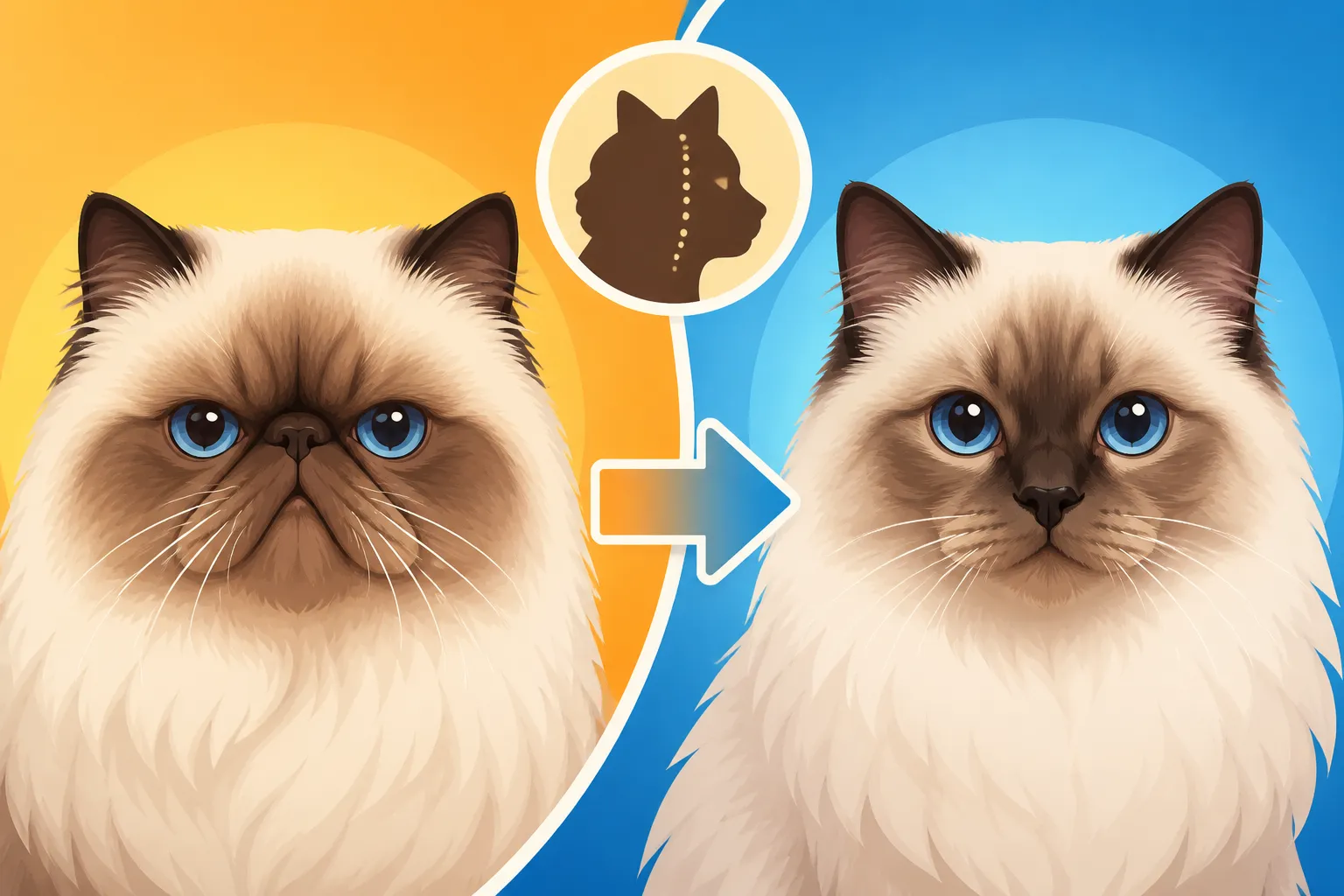
In the early days of the Himalayan, there wasn't the extreme flatness we often see today. Instead, there was a range, commonly categorized as "doll face" and "peke face." The "doll face" Himalayan, often considered the more traditional look, featured a sweet, open expression with a visible nose that sat slightly below the eyes, and a gentle slope to the forehead. Think of it as a softer, more moderate version of the Persian facial type. These cats still had a full, round head, but their features were more balanced and less compressed. Many enthusiasts still prefer this classic appearance, appreciating its elegance and often associating it with fewer health complications. If you're curious about the specifics, you might want to read more about What a Doll Face Himalayan's Profile Measures.
Then there was the "peke face," named after the Pekingese dog breed, which already had a history of flattened faces. This profile was a step towards a flatter look, characterized by a shorter, slightly indented nose that was more in line with the eyes. While still distinct from today's extreme types, the peke face introduced a degree of brachycephaly (short-headedness) that would become more pronounced over time. Both types were present in the early breed, showcasing the genetic variability and the different directions breeders could take. The journey from these initial types to the modern show face is a testament to selective breeding and evolving aesthetic preferences within the cat fancy. To fully grasp the distinction, exploring What a Peke Face Himalayan's Profile Measures can provide valuable insights.
The Influence of the Persian Standard
The most significant driver behind the Himalayan's facial evolution is undeniably its close relationship with the Persian breed standard. When the Himalayan was first developed and recognized, it was often shown and eventually absorbed into the Persian breed in many registries, notably the CFA (Cat Fanciers' Association). This meant that Himalayans were judged against the same standard as their solid-colored Persian cousins.
The Persian standard, over many decades, began to favor an increasingly extreme facial type. The ideal became a broad, round head with small, low-set ears, full cheeks, and most critically, a short, snub nose with a "break" (an indentation) between the eyes. This "break" eventually became a demand for the nose leather (the visible part of the nose) to be entirely flat or even indented between the eyes, with the top of the nose aligned with the bottom of the lower eyelid. This emphasis on a "flat" or "pushed-in" look in the Persian standard naturally extended to the Himalayan. As breeders strived to produce cats that would excel in the show ring, they selected for these increasingly exaggerated features, leading the Himalayan's face to become progressively flatter, mimicking the winning Persian profile. The standard, while aiming for beauty, inadvertently guided breeders towards a conformation that prioritized aesthetics over some practical considerations.
The Shift in Show Ring Preferences
The show ring is a powerful force in shaping breed aesthetics. What wins championships often becomes the blueprint for future breeding, and for Himalayans, the allure of the flatter face in competition was undeniable.
What Judges Started Looking For
Initially, judges appreciated the balance and symmetry of a doll-faced Himalayan. However, as the Persian standard began to emphasize the "extreme" or "ultra-typed" look, judges in the Himalayan division, which was often considered a colorpoint division of the Persian, followed suit. The pursuit of the perfect "Persian type" meant rewarding cats with increasingly rounded heads, tiny ears that almost disappeared into the ruff, and critically, that very flat, broad nose with the prominent "break." This specific look was seen as the epitome of the breed's refinement and distinction.
It wasn't just about flatness; it was about the overall proportion and density of the head. Judges sought a substantial, cobby body with short, heavy boning, complementing the massive, round head. The flatter face became a key component of this overall desired "type." This meant that kittens born with slightly flatter noses, or with a more pronounced "break" in their profile, would often be chosen for showing and breeding over those with a more traditional doll face. This selective process, driven by the desire for show success, created a strong pressure on breeders to move away from the moderate faces of the past. The definition of a "beautiful" Himalayan subtly, but surely, began to shift.
The "Extreme" or "Ultra-Typed" Aesthetic
The term "extreme" or "ultra-typed" perfectly captures the direction that show Himalayans, and Persians in general, took. This aesthetic is characterized by a face that is not just flat, but often appears almost concave between the eyes, with the nose leather sitting extremely high, sometimes even above the level of the eyes. The goal was to achieve a completely open, round face when viewed head-on, with every feature contributing to this circular appearance. The chin, too, became part of this extreme type, needing to be deep and full to complement the broad skull.
This ultra-typed look became highly celebrated in the show circuit. Winning cats often exhibited these exaggerated features, which in turn encouraged breeders to double down on selecting for them. The logic was simple: if that's what wins, that's what we breed. This led to generations of cats carefully selected for these traits, often pushing the boundaries of what was naturally comfortable or healthy for the animals. The aesthetic became self-perpetuating, with breeders sometimes striving for an almost caricatured version of the original "peke face." While undoubtedly striking, this relentless pursuit of an extreme aesthetic eventually brought about significant health challenges that are now widely acknowledged and discussed among veterinarians and conscientious breeders alike.
Breeding for the Flatter Face
The intentional selection for specific traits, often over many generations, is how all breeds are developed. In the case of the flatter-faced Himalayan, this involved meticulous breeding decisions.
Selective Breeding Practices and Their Goals
Breeders dedicated to the show ring meticulously studied the breed standard and the winning cats to inform their pairings. Their primary goal was to consistently produce kittens that embodied the "ideal" extreme Persian type, with the desired head shape, eye placement, and, of course, the signature flat nose. This often meant breeding cats that already exhibited these traits, hoping to intensify them in their offspring. It's a complex genetic dance, trying to combine the best features from both parents.
This selective breeding wasn't just about physical appearance; it also included temperament and health within the scope of the standard's allowances. However, the visual impact of the flat face often took precedence. Breeders would carefully evaluate litters, identifying kittens with the most promising facial structures from a very young age, sometimes even before their points fully developed. These "best in type" kittens would be retained for future breeding programs, while others might be sold as pets. The focus was on refining the lines to produce the most consistent "show quality" offspring, constantly pushing the envelope on the flatness of the face to meet and exceed the ever-evolving interpretation of the show standard. It's a practice that requires immense dedication and a keen eye for genetics, but also one that carries a responsibility to the animals' welfare.
Genetic Implications of Extreme Brachycephaly
While the aesthetic goal of extreme brachycephaly was achieved, it came with significant genetic implications, many of which are now well-documented health concerns. Brachycephaly refers to the shortening of the skull bones, which impacts not just the visible face but also the underlying structures of the head. When the skull is severely shortened, the soft tissues within the head don't necessarily shrink proportionally. This can lead to a host of issues, essentially cramming normal-sized structures into a much smaller space.
One of the most concerning implications is the impact on the respiratory system. The shortened muzzle means a compressed nasal passage, often accompanied by stenotic nares (narrow nostrils), an elongated soft palate, and even hypoplastic trachea (a narrowed windpipe). These structural abnormalities collectively form what is known as Brachycephalic Obstructive Airway Syndrome, or BOAS. Cats with BOAS often struggle to breathe, particularly during exercise or in warm weather. You might notice them snoring loudly, even when awake, a sign that their airway is compromised. This is a common concern for owners, and learning Why a Himalayan Snores Louder Than Its Siamese Ancestors can provide context.
Beyond breathing, the genetic changes associated with extreme brachycephaly affect the eyes and teeth. The shallow eye sockets can lead to ocular issues like entropion (inward rolling eyelids) or ectropion (outward rolling eyelids), which cause irritation and tear staining. Their prominent eyes are also more exposed to injury. Furthermore, the shortened jaw often results in dental overcrowding and malocclusion, making eating difficult and increasing the risk of dental disease from a young age. These are complex genetic challenges that breeders are now working to address, often by trying to reintroduce more moderate lines while still adhering to the breed's beloved characteristics.
Health Concerns Associated with Extreme Brachycephaly
It’s heartbreaking for any cat owner to see their beloved companion struggle, and unfortunately, the pursuit of the extremely flat face in Himalayans has led to several well-documented health issues. Many owners find themselves navigating these challenges, often requiring dedicated care and frequent veterinary attention.
Respiratory Challenges in Flat-Faced Himalayans
The most prominent health concern directly linked to the severely flattened face is Brachycephalic Obstructive Airway Syndrome (BOAS). Imagine trying to breathe through a perpetually stuffy nose, but instead of just a cold, it's the very structure of your face causing the obstruction. That's often the reality for many ultra-typed Himalayans. Their narrowed nostrils, or stenotic nares, restrict airflow right at the entrance of the respiratory system. Further back, the soft palate, which is the fleshy part at the back of the roof of the mouth, can be too long, flapping into the airway and partly blocking it, especially when the cat breathes heavily or gets excited. You might even hear a distinctive snoring sound or a guttural rumble when they're simply resting or sleeping. If you notice your Himalayan consistently making loud breathing noises, or exhibiting signs like open-mouth breathing, especially during play or in warmer temperatures, it's a serious indicator that they might need veterinary attention. Understanding When a Himalayan's Open Mouth Breathing Needs a Vet is crucial.
These respiratory obstructions aren't just uncomfortable; they can lead to chronic oxygen deprivation, which puts strain on the heart and other organs. The constant effort to breathe can also lead to secondary issues like everted laryngeal saccules, where tissue in the larynx gets pulled into the airway due to negative pressure, further worsening the obstruction. These cats are particularly vulnerable to heatstroke because they can't pant effectively to cool themselves down. Owners must be vigilant about keeping their environment cool, especially during summer months, as a Himalayan can overheat twice as fast as a Siamese due to its unique physiology and dense coat.
Ocular and Dental Issues
Beyond breathing, the anatomical changes of an extreme flat face significantly impact eye health. The shallow eye sockets mean the eyes are often quite prominent, leaving them more exposed to trauma and environmental irritants. This, coupled with eyelid abnormalities like entropion (where the eyelids roll inward, causing eyelashes to rub against the cornea) or ectropion (where they roll outward, exposing the conjunctiva), leads to chronic irritation, excessive tearing, and often, rust-colored tear staining that can be particularly noticeable on a pale coat. These tear stains are a cosmetic concern, but the underlying irritation can lead to painful corneal ulcers if left unaddressed. It’s no wonder many owners spend a good portion of their morning wiping their Himalayan’s face, a routine that is absolutely essential to prevent infections. Learn more about Why a Himalayan's Eyes Water All Day and what that means for their comfort.
A shortened jaw, another consequence of the flattened skull, creates a crowded mouth for a cat that is supposed to have a full set of teeth. The teeth often grow in at awkward angles, overlap, or are simply too numerous for the available space. This dental overcrowding makes it incredibly difficult for the cat to clean its own teeth and creates pockets where food particles and bacteria can accumulate, leading to severe periodontal disease. This often necessitates earlier and more frequent dental cleanings under anesthesia, which carries its own set of risks, especially for brachycephalic breeds. Many flat-faced Himalayans struggle to eat certain types of kibble, and you might find them dropping food onto their ruff or preferring wet food. The problems with the jaw can be extensive, so understanding How a Shortened Jaw Crowds a Himalayan's Teeth is vital for any prospective owner.
Heat Sensitivity and Grooming Difficulties
The combination of a long, dense coat and a compromised airway makes flat-faced Himalayans incredibly susceptible to overheating. Their thick Persian coat, designed for colder climates, acts like a warm blanket. Unlike many other breeds, they cannot efficiently cool themselves by panting due to their brachycephalic anatomy. This means they struggle significantly in even moderately warm temperatures, let alone a heatwave. Owners must take extreme precautions, ensuring their cat always has access to cool, air-conditioned spaces, cooling mats, and plenty of fresh water. Travel, especially by air cargo, is often restricted for these breeds due to the high risk of respiratory distress and heatstroke in a stressful, un-airconditioned environment. Indeed, Why Airlines Refuse a Flat Faced Himalayan is a serious consideration.
Furthermore, the very flat face and stocky body can present grooming challenges. While their luxurious coat is part of their appeal, the deep folds around the nose and eyes can trap moisture and debris, leading to skin infections, or "fold dermatitis." This requires daily cleaning and drying to prevent a sour smell and painful irritation. Additionally, some cats with extreme profiles may find it harder to reach certain areas of their body for self-grooming, particularly if they are also overweight. This can lead to matting, especially in the armpits, britches, and behind the ears, necessitating more frequent professional grooming or even sedation for clipping. These ongoing care needs highlight the lifelong commitment required for a flat-faced Himalayan.
The Ongoing Debate and Modern Perspectives
The increasing awareness of health issues in brachycephalic breeds has sparked a crucial conversation within the cat community, influencing both breeders and cat registries.
Criticisms from Veterinary and Welfare Organizations
Veterinary associations and animal welfare organizations globally have voiced serious concerns about the health implications of extreme brachycephaly. Organizations like the British Veterinary Association (BVA) and the Royal Society for the Prevention of Cruelty to Animals (RSPCA) have been particularly vocal, publishing reports and campaigns to raise public awareness. They highlight that while the flat face might be seen as aesthetically appealing, it often comes at the cost of the animal's quality of life. The daily struggle to breathe, the chronic eye irritation, and the pain from dental issues are not minor inconveniences; they are significant welfare concerns.
These organizations advocate for a shift back to more moderate facial types, emphasizing that breeding should prioritize health and function over exaggerated physical traits. They argue that perpetuating breeds with inherent health problems is unethical and puts an undue burden on pet owners, who often face substantial veterinary bills and emotional distress. Pet insurance providers like Healthy Paws, for example, have seen an increase in claims related to brachycephalic health issues, underscoring the financial impact these conditions can have on families. This growing scientific consensus has put pressure on cat registries and breed clubs to review and potentially revise their breed standards to encourage healthier conformations.
Efforts to Promote Healthier Conformation
In response to these criticisms and a broader understanding of genetic health, there's a discernible movement within the cat fancy to promote healthier conformations. Some conscientious breeders are now actively working to breed back towards the more traditional, moderate "doll face" look. Their goal is to maintain the Himalayan's beloved point coloration and gentle temperament while minimizing the health risks associated with extreme brachycephaly. This involves carefully selecting breeding cats that exhibit better breathing, more open nostrils, and fewer ocular or dental issues, even if it means foregoing some of the "winning" show traits.
Some cat registries and breed clubs are also beginning to re-evaluate their standards. While changes can be slow and contentious, there's a growing recognition that the long-term health of the breed depends on promoting functional anatomy. This might involve updating scorecards to penalize overly extreme features or specifically rewarding features associated with better health, such as visibly open nostrils. Veterinary screenings for BOAS and other brachycephalic-related conditions are also becoming more common and are often recommended as part of a responsible breeding program. This positive shift indicates a hopeful future for the Himalayan, one where beauty and well-being can coexist.
Making Informed Choices as a Himalayan Enthusiast
If you're considering welcoming a Himalayan into your home, understanding the history and the associated health considerations of their unique facial structure is paramount. Your choices as a potential owner can significantly impact the future of the breed.
What to Look for in a Reputable Breeder
Finding a reputable breeder is the single most important step when acquiring any purebred cat, and it's especially true for Himalayans. A good breeder prioritizes the health and welfare of their cats above all else. When you contact a breeder, ask specific questions about the facial type of their breeding cats and their offspring. Don't be shy; a transparent breeder will welcome your questions. Ask to see photos of the parents' profiles, not just head-on shots, to assess their nose length and the degree of the "break" in their face. A more moderate, "doll face" look often indicates a lower risk of brachycephalic-related health problems.
Beyond facial structure, inquire about health testing. Reputable Himalayan breeders should test for genetic conditions prevalent in both Persians and Himalayans, such as Polycystic Kidney Disease (PKD). While BOAS isn't always a simple genetic test, a breeder should be able to discuss the respiratory health of their lines. They should also be able to explain How a Vet Grades a Himalayan's Nostrils and demonstrate that their cats have clear, easy breathing. Look for breeders who are open about potential health challenges, provide veterinary records, and offer a health guarantee. They should be willing to invite you to their cattery (or at least provide extensive video tours) to see the living conditions and interact with the cats and kittens, allowing you to observe their breathing and overall vitality.
Supporting Health-Focused Breeding
As a prospective or current Himalayan owner, you have the power to support breeding practices that prioritize health. By choosing a kitten from a breeder who aims for a more moderate facial type, you are sending a clear message to the market that demand exists for healthy, functional cats. This directly encourages breeders to move away from the extreme aesthetics that have led to so many health issues.
Beyond your initial purchase, consider discussing these issues within your local cat communities. Share information about the importance of health over extreme type. If you have a Himalayan, ensure they receive regular veterinary check-ups, especially focusing on their respiratory, ocular, and dental health. Promptly addressing any signs of breathing difficulty, eye irritation, or dental pain can significantly improve their quality of life. Investing in good pet insurance, like Healthy Paws, can also provide peace of mind, knowing that you'll be supported if your beloved feline friend faces any of these common brachycephalic-related health challenges. By making informed choices and advocating for health, we can all contribute to a brighter, healthier future for the magnificent Himalayan cat.
Here’s a quick overview of key facial features and their associated health considerations:
| Feature | Doll Face (Moderate) | Peke Face (Slightly Flattened) | Extreme/Ultra-Typed (Severely Flattened) |
|---|---|---|---|
| Nose Length | Clearly visible, extends beyond eyes | Shorter, slight indentation below eyes | Very short, often indented, nose leather level with eyes |
| Profile Break | Gentle, gradual slope | Defined indentation | Deep, almost concave |
| Nostrils | Open and wide | Can be slightly narrowed | Often stenotic (very narrow), restricting airflow |
| Eyes | Round, expressive, well-seated | Round, may show slight prominence | Prominent, shallow sockets, prone to exposure and tearing |
| Jaw Structure | Well-aligned, less crowding | May show minor crowding | Severely shortened, dental overcrowding and malocclusion |
| Breathing | Generally unobstructed, quiet | May have subtle snorting, especially when excited | Often noisy breathing, snoring, signs of BOAS |
| Heat Tolerance | Good, given dense coat | Moderate, requires more attention in heat | Poor, high risk of heatstroke, requires constant cooling |
| Grooming Ease | Standard longhair grooming | May need extra care around nose/eyes | Intensive daily face cleaning, high risk of fold dermatitis |
| Health Risks | Lower risk of brachycephalic-related issues | Increased risk of mild BOAS, eye/dental issues | High risk of severe BOAS, chronic eye, and dental problems |
Disclaimer
The information provided in this article is for general informational purposes only and does not constitute veterinary advice. Always consult with a qualified veterinarian for any health concerns or before making any decisions related to your pet's health and care.