Which Rabbit Shares the Himalayan Pattern
A cat with dark ears, a shaded face, and a pale body can look remarkably like a rabbit with the same markings. That resemblance is more than a naming coincidence: the Himalayan rabbit shares the temperature-sensitive color pattern that helped inspire the Himalayan cat’s name. Here’s what the two animals have in common, what they don’t, and how to tell their stories apart.
The rabbit behind the Himalayan cat’s name
What a Himalayan rabbit looks like
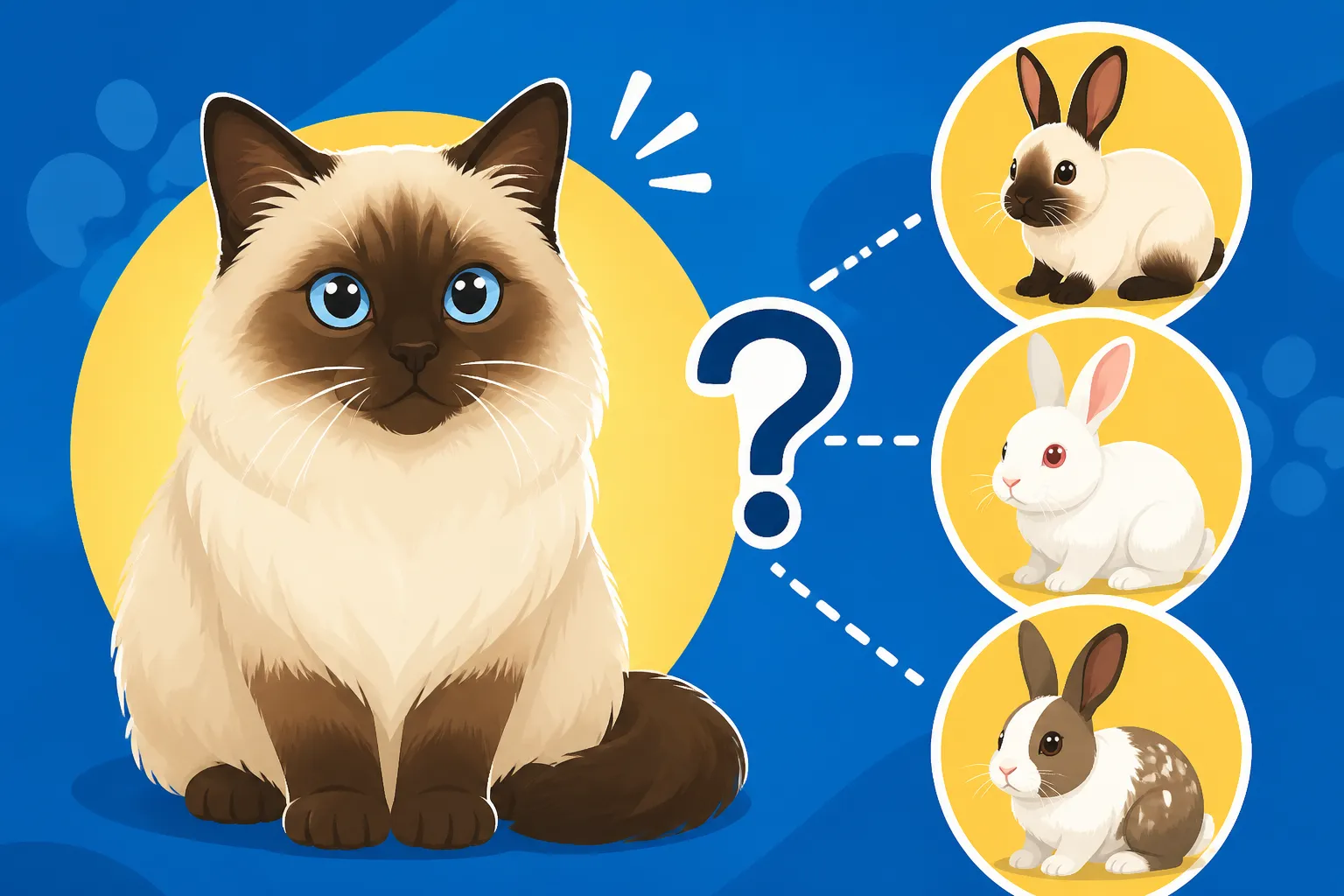
A Himalayan rabbit typically has a mostly white body, with darker color on the nose, ears, feet, and tail. Those colored areas are called points. Depending on the rabbit’s color variety, the points may look dark brown or black, bluish, or another recognized shade. From across a room, the pattern can resemble the familiar contrast of a pointed Himalayan cat.
The markings are not simply patches placed randomly on a white coat. The darker pigment tends to appear on the cooler parts of the body. The nose, ears, paws, and tail are more exposed to the surrounding temperature than the rabbit’s trunk, which is kept warmer by the body. That helps explain why the body can remain pale while the extremities develop color.
A young rabbit may also look paler than it will later. As its coat grows and changes, the contrast can become easier to see. The exact appearance varies with the rabbit’s genetics, age, and surroundings, so a photograph alone is not always enough to identify a rabbit’s breed or color variety.
Why the cat was named after the rabbit
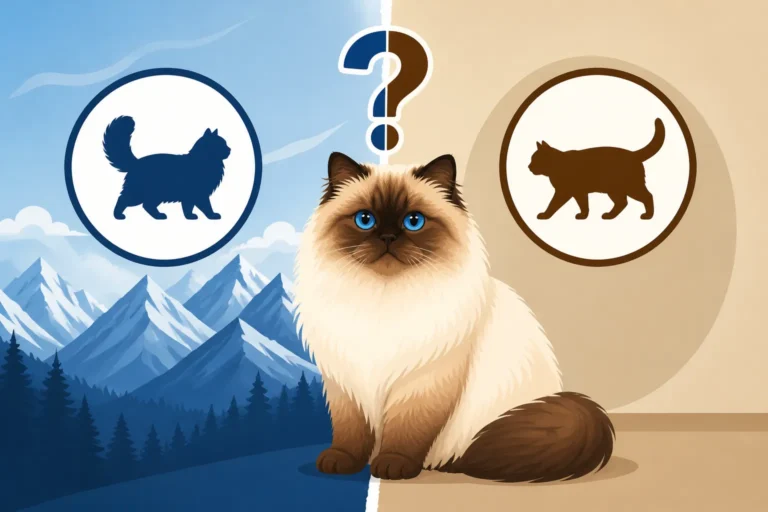
The Himalayan cat’s name points to a resemblance in coat pattern, not to a close family relationship between rabbits and cats. The cat was developed by crossing Persian and Siamese cats, combining a long Persian-style coat and body type with the colorpoint pattern associated with Siamese cats. The rabbit’s markings offered a familiar visual comparison.
The name can be confusing because it sounds geographic. It may suggest that the cat or rabbit came from the Himalayan mountain region, but the name is used to describe the animals’ appearance rather than establish that origin. For a broader look at the cat’s history, see The Himalayan Is Named After a Rabbit and Why the Himalayan Borrowed a Rabbit’s Name.
It is also useful to distinguish a name from a genetic connection. A Himalayan cat is not descended from a rabbit, and the rabbit did not contribute genes to the cat breed. The two animals simply show a similar pattern, produced through related biological principles in two different species.
How the Himalayan pattern develops
Temperature-sensitive pigment explains the dark points
In both Himalayan rabbits and pointed cats, pigment production is affected by temperature. The pigment-producing process works more readily in cooler areas of the body and less readily in warmer areas. As a result, the extremities develop darker fur while the warmer trunk stays lighter.
This is why the pattern often looks especially clear on the nose, ears, feet, and tail. It also explains why a pointed animal’s coat can change in appearance over time or after a major change to its fur. For instance, a shaved patch on a pointed cat may regrow darker than the surrounding body coat because the newly growing area is cooler while the fur is short. The details differ between species, but the general temperature-linked principle is similar.
The similarity should not be taken to mean that rabbits and cats carry one identical “Himalayan gene.” They are different species, with their own inherited variants and genetic histories. The pattern is a useful example of similar traits arising through comparable biological mechanisms, not proof of a shared recent ancestor or shared mutation.
Why a Himalayan cat’s body color can vary
A Himalayan cat’s coloring is influenced by its point color, its age, and temperature. Kittens are usually born very pale, then develop color on the points as they grow. Their final appearance may take time to settle, and the contrast between body and points can change as the cat matures. Why Every Himalayan Kitten Is Born Almost White explains the pale-at-birth stage, while How Temperature Decides a Himalayan’s Point Color explores the role of temperature in the coat.
A cat’s body coat may also darken with age or in cooler conditions. That does not mean the cat has stopped being a Himalayan or has become a different color pattern. It reflects how the pigment-related process shows up in the coat over time. A warm indoor home may help preserve a lighter look, but owners should never try to manage a cat’s health around coat color by keeping it uncomfortably warm or cold.
The Himalayan rabbit’s pattern follows its own breed and color standards. Its appearance can also be affected by temperature, but rabbit coat development and cat coat development are not interchangeable. If you are comparing photos of the two, look for the pattern—the pale trunk and darker extremities—rather than expecting matching shades or identical markings.
| Feature | Himalayan rabbit | Himalayan cat |
|---|---|---|
| Meaning of the name | A rabbit breed and coat pattern | A cat breed name associated with Persian and Siamese ancestry |
| Typical pattern | Pale body with darker nose, ears, feet, and tail | Pale body with darker face, ears, paws, and tail |
| Why points develop | Temperature-sensitive pigment production | Temperature-sensitive pigment production |
| Genetic relationship between the animals | No direct relationship to the cat breed | No rabbit ancestry |
| What the resemblance tells you | The animals share a visual pattern | The name reflects that visual resemblance |
Similar markings do not mean the same breed
Coat pattern is not the same as breed identity
A coat pattern describes how color is distributed; a breed identity involves a wider set of traits and a documented lineage. A rabbit with Himalayan-style points may resemble a Himalayan rabbit without necessarily being one. Likewise, a pointed cat may share a Himalayan cat’s coloring without having the same breed background.
For cats, the distinction can be particularly tricky because registries do not all use the same breed labels. Some record the Himalayan as a distinct breed, while others place it within a Persian division or use a colorpoint Persian description. The paperwork can sound different even when people are talking about a similar type of cat. See How to Tell a Himalayan From a Persian and How TICA Registers the Himalayan Today for more on those distinctions.
For rabbits, breed identification also depends on more than one striking coat feature. Body shape, coat, size, and other breed characteristics matter, and formal definitions can vary between rabbit organizations. A pointed coat alone is not enough to confirm a rabbit’s breed. If the question matters for registration, breeding, or a show, check the relevant organization’s standard and the animal’s documented background.
A quick way to separate resemblance from relationship
When you see the phrase “Himalayan pattern,” ask what the speaker means. They could be referring to the dark-pointed appearance, a specific cat breed or division, or the Himalayan rabbit breed. The same word can be used in different contexts, which is why online searches and casual conversations sometimes blur the distinctions.
A helpful comparison is to separate three questions:
- What does the animal look like? Look for a pale body and darker points.
- What species is it? A rabbit and a cat have very different bodies, care needs, and histories.
- What is its documented breed or lineage? That requires more than judging the coat from a picture.
If you’re looking into a Himalayan cat specifically, Why a Himalayan Is a Persian With the Point Gene explains the cat’s relationship to Persian ancestry. For a closer look at how the coat’s darker areas are described, How a Himalayan’s Points Are Judged is a useful companion.
What the shared pattern means for owners
Don’t use coat color alone to make health or care decisions
The Himalayan pattern is visually memorable, but it does not tell you everything about an animal’s health or daily needs. For a cat, coat points do not tell you whether its breathing, eyes, teeth, or kidneys are healthy. Those questions call for observation and veterinary care, not color identification. For an overview of inherited health considerations, see Every Himalayan Inherits Two Disease Lists, Not One.
For a rabbit, the pattern does not replace species-appropriate care either. A rabbit’s housing, diet, handling, and veterinary needs are not the same as a cat’s. If you are caring for both animals, keep their food, litter, and grooming supplies clearly separated. A cat’s grooming routine, for example, cannot be substituted for rabbit coat care simply because both animals have pale fur and dark points.
If you’re shopping for everyday rabbit supplies, a retailer such as Chewy may help you compare basic items, but a product listing cannot verify breed or explain the animal’s genetics. Chewy is a shopping option, not a substitute for a rabbit-savvy veterinarian or breed documentation. When choosing any item, check that it is appropriate for rabbits rather than assuming a product marketed for cats will be suitable.
Keep the distinction clear when researching
Search results can mix articles about rabbits, pointed cats, and the Himalayan region. To get more useful information, include the species in your search—for example, “Himalayan rabbit coat pattern” or “Himalayan cat colorpoint genetics.” If you are considering adoption or purchase, ask the breeder, rescue, or current caretaker what is known about the animal’s background, and request relevant records rather than relying on a coat photo.
For cat owners comparing different pointed breeds, the visual resemblance can be only one part of the decision. A Himalayan cat’s long coat and Persian-influenced build come with different grooming and care considerations from those of a rabbit. Who the Himalayan Actually Suits offers a broader look at the kind of home and routine that may fit this cat.
The short answer is that the Himalayan rabbit shares the Himalayan cat’s recognizable pale-body-and-dark-points look. That resemblance inspired the cat’s name, but it does not mean the animals share a breed history or the exact same genetic variant. It is a striking example of how a similar pattern can appear in two very different species.
Disclaimer
This article is for general informational purposes only and does not constitute professional advice. Laws, prices and regulations vary by location and change over time. Consult a qualified professional for guidance on your specific situation.