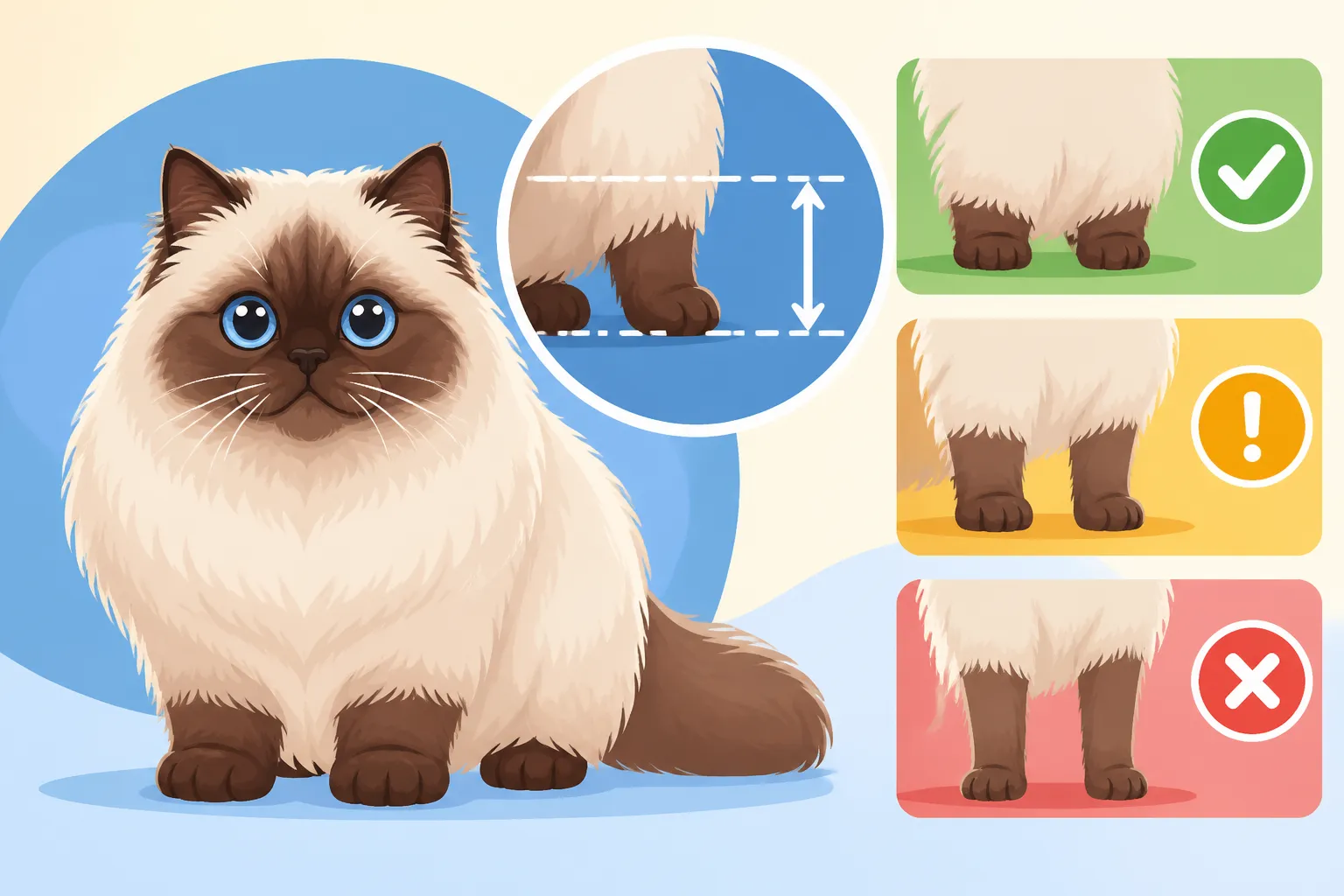
How Short a Himalayan’s Legs Should Be
A Himalayan’s short legs are part of its compact, sturdy Persian-style build, but there is no single measurement every cat must meet. Long fur can make the legs look even shorter, and a low stance alone does not mean something is wrong. This guide explains what proportionate legs look like, how to assess comfortable movement, and when a change deserves veterinary attention.
What short legs should look like on a Himalayan
The breed is compact, not meant to be measured by inches
Himalayans are generally described as cobby: compact-bodied, broad, and sturdy, with relatively short, strong legs. The legs should look balanced with the rest of the cat rather than unusually long or fine-boned. Their paws are typically round and firm, and the cat should be able to stand and walk without obvious strain. For the broader meaning of this body type, see Why a Himalayan Is Described as Cobby.
There is not one reliable leg-length number that can be applied to every Himalayan. Cats vary in size, sex, age, and build, and a measurement taken from the floor to the belly can be misleading if the cat is crouched, sitting, or standing on a soft surface. Breed descriptions focus on overall proportion and sound structure, not a ruler test.
That distinction matters if you are comparing kittens or looking at photos online. A kitten may appear leggy before its body fills out, while a full coat can make an adult seem lower to the ground than it is. The question is less “How many inches are the legs?” and more “Do the legs support the body comfortably and move evenly?”
Coat and body shape change the visual impression
A Himalayan’s thick coat can obscure the line between its legs and body. Fur around the belly, chest, and britches may hang low enough to make the cat appear shorter-legged, especially when it is sitting or viewed from the side. A broad chest and rounded body also affect how leg length reads to the eye.
Try observing the cat standing naturally on a firm, level floor. Look at the legs from the front and side, then watch the cat walk a few steps. A relaxed stance, even weight-bearing, and a smooth gait tell you more than a posed photo. Avoid judging from a picture where the cat is curled up, crouching, or photographed from a low angle.
Body size can create another visual mismatch. A compact cat with a heavy coat may look especially low-slung, even when its legs are proportionate. For context on how the frame affects appearance, How Heavy a Full Grown Himalayan Gets discusses adult size and the Persian-style build.
How to assess leg proportion and movement
Look at the whole cat, not one feature
When you assess a Himalayan’s legs, take in the body as a whole. The legs should appear substantial enough for the cat’s frame, with no obvious bowing, twisting, or pronounced difference between left and right. The cat should be able to stand squarely and walk without repeatedly shifting weight off one leg.
A simple observation at home can be useful: watch your cat walk across a clear, non-slippery floor, turn, and settle down. Notice whether the stride looks even and whether the cat seems comfortable placing each paw. Do not force a jump or stretch the legs to “test” them. If you are assessing a kitten, remember that its proportions can change as it grows, so a single snapshot is not a final verdict.
| What you notice | What it may mean | A sensible next step |
|---|---|---|
| Short-looking legs with an even, comfortable walk | Often consistent with a compact build and dense coat | Keep observing normal movement |
| Legs appear different in photos but not in person | Camera angle, posture, and coat may be affecting the impression | Compare the cat standing naturally on level ground |
| Persistent limp, reluctance to bear weight, or a new change in gait | Possible discomfort or injury, among other causes | Contact a veterinarian for an assessment |
| Difficulty getting up, climbing a low step, or using the litter box | Could reflect pain, mobility limits, or another health issue | Arrange a veterinary check, especially if the change is new |
The table is a guide to observation, not a way to diagnose a cat. A cat can be naturally cautious about jumping without having a leg problem, and a cat that jumps confidently can still have an issue that is not obvious at first glance. If you are unsure, describe what you have seen to your veterinarian and, if possible, take a short video of the gait at home.
The way a cat moves matters more than whether it jumps high
Himalayans are not typically built for dramatic leaps, and some prefer furniture that is easy to reach. Their compact frames, individual personalities, and the layout of the home all influence whether they climb or jump. A cat choosing a sofa over a tall cat tree does not automatically indicate a problem. Why a Himalayan Uses Steps Rather Than Jump explores why some cats choose a lower-effort route.
Pay attention to changes from your cat’s usual habits. If a cat that once climbed onto a favorite chair suddenly avoids it, pauses before standing, or seems stiff after resting, that pattern is more useful information than its leg length alone. A new limp, repeated stumbling, swelling, vocalizing when moving, or reluctance to use a leg should not be dismissed as “just how the breed walks.”
For a young kitten, look for coordinated movement as well as proportion. Kittens may be clumsy while learning, but they should still be able to move about comfortably. If the legs appear markedly uneven or the kitten consistently avoids putting weight on one limb, ask the breeder what they have observed and arrange veterinary advice rather than relying on appearance alone.
Short legs and practical home care
Make everyday routes easy to manage
A Himalayan does not need a tall climbing setup to have an enriching home. Wide, stable platforms and short steps can make favorite resting places easier to reach without asking the cat to make a large jump. Choose equipment that does not wobble, has a grippy surface, and leaves room for the cat to turn around comfortably. Why a Cobby Himalayan Needs Wide Platforms, Not Tall Ones offers more on setting up accessible spaces.
Think about the cat’s daily routes, not just its play area. Can it reach water, food, a resting spot, and the litter box without climbing over something awkward? A low-entry litter box may help a cat that is stiff or reluctant to step over a high edge. If you are comparing options, check the entry height, interior space, and stability; retailers such as Chewy list product dimensions that can help you narrow down choices, though the cat’s comfort is the real test.
If your Himalayan needs help getting onto a chair or couch, use a broad step or ramp rather than lifting it by the legs or pulling it upward. When lifting is necessary, support the chest and hindquarters so the body is held securely. The guidance in Lifting a Cobby Himalayan Without Straining Its Back can help you handle a sturdy, compact cat gently.
Keep weight and coat from hiding mobility changes
A thick coat makes it harder to judge body shape by sight, and extra weight can make movement more demanding. Check your cat’s body condition with your veterinarian instead of relying on how large or fluffy it looks. A gradual change in willingness to move may be easier to notice if you pay attention to ordinary routines: getting up from a bed, walking to the food bowl, or stepping into the litter box.
Regular grooming also helps you see and feel the legs more clearly. Part the coat gently when you comb so you can check the skin and notice whether one area seems unusually sensitive. A dense coat can hide small wounds, swelling, or a change in how the cat holds a limb. If you find tenderness, a warm or swollen area, or a sudden difference between legs, avoid repeatedly handling it and contact your veterinarian.
For a kitten, ask the breeder about the parents’ structure and movement, and look for clear, unedited views of the kitten standing and walking. A responsible conversation should focus on health and comfort as well as appearance. Himalayans may be bred with Persians within recognized breeding programs, so pedigree and breed terminology can vary; Why a Himalayan and a Persian May Be Mated explains that relationship.
When short legs deserve a closer look
Know the difference between build and a change in ability
A naturally compact build is not the same thing as a new mobility problem. If your Himalayan has always been low to the ground, walks evenly, and moves comfortably through its usual routine, short-looking legs may simply reflect its proportions, coat, and stance. By contrast, a sudden change deserves attention even if the cat’s legs look normal.
Contact a veterinarian if your cat develops a persistent limp, cannot bear weight, appears painful when standing, or suddenly struggles with ordinary movements. A veterinarian can examine the cat and decide whether further assessment is needed. Do not give human pain medicines or try to manipulate a painful leg at home; some common medicines intended for people can be dangerous to cats.
A change that develops gradually can also matter. Older cats may become less willing to jump or may move more cautiously because of discomfort, joint changes, or other health issues. Rather than assuming this is simply age or breed temperament, note when the change began and which activities are affected. That history can make a veterinary visit more productive.
Choose a breeder or kitten for soundness, not an extreme look
When choosing a Himalayan kitten, avoid treating the shortest-looking legs as a prize. An exaggerated appearance is not a substitute for comfortable movement and good overall health. Ask to see the kitten walk on a level surface, and ask what the breeder has observed about its activity, coordination, and veterinary care.
It is also reasonable to ask about the parents’ general structure and whether either has a history of mobility concerns. Look for straightforward answers rather than guarantees based on a photograph or a quick look at the kitten. A reputable breeder should be willing to discuss the cat’s health and how it moves, not only how it looks in a posed photo.
If you are considering an adult cat, watch its normal routine and ask about any known changes in mobility. A calm cat may not perform on cue, so give it time to move naturally. For related questions about the Persian build and possible inherited concerns, see Whether a Himalayan Inherits the Persian’s Hip Problems and Why a Himalayan’s Short Persian Legs Skip a Step.
A Himalayan’s legs should look short in proportion to its compact body, but they should still support comfortable, even movement. There is no universal height to chase. Focus on how the cat stands, walks, and manages everyday activities, and ask a veterinarian about changes that are new, persistent, or painful.
Disclaimer
This article is for general informational purposes only and does not constitute professional advice. Laws, prices and regulations vary by location and change over time. Consult a qualified professional for guidance on your specific situation.