What a Himalayan’s Coat Should Feel Like in the Ring
A Himalayan’s coat should feel long, dense, fine and lively—not limp, greasy, brittle or packed into hidden mats. Yet a full Persian-type coat can feel different depending on where you touch it, how recently it was groomed and whether the cat is shedding. This guide explains what judges look for, how to assess coat texture at home and how to prepare without masking problems.
What a Himalayan coat should feel like
Look for a long, fine coat with body
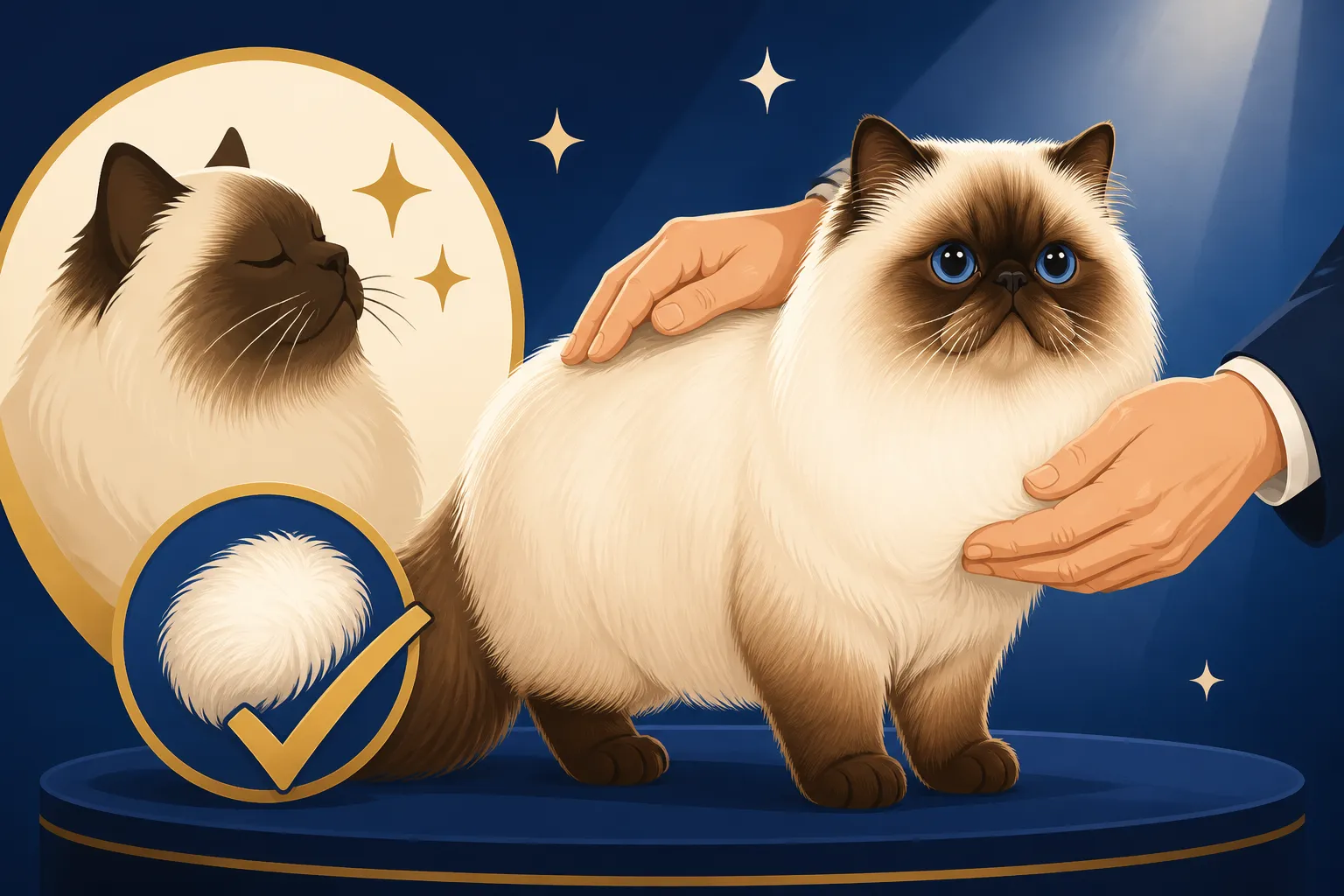
The Himalayan is judged according to Persian-type standards, with its color pattern and blue eyes adding the familiar pointed look. Its coat should be long and abundant, with a fine texture and enough body to stand away from the cat rather than lying flat against the sides. When you run your fingers through it gently, the hair should feel soft and substantial, not coarse or greasy.
“Fine” does not mean thin or sparse. A Himalayan can have fine individual hairs and still carry a thick coat overall because of its full undercoat. The ideal impression is a coat that has movement and volume: it parts under your hand, then settles back without feeling packed, sticky or lifeless.
The coat also varies across the body. A full ruff may feel especially plush, while the hair along the back can feel more even and flowing. The tail should be well furnished, and the britches can carry a generous amount of coat. For context on the dramatic neck hair, see How Full a Himalayan’s Ruff Should Be.
Understand the difference between soft, woolly and limp
A healthy, well-kept coat often feels soft and silky, but softness alone does not tell you whether the coat has the desired texture. A coat that feels cottony or woolly may be overly dense, tangled close to the skin, or not fully separated by grooming. A limp coat can feel smooth at first touch but lack the lift and resilience expected of a full coat.
Try a gentle check on the side of the body. Use your fingertips to separate the hair down toward the skin, then let it fall naturally. You should be able to move through the coat without pulling. The hair should not cling to your hand with an oily residue, nor should it feel like a single compacted layer. Avoid repeatedly raking your fingers through the coat; that can create tangles and is not a useful substitute for combing.
A Himalayan’s texture is also not identical from one cat to another. Age, season, health, hormones, grooming habits and the individual coat all affect how it feels. A kitten’s coat may not have the fullness of an adult’s, and a cat in a seasonal shed may feel less dense than it does at another time of year. The standard describes the overall desired type, not a guarantee that every cat will feel precisely the same.
Consider the whole cat, not one handful of fur
A judge’s impression comes from the complete presentation: coat length and condition, body shape, head, eyes, color and balance. Coat texture matters, but it is not a standalone test where one pinch determines the result. A soft coat can still be poorly presented if it is tangled, dirty or flattened, while an abundant coat can look less polished if it is not separated down to the skin.
Likewise, the coat should complement the cat rather than hide its structure. A large ruff and full britches are part of the breed’s appearance, but the cat’s outline and balance remain important. The Persian-type head and profile are considered as part of the overall standard; Why a Himalayan’s Head Is Judged as a Persian’s explains that broader context.
| What you notice | What it may suggest | What to check next |
|---|---|---|
| Soft hair that separates easily | A clean, groomed coat with good movement | Check down to the skin for small tangles |
| Hair that feels compact or cottony | Dense undercoat, shedding or mats beginning | Part the coat in several places rather than brushing only the surface |
| Greasy or sticky feel | Residue, natural oil buildup or a skin concern | Look for redness, odor or irritation and ask a vet if it persists |
| Coat that lies flat and feels limp | Coat condition, recent grooming or individual variation | Assess the cat when fully dry and naturally settled |
| Brittle or unusually dry hair | Possible coat-care or health issue | Review bathing and grooming habits; seek veterinary advice for sudden changes |
How to assess coat texture without damaging it
Part the coat gently in several places
Start when your cat is relaxed, on a stable surface where they feel secure. Use your fingers or the teeth of a comb to part the hair, rather than pressing a brush hard against the coat. Check behind the ears, under the front legs, along the chest, around the belly and through the britches. These areas can hide tangles even when the top layer looks smooth.
A mat is not just a rough patch on the surface. It can form close to the skin, where it pulls as the cat moves and may irritate or trap moisture. The coat can feel lush from above while a compact knot is developing underneath. That is one reason a quick pat is not enough to judge condition. Which Part of a Himalayan’s Persian Coat Mats First describes the areas that deserve extra attention.
If you find a small tangle, do not yank a comb through it. Hold the hair near the skin to reduce pulling, then work carefully from the outer edge of the tangle. Stop if your cat seems painful, the knot is tight against the skin, or the area is inflamed. Large or close mats are safer for a professional groomer or veterinary team to assess than for an owner to cut out with scissors.
Use a comb that reaches the undercoat
A brush can smooth the surface and make the coat look neat, but it may not reach through a thick undercoat. A metal comb with suitable spacing can help you detect resistance and work through the coat in sections. The goal is not to drag a tool through quickly. Comb gently, following the hair, and check that the teeth can pass from the outer coat toward the skin without catching.
Tool choice depends on your cat’s coat and tolerance. A very wide-toothed comb may pass over small tangles, while an overly fine comb can pull or snag. For practical guidance on choosing a tool, see Which Steel Comb a Himalayan’s Coat Needs. If you are buying grooming tools through Chewy, look at the comb’s tooth spacing and design rather than choosing based on a broad “longhair” label alone.
A useful routine is to work a small area at a time and then check it with your fingers. The underarms, chest and rear are easy to miss when you only comb the back and sides. If your cat dislikes long sessions, keep them brief and calm, rewarding cooperation rather than trying to finish the entire coat in one difficult sitting. The Daily Comb a Himalayan Cannot Skip offers more detail on making that routine manageable.
Judge the coat when it is clean and fully dry
A coat can feel different after a bath, during a shed or immediately after being brushed. Damp hair may clump together and feel heavier, while a coat with product residue can feel coated or unusually slick. Do not assess the natural texture while the fur is wet. Wait until the coat is fully dry and has settled.
For a show cat, preparation should make the coat clean, separated and comfortable—not disguise its natural condition. Heavy oils, powders or sprays can leave residue and change the feel. Follow the show’s grooming rules and ask an experienced breeder or groomer to demonstrate appropriate preparation. If the coat has a persistent odor, greasy patches or a sudden texture change, consider whether there may be a skin or health issue rather than trying to cover it with grooming products.
What can change how a Himalayan’s coat feels
Mats and shedding can distort the impression
Himalayans carry a long Persian-type coat with an undercoat, so loose hair can gather and tangle before it is obvious on the surface. During shedding, the coat may feel less even: one area may seem airy while another feels dense or slightly clumped. This does not automatically mean the cat’s coat has poor texture, but it does mean that a careful check down to the skin is worthwhile.
Mats can make a coat feel woolly, stiff or lumpy. They can also pull the hair into ridges, making the coat look less full in one place and too bulky in another. A well-groomed cat may still develop a tangle if a routine is missed, particularly in friction areas. Why a Himalayan Mats Faster Than a Ragdoll explains why these coats can require more frequent attention than their appearance might suggest.
There is no need to punish yourself over one missed grooming session. The useful question is whether you can comfortably part and comb the coat now. If not, work carefully or seek help. Forcing a tool through a mat can hurt the cat and make future grooming harder, and cutting close to the skin risks injury because it is difficult to tell where the skin ends and the tangled hair begins.
Age, season and health matter
Coat condition changes through a cat’s life. A young Himalayan may not yet have the full adult coat, while an older cat may groom less effectively or develop changes in coat density. Seasonal shedding can also alter how full the coat feels. These normal variations are why a single touch should not be treated as a definitive judgment about quality or health.
A sudden change deserves more attention than a gradual, expected variation. If the coat becomes dull, greasy, unusually sparse, brittle or matted despite regular care, check the skin and the cat’s general condition. Changes in grooming behavior, appetite, weight or energy can be relevant. A veterinarian can help distinguish routine coat changes from a medical concern.
Color and texture are related only indirectly. The pointed pattern is influenced by temperature-sensitive pigmentation, so cooler areas such as the face, ears, legs and tail develop darker points. That does not mean the darker areas should feel rougher or that color alone tells you whether a coat is healthy. For the relationship between coat appearance and the pointed pattern, see How a Himalayan’s Points Are Judged and Why a Himalayan’s Pale Coat Discolors With Age.
Presentation can affect how the coat appears
A clean coat that is combed through can look fuller because individual hairs are separated. A coat that has been pressed down by a carrier, damp weather or close handling may look flatter until it is gently groomed and allowed to settle. This is a presentation issue, not necessarily a change in the actual texture.
The coat’s length and fullness also develop over time. A Himalayan may not have the same mature coat as an adult when young, and a well-maintained coat can still vary from one season to the next. How Long a Himalayan’s Coat Actually Grows provides more context on development and coat length.
If you are preparing for a show, ask someone familiar with the relevant registry and show rules to assess your cat in person. A breeder or experienced exhibitor can help you distinguish a natural coat trait from a grooming issue, and can point out whether a particular area needs more attention. Avoid making major changes based only on photographs: lighting, camera angle and recent grooming can make coat density and texture difficult to judge.
A practical coat-check and grooming routine
Follow a repeatable check
A short, consistent inspection is more useful than an occasional intense session. Choose a calm time and check the same areas each time so you notice changes early. If you are preparing for a ring, include a final look at the coat’s cleanliness, separation and general condition, but do not turn grooming into a stressful last-minute struggle.
- Set your cat on a secure, nonslip surface.
- Part the coat gently at the chest, underarms, belly, behind the ears and britches.
- Run a suitable comb through small sections, stopping if it catches.
- Check the skin for redness, dampness, debris or sore areas.
- Remove loose hair carefully and smooth the coat without pulling.
- Stop if your cat is distressed or if a mat is too close to the skin to work safely.
You can keep a basic grooming kit in one place so the routine feels predictable. If you order tools or grooming supplies through Chewy, check that anything used around the face is specifically suitable for that area and follow the product directions. Avoid putting grooming products near the eyes unless they are intended for that use and your veterinarian has advised they are appropriate.
Prepare for the ring without overdoing it
The coat should be clean, dry, free of tangles and naturally full. Give yourself enough time for grooming so you are not trying to bathe, dry and comb a stressed cat at the last moment. A bath is not automatically needed before every show; timing and frequency depend on the cat, the condition of the coat and the rules of the event. If a bath is part of your preparation, drying all the way to the skin matters, because a damp undercoat can clump and mat.
For a show, think about presentation rather than trying to change what the coat is. The coat should still feel like the cat’s own clean hair, not like a layer of styling product. Ask a knowledgeable exhibitor to review your preparation if you are new to showing. They can demonstrate how much combing is appropriate and what judges in your ring are likely to notice.
Chewy may be a convenient place to compare basic combs, grooming tables or coat-care supplies, but the right purchase is the one your cat tolerates and that suits the coat. You do not need a crowded kit to maintain a good routine. A few appropriate tools, regular gentle handling and early attention to tangles usually make a bigger difference than buying every product marketed for long-haired cats.
Know when grooming is not the answer
Coat care should not hurt. If your cat cries, snaps, struggles intensely or repeatedly avoids being touched in one spot, pause and check for pain, skin irritation or a tight mat. Do not hold a cat down and force a painful grooming session simply to finish the coat. A groomer experienced with longhaired cats or a veterinary clinic can help with difficult mats and safe clipping.
Seek veterinary advice when you notice a sudden, persistent change in coat texture, bald areas, excessive scratching, sores, a strong odor or skin that looks inflamed. A dull or tangled coat can sometimes reflect a cat’s inability to groom comfortably, not just a missed combing session. Changes in mobility, weight or behavior are also worth mentioning at an appointment.
For most owners, the simplest test is this: can you part the coat gently, reach the skin with a suitable comb and move through the hair without pulling or finding hidden mats? If yes, and the coat is clean and comfortable, you are looking at a coat in good practical condition. The show-ring ideal adds the desired length, fine texture, fullness and lively presentation—but the cat’s comfort and skin health come first.
Disclaimer
This article is for general informational purposes only and does not constitute professional advice. Laws, prices and regulations vary by location and change over time. Consult a qualified professional for guidance on your specific situation.