Why the Himalayan Is Less Common Than the Persian
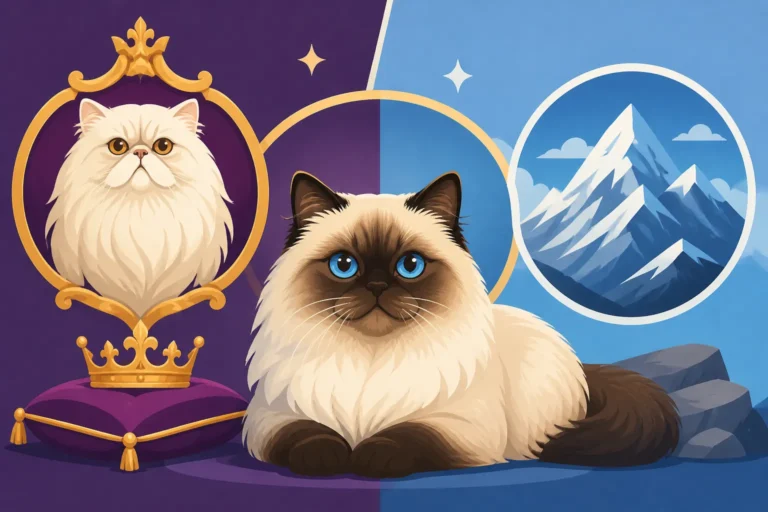
A Himalayan may look like a Persian wearing Siamese-style points, but that striking combination does not translate into Persian-sized numbers. The difference comes down to genetics, registry categories, breeding priorities, and the practical demands of caring for a longhaired cat. Here’s why Himalayans are less common—and why counting them is not as straightforward as it seems.
Why Himalayan numbers are difficult to compare with Persian numbers
Registries do not all count Himalayans the same way
The word “Himalayan” can refer to a distinct breed in one registry and a Persian variety or division in another. For example, the Cat Fanciers’ Association places Himalayans within the Persian breed structure, while The International Cat Association registers the Himalayan separately. That difference matters: a registry that records pointed Persians as Persians may not publish a Himalayan total that can be compared directly with a registry that tracks Himalayans as their own breed.
This is one reason a simple claim such as “there are this many Himalayans for every Persian” can be misleading. The number depends on which registry is being counted, how its categories are organized, and whether the figures refer to registrations, active breeders, show entries, or some other measure. A cat can be recognizably Himalayan to its family while appearing under a Persian category on its paperwork. For more on the terminology, see Why CFA Made the Himalayan a Persian Division in 1984 and TICA Still Registers the Himalayan as a Breed of Its Own.
The labels also vary beyond the United States. In some places, the Himalayan is known as a Colorpoint Persian rather than as a separate breed name. So a buyer browsing breeder listings in Boston, London, or Toronto may encounter different terms for cats with a similar pointed coat and Persian type. The naming differences do not mean one cat is less Himalayan than another; they reflect different registry conventions.
A Himalayan is a specific kind of pointed Persian type
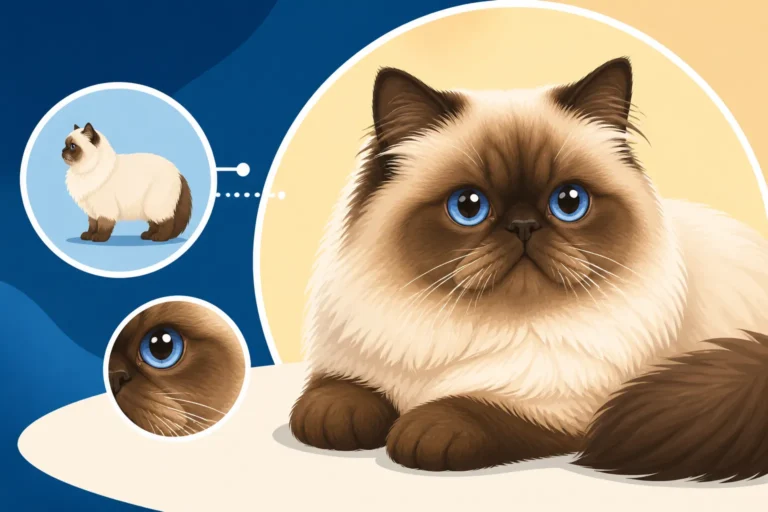
The Himalayan combines a Persian-style long coat and body with colorpoint markings: a paler body and darker coloring on the face, ears, legs, and tail. The pattern is connected to a temperature-sensitive form of pigment production. The cooler parts of the body develop darker fur, while warmer areas tend to remain paler. That creates the familiar contrast, though the shade and definition can vary from cat to cat.
The point pattern is recessive. In broad terms, a kitten needs to inherit the relevant version of the colorpoint gene from both parents to show the classic pointed pattern. A Persian that does not look pointed may still carry the gene, so appearance alone does not always reveal what a cat could pass to its kittens. This adds a layer of planning for breeders who want pointed kittens while also selecting for other traits. Learn more in Why a Himalayan Needs Two Copies of the Point Gene and How a Persian Can Carry the Himalayan Gene Hidden.
A Persian’s large gene pool and broad range of coat colors give breeders many possible directions to pursue. A Himalayan breeding program has a narrower visual target: the pointed pattern, the desired eye color, and Persian features must come together. That does not make Himalayans a different species of cat or inherently harder to breed in every case. It does mean that producing a particular look requires attention to inheritance and careful choices about which cats are paired.
Why fewer breeders focus on Himalayans
The breeding goal takes deliberate planning
A breeder aiming for Himalayans is not simply pairing two fluffy cats and hoping for dark points. They need to understand which cats carry the colorpoint gene, what traits appear in their lines, and how the planned pairing fits the breeding program. If the goal is a particular point color or a specific combination of coat and type, the breeder may need to plan across generations rather than expect every litter to produce the same result.
The selection process involves more than appearance. Responsible breeders also consider health, temperament, structure, and how well a cat can breathe and function. Those priorities can limit the number of suitable breeding cats. A program with a small number of carefully chosen cats may produce fewer litters than a larger operation, but producing more kittens is not the only measure of a healthy or responsible breeding program.
The colorpoint gene can also appear in Persian lines without producing pointed kittens in every generation. That can be useful for planned breeding, but it does not guarantee a breeder will have a particular Himalayan kitten available at a particular time. If you are comparing a Himalayan with a solid Persian, Why a Himalayan Is a Persian With the Point Gene explains how the pointed appearance fits into the broader Persian background.
Breeders weigh appearance against health and welfare
Himalayans are longhaired cats with Persian ancestry, so responsible breeding includes attention to the challenges that can come with coat care and facial structure. A very flat face may be striking, but appearance should not outweigh comfortable breathing, healthy eyes, and a functional bite. Breeders who prioritize health may choose cats with more moderate features, even if those cats do not match every buyer’s idea of an extreme show look.
Health testing and careful record keeping take time and resources. Breeders may also keep cats until they are old enough for their development and health to be assessed, rather than rushing to place kittens. When fewer breeders are willing to take on the work of maintaining a responsible program, fewer kittens may be available. That is a more meaningful explanation than assuming a breed is uncommon simply because its kittens are difficult to produce.
A thoughtful buyer can ask what health checks were done, how the kittens are raised, and what the breeder does to prepare them for daily grooming. It is also useful to ask which registry will issue the papers and what name will appear there. What a Himalayan Buyer Should Ask About Registration and What Nobody Tells You Before Buying a Himalayan offer useful context for those conversations.
Why the Persian has a much broader market
Persian appeal covers more colors and breeding choices
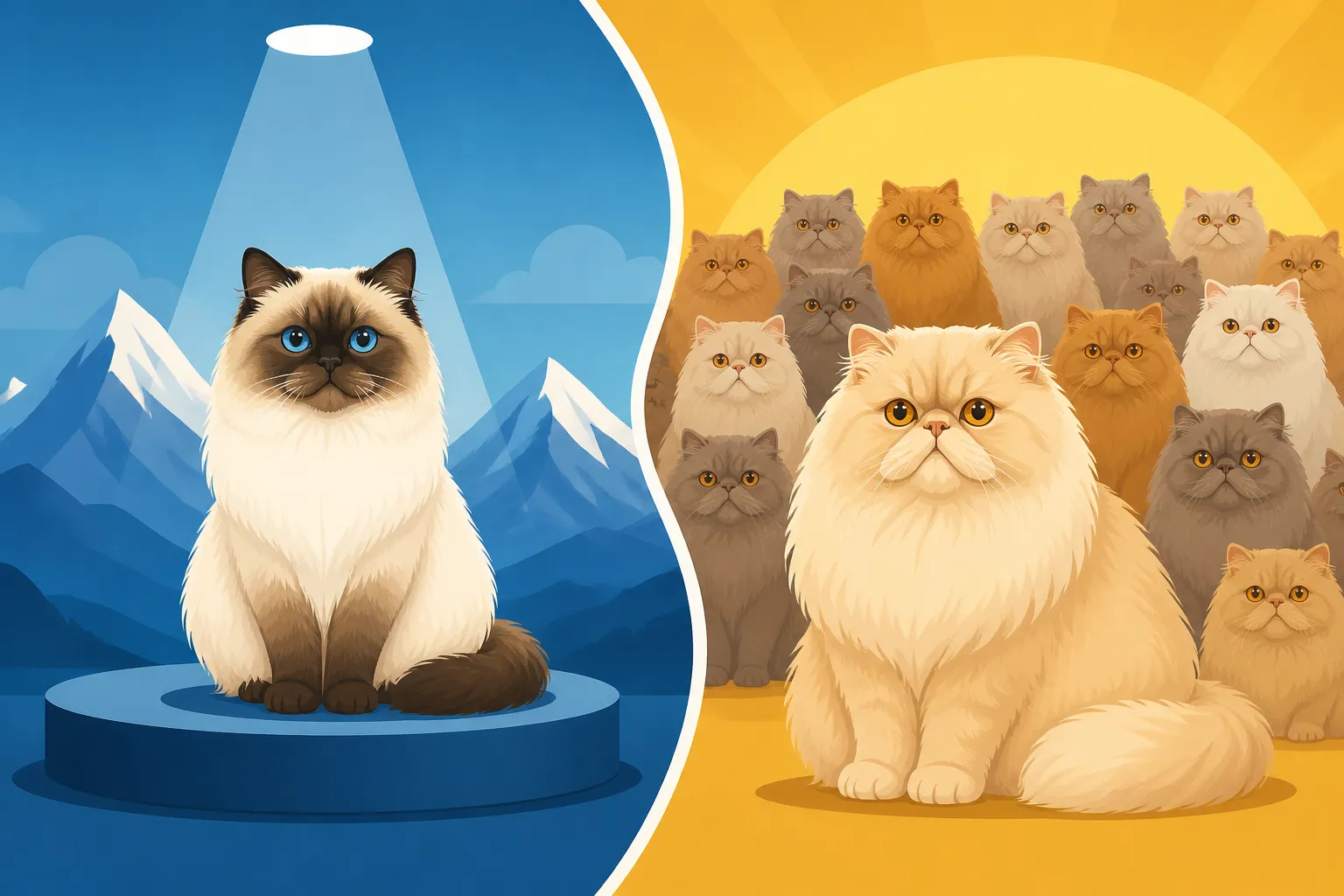
Persians are known in many colors and patterns, while Himalayans are defined by the pointed look. That broader range gives Persian breeders and buyers more options. Someone drawn to a Persian’s coat, expression, or laid-back reputation can look at numerous color varieties without needing the colorpoint pattern. A Himalayan buyer, by contrast, is often looking specifically for the pale body, darker points, and blue eyes associated with the variety.
That difference can shape the size of the market. More color options may mean more potential matches between what buyers want and what breeders produce. It does not mean every Persian color is equally common, or that every Himalayan point color is hard to find. Availability shifts with the breeder’s program, local demand, and the timing of litters. The range of recognized colors is discussed in How Many Himalayan Point Colors Exist.
The Persian is also a familiar breed name to a wider audience. People may search for a Persian without knowing that a pointed Persian-type cat could be registered or advertised as a Himalayan, a Colorpoint Persian, or a Persian division. That makes the Himalayan’s visibility appear smaller than it may be in everyday homes. A cat’s name in a listing or pedigree can affect search results and show records even when the animal’s appearance is unmistakably pointed.
Long-coat care narrows the pool of suitable homes
A Himalayan’s thick coat needs consistent attention. Combing helps prevent tangles and mats, particularly in areas such as the armpits, chest, and hindquarters. Many owners also establish a regular face-cleaning routine because the eyes can water and the facial folds may need gentle care. Those daily tasks are manageable for many households, but they are a real commitment—not a once-a-month grooming job.
For some potential owners, the coat-care routine is enough to steer them toward a shorthaired cat or a breed with less demanding grooming needs. Others love the look but underestimate how quickly a small tangle can become a difficult mat. That practical mismatch can reduce demand compared with a breed that is easier to maintain. Stores such as Chewy can be one option for finding everyday supplies like combs and pet-safe cleaning products, but an owner should check that any product is appropriate for use around a cat’s eyes.
The cat’s face can also affect what daily life looks like. A shallow, wide dish may be easier for some flat-faced cats to use than a deep bowl, and a water-resistant feeding area can save time when food or water ends up on the ruff. Some households use retailers such as Chewy to restock bowls, litter, and grooming tools as needed; the important part is choosing equipment that suits the individual cat, not buying a particular brand. Even a dedicated owner should plan for routine coat care, face care, and veterinary attention before bringing a Himalayan home.
| Factor | How it can affect Himalayan numbers | What it means for a buyer |
|---|---|---|
| Registry categories | Himalayans may be counted separately or within Persian records | Check which registry and breed label appear on the paperwork |
| Recessive colorpoint inheritance | Breeding for pointed kittens requires genetic planning | Ask how the breeder selected the parents and tracks their lines |
| Narrower appearance target | Buyers seeking a pointed coat are looking for a specific look | Availability depends on point color, breeder plans, and timing |
| Health-focused breeding | Responsible selection may limit suitable breeding pairs | Ask about health priorities, testing, and the cats’ everyday function |
| Long-coat maintenance | Some households decide the grooming routine is not a fit | Be realistic about frequent combing and regular face care |
What “less common” means when you are looking for a Himalayan
Availability depends on location and timing
A Himalayan may be less visible than a Persian in national listings, but that does not mean there are no responsible breeders near you. It may simply take more searching to find one whose breeding goals, health practices, and kitten-raising approach match what you are looking for. In a large metropolitan area, you might find several breeders within driving distance; elsewhere, the nearest suitable cattery could be in another state or province.
Rather than choosing the first available kitten, contact breeders early and ask what they expect to have. Be clear about whether you are open to different point colors, whether you want a pet or show prospect, and what kind of face and coat you prefer. A breeder may not be able to promise a particular color or profile in a future litter, so a willingness to wait or consider more than one color can make the search easier.
If a listing emphasizes an unusually rare color but offers little information about health, registration, or how kittens are raised, slow down. Rarity language can be a marketing tool. Ask to see the parents’ information, veterinary records, and the terms of the sale. A genuine scarcity claim should never replace basic questions about welfare and health.
The right match matters more than finding one quickly
A Himalayan’s temperament and daily needs matter just as much as its points. Before deciding, consider whether you have time for regular combing, whether the cat’s face and coat care fit comfortably into your routine, and whether you can provide a calm indoor home. It can help to spend time with adult Himalayans or talk with owners about the parts of care that are easy to overlook when you first fall for a kitten’s appearance.
For a rescue or adult cat, the same practical questions apply, along with questions about current grooming habits, health history, and the cat’s comfort with handling. Some adult cats may already be accustomed to daily combing; others may need patient, gradual training. A retailer such as Chewy may help owners replenish routine supplies, but no shopping list substitutes for learning how the individual cat responds to grooming and face cleaning.
Ultimately, Himalayan numbers are shaped by a mix of registry bookkeeping, a specific inherited coat pattern, responsible breeding choices, and the level of care many homes are prepared to provide. The Persian’s broader range of colors and wider name recognition also help explain why it is more commonly encountered. When comparing the two, focus less on which is rarer and more on whether the cat’s needs, health, and temperament are right for your household.
Disclaimer
This article is for general informational purposes only and does not constitute professional advice. Laws, prices and regulations vary by location and change over time. Consult a qualified professional for guidance on your specific situation.