What the Himalayan Standard Weights Most
A Himalayan can have vivid blue eyes, a dramatic mask, and a coat that turns heads, yet those striking details do not all carry equal weight in the show ring. The standard looks at the cat as a whole, with particular attention to Persian type, head shape, body structure, coat, and point color. Here’s how those priorities fit together—and why they are not the same as a target number on the scale.
What “weights most” means in the Himalayan standard
Breed standard priorities are not a body-weight chart
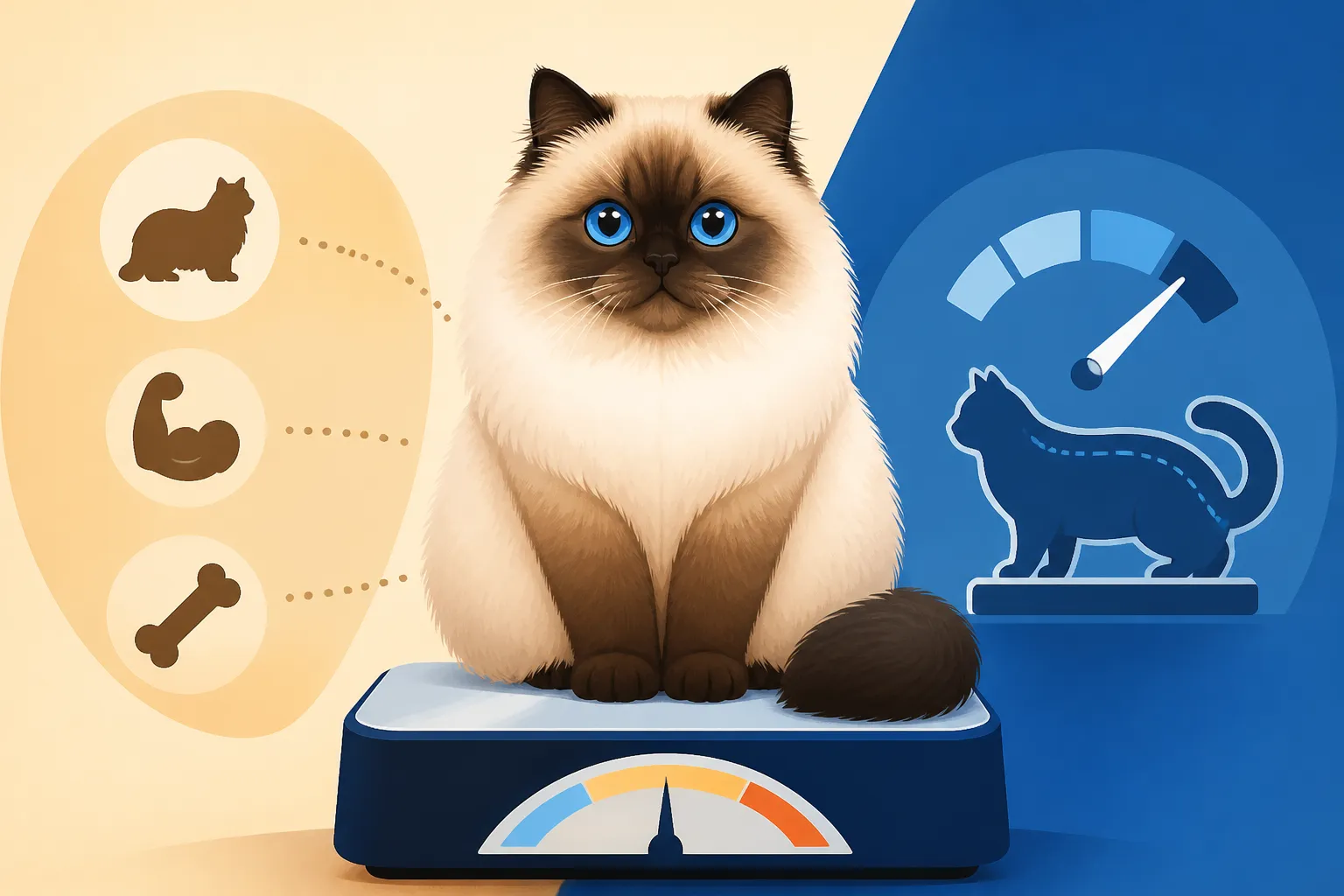
The word “weights” can sound as if the Himalayan standard sets a preferred number of pounds. In practice, a breed standard describes the features a judge looks for; it is not a weight chart. A cat’s size on a scale does not establish whether its proportions, head, coat, or coloring meet the standard.
The Himalayan is generally judged within Persian type, although registry terminology and show arrangements can differ. That means the standard emphasizes a rounded, substantial appearance, a full coat, and a head with the characteristic Persian shape, alongside the colorpoint pattern. The goal is not simply to find the biggest cat or the palest body coat. It is to assess how the features work together.
For a pet owner, this distinction matters too. A thick coat can make a Himalayan look much heavier than it is, and a compact, sturdy frame does not automatically mean a cat is overweight. To assess body condition, feel for the ribs and waist beneath the fur and ask a veterinarian to interpret what you find. A scale reading alone is only one part of the picture. For more on the breed’s general size, see How Heavy a Full Grown Himalayan Gets.
No single feature should be judged in isolation
A Himalayan’s eyes, face, coat, body, and points contribute to its overall appearance. A particularly vivid eye color cannot compensate for every other feature, just as a beautiful coat does not tell you whether a cat has sound proportions. Judges consider the whole animal against the applicable standard rather than awarding an invented universal score to each trait.
That is also why comparisons between show cats can be difficult for new owners. One cat may have a striking profile, while another presents a fuller coat or more clearly defined points. Which details matter most can depend on the standard and the judging context. It is safer to think in terms of a coordinated breed type than to assume a single feature guarantees a win.
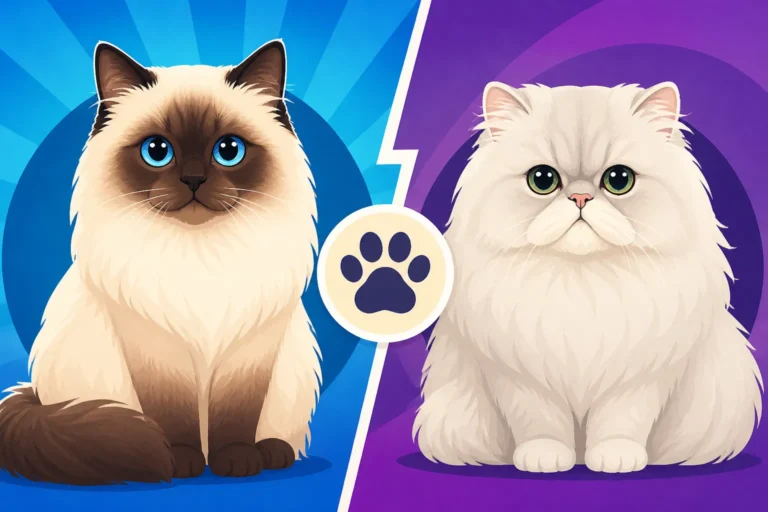
The standard is also not a health certificate. A cat’s appearance cannot confirm that it has healthy eyes, kidneys, teeth, or breathing. When choosing a kitten, ask about health history and relevant testing as well as appearance. The distinction between a Persian-type head and the pointed coat pattern is explored in What the Persian Standard Asks of a Himalayan.
The features that shape Himalayan type
The head and profile are central to the overall look
The Himalayan’s head is a major part of its recognizable type. Breed descriptions emphasize a rounded head, a short nose, full cheeks, and large, round eyes set in a broad face. The profile is especially noticeable because the nose and forehead create the characteristic flattened appearance. The precise wording and ideal presentation can vary by registry, so a breeder or exhibitor should identify which standard they are using.
A profile should not be reduced to “the flatter, the better.” The standard describes a particular shape, but extreme facial structure can be associated with practical concerns such as noisy breathing, eye irritation, or difficulty keeping facial folds clean. If you are evaluating a kitten, look at its face from the side and watch it breathe while resting and after ordinary activity. Ask the breeder about veterinary assessments instead of relying on photographs alone.
The head also needs to fit the body. A round face on a narrow, lightly built frame may not give the same overall impression as a broad head on a sturdy, compact body. For a closer explanation of how facial structure is considered, read Why a Himalayan’s Head Is Judged as a Persian’s and What a Himalayan’s Profile Should Look Like Side On.
Body structure and proportion matter more than apparent bulk
The Himalayan is commonly described as cobby: compact, broad, and substantial in build, with relatively short legs. That does not mean a cat should be heavy from excess body fat. A dense coat can disguise both the cat’s natural outline and changes in its condition, so judges and owners need to distinguish sound structure from unnecessary weight.
Look for balance rather than size alone. The body should appear sturdy in relation to the head and legs, while the coat contributes to the breed’s rounded silhouette. A cat that is carrying excess weight may have difficulty grooming, moving comfortably, or reaching its hindquarters. Those are welfare concerns, not show virtues.
At home, use your hands as well as your eyes. Gently feel along the ribs and spine, since a Persian-length coat can hide contours that would be easy to see on a shorthaired cat. If you are uncertain, have your veterinarian check body condition during a routine visit. For more about the breed’s compact shape, see Why the Himalayan Is Described as Cobby.
| Feature | What the standard generally emphasizes | What it does not mean |
|---|---|---|
| Head and profile | A rounded Persian-type head and characteristic short profile | That the flattest possible face is automatically best |
| Body | A compact, sturdy, balanced build | That a higher number on the scale means better type |
| Coat | A long, full coat that contributes to the overall outline | That coat volume proves the cat is healthy or fit |
| Colorpoint pattern | Distinct points against a lighter body coat, with blue eyes | That color alone determines quality |
| Overall presentation | Harmony among the cat’s features | That one striking trait can replace the rest |
Coat, color, and eyes in the standard
The coat contributes to silhouette and presentation
A Himalayan’s long coat is more than decoration: it changes the way the cat’s proportions appear. A full coat and ruff can make the body look broader and rounder, while tangles or uneven grooming may obscure the outline. Coat quality and condition therefore influence the cat’s presentation, but a large coat should not be mistaken for a large frame.
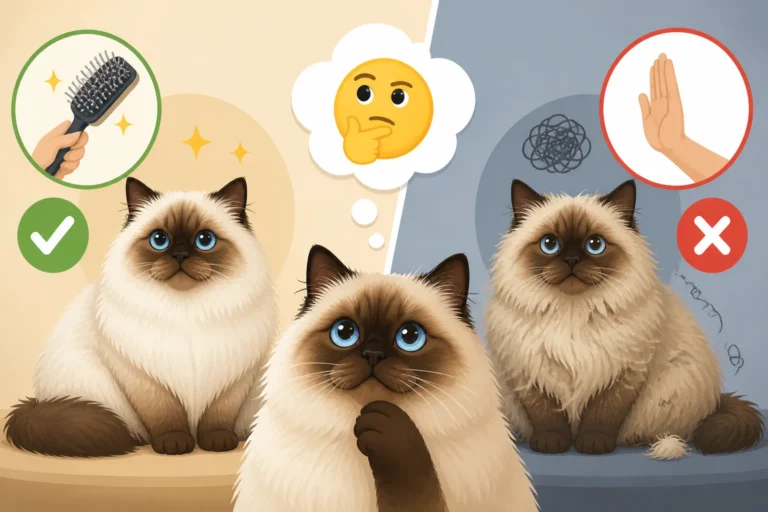
Regular grooming is especially useful for owners trying to understand their cat’s natural build. Combing down to the skin can reveal mats, changes in body condition, or areas the cat has stopped grooming. If you are shopping for supplies, Chewy is one place owners may look for a suitable metal comb, but the tool matters less than using it gently and checking that it reaches through the undercoat. A brush that only smooths the surface can leave tight tangles hidden underneath.
For show preparation, grooming should support the coat rather than conceal problems. At home, it is practical care: short, consistent sessions are usually easier for a cat to tolerate than a long struggle after mats have formed. The breed’s coat and how it affects the outline are part of a larger picture described in How a Himalayan’s Coat Should Feel in the Ring.
Point color and blue eyes are defining features, not the whole standard
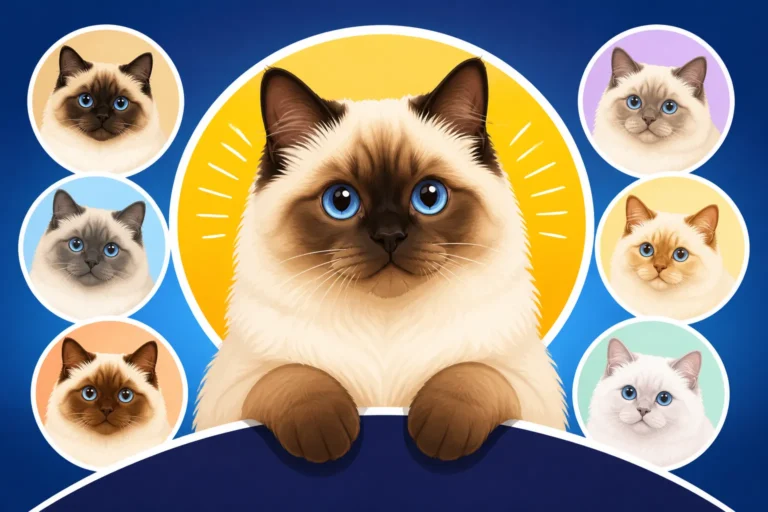
The Himalayan’s colorpoint pattern sets it apart from a solid-colored Persian. The face, ears, legs, and tail are darker than the body, and the eyes are blue. Because temperature affects where darker pigment develops, a Himalayan’s point color and body contrast can change over time. Age, coat growth, and shaved patches can also affect how the coloring looks.
A strong visual contrast may catch the eye, but color should be considered alongside type and condition. A pale body coat does not make a cat well-built, and dark points do not tell you whether it has healthy eyes or clear breathing. The specific color descriptions and judging criteria depend on the applicable registry standard. See How a Himalayan’s Points Are Judged for more on the role of the points.
Blue eyes are an essential part of the breed’s familiar appearance, but eye color is not a substitute for eye health. Owners should notice persistent squinting, redness, cloudiness, or discharge and seek veterinary advice when these appear. If ordinary face cleaning is part of your routine, Chewy may carry supplies such as soft cotton pads, but use products around the eyes only when they are appropriate for cats. The standard’s eye-color requirement is discussed in Why Only Blue Eyes Are Allowed on a Himalayan.
Using the standard when choosing or caring for a Himalayan
Ask what standard the breeder follows
If you are speaking with a breeder, ask which registry the kitten is registered with and which standard they use when describing its type. This helps avoid confusion when one person calls a cat a Himalayan and another describes it as a colorpoint Persian. The names and categories can differ across organizations, even when people are talking about cats with a very similar appearance.
Ask practical questions alongside the show-related ones. Request to see the kitten’s parents, including a side view and a relaxed view of the face. Ask how the kitten breathes during ordinary activity, what grooming it is used to, and what health screening has been done in its family. A photograph can show coat color, but it cannot reliably answer every question about comfort, movement, or health.
A responsible conversation should leave room for the kitten’s welfare, not just its appearance. Be wary of claims that a particular face shape or rare color alone proves exceptional quality. To understand how registration terminology can affect the breed name on paperwork, see How to Tell a Himalayan From a Persian.
Choose practical health and care over a show-ring checklist
For a pet home, the most useful parts of the standard are the ones that help you understand what the cat needs. A long coat calls for regular grooming; a shortened face may mean paying attention to breathing and eye comfort; and a sturdy build makes it worth monitoring body condition rather than guessing from appearance. These needs matter whether or not the cat is ever shown.
Set up care routines that are comfortable for the individual cat. Use a shallow, easy-to-reach dish if a deep bowl makes eating awkward, introduce grooming gradually, and pause if your cat becomes distressed. Chewy can be a convenient place to compare grooming tools or shallow bowls, but check that a product suits your cat’s size and needs rather than buying something simply marketed for the breed.
Finally, treat the standard as a description of breed type—not a promise of health or a reason to overlook warning signs. Breathing that seems labored, persistent eye discomfort, or difficulty moving comfortably deserves attention from a veterinarian. The best-looking Himalayan is not necessarily the healthiest, and a pet’s comfort matters more than matching a show photograph.
Disclaimer
This article is for general informational purposes only and does not constitute professional advice. Laws, prices and regulations vary by location and change over time. Consult a qualified professional for guidance on your specific situation.