Which Breeds Carry Himalayan Blood
A pointed coat can make a cat look Himalayan, but color alone does not prove Himalayan ancestry. The answer depends on pedigrees and breed-development history: some breeds have documented Himalayan or Persian colorpoint contributions, while others share only the temperature-sensitive colorpoint pattern. Here’s how to tell those connections apart and what they mean when you’re researching a cat’s family tree.
What Himalayan blood means
Himalayan ancestry is more specific than pointed coloring
“Himalayan blood” usually means a cat has Himalayan ancestors in its documented pedigree. The Himalayan was developed from Persian and Siamese cats, combining a Persian-style coat and body with the Siamese-derived colorpoint pattern. In some registries, the Himalayan is treated as a Persian variety or division rather than as a completely separate breed. That makes its ancestry especially closely connected with Persian lines.
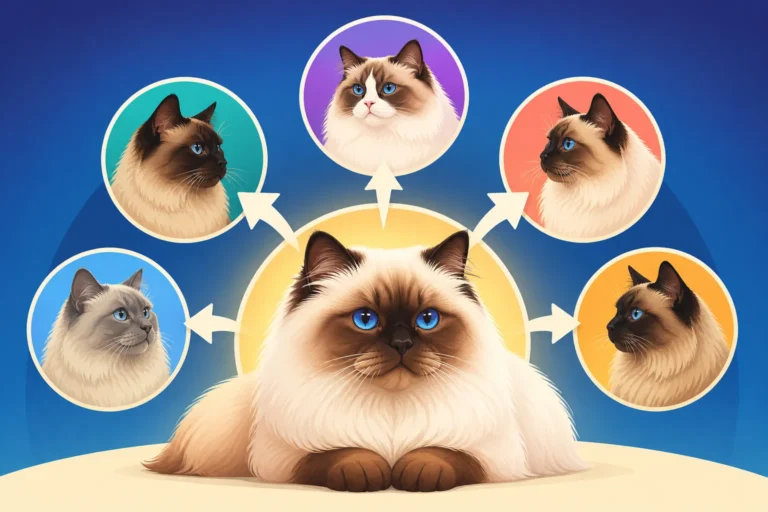
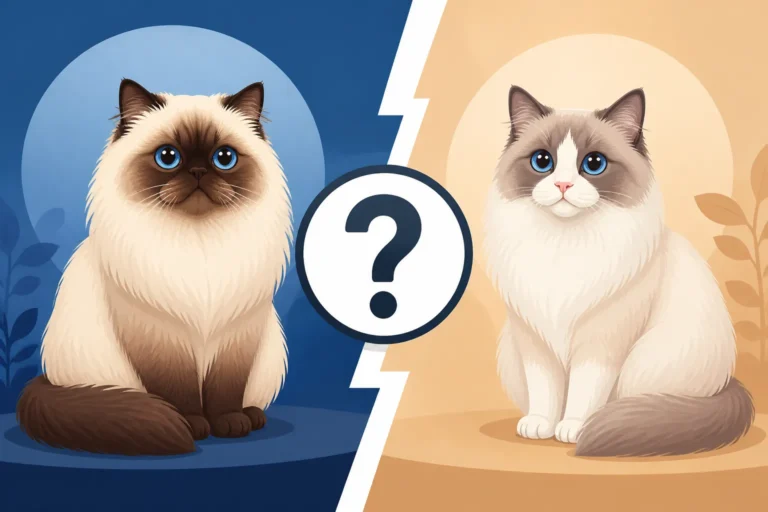
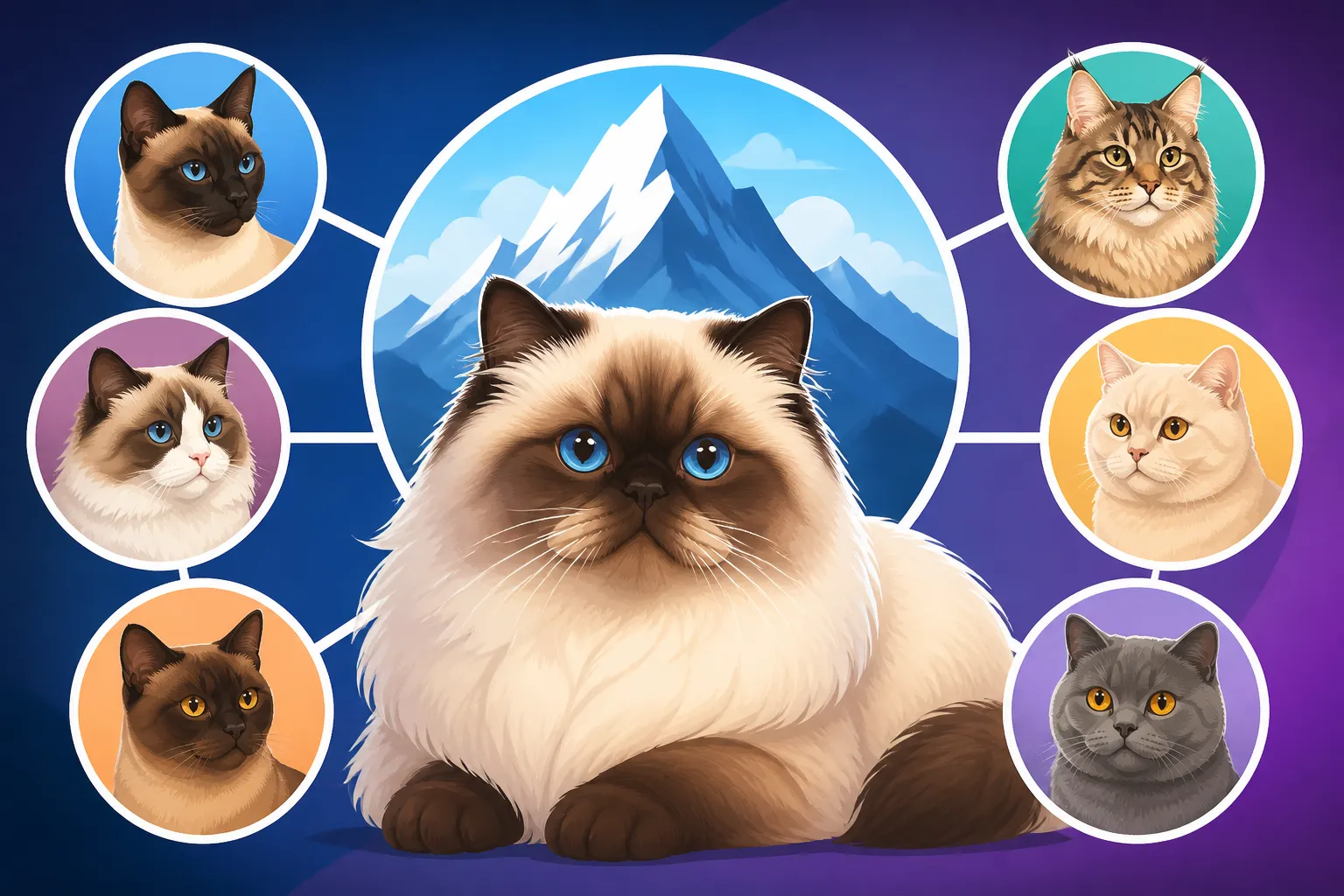
The point pattern alone does not establish that a cat has Himalayan relatives. Siamese, Birman, Ragdoll, Balinese, and other pointed cats may have darkened ears, faces, paws, and tails because of colorpoint genetics. Those markings can resemble a Himalayan’s, but resemblance is not the same as descent. The history of colorpoint patterns across breeds is explained in Which Other Animals Carry the Himalayan Pattern and Why a Himalayan Is Named After a Rabbit.
A Persian may also carry the gene for pointed coloring without looking pointed itself. That means a cat’s visible appearance can’t always reveal all the color genetics or ancestry behind it. To understand the difference between a pointed coat and a documented Himalayan relationship, it helps to know How a Persian Can Carry the Himalayan Gene Hidden and Why the Himalayan Is a Persian With the Point Gene.
Registries can describe the same ancestry differently
Breed names on paperwork can be confusing. One organization may list a Himalayan separately, while another may register the same type under a Persian division or colorpoint category. A pedigree might therefore show “Himalayan,” “Colorpoint Persian,” or “Persian,” depending on the registry and the cats’ recorded lines.
That wording does not automatically make the ancestry more or less real. What matters is whether the pedigree traces the individual cat’s parents and earlier generations. A seller’s casual description such as “Himalayan mix” is not the same as a documented pedigree, and a pointed coat is not proof of a Himalayan ancestor.
If you are checking a pedigree, look for the actual breed or variety listed for each generation, rather than relying on a single label in an advertisement. How the Himalayan Is Registered by TICA Today and How the Himalayan Is Registered by CFA Today explain why the paperwork may differ between registries.
Breeds with a documented Himalayan connection
Persian
The Persian is the clearest and closest breed relationship. Himalayans were created by crossing Persian and Siamese cats, and many registries place Himalayan cats within the Persian breed structure. In some settings, “Himalayan” refers to the pointed Persian variety rather than a fully separate breed category.
This connection is more than a shared appearance. Persian cats contributed the long coat, rounder build, and many of the physical traits associated with the Himalayan. The Siamese contribution supplied the colorpoint pattern. A Himalayan pedigree may therefore sit within Persian records, and Persian breeding lines may include cats with Himalayan coloring or ancestry.
Still, not every Persian has Himalayan ancestry in a recent generation, and not every Persian carries the point gene. A particular cat’s relationship depends on its own pedigree and genetic inheritance. The registry history is covered in Why CFA Made the Himalayan a Persian Division in 1984 and Why CFA Called the Himalayan a Persian Variant.
Exotic Shorthair
The Exotic Shorthair has a close relationship to Persian and Himalayan lines. It was developed to produce a shorthaired cat with a Persian-like appearance, and Persian cats were central to that development. Himalayan cats and other colorpoint Persians can be part of the broader ancestry or breeding history of some Exotic lines.
That does not mean every Exotic Shorthair has a Himalayan parent or grandparent. Breed histories describe how a breed was formed overall; they do not establish the exact ancestry of every individual cat. A specific Exotic’s pedigree is the only reliable way to confirm whether Himalayan ancestors appear in its family tree.
The Exotic’s short coat also does not erase its connection to Persian-type ancestry. It can share facial structure and body traits with longhaired relatives while requiring a different grooming routine. For a comparison of the breeds’ appearances, see Why an Exotic Shorthair Has a Himalayan’s Face Without the Coat.
Selkirk Rex
The Selkirk Rex was developed using several breeds, including Persian-related cats and Exotic Shorthairs. Himalayan cats may appear in some Selkirk Rex pedigrees or breeding histories, but that connection should not be assumed for every Selkirk. The breed’s ancestry can vary by line, and the individual pedigree is what confirms a particular cat’s family background.
The Selkirk Rex is best known for its curly coat, which comes from a different genetic trait than Himalayan points. A Selkirk can have Persian or Himalayan ancestry without having a Himalayan coat pattern, and a pointed Selkirk’s coloring does not, by itself, prove Himalayan descent.
This is a useful example of why “blood” and “looks” need to be considered separately. One cat can inherit coat texture from one branch of its family and color pattern from another. A breed history describes possible ancestry; a pedigree identifies the ancestry recorded for the cat in front of you.
Minuet
The Minuet, formerly known as the Napoleon, was developed by combining Munchkin cats with Persian-family breeds. Depending on the line, that Persian-family contribution may include Persians, Himalayans, or Exotic Shorthairs. As with Selkirk Rex cats, the existence of Himalayan ancestry in some lines does not mean it is present in every Minuet.
A Minuet’s short legs are associated with its Munchkin ancestry, while its coat and facial characteristics may reflect Persian-family ancestors. Those visible traits can make the breed’s background look like a blend of several different influences, but appearance alone cannot tell you which specific ancestors were Himalayan.
If the question is whether an individual Minuet carries Himalayan blood, ask for its pedigree and check the recorded ancestors. The broader breed-development story can point you toward likely connections, but it cannot substitute for documentation.
| Breed or group | Relationship to Himalayan ancestry | What appearance alone can tell you |
|---|---|---|
| Persian | Closest relationship; Himalayan cats may be registered within Persian categories | A Persian-looking body does not confirm a pointed ancestor |
| Exotic Shorthair | Developed with Persian-family influence; some lines may include Himalayan ancestry | A short coat does not rule out Himalayan relatives |
| Selkirk Rex | Developed using Persian-related breeds; Himalayan ancestry may occur in some pedigrees | Curly fur is not evidence of Himalayan descent |
| Minuet | Persian-family breeds, which can include Himalayans, may appear in its development | Short legs and a round face do not identify specific ancestors |
| Siamese, Birman, Ragdoll, and other pointed breeds | May share the colorpoint appearance without established Himalayan ancestry in a particular cat | Pointed markings alone do not prove Himalayan blood |
Pointed breeds that are not automatically Himalayan descendants
Shared colorpoint markings do not prove shared family lines
Siamese cats are an important part of the Himalayan’s origin because the colorpoint pattern came through Siamese ancestry. But that does not mean every Siamese today descends from a Himalayan. In fact, the relationship often runs the other way in the origin story: the Siamese contributed to the development of the Himalayan.
Birman and Ragdoll cats can also have pointed coats, but that feature is not enough to establish Himalayan ancestry. Their breed histories and pedigrees must be considered separately. A seal-point cat with a pale body and dark mask may look familiar, yet the same general pattern can appear through different lines and breed histories.
The same caution applies to Balinese, Colorpoint Shorthairs, and other pointed cats. Their coloring can come from point-pattern genetics without a known Himalayan ancestor in the pedigree. For a closer look at why the pattern appears in different animals, read Which Other Species Show the Himalayan Pattern.
What to ask when a seller says “Himalayan blood”
If a breeder or seller says a cat has Himalayan blood, ask what they mean. Are they describing a documented ancestor in the pedigree, a colorpoint coat, a Persian-like face, or simply a family resemblance? Those are different claims, and a clear answer should distinguish them.
Ask to see the pedigree and identify where the Himalayan or colorpoint Persian ancestor appears. If the cat is registered, compare the paperwork with the registry’s naming conventions. If it is a mixed-breed cat without formal papers, the seller may be sharing family information, but that statement should not be treated as verified ancestry unless it is supported by records.
A responsible conversation does not need to feel confrontational. You can say, “When you say Himalayan, do you mean the cat has a Himalayan ancestor in its pedigree, or that it has a pointed coat?” That simple question often clears up whether the description is about lineage or appearance. What a Himalayan Buyer Should Ask About Registration offers more background on how to interpret breed paperwork.
How to check a cat’s ancestry responsibly
Read the pedigree rather than guessing from coat and face
Start with the cat’s registration documents, if available. Look for the breed or variety listed for the parents and grandparents, and note which registry issued the record. Since Himalayan naming can vary, a Persian or Colorpoint Persian entry may be relevant even if the word “Himalayan” does not appear on every line.
Then check whether the seller’s claim matches the documents. If a Himalayan ancestor is said to be several generations back, ask which generation and whether the breeder can show the relevant records. A pedigree is most useful when it traces the actual cat rather than simply describing the general history of its breed.
When no pedigree exists, be precise about what is known. “Pointed domestic longhair” describes visible traits. “Himalayan mix” suggests ancestry but may be unverified. “Has a documented Himalayan grandparent” is a specific pedigree claim that should be supported with records.
Separate ancestry from care needs
Himalayan ancestry can be interesting, but it does not by itself tell you everything about a cat’s health, temperament, or grooming needs. Individual features matter. A long, dense coat may need regular combing whether or not a Himalayan appears in the pedigree. A shortened face may call for attention to breathing, eyes, and eating comfort, but those concerns should be assessed in the individual cat rather than assumed from a breed label.
For longhaired cats, a steel comb and patient, consistent grooming can help catch tangles before they tighten into mats. Chewy is one retailer where owners may compare basic grooming supplies, but the right tool depends on the cat’s coat and tolerance. Introduce grooming in short, calm sessions rather than waiting until a knot has become painful.
A pale coat or tear marks can also lead owners to look for face-cleaning products. Chewy may offer a range of cat-care supplies, but avoid putting products near the eyes unless their labeling and your veterinarian’s advice support that use. Gentle wiping with an appropriate method is safer than scrubbing stained fur or trying unverified home remedies.
If you are preparing for a new cat, focus on its actual daily needs: coat length, face shape, activity level, and comfort with handling. Chewy can be one place to compare routine supplies such as shallow dishes or combs, but a retailer’s product listing cannot confirm ancestry or replace a veterinary recommendation. The most useful decision comes from combining honest pedigree information with direct observation of the cat.
Disclaimer
This article is for general informational purposes only and does not constitute professional advice. Laws, prices and regulations vary by location and change over time. Consult a qualified professional for guidance on your specific situation.