What Retinal Atrophy Does Behind a Himalayan’s Blue Eyes
One of the most heartbreaking discoveries for any Himalayan owner is noticing changes in their beloved cat's vision. It’s an unsettling thing to realize your furry companion might be struggling to navigate their familiar world. When we talk about eye conditions in Himalayans, one that often comes up is Retinal Atrophy, a genetically inherited disease that unfortunately leads to blindness. This guide is here to walk you through what Retinal Atrophy is, how it progresses, and what you can do to support your Himalayan if they are affected.
Understanding Retinal Atrophy in Himalayans
Retinal atrophy, often referred to as Progressive Retinal Atrophy (PRA), isn't just one single disease but rather a group of degenerative disorders that affect the retina, the light-sensitive tissue at the back of your cat's eye. Think of the retina as the film in an old camera; it captures the images and sends them to the brain. In Himalayans, this condition is primarily inherited, tracing its lineage back to the Persian side of their ancestry. It's a cruel twist of genetics that can slowly diminish a cat's world.
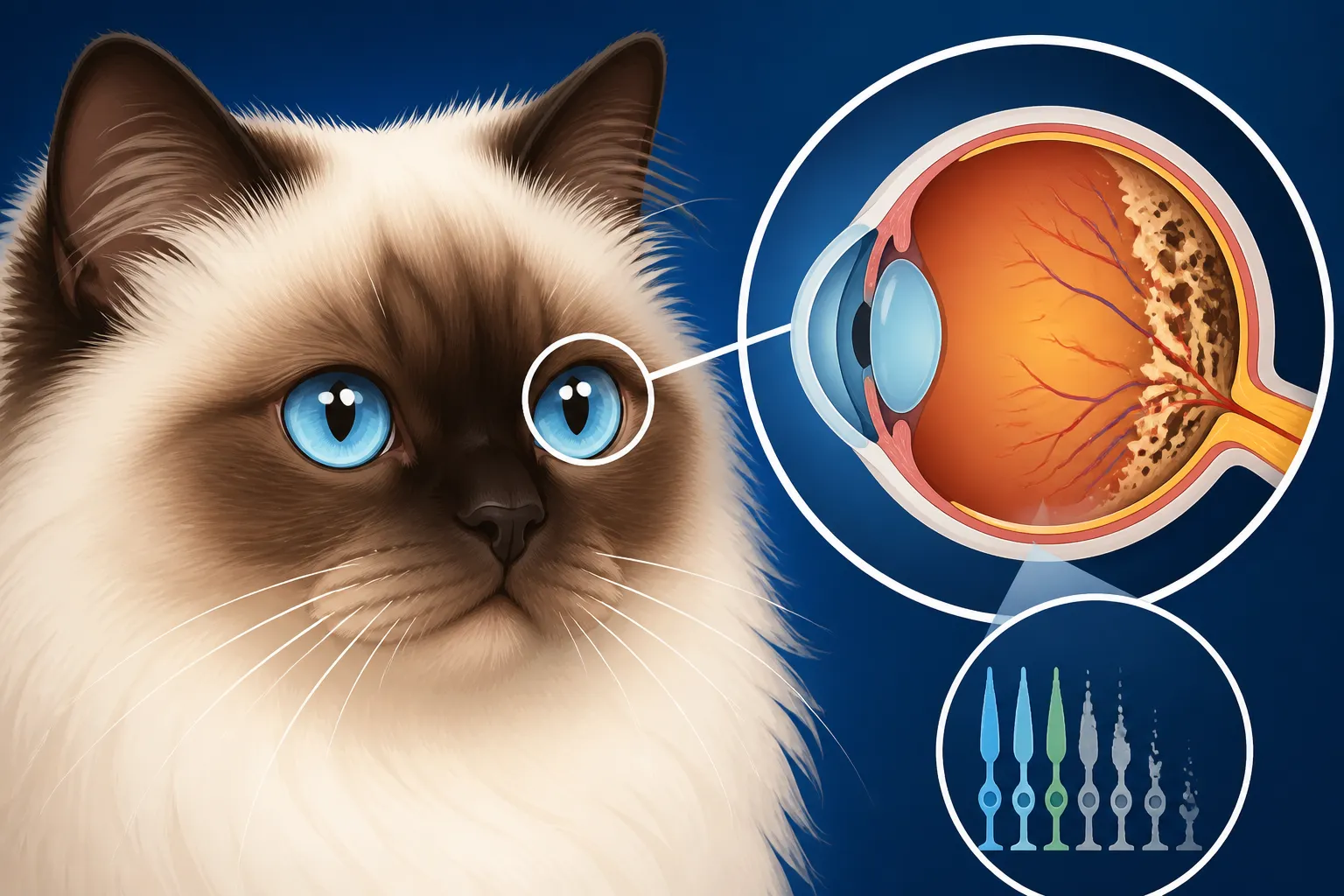
The disease targets the photoreceptor cells within the retina – specifically the rods and cones. Rods are responsible for vision in low light and detecting movement, while cones handle bright light and color perception. Depending on the specific form of PRA, either the rods or cones (or both) can be affected, leading to a gradual loss of function. For many Himalayan owners, the first subtle signs might go unnoticed because cats are incredibly adept at compensating for vision loss, especially in familiar environments. They rely on their other keen senses, like hearing and smell, to get around, making it a challenge for us to spot the problem early on.
This is a progressive condition, meaning it doesn't happen overnight. It’s a slow, insidious process where the retinal cells gradually degenerate and die off. While it's not painful for your cat, the eventual outcome is complete blindness. The genetic basis means that responsible breeding practices are absolutely paramount to prevent this devastating disease from being passed down through generations. Understanding this genetic link is the first step in addressing and ultimately reducing the prevalence of PRA in our beloved Himalayans.
What Happens Inside the Eye
To truly grasp what Retinal Atrophy does, imagine the delicate structures within your Himalayan’s eye. The retina is a thin layer of tissue containing millions of specialized cells, the photoreceptors. These cells are packed with light-sensitive pigments that convert light into electrical signals. These signals are then transmitted along the optic nerve to the brain, where they are interpreted as images. It’s a marvel of natural engineering, allowing our cats to see the world, chase sunbeams, and follow a toy.
When PRA strikes, these photoreceptor cells begin to break down. In some forms, the cells develop abnormally and die off at an early age (retinal dysplasia), while in others, they develop normally but then degenerate over time (progressive rod-cone degeneration). For Himalayans, the latter is more common. Initially, the rods, which are crucial for night vision, are often the first to go. This explains why many cats with early PRA struggle more in dimly lit rooms or become hesitant to move around after dark.
As the disease progresses, the cones also begin to fail. This leads to a loss of daytime vision and eventually, complete blindness. The changes occurring at a cellular level are irreversible, and sadly, there is no cure or treatment currently available that can restore vision once it's lost due to PRA. It’s a hard truth, but facing it allows us to focus on quality of life and prevention for future generations.
The Genetic Link from Persian Ancestry
The Himalayan cat, as we know, is a beautiful blend of the Persian and the Siamese. While the Siamese contributed the striking point coloration and blue eyes, it’s often the Persian side that carries the predisposition for certain health issues, including various forms of Retinal Atrophy. This means that if your Himalayan has PRA, it’s highly probable that one or both of its Persian ancestors passed on the faulty gene.
Scientists have identified specific genetic mutations linked to different forms of PRA in various cat breeds, including Persians and, by extension, Himalayans. For example, there's a known mutation called rdAc (rod-cone degeneration, allele c) that affects photoreceptor cells. A cat needs to inherit two copies of this faulty gene (one from each parent) to be affected by the disease. Cats with only one copy are carriers; they don't develop PRA themselves but can pass the gene on to their offspring. This is why a thorough understanding of a cat's genetic background is crucial for responsible breeders. Ignoring this genetic reality means perpetuating a cycle of suffering for future kittens and their unsuspecting families.
How Retinal Atrophy Impacts Your Himalayan's Vision
The journey of vision loss due to Retinal Atrophy is a gradual one, and it can be incredibly challenging for both the cat and their owner. Imagine waking up one day and realizing the world around you is slowly fading into darkness. While our cats don't experience it exactly that way, the psychological impact can be significant. They might become more cautious, start bumping into things, or show changes in their usual playful behavior. It’s a stark reminder of how much we rely on our sight, and how disorienting its loss can be.
The typical age of onset for clinically noticeable signs in Himalayans can vary, but it often becomes apparent between two and five years of age. However, the genetic mutation might be present from birth, with the degeneration silently progressing. Owners frequently report a progression from night blindness to complete blindness over a period of months to a couple of years. It’s a sad reality that this beautiful breed, known for its serene demeanor, can face such a profound challenge in their relatively young lives. You might notice subtle shifts first, like a reluctance to jump off furniture in the evening, or perhaps they startle more easily when approached from an unexpected direction. These aren't just quirks; they're vital clues.
It's also worth noting that because the deterioration is usually slow, Himalayans are often very adaptable. They learn to map their environment in their minds, using their whiskers, hearing, and powerful sense of smell to navigate. This remarkable adaptability, while a blessing, can also mask the severity of the vision loss, making it harder for owners to pinpoint the exact stage of the disease. That’s why vigilance and knowing what signs to look for are so important.
Early Warning Signs and Progression
Recognizing the subtle cues that your Himalayan's vision might be failing is key. The earliest signs often relate to night blindness, medically termed nyctalopia. Your cat might hesitate to enter dimly lit rooms, or they might bump into furniture they usually navigate with ease after sundown. You might notice their pupils appearing more dilated than usual, especially in normal lighting, as their eyes try to gather every speck of available light. This widespread pupil dilation is a classic sign as the retina struggles to respond normally.
As the disease advances, daytime vision also deteriorates. Your Himalayan might start bumping into objects even in bright light, become less coordinated, or appear disoriented in new environments. They may also show increased reliance on their other senses, such as hearing and smell. For instance, they might respond more acutely to sounds or become more sensitive to changes in scent patterns around the house. They might also become less inclined to play with toys that require tracking movement, preferring interactive toys that make noise or are scented. If you notice your cat seeming less enthusiastic about their favorite wand toy, it could be a signal that their sight is faltering.
Another visual clue can be the reflection from their eyes when light shines on them. As the retina degenerates, the tapetum lucidum (a reflective layer behind the retina) can become more prominent, leading to an exaggerated "eyeshine" that seems unusually bright or green. While this isn't diagnostic on its own, combined with other symptoms, it can be a strong indicator that something is amiss. It’s crucial to seek veterinary attention if you observe any of these changes, even if they seem minor. Early detection, while not curing the condition, allows you to prepare and make adjustments to your cat's environment to ensure their safety and comfort.
Distinguishing PRA from Other Eye Conditions
It's important to remember that not all vision problems in Himalayans are due to Retinal Atrophy. Other conditions can affect their eyesight, and it takes a thorough veterinary examination to get an accurate diagnosis. For example, cataracts, where the lens of the eye becomes cloudy, can also cause vision impairment. Glaucoma, characterized by increased pressure within the eye, can be very painful and lead to rapid vision loss. Sometimes, infections or injuries can also affect vision.
The distinguishing factor for PRA is its progressive, non-painful nature and the specific way it impacts the photoreceptor cells. A veterinary ophthalmologist can perform specialized tests, such as an electroretinogram (ERG), which measures the electrical responses of the retina to light. This test is highly effective in diagnosing PRA, even before clinical signs become overt. Other tests, like ophthalmoscopy, allow the vet to visualize the retina directly and look for characteristic changes like retinal thinning or pigmentary abnormalities. Genetic testing, which we'll discuss shortly, can confirm the presence of specific mutations linked to PRA. For a comprehensive understanding of eye health, you might also want to read about How Retinal Atrophy Blinds a Himalayan by Five.
| Symptom / Condition | Progressive Retinal Atrophy (PRA) | Cataracts | Glaucoma |
|---|---|---|---|
| Pain | No (vision loss only) | No (unless severe inflammation) | Yes (often severe) |
| Onset | Gradual, progressive | Gradual | Rapid |
| Pupil Appearance | Often dilated, poor light response | Cloudy/opaque lens, visible to naked eye | Dilated, fixed, unresponsive pupil |
| Night Vision | First affected, significant impairment | Affected, but not exclusively | Affected, but generalized loss |
| Eyeball Appearance | May appear normal initially, then tapetal shine | Cloudy lens | Enlarged, bulging eye, redness |
| Genetic Predisposition | High, inherited from Persian side | Can be inherited or secondary | Can be inherited or secondary |
| Diagnostic Test | ERG, Ophthalmoscopy, Genetic Test | Ophthalmoscopy, Slit Lamp Exam | Tonometry (IOP measurement) |
Managing Life with a Himalayan Facing Vision Loss
Discovering your Himalayan is losing their sight is undoubtedly upsetting. It’s natural to feel a pang of sadness or even helplessness. However, it's crucial to remember that a blind cat can still live a very happy and fulfilling life. Your Himalayan relies on you for stability, comfort, and a consistent environment. The most important thing you can do is adjust their world to make it as safe and navigable as possible. They still love to cuddle, they still enjoy their favorite nap spots, and they still need your affection more than ever. It's about shifting your perspective and focusing on their remaining senses.
One of the biggest frustrations for owners is feeling like they can't "fix" it. And while we can't restore their sight, we can empower them to thrive. This means creating a predictable and unchanging home environment. Don't move furniture around unless absolutely necessary, and if you do, do it slowly and allow them time to adapt. Keep their food bowls, water dishes, and litter boxes in the same, easily accessible spots. Consistency truly is king for a blind cat. For more specific guidance on environmental adjustments, you might find insight in articles discussing What to Leave Where for a Himalayan Losing Its Sight.
Remember that your voice becomes their guiding light. Talk to them as you approach, let them know you're there. Use consistent verbal cues for different actions, like "up" for getting on the sofa or "down" for getting off. Their sense of hearing will become incredibly acute, and your familiar voice can provide immense comfort and reassurance. It's a journey that requires patience, empathy, and a whole lot of love, but it’s a journey you can navigate together, strengthening your bond in the process.
Creating a Safe and Predictable Home Environment
The cardinal rule for living with a vision-impaired Himalayan is consistency. Cats thrive on routine and familiarity, and for a cat losing its sight, this becomes paramount. Avoid rearranging furniture. If you absolutely must move something, do it gradually, allowing your cat time to explore and re-map their environment with their whiskers, paws, and memory. Block off dangerous areas like stairs with pet gates, especially in the early stages as they adjust. For outdoor access, a fully enclosed and escape-proof "catio" can be a safe way for them to enjoy fresh air without the dangers of the outside world.
Think about sensory markers. You can use different textures of mats in front of their food bowls or litter boxes to signal where they are. Small, subtle scent cues, like a drop of essential oil (cat-safe, like lavender or chamomile, used sparingly and away from their direct scent path) on a favorite bed or a specific corner they frequent, can also help them orient themselves. Always keep their litter boxes, food, and water in predictable, easy-to-reach locations. A wider, shallower water bowl might also be more accessible for a cat who can't see the water level. Ensure any sharp corners or edges of furniture are padded to prevent accidental bumps and injuries.
Investing in toys that make noise or have strong scents can enrich their lives. Ball toys with bells inside, crinkle balls, or even catnip-filled toys can engage their other senses and encourage play. Continue to interact with them, perhaps using a gentle voice and slow movements when approaching, always letting them know you are there before you touch them. A strong bond and a sense of security from you will be their greatest asset.
Veterinary Support and Ongoing Care
While there's no cure for PRA, regular veterinary check-ups are still incredibly important. Your vet can monitor the progression of the disease and address any secondary issues that might arise. For instance, sometimes eyes affected by PRA can be more prone to other conditions. Your vet will ensure there are no other underlying issues contributing to their discomfort or vision loss. They can also offer advice on pain management if your cat develops other age-related issues, ensuring any medication is suitable for cats with potential kidney predispositions, which is also a concern in Himalayans.
It's also a good opportunity to discuss their overall health. As our Himalayans age, they can develop other conditions that, while unrelated to their eyes, can impact their quality of life. An annual check-up, including blood work, is always a good idea, especially as they get older. If you have pet insurance like Healthy Paws, they can sometimes help with the costs associated with diagnostic tests or any subsequent care, ensuring you can provide the best possible support without financial strain. Discussing your cat's specific needs with your vet is paramount to tailoring a care plan that supports them holistically.
Your vet can also connect you with resources for owners of blind cats, which can offer invaluable support and practical tips. They can explain more about How a Himalayan Behaves as Its Sight Goes and what to expect. While the prognosis for vision restoration is nil, the prognosis for a long, happy life with appropriate care and a loving owner is excellent.
Prevention and Genetic Testing
This is where we, as a community of Himalayan lovers, can make the biggest difference. The devastating reality of Retinal Atrophy is that it's largely preventable through responsible breeding practices. Knowing the genetic markers allows breeders to make informed decisions that can gradually eliminate this disease from future generations of Himalayans. It's not a quick fix, but it's the most ethical and impactful path forward.
For anyone considering bringing a Himalayan kitten into their home, asking about genetic testing is not just a good idea – it's an absolute necessity. A reputable breeder will be transparent about their cats' health clearances, including genetic tests for PRA and other common hereditary conditions. If a breeder is evasive or dismissive about testing, it should raise a significant red flag. This isn't just about avoiding a heartbreaking diagnosis; it's about supporting ethical breeding and the long-term health of the breed.
The future of the Himalayan breed, free from the shadow of diseases like PRA, lies in diligent testing and careful selection. Every step we take to support responsible breeding helps ensure that these beautiful, gentle cats can live their lives to the fullest, with the best possible start. It truly falls on all of us to demand and support these practices.
The Importance of Screening Breeding Stock
For breeders, screening their breeding stock for the specific genetic mutations linked to PRA is one of the most critical responsibilities they have. This usually involves a simple DNA test, often done via a cheek swab, that can identify whether a cat is clear, a carrier, or affected by the disease. A clear cat does not have the gene and cannot pass it on. A carrier cat has one copy of the gene; they won't develop PRA themselves but can pass it to 50% of their offspring. An affected cat has two copies of the gene and will develop PRA.
Ethical breeding dictates that affected cats should never be bred. Carriers should only be bred to clear cats, and then their offspring should also be tested to ensure the faulty gene is not further propagated. The goal is to eventually breed out the gene entirely from the line. Organizations like the Cat Fanciers' Association (CFA) and The International Cat Association (TICA) provide guidelines and often encourage such testing among their registered breeders. If you're planning to get a kitten, don't hesitate to ask a breeder for proof of genetic testing for PRA in both parent cats. A breeder who proudly shares these results, perhaps even mentioning a specific test like the OptiGen PRA test, demonstrates their commitment to the health of their kittens.
This dedication to testing is a true mark of a responsible breeder, helping to safeguard the health of the breed. It ensures that the genetic legacy of the Himalayan cat is one of health and vitality, not hidden suffering. For more information, you could also explore Why a Himalayan Breeder Should Test Eyes as Well as Kidneys.
How Genetic Testing Works
Genetic testing for PRA in Himalayans is a straightforward process that offers invaluable insight into a cat's genetic health. It typically involves collecting a DNA sample, most commonly through a simple, non-invasive cheek swab. This swab is then sent to a specialized veterinary genetic testing laboratory. The lab analyzes the DNA for specific gene mutations known to cause PRA in Persians and related breeds.
The results will usually classify your cat into one of three categories:
- Clear (N/N): The cat does not carry the gene mutation for PRA and will not develop the disease, nor will they pass it on to their offspring.
- Carrier (N/PRA): The cat carries one copy of the gene mutation. They are clinically normal and will not develop PRA themselves, but they can pass the gene to approximately 50% of their offspring.
- Affected (PRA/PRA): The cat carries two copies of the gene mutation and will develop PRA.
These results are crucial for breeders to make informed decisions about breeding pairs, ensuring that affected kittens are not produced. For potential owners, seeing clear test results for both parents provides peace of mind that their future kitten has the best possible genetic start regarding PRA. Even if you don't plan to breed, understanding your cat's genetic status can prepare you for potential health challenges down the line. It's a small investment in a lifetime of knowledge and proactive care, something any good pet owner, perhaps supported by an insurance like Healthy Paws, values deeply.
Disclaimer
The information provided in this guide is intended for educational and informational purposes only, and does not constitute veterinary advice. Always consult with a qualified veterinarian or veterinary ophthalmologist for any health concerns or before making any decisions about your pet's medical care.