How a Himalayan Asks to Be Let Into a Room
We've all been there: you're engrossed in something, and then you feel it – that silent, intense presence. You look up, and there they are, your magnificent Himalayan, sitting by a closed door, staring at you with those piercing blue eyes. They haven't made a sound, or maybe just the softest little chirp, but the message is clear: "I would very much like to be on the other side of that door, thank you very much." Understanding how these wonderfully reserved cats communicate their desire for entry can save both of you a lot of quiet frustration. This guide will help you decode those subtle, often regal, requests.
Understanding the Himalayan's Unique Communication Style
Himalayans are truly fascinating creatures when it comes to expressing their needs. They're a beautiful blend, combining the serene, often quiet nature of their Persian lineage with just a whisper of the vocal tendencies from their Siamese ancestors. This unique mix means their "asking to be let into a room" isn't usually a full-blown concert, but rather a sophisticated ballet of subtle cues and polite persistence.
The Quieter Echo of Their Siamese Ancestors
If you've ever lived with a Siamese, you know they can be quite the chatterboxes. They'll tell you about their day, their plans, their opinions on dinner, and yes, loudly demand access to any room they deem theirs. The Himalayan, thankfully for our eardrums, inherited only a fraction of that vocal enthusiasm. They have the ability to be vocal, but they generally choose discretion over declaration. It’s like they have a magnificent opera voice, but prefer to sing lullabies.
Imagine your Himalayan sitting by a closed door. A Siamese might be standing on its hind legs, batting the door, and letting out a series of insistent "Mrow! Mrow!" sounds that echo through the house. Your Himalayan, however, is more likely to emit a soft, almost questioning "mrrp?" or a gentle, drawn-out "meow" that sounds more like a sigh than a demand. It’s a polite inquiry, not a command performance. They expect you to understand their refined language. It’s this understated vocalization that often catches new owners off guard, making them wonder if their cat is truly asking for something or just, well, existing by the door. You might find yourself asking, "Did she just meow, or was that the house settling?" because it's truly that delicate. This quiet charm is part of what makes them so special, but it requires a keen ear and a watchful eye from their humans. It’s a little secret language between you and your furry companion, and learning to interpret What Is Left of the Siamese Voice in a Himalayan is key to a harmonious household.
The Persian Influence: Patience and Expectation
On the other side of their genetic coin, we have the Persian, known for its calm, dignified, and often quite silent demeanor. Persians are not typically demanding; they have an air of quiet expectation. They believe that their mere presence should be enough to convey their desires. This trait is heavily present in Himalayans. Your Himalayan isn't going to throw a tantrum if the door isn't immediately opened. Instead, they'll often employ a strategy of patient waiting, observing you with an almost regal air until you finally notice their subtle plea.
This isn't to say they're entirely passive; it's more about their approach. A Golden Retriever might bring you its leash to ask for a walk, or a Siamese might launch into a lengthy monologue about the injustice of a closed door. A Himalayan, however, is more likely to simply be there, a magnificent, fluffy sentinel at the threshold, silently broadcasting their wish. They'll sit, they'll watch, and they'll wait, sometimes for what feels like an eternity, confident that eventually, their sheer presence will compel you to act. This can be a challenge if you're used to more overtly communicative pets. You might mistake their stillness for contentment, only to realize later that they’ve been waiting patiently for the grand opening of the pantry door for the last fifteen minutes. It’s a testament to their quiet dignity, but it also means you need to be tuned into their subtle frequency. Don't expect a persistent yowl or a dramatic door-scratching display; instead, prepare for a lesson in dignified patience. Why a Himalayan Is Quieter Than Its Siamese Ancestors explains more about their vocal nature.
Decoding the Subtle Signals: Body Language and Non-Vocal Cues
Since a Himalayan typically eschews the more boisterous forms of communication, understanding their body language becomes absolutely paramount. It’s a masterclass in subtlety, where a flick of a tail or a slight shift in gaze carries volumes of meaning.
The Silent Vigil: Sitting and Staring
This is perhaps the most iconic Himalayan method of asking for access. They don't need to knock; they simply exist by the door. You'll catch them out of the corner of your eye, sitting perfectly still, often with their beautiful, fluffy tail neatly wrapped around them. Their blue eyes, which are a characteristic feature of the breed, will be fixed directly on you. There's no frantic pacing, no pawing at the door, just a statuesque pose of pure, unadulterated expectation.
You might be sitting on the sofa, scrolling through your phone, when you feel that peculiar sensation of being watched. You glance up, and there's your Himalayan, perhaps five feet from the closed bathroom door, gazing intently at you. They're not making a sound, not twitching a muscle beyond a slow blink now and then. This isn't just them admiring your aesthetic; this is a direct, albeit silent, communication. They are conveying, with every fiber of their being, "Human, this barrier needs to be removed. My presence here should be all the hint you require." It can be easy to miss, especially if you're not used to such understated requests. You might think they're just resting, but pay close attention to the direction of their gaze. It's usually a direct line from them, to the door, to you. This silent vigil is often their first and most preferred tactic.
The Gentle Paw Tap and Head Nudge
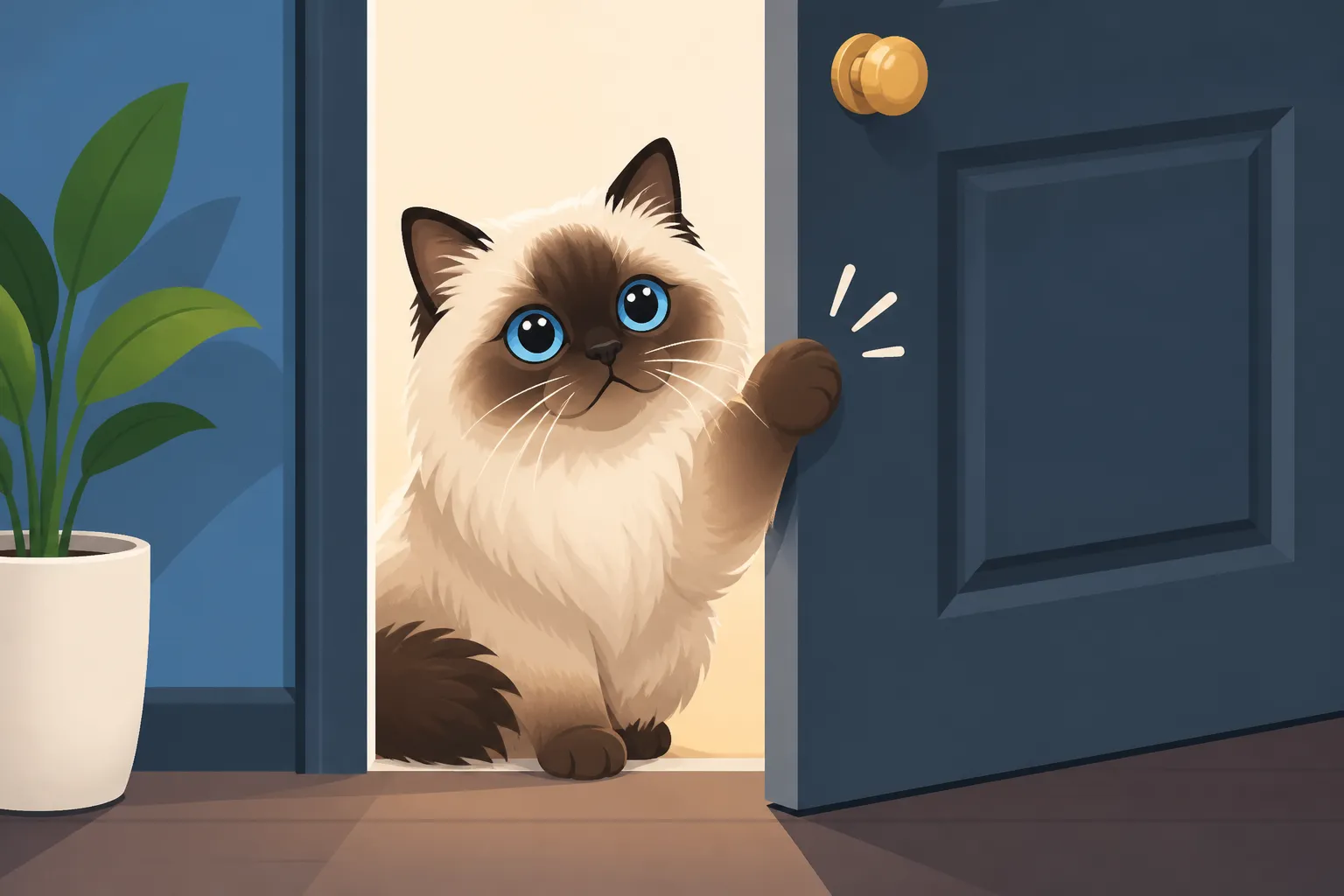
When the silent stare doesn't immediately yield results, your Himalayan might escalate their communication, but even then, it's typically done with a remarkable level of gentleness. You won't find them scratching vigorously at the door, potentially damaging the paintwork or creating a racket. Instead, they might offer a soft, almost hesitant paw tap against the lower part of the door. It's more of a suggestion than an insistent demand, a quiet "Excuse me, may I remind you of this obstacle?"
Similarly, if you happen to be standing near the desired door, they might employ a delicate head nudge. They'll walk up to your leg, rub their soft, fluffy head against you, and then subtly lean towards the door, perhaps even glancing back at it as if to say, "Remember this? It's still closed." This is their polite way of physically guiding you towards the solution to their dilemma. It's a sweet, almost endearing gesture that leverages their natural charm. Imagine you're doing dishes, and you feel a gentle bump against your calf. You look down, and there's your Himalayan, looking up at you with those deep blue eyes, then slowly shifting its gaze to the closed laundry room door, then back to you. They're not crying, not demanding; they're simply guiding you, with the utmost grace, to perform your duty as their door-opener. It’s a testament to How a Himalayan Asks Without Raising Its Voice in a manner that's far from aggressive or irritating.
The Strategic Placement: Why Your Himalayan is Exactly Where They Are
Himalayans are intelligent creatures, and they often understand the dynamics of a household. They know where you tend to walk, where you sit, and where you're most likely to notice them. When they want to be let into a room, they don't just sit anywhere; they sit strategically.
This might mean positioning themselves just around a corner, so that when you turn, they are the first thing you see, perfectly framed against the closed door. Or they might lie down right in the pathway to the door, creating a charming, fluffy obstruction that you literally cannot step over without acknowledging them. They might even move to their favorite cat tree (perhaps one found on Amazon that's not too tall, as they aren't big jumpers) positioned near the door, making sure they are visible yet still maintaining their dignified distance. They are masters of being "conveniently" in your line of sight. It's not about being underfoot in an annoying way; it's about making it impossible for you to genuinely miss their presence and their unspoken request. They understand that if you can't see them, you can't open the door, so they'll put themselves in prime viewing position, often with a clear sightline from their eyes to yours. They are the ultimate practitioners of "if you build it, they will come" – only they build a silent, fluffy monument to a closed door, and you are the one who is supposed to come and open it. Your Himalayan dedicates significant time to these quiet observations; they are adept at What a Himalayan Does All Day in One Chair and applying that patient observation to their needs.
When the Urgency Rises: Escalating Communication
While Himalayans are masters of subtlety, even they have their limits of patience. When their initial, gentle cues go unnoticed or unheeded, they will, in their own charming way, escalate their communication. But don't expect a dramatic shift; it's more like turning up the volume dial by a millimeter.
The Soft, Insistent Chirp or Meow
When the silent treatment and gentle nudges don't work, your Himalayan will resort to a vocalization, but it's still far from the ear-splitting yowls you might get from other breeds. Their "insistent" sound is often a soft, almost trilling chirp, or a slightly louder, more drawn-out "meow" that carries a note of mild exasperation. It's not aggressive; it's more like a polite cough in a quiet library, designed to get your attention without causing a scene.
This vocal escalation is usually reserved for moments of higher urgency, perhaps when they really need to access their litter box, or when they know it's almost mealtime and the kitchen door is closed. They might repeat this soft sound a few times, pausing in between to give you a chance to respond. It's their way of saying, "Alright, I've been patient. Now, could we please get this door opened?" It’s rarely a full-throated cry, but a subtle increase in volume and frequency. If you hear this specific sound, know that your Himalayan has moved past polite suggestion and is now making a more direct, but still incredibly gentle, request. It's a distinctive sound that, once you recognize it, becomes a clear signal. You’ll definitely notice the difference between this and Whether a Himalayan Yowls the Way a Siamese Does – it's a world apart.
The "Accidental" Obstacle: Getting Underfoot
Another subtle escalation technique Himalayans employ is to "accidentally" get in your way. This isn't a deliberate trip-hazard maneuver like some more boisterous pets might try. Instead, it's a carefully choreographed movement designed to make it impossible for you to ignore them.
Imagine you're walking towards the kitchen, but the door to the sunny living room is closed, and that's exactly where your Himalayan wants to be. As you approach, they might leisurely stretch out, or casually stroll into your path, making you pause or gently step around them. They're not trying to trip you, but they are making themselves an unavoidable presence. Each time you try to move past, they might shift slightly to remain in your immediate vicinity, forcing you to acknowledge them. This can also happen when they know you're about to sit down; they might suddenly appear in your chosen chair, making you pause before settling. It's a non-confrontational but highly effective way of saying, "My needs are here, and I am here. Therefore, we must address this." It's almost like a slow-motion blockade, where your sweet, fluffy cat becomes an immovable (but very soft) object in your path until their desired room is opened.
The Focused Stare with a Tail Twitch
When all other subtle cues haven't worked, and the soft vocalizations are still falling on deaf ears, your Himalayan might combine their most potent silent weapon – the focused stare – with a small, but significant, tail twitch. This is their equivalent of flashing a neon sign that says, "NOW!"
The stare will be even more intense, those blue eyes drilling into you with an unwavering gaze. But this time, you might notice the very tip of their fluffy tail giving a slight, almost imperceptible twitch, or perhaps a slow, deliberate sweep from side to side. This isn't the rapid, agitated tail flick of an annoyed cat, but a more controlled, purposeful movement. It's a subtle sign of growing urgency and heightened focus. It's their final, most direct silent plea before they might give up and settle somewhere else, or perhaps resort to a slightly louder "mrrrow?" of complaint. Think of it as a finely tuned instrument of communication; every small movement is meaningful. If you see this combination, it's a clear signal that your regal companion has waited long enough, and it's time to grant them passage. They are rarely impatient or demanding, choosing instead to wait Why a Himalayan Waits Rather Than Complains at a Door.
Practical Tips for Responding to Your Himalayan's Requests
Understanding your Himalayan's unique way of asking for room access is one thing, but knowing how to respond effectively and consistently is another. Developing a routine and being observant can go a long way in fostering a happy, communicative relationship with your reserved companion.
Learning Your Cat's Personal Door Code
Every cat, even within the same breed, has its own quirks and preferences. While the general communication methods described above are common for Himalayans, your individual cat might have a specific little "mrrp" or a particular head tilt that is their unique signal for "open this door, please." The best way to learn this is simply to pay close attention. Observe their behavior when they are by a closed door and you know they want in. What is the first thing they do? What's the "escalation" sequence for them?
For example, your Himalayan might always start with a silent stare, then progress to a paw tap, and only then let out a soft meow. Learning this sequence, this "personal door code," will help you respond more quickly and prevent them from needing to escalate their efforts. Consistency from your end is also crucial. If you respond to their soft meow one day but ignore it the next, they'll become confused and might resort to louder, less desirable behaviors in the long run. Establishing a predictable response reinforces the behavior you want to see. Just as they expect to be fed at certain times of day, learning Why a Himalayan Expects to Be Fed at the Same Hour will help you understand their need for routine when it comes to door access.
Creating Predictable Access Points
For many households, not every door can or should be left open. However, for rooms that your Himalayan frequently uses – like a bedroom they sleep in, or a room with a favorite sunny spot – consider establishing predictable access points. If you can, leaving certain doors ajar, even just a few inches, can be a simple solution. This allows them to come and go as they please without needing to ask.
For areas where a fully open door isn't practical, like a child's playroom or a home office where you might need quiet, consider a pet gate. Just be mindful of your Himalayan's build. They are a cobby, low-slung breed, so a standard tall gate might seem like an insurmountable obstacle, even if they could theoretically jump it. They might simply decide that The Height a Himalayan Decides Is Not Worth It. Look for gates with a small pet door, or even one that is lower to the ground. Placing a favorite bed or a comforting blanket (perhaps one you ordered from Amazon for its softness) right outside the door can also make waiting more pleasant for them if immediate access isn't possible. The goal is to minimize their frustration and empower them to access their preferred spots whenever possible, fostering a sense of security and autonomy.
| Communication Cue | Typical Himalayan Response | Contrast with More Demanding Breeds (e.g., Siamese) | Owner's Interpretation |
|---|---|---|---|
| Vocal | Soft "mrrp," gentle meow, chirp | Loud, insistent yowls, meows, "talking" | "Is that for me? Do you want something?" |
| Physical (Direct) | Gentle paw tap, head nudge against leg | Persistent scratching, batting door, jumping | "Oh, you want my attention for the door." |
| Physical (Indirect) | Sitting by door, staring at owner | Pacing, throwing body against door, vocal complaint | "They want into that room, they're waiting for me." |
| Escalation | Slightly louder chirp/meow, subtle tail twitch, blocking path | Aggressive scratching, sustained loud vocalizations, frantic activity | "Okay, this is important, I should respond now." |
| Patience Level | High, will often wait silently for extended periods | Low, will quickly escalate to loud demands | "They'll wait for me, but I shouldn't take too long." |
Avoiding Frustration (for both of you!)
The most common frustration for Himalayan owners regarding door access usually stems from not recognizing these subtle cues. When a Himalayan's polite, quiet requests are consistently missed, they can either learn to become more vocal (which might not be the quiet companion you initially envisioned) or, conversely, they might become withdrawn and simply give up, finding another less desirable spot to nap. Neither outcome is ideal.
Imagine your Himalayan sitting patiently by the door to the bedroom for ten minutes, giving soft "mrrps" and head nudges, and you're oblivious because you're immersed in your latest Amazon Kindle read. The frustration mounts for your cat. By learning their specific signals and responding promptly, you reinforce their trust in you as their caregiver and communication partner. This creates a positive feedback loop: they ask politely, you respond, and everyone is happy. It reduces stress for your cat, who isn't left wondering why the door won't open, and it reduces stress for you, as you won't have to deal with more disruptive behaviors down the line. It's a small investment of your attention that pays dividends in a harmonious household. Learning their schedule and understanding when they want to divide their day between sleep and a warm lap helps you predict when they might need access to a room. How a Himalayan Divides Its Day Between Sleep and Lap is a good read to help you understand their rhythm.
In the end, learning how your Himalayan asks to be let into a room is all about tuning into their unique, understated language. It's not always loud, but it's always clear once you know what to look for. And truly, there's nothing more rewarding than seeing that gentle blink of acknowledgment when you finally open the door, knowing you've understood your quiet, fluffy friend perfectly.
Disclaimer
This article is for general informational purposes only and does not constitute professional advice. Laws, prices and regulations vary by location and change over time. Consult a qualified professional for guidance on your specific situation.