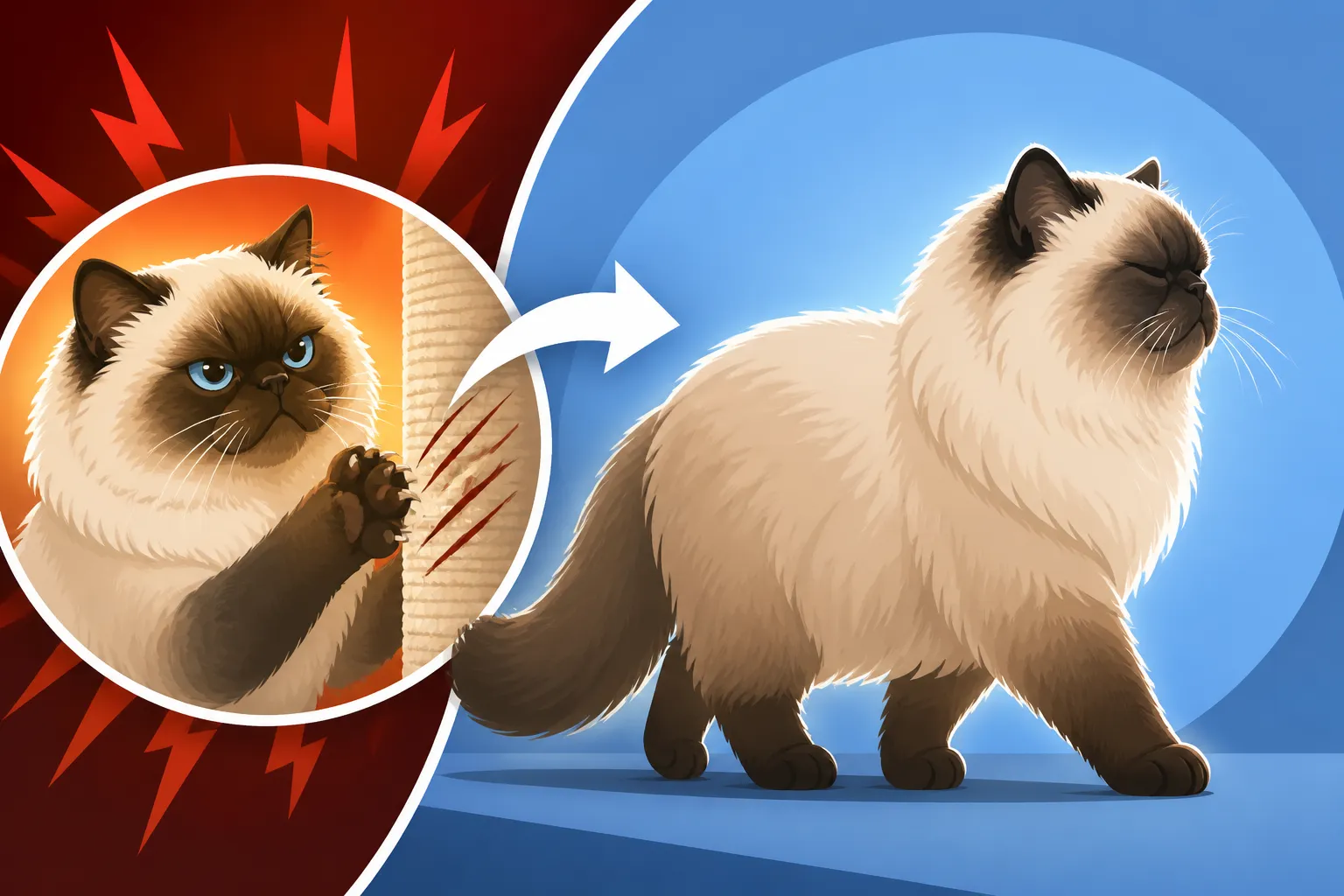
Why a Himalayan Walks Away Rather Than Scratch
Oh, the Himalayan cat! If you've ever shared your home with one of these fluffy, serene beauties, you've probably noticed something rather peculiar about their approach to conflict: they'd rather stage a graceful retreat than engage in a full-blown feline spat. It’s a common frustration for new owners who might expect a bit more bravado, or perhaps for those used to more 'spirited' breeds, to see their magnificent floof simply walk away from a perceived challenge. This guide dives deep into why your regal Himalayan often chooses peace over paws, exploring the unique blend of temperament, physical traits, and communication styles that shape their famously gentle reactions.
The Himalayan Temperament: A Blend of Calm and Reserved
When you bring a Himalayan into your life, you’re not just getting a stunning coat and striking blue eyes; you're also inviting a personality that cherishes tranquility above all else. Their default setting isn't "fight or flight"; it's more often "assess and retreat." This isn't a sign of weakness, but rather a deeply ingrained aspect of their character, stemming from generations of carefully cultivated genetics.
Inherited Traits from Persian Ancestry
Let's be real, a huge part of what makes a Himalayan a Himalayan comes from their Persian lineage. Persians are legendary for their calm, almost aristocratic demeanor. They're not the type to climb your curtains, stalk birds with wild abandon, or pick fights with the neighbor's dog. Instead, they prefer to survey their kingdom from the comfort of a plush sofa, ideally with a human lap nearby. This placid, sweet nature is a dominant trait that has profoundly shaped the Himalayan.
Imagine a Persian. You picture a serene, quiet creature, right? One that might give a gentle head-butt for attention but is unlikely to bat aggressively at your hand, let alone another cat's tail. This inherent gentleness is passed directly to the Himalayan. They thrive in predictable, peaceful environments. Loud noises, sudden movements, or disruptions to their routine are far more likely to send them seeking a quiet corner than to prompt a defensive hiss and swipe. Their preference is always for harmony, and conflict, no matter how minor, simply isn't worth the energy or the emotional upheaval for them. They're not wired for confrontation; they're wired for comfort and a quiet life.
The Siamese Influence: Voice Without the Fury
Now, of course, a Himalayan isn't just a Persian. They've got that dash of Siamese ancestry, and anyone familiar with a Siamese knows they can be quite the conversationalists! The Siamese side is famous for its vocalizations, its more active nature, and, sometimes, a bit of a dramatic flair. You might think this would inject a feistier, more combative streak into the Himalayan, but curiously, it mostly manifests as a voice rather than aggression.
You’ll find your Himalayan is often quite chatty, using a range of soft chirps, trills, and gentle meows to communicate their needs or simply to acknowledge your presence. They might "talk" to you about their empty food bowl, the optimal temperature of their sunbeam, or the pressing need for a cuddle. This vocal tendency is a clear echo of their Siamese forebears. However, unlike some of their more vociferous Siamese cousins who might use their voice to express displeasure or demand attention with a certain insistence, the Himalayan typically uses it as a polite request or a soft complaint. They’ve inherited the ability to speak their mind, but usually without the accompanying fury or aggression. It’s as if they took the volume dial from the Siamese and turned it way down, keeping the communication but discarding the sharpness. This selective inheritance means they still possess a means of expressing themselves when bothered, but their go-to isn't a physical altercation. You can hear this gentle conversational style, often quite different from a pure Persian's quietude, in The Himalayan Kept the Siamese Voice and Lost the Volume.
Physical Limitations and Practicalities
Beyond their gentle disposition, the very physical attributes of a Himalayan cat play a significant role in why they opt out of brawls. Their distinctive build, which makes them so charming to look at, isn't exactly designed for agility or sustained physical exertion required in a catfight.
The Cobby Build and Short Legs
Take a good look at your Himalayan. They have what's affectionately called a "cobby" build – that means they are compact, well-rounded, and rather substantial. Their legs are typically short and sturdy, and their overall body shape is heavy and broad. While this gives them their endearing, teddy-bear like appearance, it's not exactly conducive to being a nimble, quick-footed fighter.
Imagine a graceful, sleek cat like an Abyssinian or a Siamese, leaping, twisting, and striking with lightning speed. Now picture your cobby Himalayan trying to replicate those moves. It's simply not their forte. Their body is built for comfort and stillness, not for agile combat. Short legs mean they can't jump or run with the same explosive energy as a lankier breed. Their dense bone structure and substantial weight make them less flexible and slower to react. If a situation demands quick evasive action or an aggressive lunge, their physical form makes it challenging and uncomfortable. It's often easier and more sensible for them to slowly turn and walk away, preserving their energy and avoiding the awkwardness of trying to maneuver their cobby frame into a fighting stance. They simply aren't engineered for high-impact physical altercations; their bodies tell them to seek calm. If you observe their gait, you might notice Why a Himalayan's Short Persian Legs Skip a Step, a testament to their build.
The Flat Face and Breathing Challenges
The Himalayan's adorable, often extreme, flat face (or brachycephalic profile) is another key factor in their aversion to physical confrontations. While undeniably charming, this flattened facial structure means they can experience breathing challenges, especially when stressed, excited, or exerting themselves.
Think about it: aggressive encounters are stressful and require bursts of energy. A cat in a fight will often pant, hiss vigorously, and expend a significant amount of physical effort. For a Himalayan, whose airways can sometimes be compromised by their facial structure, this kind of exertion can quickly lead to overheating and respiratory distress. Imagine trying to run a sprint while breathing through a straw – that's a bit what sustained exertion can feel like for some Himalayans. Their bodies are telling them, loud and clear, that getting into a heated scrap is not worth the potential discomfort or even danger to their breathing. They quickly learn that avoiding such situations entirely is the best course of action for their own well-being. This physical reality is a big part of why you'll often notice Why a Himalayan Snores Louder Than Its Siamese Ancestors and Why a Himalayan Overheats Twice as Fast as a Siamese. They're simply not equipped for situations that demand intense, prolonged physical effort, making retreat a wise, self-preserving strategy.
Communication and Conflict Avoidance
Himalayans are masters of subtle communication, often preferring to "speak" with their body language rather than resorting to overt aggression. Their methods of signaling displeasure are usually quiet, understated, and designed to de-escalate rather than escalate.
Subtle Signals and Passive Resistance
Your Himalayan isn't likely to stand their ground with a puffed-up tail and an angry yowl. Instead, they communicate their boundaries and discomfort through a nuanced array of subtle signals and passive resistance. These are often easy to miss if you're not attuned to their quiet ways, but once you learn to read them, you'll see a wealth of information in their gentle expressions.
When a Himalayan is unhappy or feels encroached upon, they might start with a slow blink, a clear signal of "I'm not happy, but I'm not going to fight." They might turn their head away from the offending party, presenting a shoulder as a polite dismissal. A gentle twitch of the tail, rather than a forceful lash, can indicate irritation. Sometimes, they'll simply freeze in place for a moment, observing the situation, before making their strategic exit. This might involve a slow, deliberate walk to another part of the room, or even a casual leap onto a nearby chair, creating distance without drama. They aim to avoid conflict, not to invite it. This quiet, almost dignified way of expressing themselves is a hallmark of the breed. They've perfected the art of asking for space without raising their voice, literally or figuratively. It's a testament to their calm nature and their inherent preference for peace. They might just offer a soft chirp, as you can read about in How a Himalayan Asks Without Raising Its Voice, rather than a confrontational sound.
Prioritizing Comfort and Routine
At their core, Himalayans are creatures of comfort and habit. They thrive on routine, predictability, and a peaceful environment. Any disruption to their carefully constructed world of naps, mealtimes, and preferred lounging spots is met with strong disapproval. Conflict, by its very nature, is chaotic and uncomfortable, making it something they will almost always try to avoid.
For a Himalayan, a squabble over a favorite toy, a prime sunbeam, or even a sudden loud noise is an unwanted disturbance. Rather than engaging in a fight to "win" a spot, they'd much rather simply find another comfortable spot or wait patiently for the disruption to pass. Their emotional well-being is deeply tied to their sense of security and the peaceful rhythm of their day. A confrontation doesn't align with this philosophy. They're not going to defend their territory with aggression if it means sacrificing their inner peace. Instead, they will quietly remove themselves from the situation, seek out a familiar, safe space, and resume their contented existence. This prioritization of comfort explains why they're so particular about their chosen spots; Why a Himalayan Claims One Chair and Keeps It illustrates just how important these routines are to them. It’s an act of self-preservation, ensuring their world remains as calm and predictable as possible.
When a Himalayan Might React Differently (and Why)
While their default mode is certainly "walk away," it's crucial to remember that Himalayans are still cats. And like any living creature, there are certain extreme circumstances that can push even the most placid feline to react defensively, even aggressively. These situations are usually out of character and highlight just how sensitive these cats can be.
Extreme Pain or Fear
Let's be absolutely clear: any cat, regardless of breed or temperament, can lash out if they are in severe pain or truly terrified. A Himalayan is no exception to this fundamental animal instinct. If your usually serene cat suddenly becomes aggressive, the very first thing you should consider is that they might be hurt, sick, or in immense distress.
Imagine an accidental injury – perhaps they've been stepped on, or a door closed on their tail. The sudden, intense pain can trigger an instinctive, reflexive response to strike out, even at a beloved owner. Similarly, if they feel genuinely trapped, unable to escape a perceived threat, or face an overwhelming, sudden danger, their survival instincts can override their natural gentleness. This isn't aggression stemming from a desire to fight; it's a desperate, last-resort defense mechanism. They're not choosing to fight; they're reacting to an immediate, unbearable threat. Understanding this distinction is vital. If your Himalayan, who normally walks away, suddenly displays aggression, it's a red flag that something is seriously wrong and often requires immediate veterinary attention. These cats are known for hiding discomfort, so this kind of reaction is a significant sign that something is amiss. Indeed, Why a Himalayan Hides Illness Behind an Expressionless Face means you have to be extra vigilant.
Lack of Socialization or Past Trauma
While Himalayans generally possess an inherently gentle nature, a cat's early experiences and environment play a profound role in shaping its adult behavior. A lack of proper socialization during their crucial kittenhood, or a history of past trauma or abuse, can absolutely override their natural predispositions, making any cat, including a Himalayan, more prone to defensive aggression.
A Himalayan kitten who isn't handled gently, exposed positively to various sights and sounds, and taught appropriate boundaries may grow into an adult who hasn't learned the subtle art of conflict avoidance. They might not have developed the confidence or the coping mechanisms to simply walk away. Instead, they might perceive potential threats more readily and react with fear-based aggression. Similarly, a rescue Himalayan with a difficult past – perhaps neglected, abused, or repeatedly put in stressful, inescapable situations – might carry deep-seated anxieties. These cats might be hyper-vigilant and quicker to resort to defensive behaviors, including scratching or biting, because their past experiences have taught them that fighting is their only means of survival. It’s a tragic testament to the impact of environment on even the most gentle breeds. In these cases, patience, gentle rehabilitation, and sometimes professional behavioral guidance can help them learn to trust and rediscover their innate serenity.
Comparing Himalayan Reactions to Other Feline Responses
To truly appreciate the Himalayan's unique approach to conflict, let's look at how their typical reactions stack up against what you might see in a more overtly aggressive cat.
| Behavior Trait | Typical Himalayan Reaction | Typical Aggressive Cat Reaction |
|---|---|---|
| Initial Confrontation | Turns head away, slow blink, quiet retreat to a safe spot. | Direct stare, pupils dilated, flattened ears, low growl/hiss. |
| Vocalizations | Soft chirps, trills, quiet meow, subtle "silent meow" for attention. | Loud, sustained growls, hisses, spits, caterwauls, screams. |
| Body Posture | Low to the ground, trying to appear smaller, head down, tail low. | Puffed fur (piloerection), arched back, tail thumping or held high and stiff, side-on stance. |
| Physical Contact | Avoids contact, steps away, uses body to create distance. | Bites, swats with claws, grabs with front paws ("bunny kicks") with hind legs. |
| Eye Contact | Averts gaze, slow blinks. | Intense, unblinking stare. |
| Resolution | Retreats, finds new peaceful spot, waits for situation to calm. | Escalates until one party retreats or physical fight occurs. |
As you can see, the Himalayan's preference for de-escalation is clear. They are masters of the gentle exit.
In conclusion, your Himalayan's tendency to walk away rather than scratch isn't a flaw; it's a beautiful expression of their unique breed character. It’s a combination of their Persian-derived placid temperament, the selective inheritance of Siamese vocalizations without the accompanying aggression, and their physical build that makes fighting uncomfortable and impractical. They are peace-loving, comfort-seeking companions who communicate their boundaries with subtle dignity. Understanding this gentle nature means appreciating their quiet cues and providing them with the serene environment they instinctively crave. They teach us that sometimes, the most powerful response to conflict is simply to turn and walk away, seeking harmony over discord. For the discerning owner, learning to read these subtle signals and respecting their gentle boundaries is part of the deep, rewarding bond you'll share with these magnificent cats. You might even find yourself shopping on Amazon for extra-comfy beds or quiet enrichment toys that match their calm demeanor.
Disclaimer
This article is for general informational purposes only and does not constitute professional advice. Laws, prices and regulations vary by location and change over time. Consult a qualified professional for guidance on your specific situation.