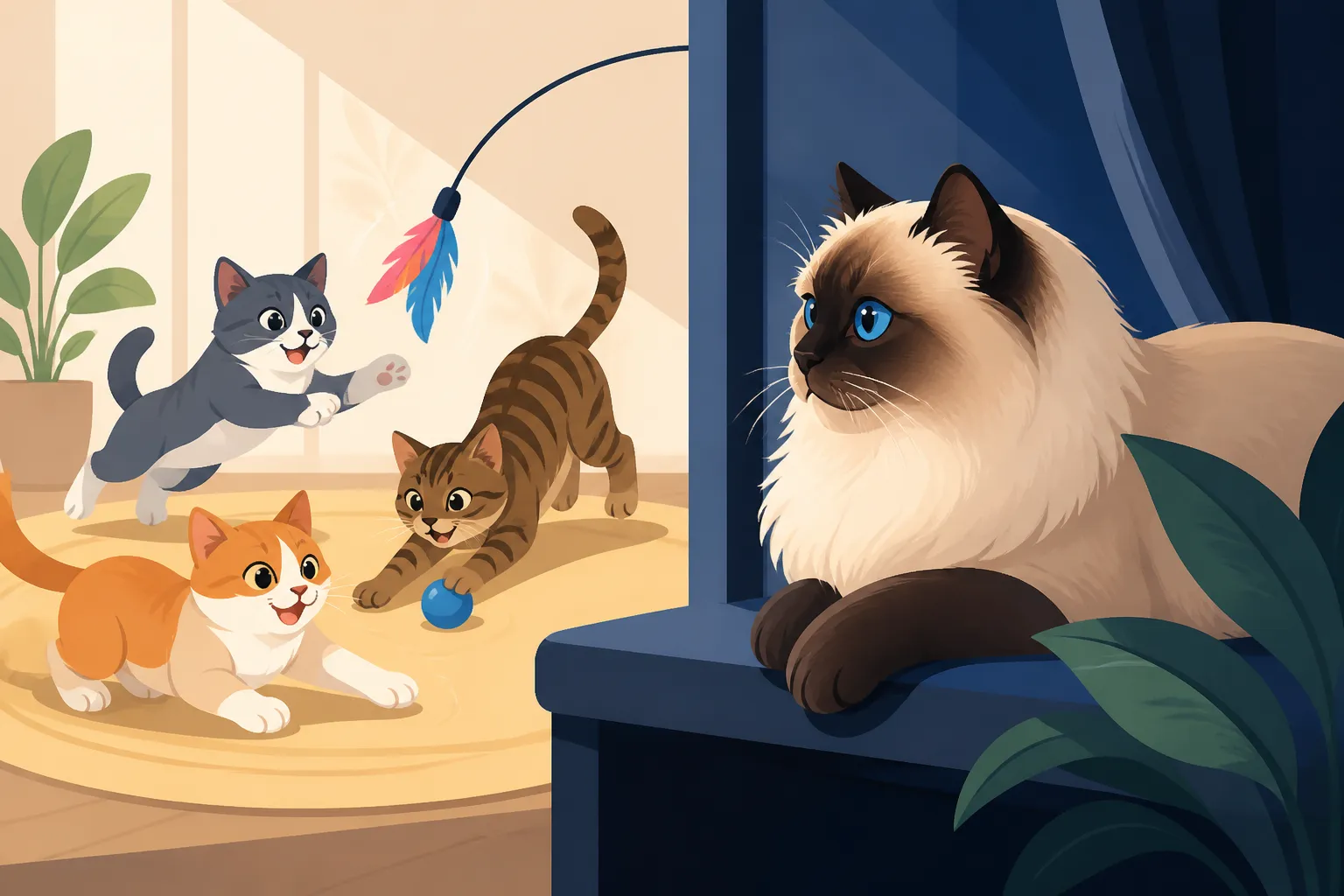
Why a Himalayan Watches Rather Than Joins In
It’s a common sight for us Himalayan cat parents: you’re in the middle of a lively family game, or maybe the dog is doing zoomies around the living room, and there, perfectly poised on the coziest armchair, is your beautiful Himmy, observing everything with an almost regal detachment. You might wonder if they’re just aloof, or perhaps not as interested in the household's goings-on. But trust me, that isn't the whole story. This guide is here to shed light on why your Himalayan cat often prefers to watch rather than dive headfirst into the action, and how their unique blend of traits makes them the most delightful, if sometimes understated, participants in your family life.
The Himalayan's Inherited Temperament: A Blend of Worlds
When you bring a Himalayan into your home, you’re not just getting a stunning cat with those captivating blue eyes and a luxurious coat; you’re welcoming a fascinating genetic tapestry. This breed is a deliberate blend of the placid Persian and the vocal Siamese, and understanding this heritage is key to unlocking the mystery of their observational nature. It’s like they picked up certain traits from each parent, but not always the ones you’d expect in equal measure.
The Persian Influence on Activity Levels
Let's talk about the Persian side first, because it's a huge factor in why your Himmy is often content to be a spectator. Persians are renowned for their calm, sweet, and often quite dignified demeanor. They are generally not high-energy cats. You won't typically find a purebred Persian scaling your curtains or tearing through the house like a furry missile. Instead, they prefer quiet companionship, long naps in sunny spots, and being adored from a comfortable perch.
This inherent calm is deeply ingrained in the Himalayan. They inherited that beautiful, flowing coat, those round eyes, and a significant portion of that laid-back personality from their Persian ancestors. So, when your Himalayan is watching the kids play rather than chasing after a toy, it's not because they don't care. It’s often their natural inclination. They derive pleasure from simply being in the presence of their family, observing the world around them from a serene vantage point. This might be frustrating for new owners who expect a constantly playful kitten, but it’s simply part of the breed’s charm. They are perfectly happy being the quiet, elegant observer, absorbing all the nuances of your daily life without needing to physically engage in every single moment. It's a form of participation for them, just a more serene one. This gentle disposition is why they are often described as lap cats, though even then, they might prefer to sit next to you rather than directly on you, just so they can maintain that perfect viewing angle.
The Echo of the Siamese Voice, Not the Vim
Now, let's consider the Siamese part of the equation. Siamese cats are famous for their boundless energy, their agility, and their incredibly vocal nature. They're often described as dog-like in their playfulness and their tendency to "talk" constantly. So, you might expect a Himalayan, having Siamese blood, to be a miniature dynamo, full of boisterous energy.
Here's the twist: Himalayans did inherit a degree of vocalization from the Siamese, which is why they tend to be more chatty than their Persian cousins. They might chirp, trill, or even "talk" to you with soft meows to express their needs or opinions. However, the high-octane physical energy of the Siamese largely got filtered out during the breeding process. It's like they got the microphone, but not the dance moves. So, your Himalayan might sit and vocally "comment" on the activities around them – a soft trill when you walk by, a questioning meow if something new appears – but they aren't likely to join the energetic romp. They are perfectly content to be the charming narrator of the household, offering their insights from a safe, comfortable distance. It’s a subtle but significant difference from a full-blown Siamese, and it explains why your Himmy will talk to you but often won’t chase a feather wand for more than a few minutes. If you’ve ever wondered Where the Himalayan's Voice Came From, it's definitely that Siamese heritage, but applied in a gentler, more thoughtful way.
Physical Realities That Dictate Engagement
Beyond temperament, there are very tangible, physical reasons why your Himalayan might choose to watch from the sidelines. These aren't just preferences; they are structural realities that influence their capacity for prolonged or vigorous activity. Understanding these physical limitations isn't about feeling sorry for them, but rather about appreciating how perfectly they are adapted for their preferred, calmer lifestyle.
The Cobby Build and Short Legs
One look at a Himalayan and you can see their distinctive physique: a cobby (compact and stocky) body, short, thick legs, and a broad chest. This isn't the streamlined, agile body of a sprinter or a jumper. Their build is designed for lounging comfortably, for providing a substantial presence on your lap, and for moving with a deliberate, rather than frantic, pace.
Imagine trying to run a marathon in a heavy winter coat with short, sturdy legs – it’s just not what you’re built for! Similarly, your Himalayan's body isn't optimized for quick bursts of speed, acrobatic leaps, or sustained chasing. When a laser pointer dots across the room, they might follow it with their eyes, perhaps even a paw swipe or two, but a full-on sprint across the floor? Not likely to happen for very long. This cobby frame makes high-impact activities physically demanding and less appealing. They might attempt a short pounce on a toy dangled right in front of them, but they quickly revert to their default state of serene observation. Their short legs also mean that reaching high places, which many cats love, often isn't worth the effort. This contributes to their preference for staying on lower surfaces, where they can watch the world go by without having to exert themselves too much. If you've ever seen a cat try to jump onto a counter and barely make it, you'll understand why many Himalayans simply opt out of the challenge. Why a Himalayan Stays on the Floor and the Sofa is a direct result of this body type.
The Flat Face and Breathing Limitations
Perhaps the most significant physical factor influencing a Himalayan's activity level is their brachycephalic, or flat, face. While incredibly endearing and a hallmark of the breed's appearance, this facial structure comes with specific anatomical challenges, particularly concerning their respiratory system. The shortened muzzle means that the nasal passages are often constricted, and they can have an elongated soft palate that partially obstructs their airway.
What does this mean for playtime? It means that even moderate physical exertion can quickly lead to labored breathing and overheating. Many Himalayans will start panting after just a few minutes of enthusiastic play. It's not that they don't want to play; it's that their bodies physically struggle to keep up and regulate their temperature during intense activity. This isn’t a sign of laziness; it’s a self-preservation mechanism. They learn very quickly that pushing themselves too hard leads to discomfort. As a result, they naturally gravitate towards activities that allow them to participate mentally and visually without putting a strain on their respiratory system. So, while other cats might chase a toy mouse for ten minutes straight, your Himmy might prefer to bat it around gently from a lying position, or simply watch you swing a wand toy, enjoying the visual stimulation. If you're observing How Soon a Himalayan Starts Panting During Play, you'll quickly realize why they prefer to be the quiet observer. This physical reality is something every Himalayan owner must be keenly aware of, especially when considering playtime or even travel plans.
The Comfort Zone: A Himalayan's Preferred Domain
Given their inherent temperament and physical makeup, it's no surprise that Himalayans thrive in environments that cater to their preferences. They are masters of creating their own comfort zones, and within these spaces, they are deeply engaged observers, participating in their own unique way. Their world might be smaller in terms of physical range, but it's rich in sensory detail and the comforting predictability of routine.
The Allure of the Cozy Vantage Point
For your Himalayan, the best seat in the house isn't necessarily in the thick of the action, but rather a strategic location that offers a panoramic view of everything. They are true connoisseurs of comfort, seeking out the warmest, softest, most elevated-but-not-too-high spots from which to survey their domain. Think of a plush cat bed nestled on a favorite armchair, a soft blanket draped over a window perch, or perhaps even a designated spot on the sofa, strategically placed so they can watch the kitchen, the living room, and maybe even catch a glimpse of the outside world.
From this chosen vantage point, your Himmy becomes the ultimate household monitor. They are watching you cook dinner, observing the kids doing their homework, noting the comings and goings of family members, and generally keeping a keen eye on the pulse of the home. For them, this is engagement. They are processing information, enjoying the visual stimulation, and feeling secure in their ability to know exactly what's happening. They aren't aloof; they are deeply invested in the theatrical production of daily life unfolding before them. To help your Himmy indulge this natural inclination, consider investing in a few well-placed, luxurious cat beds. A quick search on Amazon will reveal an abundance of options, from donut beds to orthopedic pillows, perfect for their regal repose. Providing them with these comfortable observation decks is one of the best ways to cater to their personality. This preference for a cozy spot over constant movement is Why a Himalayan Picks the Sofa Over the Windowsill for comfort and warmth.
Routine and Predictability as Entertainment
Another crucial aspect of the Himalayan's comfort zone is their profound appreciation for routine. While some cats thrive on spontaneity and new adventures, your Himmy finds deep security and entertainment in the predictable rhythms of your household. The daily schedule of meal times, your work schedule, the children's school routine, even the time you usually settle down to watch TV – these aren't just events; they are the framework of your Himalayan's world.
For a Himalayan, observing these routines unfold is their entertainment. They know when the morning bustle begins, anticipating the sounds and movements of breakfast preparation. They'll watch you get ready for work, perhaps offering a soft trill of farewell. When you return home, they'll often be waiting in their favorite spot, watching your entrance with keen interest. The consistency of these patterns provides them with a sense of control and understanding of their environment. Any deviation from this routine can actually be unsettling for them, as it disrupts their daily "show." It's why they might express a subtle displeasure if dinner is late, or if their favorite napping spot is suddenly occupied. They are incredibly sensitive to changes in their environment and the established order of things. By upholding a consistent routine, you are providing your Himalayan with a rich, engaging, and reassuring world that they can comfortably observe and participate in from their chosen perch. They find solace and enjoyment in the dependable flow of domestic life, making them true connoisseurs of the everyday. How a Himalayan Reacts When Its Routine Breaks can tell you a lot about their reliance on predictability.
Encouraging Gentle Interaction and Engagement
Just because your Himalayan prefers to watch doesn’t mean they don’t want to connect with you. It simply means you need to tailor your approach to their unique preferences and physical capabilities. It's about meeting them where they are, rather than trying to force them into a mold that doesn't fit. You'll find that these gentle giants offer an immense amount of love and companionship, even if it's expressed in quieter, more thoughtful ways.
Tailoring Play to Their Abilities
Since intense, acrobatic play isn't really their forte, the key to engaging your Himalayan in play is to focus on low-impact, short-duration sessions. Think quality over quantity. Instead of trying to get them to chase a laser pointer up a wall, aim it along the floor, allowing them to stalk and pounce with minimal exertion. Wand toys are fantastic because you do most of the energetic movement, while they can swat, bat, and even make a small pounce without overdoing it. Look for wand toys with soft feathers or crinkly attachments that are easy for them to grab and hold. You can find a fantastic array of these on Amazon, perfect for stimulating their hunting instincts without stressing their breathing.
Interactive play that involves gentle batting, slow pounces, or even just some focused attention on a toy placed right in front of them is ideal. Puzzle feeders can also be a good way to engage their minds without requiring much physical output, as long as the opening is wide enough for their flat face. Remember, a few minutes of focused, gentle play a couple of times a day is far more beneficial and enjoyable for a Himalayan than trying to make them run a gauntlet. Watch for signs of panting or disinterest and end the session before they become uncomfortable. This respects their limitations and keeps playtime a positive experience. Finding Which Wand Toys a Himalayan Can Actually Follow makes a big difference to their enjoyment and engagement.
| Play Style / Activity | Himalayan Cat | More Active Breeds (e.g., Siamese, Abyssinian) |
|---|---|---|
| Duration of Play | Short bursts (2-5 mins) | Longer, sustained sessions (10-20+ mins) |
| Intensity | Low-impact, gentle batting | High-energy chasing, jumping, climbing |
| Preferred Movement | Stalking, paw swipes, short pounces from seated/lying | Running, leaping, scaling, vigorous pursuit |
| Vocalizations | Soft trills, quiet meows while observing | Loud yowls, excited chirps, constant "talking" |
| Engagement Type | Observational, mental stimulation, close proximity | Active participation, physical exertion |
| Breathing Response | Quick to pant, may slow down after a few minutes | Can sustain high activity without panting easily |
| Favorite Toys | Wand toys (handled by owner), small soft toys, puzzle feeders | Laser pointers (long chases), tall cat trees, interactive robots |
The Art of the Shared Space
Perhaps the most profound way a Himalayan "joins in" is simply by being with you, sharing your space and your quiet moments. For these cats, true connection often isn't about active play, but about peaceful co-existence. A Himalayan might not be on your lap constantly, but they will likely choose a spot in the same room where they can observe you, close enough to feel your presence.
This might mean they are napping on a cat bed beside your desk while you work, or curled up on the sofa beside you as you read. Their purr, a soft rumble of contentment, is their way of participating in your shared quietude. They love gentle petting, a calm voice, and the reassuring routine of your presence. Providing comfortable spaces for them in the heart of your home, even if it's just a plush blanket or a specially bought cat bed from Amazon, allows them to feel included without needing to be physically active. Remember, a Himalayan often considers themselves a vital part of the family, simply by their watchful, serene presence. Their unspoken companionship is a gift, a gentle reminder to slow down and appreciate the simple joys. Why a Himalayan Sleeps on Your Chest is a profound expression of this quiet intimacy, a sign that they want to be as close to you as possible, even in stillness. When you see your Himmy watching, know that they are indeed "joining in," just in their own wonderfully calm and observant way.
Disclaimer
This article is for general informational purposes only and does not constitute professional advice. Laws, prices and regulations vary by location and change over time. Consult a qualified professional for guidance on your specific situation.