Why a Himalayan Needs Its Britches Trimmed
You lift your Himalayan off the sofa and find a clump of litter, a smear of something brown, and a felted knot the size of a walnut tucked under the tail. Again. If the back end of your cat has become a daily battle, this guide explains why the britches need trimming, exactly how to do it safely at home, and how to keep the problem from coming back.
What Britches Are and Why They Cause So Much Trouble
“Britches” is the old fancier’s word for the long, soft fur that grows on the backs of a longhaired cat’s hind legs and around its rear. On a Persian it is generous. On a Himalayan, which carries the full Persian coat on top of the colorpoint pattern from its Siamese ancestors, it can be enormous. The fur on the back of the thighs often grows longer than the body coat, and it is dense with a fine, cottony undercoat that behaves very differently from the sleek guard hairs you see on top.
The problem is location. That fur sits directly in the path of everything that leaves your cat’s body, and it hangs right where the cat sits, squats and scoots. A shorthaired cat walks out of the litter box and is done. A Himalayan walks out carrying a small archive of everything it just stood in.
The Anatomy of a Himalayan’s Back End
A Himalayan is a cobby cat: short legs, a broad chest, a deep body and a short tail held fairly low. That build matters more than people realize. Because the legs are short, the britches sit only a few centimeters off the litter when the cat squats. Because the body is round, the cat cannot easily twist around to reach its own rear. And because the tail is low and plumed, it tends to drape over the very area that most needs to stay clean.
Put those features together and you get a cat that is physically set up to get dirty back there and physically limited in cleaning itself. Many of these cats are not lazy groomers; their bodies simply make the job awkward.
The fur itself is also part of the story. The undercoat on the britches is so fine that it compacts the moment it gets damp. A little urine splash, a soft stool, or even moisture from licking can turn a fluffy area into a dense pad within a day. Once that pad forms, it traps more debris, which makes it denser still. This is the cycle that turns a minor grooming chore into a real problem.
Why the Persian Coat Behaves Differently Here
On most of the body, the Persian coat is a maintenance issue that a good steel comb can manage. On the britches, the coat faces three extra stresses: friction from the cat sitting and walking, contamination from the litter box, and moisture. Each of these speeds up matting on its own. Together, they mean the britches will mat faster than almost any other part of the cat, with the possible exception of the armpits.
That is why owners who keep up beautifully with the ruff still find knots under the tail. If you are already wondering where the litter is coming from in the first place, our piece on Why Litter Ends Up in a Himalayan’s Britches walks through the mechanics in detail.
What Happens When Britches Are Left Long
Left untrimmed, a Himalayan’s britches tend to follow a predictable path. First come occasional “cling-ons,” the small bits of stool stuck to the fur that every longhaired cat owner learns to dread. Then come felted patches that pull on the skin. Eventually you can end up with a solid mat that covers the anus, traps feces, and irritates the skin underneath.
At that stage, it is no longer a cosmetic problem. Trapped stool can lead to skin scalding, sores and infection, and in hot weather it can attract flies. A cat with a painful, matted rear may start avoiding the litter box because squatting hurts, which creates a whole new set of problems in your home. For the medical side of this, see Why a Matted Himalayan Becomes a Medical Case, which covers what vets see when coats are left too long.
The Real Reasons Your Himalayan Needs a Sanitary Trim
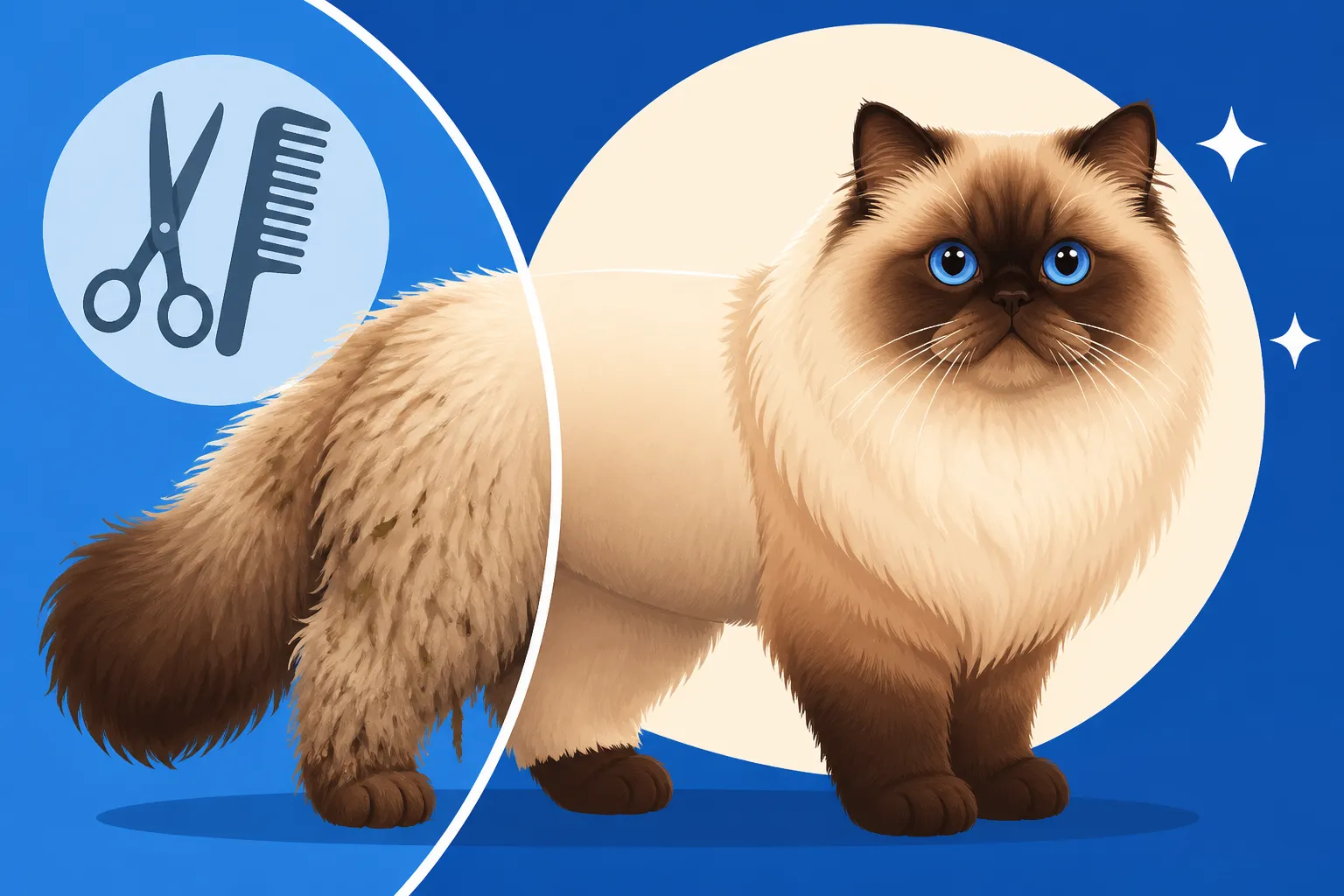
A sanitary trim, sometimes called a hygiene clip or “potty trim,” simply means shortening the fur around the anus, under the tail and on the inner backs of the thighs. It is not a show cut and it does not have to look dramatic. Done well, most people would not notice it unless they lifted the tail. Here are the practical reasons it earns a place in your routine.
Hygiene and Litter Box Cleanliness
The most obvious reason is cleanliness. A Himalayan with trimmed britches leaves the litter box with far less debris attached. That means less litter tracked through the house, fewer brown smudges on light upholstery, and fewer moments where you have to chase your cat with a damp cloth before it settles on your bed.
Your litter choice and box shape play a role too. Clumping litters with fine particles cling to fur more readily, and high-sided boxes force a short-legged cat to perch awkwardly. You can read more in Which Litter Does Not Cling to a Himalayan’s Britches and Why a Short Legged Himalayan Needs a Low Sided Box. Many owners order larger, low-entry boxes and alternative litters through Chewy or Amazon so they can try a few options without hauling heavy bags home; both carry a wide range, so read the product details and reviews from longhaired cat owners before you commit.
Comfort and Skin Health
Mats pull. Every time a matted cat walks, sits or stretches, the knot tugs at the skin underneath. That constant low-level discomfort can make a cat irritable, reluctant to move and less tolerant of handling.
Beneath the mat, the skin cannot breathe or dry properly. Moisture and bacteria get trapped, and the result can be redness, scaling, hot spots and infections that keep coming back.
A short, tidy sanitary area dries quickly after any accident, lets you see the skin, and allows you to spot problems early.
Helping Cats That Cannot Reach Themselves
Some Himalayans simply cannot groom their back ends, no matter how willing they are. Overweight cats are the biggest group. A cobby frame carrying extra weight loses the flexibility to curl around, and those cats rely entirely on their owners for rear-end hygiene. Our article Why an Overweight Himalayan Cannot Reach Its Britches goes into this in detail, along with why weight loss often improves grooming on its own.
Senior cats are the second group. Arthritis in the hips and spine, which can be easy to miss in a cat that never jumped much anyway, makes twisting painful. An older Himalayan that used to keep itself reasonably clean may suddenly start arriving with dirty britches. That change is worth noting, both as a grooming task and as a possible sign of joint pain to mention at the next vet visit. For more on that life stage, see What an Old Himalayan Needs Once Its Coat Starts Matting.
Trimming, Combing or a Full Lion Cut: Choosing the Right Approach
Not every Himalayan needs the same level of intervention. Some do well with a light tidy every few weeks. Others need a shorter trim and more frequent maintenance. A few, usually those that are badly matted or very resistant to handling, end up with a full body clip. The table below compares the main options.
| Approach | What It Involves | Best For | Upkeep | Main Drawback |
|---|---|---|---|---|
| Daily combing only | Steel comb through the britches every day, no cutting | Lean, healthy cats with a moderate coat | Daily | Rarely enough on its own for heavy-coated cats |
| Light sanitary tidy | Scissor or clipper trim around the anus and under the tail | Most adult Himalayans | Every 4 to 6 weeks | Needs a calm cat and steady hands |
| Full britches trim | Shortening the backs of the thighs plus the sanitary area | Cats with frequent cling-ons or soft stools | Every 3 to 5 weeks | Changes the outline of the hind legs |
| Professional groomer trim | Groomer clips the sanitary area and britches | Nervous owners, wriggly cats, heavy mats | Every 6 to 8 weeks | Travel stress and cost of appointments |
| Lion cut or full clip | Body shaved short, often leaving the head and tail tip | Severe matting, elderly or obese cats | Every few months | Coat may regrow darker and takes months to recover |
When Combing Alone Is Enough
A small number of Himalayans, typically lean adults with a slightly less profuse coat and firm stools, can get by on combing alone. The key is consistency. A quick pass through the britches every day, using a wide-toothed end first and then a finer end, removes debris before it can compact. For the broader routine, see The Daily Comb a Himalayan Cannot Skip.
When a Sanitary Trim Is the Better Choice
For most Himalayans, a sanitary trim is the sweet spot. You keep the luxurious look of the coat everywhere else, but you remove the fur that causes nearly all of the mess. The trimmed area is small, so the job takes only a few minutes once you and your cat are used to it.
This is particularly helpful for cats with softer stools and for homes with light-colored furniture. If you are adjusting diet to firm things up, talk to your vet first, and ask whether any fresh or wet option you're considering suits your cat.
When a Lion Cut Makes Sense
A full lion cut is a bigger decision. It is usually the right call when matting is widespread, when the cat is elderly or obese and simply cannot be maintained in full coat, or when combing has become so stressful that both cat and owner dread it.
There are trade-offs. The coat takes many months to grow back, and because Himalayan coloring is temperature-sensitive, clipped areas often regrow darker. The same effect explains Why a Shaved Patch Grows Back Dark on a Himalayan. It usually fades over later coat cycles, but it surprises owners who were not expecting it. A sanitary trim is far less likely to cause noticeable color change because the area is small and largely hidden under the tail.
How to Trim Your Himalayan’s Britches at Home
Trimming at home is very doable, provided you prepare well, go slowly and accept that the first few sessions are about building trust rather than achieving a perfect result. The single biggest risk is cutting skin. Cat skin is thin and elastic, and it tents up easily into the path of scissors, which is how many accidental cuts happen.
Tools You Will Need
Gather everything before you start. A typical setup includes:
| Tool | Purpose | Notes |
|---|---|---|
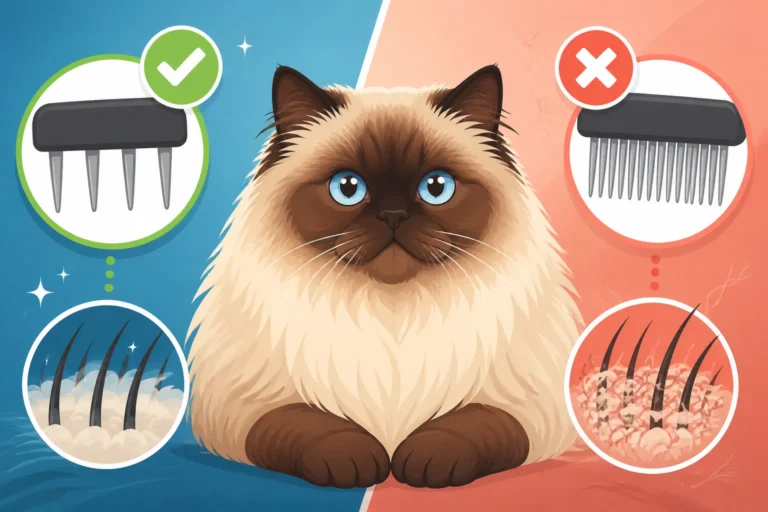
| Steel comb with wide and fine teeth | Detangling and lifting fur before trimming | The most important tool you own |
| Quiet cordless pet clippers | Safest way to shorten fur near skin | Look for a low-noise model with a guard comb |
| Blunt-tipped grooming scissors | Tidying edges, only on fur held away from skin | Never point tips toward the body |
| Non-slip mat or towel | Stops the cat sliding on a table | A bath mat works well |
| Unscented pet wipes or damp cloth | Cleaning the area before and after | Avoid fragranced products near the skin |
| Treats your cat genuinely loves | Rewarding calm behavior | Small, soft pieces work best |
| A second person, if possible | Gentle holding and distraction | Makes the first sessions far easier |
Clippers with a guard attachment are the safest choice for beginners because the guard keeps the blade a set distance from the skin. Scissors look simpler but are more dangerous in inexperienced hands. Many owners pick up clippers, combs and wipes from pet retailers such as Chewy or Amazon, where you can compare noise levels and blade guards in the listings. Always check the product details yourself and choose a model designed for cats or small animals.
Step-by-Step Sanitary Trim
Choose a time when your cat is relaxed, such as after a meal, and work on a stable surface; many cats tolerate grooming better off the floor, as explained in Why a Himalayan Tolerates Combing Better on a Table.
- Settle your cat on the non-slip mat and offer a treat. Stroke the back and hindquarters for a minute before picking up any tool.
- Comb through the britches gently, starting at the tips of the fur and working inward. Stop and tease apart small tangles with your fingers rather than pulling.
- If there is debris stuck to the fur, soften it with a damp cloth or wipe and remove it before trimming. Never try to clip through wet or soiled fur.
- Switch on the clippers away from the cat and let it hear the sound for a few seconds. Reward calm behavior.
- Lift the tail gently and, with the guard on, clip in the direction the hair grows around the anus, keeping a small margin clear of the skin itself.
- Move to the backs of the thighs. Comb the fur outward, then clip downward in short, slow strokes, following the hair growth.
- Use blunt scissors only to tidy uneven edges, and only on fur you are holding between your fingers so your fingers sit between the blade and the skin.
- Comb through once more to check for missed tufts or small knots, then wipe the area clean.
- Finish with a generous reward and let the cat leave on its own terms.
If your Himalayan resists being flipped over or held in an awkward position, you do not need to roll it onto its back. Many owners work with the cat standing or lying on its side. Our guide Combing a Himalayan’s Britches Without Turning It Over describes positions that keep the cat calmer.
Safety Rules That Prevent Accidents
A few rules prevent most home grooming injuries. First, never cut into a mat with scissors when it sits tight against the skin. That is exactly how cats get lacerated, because the skin is pulled up into the mat. Use clippers or leave it for a professional.
Second, keep sessions short. Five calm minutes is better than twenty minutes that end in a fight. If your cat starts tail-lashing, growling or twisting, stop, reward any calm moment you can find, and finish another day.
Third, know your limits. If a mat is large, tight to the skin, close to the genitals, or your cat is very distressed, stop and book a groomer or your vet. Badly matted cats sometimes need sedation for safe clipping, which is covered in Why a Matted Himalayan Ends Up Clipped Under Sedation.
Keeping the Britches Clean Between Trims
A good trim buys you time, but daily habits decide how long that time lasts. The goal is to stop debris and moisture from building up in the first place so that each trim is a small maintenance job rather than a rescue.
A Simple Daily and Weekly Routine
Most of the work happens in small, frequent sessions that take only a minute or two. A practical routine looks like this:
- Each day, give the britches a quick comb with the steel comb, focusing under the tail and the inner thighs.
- Each day, glance at the rear end after the cat uses the box, especially if stools have been soft.
- Spot-clean any debris immediately with a damp cloth or unscented wipe, then dry the area well.
- Each week, check the skin under the tail for redness, scabs or odor.
- Every few weeks, do a light sanitary trim before the fur grows long enough to catch debris again.
Diet, Stool Quality and the Litter Box
What comes out of your cat affects how much ends up on its fur. Firm, well-formed stools pass cleanly and rarely stick. Loose or sticky stools are much harder for any longhaired cat. If your Himalayan regularly has soft stools, mention it to your vet. Causes range from simple diet issues to parasites or underlying health conditions, and treating the root cause is far more effective than trimming more often.
The litter box set-up also deserves attention. A box that is too small forces the cat to squat near the edge, where fur brushes against walls and litter. A box with a high entry makes short legs awkward. Dusty litter clings to damp fur. Small changes, such as a larger low-entry box, a lower-dust litter and more frequent scooping, can noticeably reduce how dirty the britches get.
When to Call a Groomer or Vet
Professional help is the right choice in a number of situations, and knowing when to use it protects your cat.
Signs a Professional Groomer Should Step In
A groomer experienced with Persians and Himalayans is worth finding before you need one. Consider booking an appointment if the mats are large or tight to the skin, if your cat becomes so stressed that home sessions are unsafe, or if you lack the time or confidence to keep up. Plenty of committed owners use a groomer for the main tidy every couple of months and handle the daily combing at home; Why a Himalayan Owner Books a Groomer Anyway covers why that split works for so many people.
Signs the Problem Is Medical
Some changes around the rear point to health issues rather than grooming. Contact your vet if you notice any of the following:
| What You See | What It Might Indicate | Why It Matters |
|---|---|---|
| Persistent soft stools or diarrhea | Diet intolerance, parasites, illness | Ongoing contamination and dehydration risk |
| Redness, sores or scabs under the tail | Skin scald, infection, dermatitis | Can worsen quickly under fur |
| Scooting or licking the rear excessively | Anal gland issues, irritation, parasites | Often needs veterinary treatment |
| Strong odor even after cleaning | Infection or trapped material | May need clipping and treatment |
| Straining or crying in the box | Constipation or urinary problems | Urinary blockage is an emergency in male cats |
| Sudden inability to groom the rear | Arthritis, weight gain, pain | Underlying cause needs addressing |
Any straining to urinate, especially in a male cat, needs a vet immediately, not a grooming session.
Bringing It All Together
Trimming your Himalayan’s britches is not vanity and it is not a sign that you have failed at grooming. It is a practical answer to a coat and body shape that make the rear end the hardest part of this breed to keep clean. A tidy sanitary area keeps your cat comfortable, protects its skin and keeps your home cleaner. Start small, keep sessions short and rewarding, and bring in a groomer or vet when a job is beyond a calm home session.
Disclaimer
This article is for general informational purposes only and does not constitute professional advice. Laws, prices and regulations vary by location and change over time. Consult a qualified professional for guidance on your specific situation.