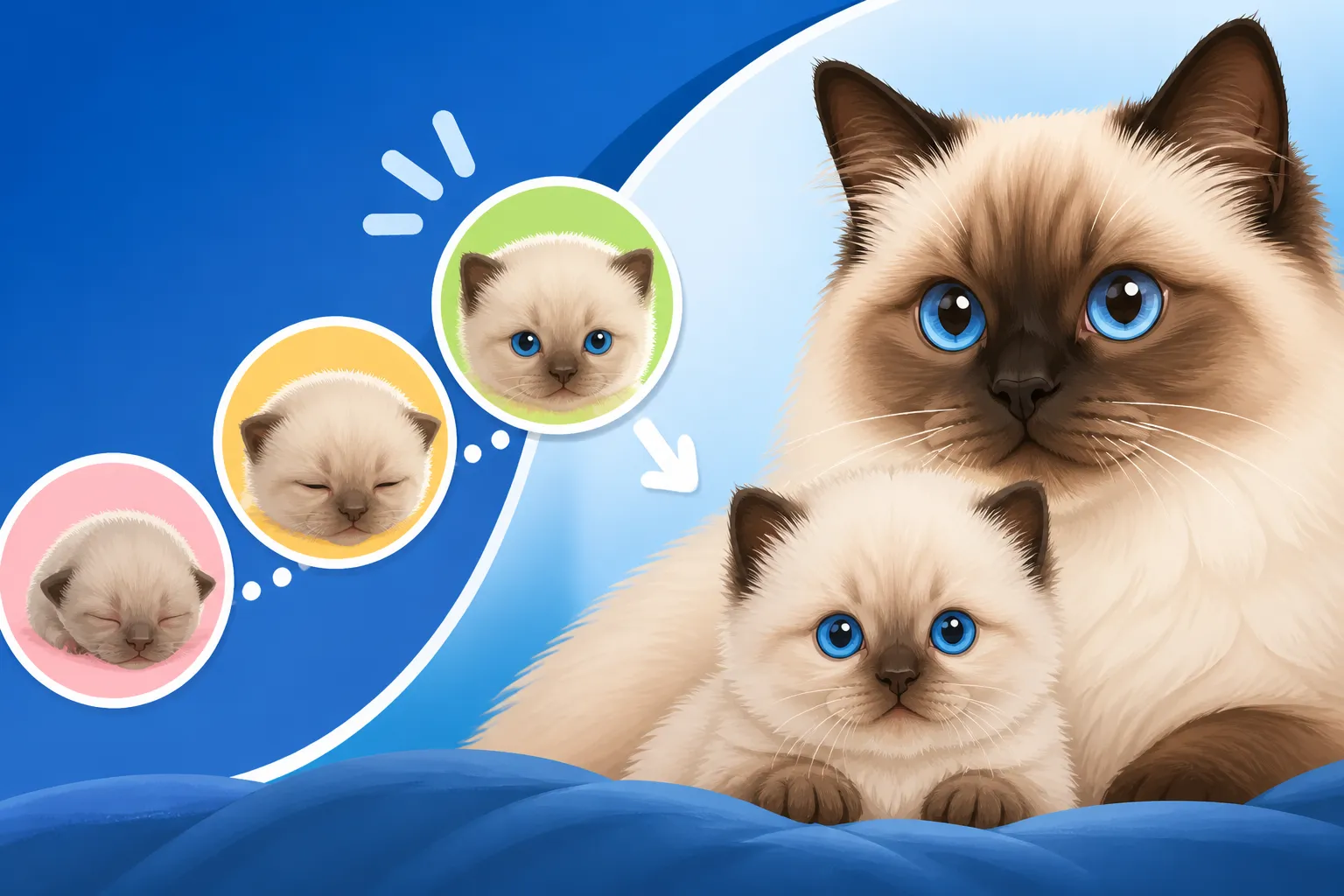
How Soon a Himalayan Kitten’s Blue Eyes Open
A Himalayan kitten’s eyes usually begin opening during the second week of life, but the change can happen gradually rather than all at once. It can be worrying to see the eyelids still closed, or to notice one eye opening before the other. This guide explains the usual timeline, what blue eyes mean, and when a kitten’s eyes need veterinary attention.
When Himalayan kittens open their eyes
The usual timeline for opening
Himalayan kittens are born with their eyelids closed, as kittens are generally. Their eyes often start opening when they are around a week old, and many are open by roughly two weeks. There is a normal range, though: a kitten may begin opening its eyes a little earlier or later than a littermate.
The process is gradual. You might first see a narrow slit, then a little more of the eye over the next few days. One eye may open before the other, and the two sides do not always change at exactly the same pace. That can look uneven without being a problem, especially if the kitten is otherwise warm, feeding, gaining steadily, and resting close to its mother and littermates.
Try not to judge the timing by photos or by comparing kittens from different litters. A single kitten’s development is more useful to watch than a calendar day counted from birth. For more on how young Himalayans change in their first weeks, see Why a Himalayan Kitten Is Still Pale at Eight Weeks and When a Himalayan Kitten’s Face Finishes Developing.
What the first few days of sight look like
Newly opened eyes do not mean a kitten can see clearly. Vision is still developing, and a young kitten may seem to respond more to warmth, touch, scent, and sound than to what is across the room. It may blink or squint in bright light, so keep the nest in a softly lit, quiet place rather than trying to test its eyesight with a phone light or other bright beam.
Himalayan kittens also do not open their eyes with their final adult eye color already visible. At first, the eyes commonly appear blue or blue-gray. The shade can look muted or cloudy while the kitten is very young, and it may become more vivid as the kitten grows. The blue color in Himalayans is associated with the breed’s colorpoint pattern, but the exact appearance develops over time. Related background is covered in Why the Point Gene Makes Every Himalayan Blue Eyed and Why Only Blue Eyes Are Allowed on a Himalayan.
| What you notice | What it may mean | What to do |
|---|---|---|
| Both eyes remain closed during the first week | Often part of normal early development | Keep the nest clean and watch the kitten’s general condition |
| A small slit appears, then gradually widens | A common pattern as the eyes open | Let the process happen without touching the eyelids |
| One eye opens before the other | Mild differences in timing can occur | Monitor for swelling, discharge, or obvious discomfort |
| Swelling, pus, crusting, or a bad smell | Possible irritation or infection | Contact a veterinarian promptly |
| Eyes are still completely closed at about two weeks | The kitten may need an examination | Ask a veterinarian for advice rather than trying to open them |
What is normal and what needs attention
Why you should never pry the eyelids open
It is tempting to help when a kitten’s eyes seem slow to open, particularly if you can see a tiny gap. Resist the urge to pull the lids apart, press on them, or wipe inside the opening. The eyelids are delicate, and forcing them can injure the eye or introduce germs. Even if the kitten seems calm, handling the eyelids is not a safe way to speed up development.
Keep the bedding clean and dry, and wash your hands before handling the kitten. If there is a little debris on the fur near the eye, do not scrub or put a product in the eye. Ask a veterinarian how to clean the area safely, especially if the kitten is very young or the debris keeps returning. Products sold for people, including eye drops and medicated wipes, should not be used unless a veterinarian specifically directs you to use them.
If you are preparing a kittening area, choose soft, washable bedding that can be changed when soiled. Chewy is one place some owners look for washable pet bedding, but the key is that the fabric should be clean, dry, and free of loose threads or anything a kitten could become tangled in. Supplies do not replace veterinary advice if an eye looks abnormal.
Warning signs that deserve a veterinary call
A little unevenness in opening is different from a swollen or painful-looking eye. Contact a veterinarian promptly if you see eyelid swelling, yellow or green discharge, sticky lids, increasing redness, a strong odor, or a kitten that keeps rubbing its face or seems unusually distressed. These signs can indicate a problem that needs assessment; waiting for the eyes to open on their own is not a good plan when there is discharge or swelling.
Also call for advice if the eyes have not begun to open around the two-week point, or if one eye stays shut while the other has opened and the difference persists. A veterinarian can examine the kitten and decide whether treatment is needed. Avoid trying to diagnose the cause yourself: the same outward sign can have different explanations, and treatment depends on what is actually going on.
The kitten’s overall condition matters too. Poor feeding, weakness, feeling cool, or failure to gain weight are reasons to seek help even if the eyes look normal. Very young kittens can change quickly, so it is better to describe what you are seeing to a veterinary clinic than to wait several days when the kitten seems unwell. Chewy may be useful for routine household supplies, but it cannot assess eye symptoms or provide an examination; for those concerns, contact a veterinary professional.
How Himalayan eye color develops
Blue at first does not tell you the final shade
A kitten’s eyes may look blue soon after they open, but that early appearance is not necessarily the finished color. As the kitten matures, the eyes can look clearer and more saturated. The Himalayan’s characteristic blue is linked to its pointed coloring, which is why blue eyes are part of the breed’s familiar appearance. Even so, kittens’ eyes can vary in how pale or deep the blue looks as they develop.
It is also useful to separate eye color from eye health. A blue eye is not, by itself, a sign that something is wrong, and a slightly hazy look in a very young kitten can be difficult to interpret at home. But cloudiness, redness, discharge, or a change in one eye should not be dismissed as normal color development. If something seems wrong, a veterinary examination is the safest way to distinguish ordinary development from an eye problem.
As the kitten grows, its coat points and facial features change as well. For a closer look at that gradual transformation, see How Many Weeks Before a Himalayan Kitten’s Points Show and How Large and Round a Himalayan’s Blue Eyes Should Be. Eye appearance can be part of the breed’s look, but it should never be assessed separately from comfort, normal blinking, and clear, clean eyes.
A calm routine helps you notice changes
You do not need to handle a kitten’s face repeatedly to keep track of development. Brief, calm observations during normal care are enough: note whether the eyes have begun to open, whether both sides are progressing, and whether there is any swelling or discharge. If you are caring for a litter, a simple written note for each kitten can help you describe changes accurately when speaking with a veterinarian.
Keep bright light, loud activity, and unnecessary handling away from the nest. The mother cat should have a quiet place to care for her kittens, with food, water, and a clean litter area nearby. If you are buying routine supplies through Chewy or another retailer, focus on practical items such as washable bedding and safe cleaning basics rather than eye treatments. A product marketed for tear stains or general eye cleaning is not a substitute for a veterinarian’s guidance for a newborn kitten.
As the kitten becomes more active, continue to observe its eyes without trying to test its vision. It will gradually respond more to its surroundings as development continues. If you are unsure whether what you see is within the ordinary range, a quick call to a veterinary clinic can help you decide whether the kitten should be examined.
Questions owners commonly ask
Is it normal for one eye to open first?
It can happen. The two eyes do not always open at the same moment, and a small difference may simply reflect gradual development. Watch for a steady change and look for warning signs such as swelling, discharge, redness, or signs of discomfort. If one eye remains closed after the other has opened, or the difference worries you, call a veterinarian rather than trying to open it yourself.
What if the eyes are still closed after two weeks?
If a kitten’s eyes have not started opening at around two weeks, contact a veterinarian for advice. Do not pry the eyelids apart or apply drops, ointments, or cleaning products without veterinary direction. A clinic can assess the kitten and recommend the right next step based on its age, condition, and what the eyelids look like.
Will a Himalayan kitten’s eyes stay blue?
Himalayans are known for blue eyes, and the breed’s point pattern is associated with that eye color. The shade may look different as a kitten matures, so early blue-gray eyes may not look exactly like the deeper blue seen later. For background on the breed’s development and appearance, see How to Tell a Himalayan From a Persian and How a Himalayan’s Points Are Judged.
Disclaimer
This article is for general informational purposes only and does not constitute professional advice. Laws, prices and regulations vary by location and change over time. Consult a qualified professional for guidance on your specific situation.