Why a Himalayan Kitten Is Still Pale at Eight Weeks
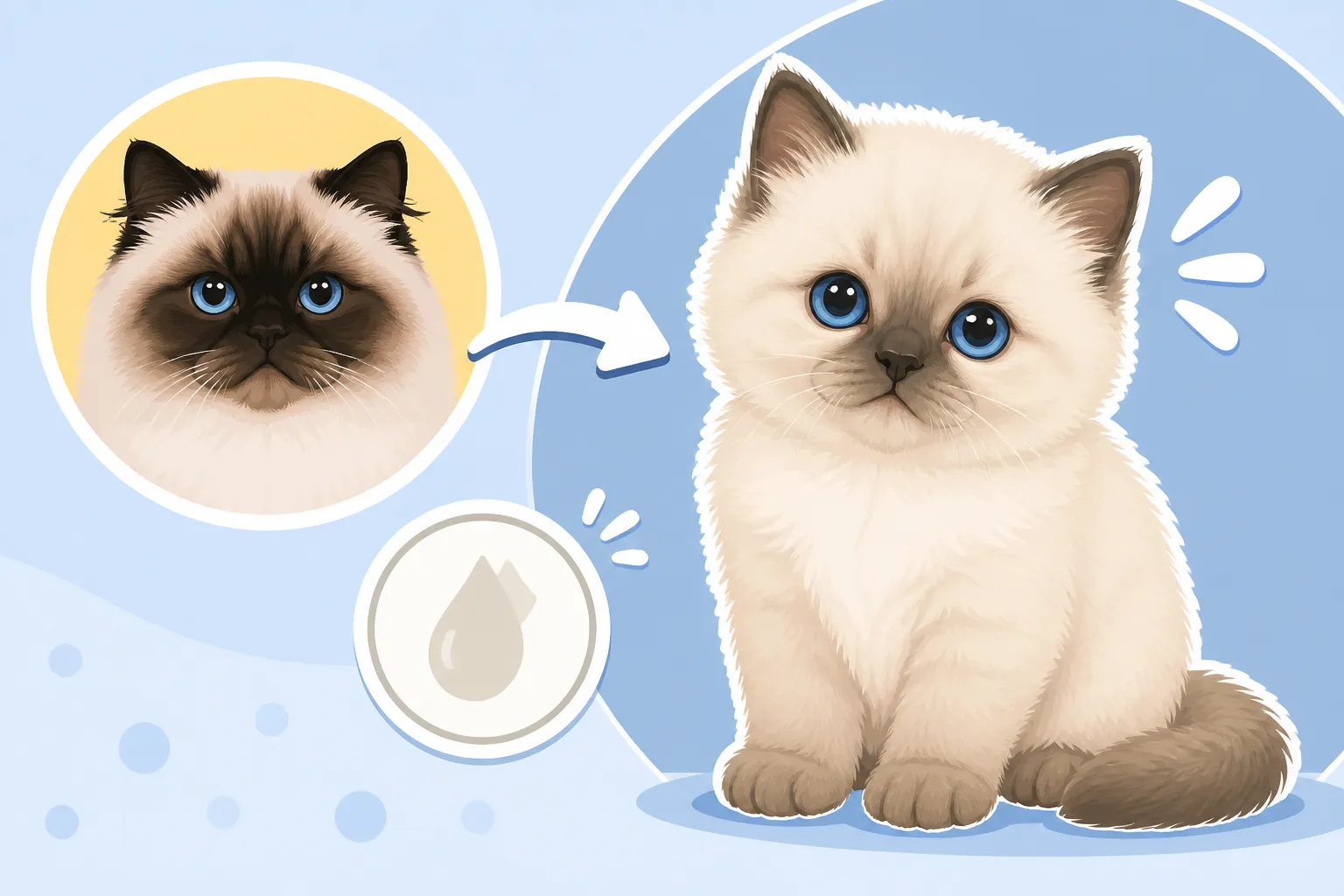
A Himalayan kitten can still look nearly white at eight weeks, leaving new owners wondering whether the expected dark ears, tail, paws, and mask will ever appear. In most cases, pale coloring at this age is normal: the pointed pattern develops gradually, and its timing and intensity vary from kitten to kitten.
Why an Eight-Week-Old Himalayan Can Still Look Pale
The colorpoint pattern develops gradually
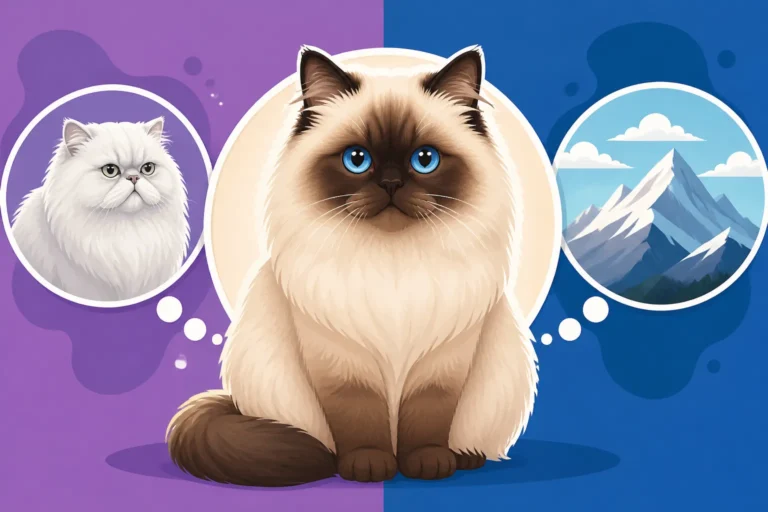
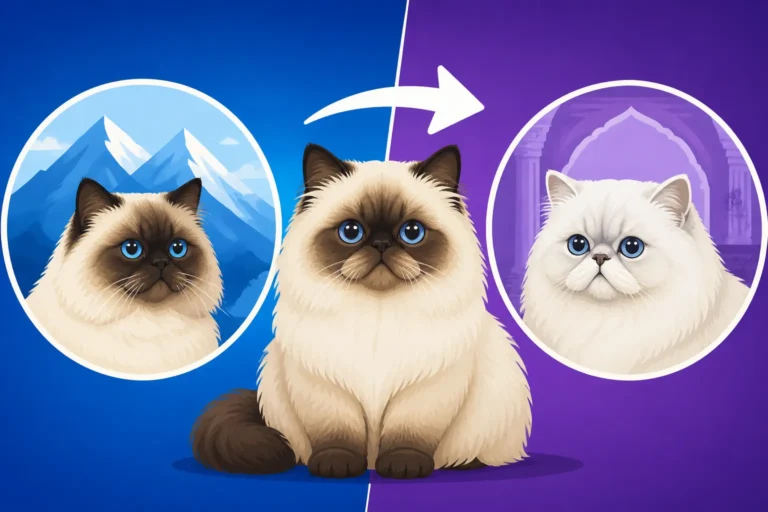
Himalayans carry a temperature-sensitive form of the colorpoint gene. It affects how pigment develops: cooler areas of the body tend to grow darker fur, while warmer areas stay lighter. That is why the ears, face, paws, and tail—the body’s cooler “points”—often become more visibly colored than the torso.
The pattern doesn’t necessarily arrive all at once. A kitten may be born almost entirely pale, then develop faint shading around the nose or ears before the tail and feet show much contrast. At eight weeks, the first changes can be subtle enough to disappear in a bright photograph or beneath soft kitten fluff.
This is why a pale kitten is not automatically a sign that the colorpoint pattern is missing. The color may simply not be obvious yet. For more on the early stages, see Why Every Himalayan Kitten Is Born Almost White and How Many Weeks Before a Himalayan Kitten’s Points Show.
Each kitten follows its own color timeline
Littermates can develop at different speeds, even when they share the same parents. One kitten may have a distinct nose mask by eight weeks, while another still looks mostly cream or white. The difference can reflect individual variation, the specific point color, coat growth, and the lighting in which you’re looking.
A pale coat can also make early shading harder to spot. Seal and blue points may eventually create strong contrast, while lighter colors can remain delicate-looking for longer. Even within a single point color, kittens don’t all darken at the same pace or to the same degree.
It’s more useful to watch for gradual change than to expect a dramatic transformation on a particular birthday. Check the same areas every few weeks: the ear tips, tail, toes, and fur around the nose. Comparing clear, naturally lit photos taken from similar angles can reveal changes that are easy to miss day to day.
The point color may be clearer than the body color
At eight weeks, look closely at the kitten’s ears, tail, paws, and face rather than judging the pattern by the torso alone. A slight shade at the ear tips or tail end may be an early clue. Sometimes the fur around the nose begins to darken before a clear mask forms.
The body coat is not always pure white. It may look ivory, cream, or softly shaded, and it can change with age. That gradual development is part of the breed’s characteristic appearance; What Color a Himalayan Kitten Is at Birth explains why the early coat can be so pale.
If you’re choosing a kitten, ask the breeder what color they expect and what clues they’re using. Photos of the kitten’s parents and older relatives may provide useful context, though they can’t promise an exact shade or final contrast. A thoughtful breeder should be comfortable explaining what is known, what is an informed estimate, and what may become clearer as the kitten grows.
What to Expect as Himalayan Points Develop
A practical guide to the changing coat
There is no exact schedule that fits every Himalayan. The table below describes a general pattern, not a deadline. Changes may be gradual, and coat length, lighting, and individual variation can affect what you notice.
| Stage | What you may notice | What it means |
|---|---|---|
| At birth | The kitten looks very pale, often nearly white | The colorpoint pattern is not yet strongly visible |
| Around eight weeks | Faint shading may appear on the ears, face, paws, or tail | Early point color may be emerging, but can be subtle |
| During the following months | Point areas often become easier to see | The coat is developing; timing and contrast vary |
| As the cat matures | Point color may continue to deepen, and the body coat may shift | The adult appearance takes time to settle |
A kitten’s color can look different under warm indoor bulbs, cool daylight, or a phone camera’s automatic color correction. For a fair comparison, take photographs in natural indirect light and avoid filters. A picture beside a plain, neutral background can make subtle shading easier to assess.
For a more detailed look at the progression, read How a Himalayan Kitten’s Points Darken Month by Month and How Many Years a Himalayan’s Points Take to Finish. Those topics also help set realistic expectations: an eight-week-old kitten’s coat is an early snapshot, not a final portrait.
Point color and body-coat color are related but not identical
The temperature-sensitive pattern explains why the points are darker, but the body coat can also change over time. As a Himalayan grows, its overall coat may become less uniformly pale. The amount of contrast depends partly on the cat’s coloring and individual development.
A kitten’s apparent color can be especially hard to judge when the coat is fluffy and fine. As the adult coat grows in, the pattern may become easier to read. The points themselves can also deepen over time, so a faintly shaded kitten may later show more noticeable color. See Why a Himalayan’s Body Coat Should Stay Light for how body color and point contrast are understood.
It’s also normal for the coat to vary somewhat across different parts of the body. A tail may look more strongly colored than the legs, for example, while the face mask develops unevenly at first. Don’t assume a kitten has a problem simply because the points are not identical in shade or equally visible yet.
What Can Affect the Appearance of the Points
Temperature plays a role, but don’t chill the kitten
Because pigment development is temperature-sensitive, cooler body areas tend to grow darker fur than warmer areas. A Himalayan kept in a cooler environment may show a darker overall coat than one kept warmer. This is a natural part of the colorpoint pattern, not a reason to make a kitten uncomfortable.
Keep the kitten at a safe, comfortable indoor temperature. Do not expose a young cat to cold conditions in an attempt to “bring out” its points. A cold room, outdoor exposure, or deliberate chilling is not a safe coloring technique, and it won’t provide a predictable result. The goal is a healthy, comfortable kitten—not a darker coat.
Temperature may also help explain why shaved or clipped areas can grow back darker. The new fur may develop under different conditions from the surrounding coat. For more, see Why the Cold Parts of a Himalayan Grow Dark Fur and How a Shaved Patch Regrows Darker on a Himalayan.
Lighting and grooming can disguise early shading
A pale kitten photographed against a white blanket may look almost completely white, even if a little color is developing on the ears or tail. Direct flash can flatten the coat’s texture and wash out subtle shades. Instead, look in soft daylight and gently part the fur where appropriate, without pulling or repeatedly handling a kitten that is trying to rest.
Grooming can also change what you see. A clean, brushed coat may show its texture and color more clearly than fur that is damp, tangled, or covered in dust. Himalayan kittens need gentle, age-appropriate handling as they get accustomed to coat care. If you’re gathering basic supplies, Chewy is one place owners may compare kitten-safe combs and grooming tools; check that any product is suitable for a young cat and use a light touch.
Avoid applying dyes, whitening products, or unapproved stain removers to make the coat look a particular way. Products used near a kitten’s eyes or mouth can cause irritation if they are not intended for that purpose. When in doubt, ask your veterinarian or breeder before using anything on the coat or face.
Point color is not a health test
A pale coat at eight weeks, by itself, does not tell you whether a kitten is healthy or unhealthy. Color development is not a substitute for veterinary care, health records, or a careful assessment of the kitten’s eyes, breathing, appetite, weight, and behavior.
If the kitten is bright, feeding normally, gaining appropriately, and has no concerning symptoms, a slow-to-show coat pattern is usually something to monitor rather than panic over. But contact a veterinarian if you notice issues such as poor appetite, lethargy, persistent eye discharge, labored breathing, or skin that is irritated, sore, or losing fur. Those signs need attention for their own sake, regardless of coat color.
When discussing a kitten with a breeder, ask about its veterinary examinations and the health history of its parents. The coat can help you understand likely coloring, but it cannot confirm a pedigree, guarantee a specific adult appearance, or replace health documentation.
How to Follow Your Kitten’s Color Changes
Take consistent photos and look for trends
Choose a regular interval—such as every few weeks—and take photographs in the same soft daylight, from similar angles. Include close views of the face, ears, paws, and tail, along with one full-body photo. The goal is not to inspect the kitten constantly, but to make gradual changes easier to see.
Keep notes about what you observe. You might write, “A little gray shading at the tail tip,” or “The ears look warmer in daylight than last month.” Simple descriptions are more useful than trying to assign a final color before the kitten has matured.
If you shop for routine kitten-care items online, Chewy can be one option for comparing basic supplies, but product labels matter more than branding. Choose items intended for kittens, and ask your veterinarian before using grooming products near the eyes or nose. A comb, good lighting, and a few dated photos are usually all you need to track color changes.
Ask the breeder focused questions
A breeder may be able to explain the expected point color based on the kitten’s parents, relatives, and early coat. Ask what color they believe the kitten is, which features they’re using to make that assessment, and whether the kitten’s appearance is still too early to call with confidence.
It’s reasonable to request recent photos in natural light and, if possible, images of the parents or older relatives. Those can help you understand the range of coat colors in the family, but genetics and development mean they are not a guarantee of the kitten’s final look. Be cautious of anyone promising an exact adult shade from a very young kitten.
You can also ask when the breeder expects the points to become easier to assess and whether the kitten has had its routine veterinary checks. A responsible answer should distinguish color predictions from health claims. A kitten may be gorgeous and still require the same careful health and care questions as any other Himalayan.
Give the pattern time to develop
An eight-week-old Himalayan can be healthy and correctly pointed while still appearing very pale. Watch for gradual shading rather than expecting the face, paws, and tail to darken at once. As the kitten grows, its point color and body coat will become easier to evaluate, though the final look varies.
If you enjoy documenting the changes, keep photos simple and consistent, and resist the urge to alter the kitten’s environment to influence its coat. Comfort, safe handling, and regular veterinary care matter far more than trying to speed up a color pattern. For another view of how temperature affects the coat, see Why a Himalayan’s Coat Changes Color After Surgery.
Disclaimer
This article is for general informational purposes only and does not constitute professional advice. Laws, prices and regulations vary by location and change over time. Consult a qualified professional for guidance on your specific situation.