When a Himalayan Kitten’s Persian Profile Sets
A Himalayan kitten’s face can look surprisingly different from one month to the next, so it is easy to wonder whether a kitten’s little nose and forehead will stay that way. This guide explains when the Persian profile becomes easier to judge, what normal growth can change, and how to distinguish a developing face from a shape that may affect breathing, eyes, or eating.
What a Persian profile means on a Himalayan
The profile is about more than a short nose
A Himalayan’s Persian profile is the shape of the head viewed from the side: the relationship between the forehead, nose, and chin. In a very flat-faced cat, these features appear close together, with the nose set high between the eyes. Other Himalayans have a more visible nose and a gentler slope from forehead to muzzle. Both can be recognized as Himalayans, though the preferred look varies by breeder and show standard.
A kitten’s profile is not a single measurement that suddenly “sets.” The skull, muzzle, and surrounding facial tissues grow as the kitten matures. Early on, a rounded head and soft features can make the nose look less defined than it will later. As the face develops, the forehead-to-nose transition and the position of the chin become easier to assess.
Photos can exaggerate or disguise a profile. A kitten photographed from above may look flatter than it does from the side, while a long coat can obscure the outline of the muzzle. When comparing kittens, ask for clear side-view photos taken at kitten eye level, as well as a relaxed front view. For a closer look at the shape breeders are describing, see What a Himalayan’s Profile Should Look Like Side On.
Face types vary, even within the breed
People often use “doll face” for a Himalayan with a more projecting nose and “Peke face” for one with a much flatter profile. These terms can help describe appearance, but they are not a substitute for assessing the individual cat’s health and structure. Two kittens from the same litter may have noticeably different profiles, and a label in an advertisement does not tell you how comfortably either kitten breathes.
The difference can be hard to judge when kittens are very young. Their faces are still changing, and expressions, posture, camera angle, and coat fluff all influence what you see. If a breeder tells you a kitten will become flatter or more extreme as it grows, ask what they mean specifically and request pictures of the kitten’s parents and older relatives. A family history can offer clues, but it cannot guarantee the exact adult appearance.
If you are comparing facial types, the useful question is not simply “Which one is flatter?” It is “How does this face function?” Look for nostrils that appear open, eyes that are not constantly irritated, and a kitten that can eat and play comfortably. The distinctions are explored further in Why a Himalayan’s Face Is Flat and a Ragdoll’s Is Not and What the Persian Standard Asks of a Himalayan.
When the kitten’s face becomes easier to judge
The first months offer clues, not a final answer
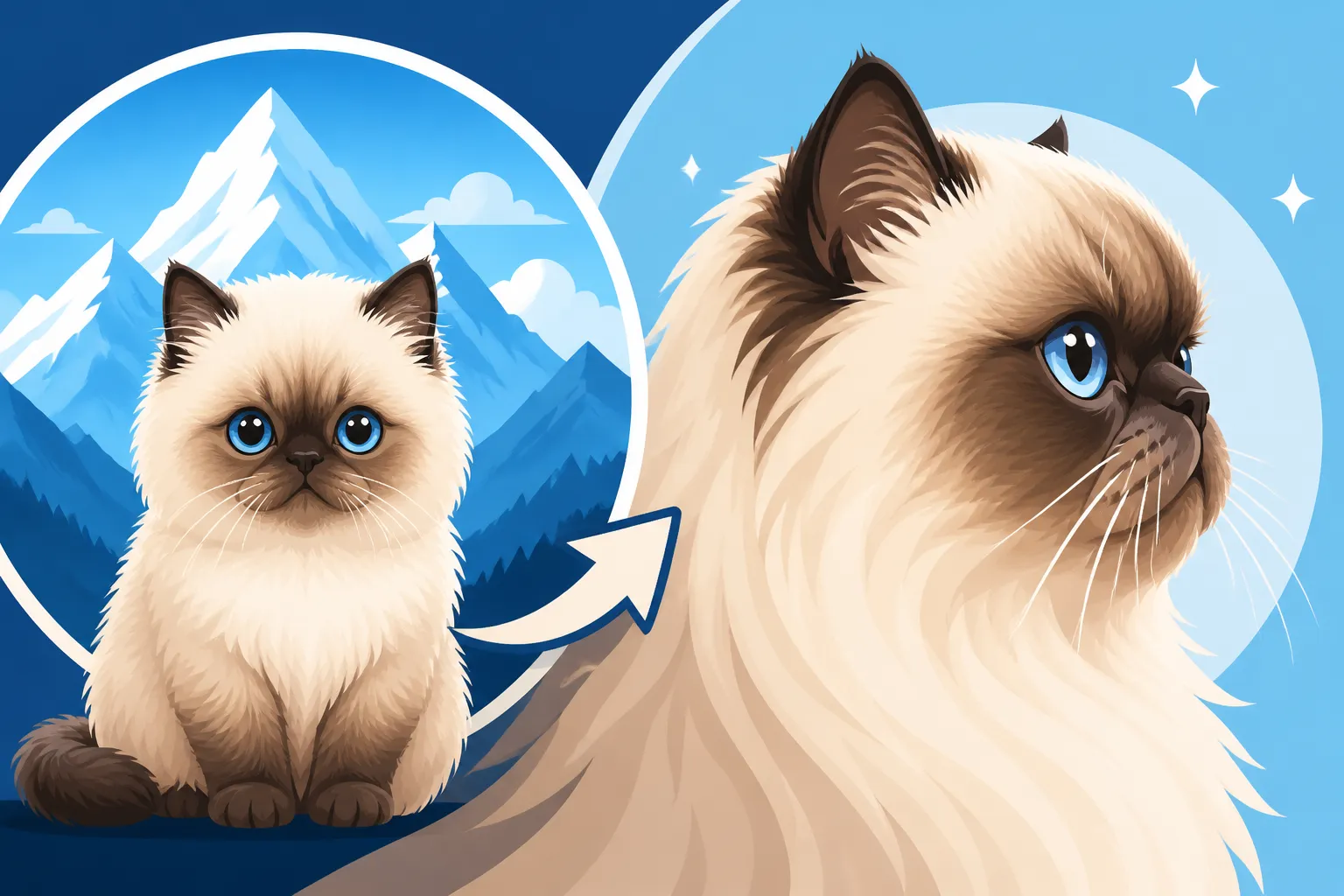
A Himalayan kitten’s basic facial structure is visible early, but a very young kitten is not a miniature adult. In the first few months, the head and muzzle are still growing, and the proportions can look different as the kitten gains size. At around twelve weeks, it may be possible to assess features more usefully than in newborn photos, but that is still an estimate—not a promise of the finished profile.
As the kitten grows, compare the same view over time. A side-on photo taken at eight weeks and another taken several weeks later can make it easier to see whether the bridge of the nose is becoming more defined or whether the face is developing a flatter outline. Ask the breeder to describe what they see without relying only on terms like “extreme,” “traditional,” or “doll face.” Clear descriptions are more useful than labels alone.
The face is only one part of a kitten’s development. A Himalayan’s coat and point color also change as it matures, which can alter the impression of the head. The colorpoint pattern may become more noticeable while the kitten’s body coat remains pale, and facial markings can make the nose area look more or less prominent in photos. For the color timeline, see How Long a Himalayan Takes to Finish Its Coat and Points.
Adult appearance takes longer than kitten pictures suggest
The profile usually becomes easier to evaluate as the head matures through kittenhood and adolescence. However, there is no universal birthday when every Himalayan’s face is finished. Individual growth, inherited structure, and the particular line all matter. The adult look may become clearer before the coat has reached its full density or the points have fully developed.
For a buyer, this means a breeder’s prediction should be treated as an informed estimate. A responsible breeder can show you relatives at different ages and explain how kittens from that line tend to mature. They should also be comfortable discussing breathing, eye comfort, and jaw structure—not only whether a kitten is likely to have a dramatic show profile.
A useful question is, “What do you expect this kitten’s profile to look like as an adult, and what are you basing that on?” Then ask whether the kitten’s parents have open nostrils, comfortable breathing, and no persistent eye irritation. If you want a more focused assessment around twelve weeks, How to Judge a Himalayan Kitten’s Nostrils at Twelve Weeks explains what to look at without pretending that one glance can predict a lifetime of health.
How to assess a developing profile safely
Observe breathing, eyes, and eating
A kitten’s face should be evaluated for function as well as appearance. Watch the kitten when it is resting and after gentle play. Breathing should not look like a struggle, and the kitten should not routinely breathe with its mouth open. A little snuffling or noise can occur, but ongoing noisy breathing, visible effort, or frequent panting deserves veterinary attention rather than being dismissed as “normal for the breed.”
Eyes matter, too. Some Himalayan cats have tear staining, but persistent discharge, squinting, redness, or discomfort should not be assumed to be cosmetic. A flattened facial structure can be associated with tear drainage and eyelid issues, so ask whether the kitten has been examined and whether the breeder has noticed recurring problems. Why Only Blue Eyes Are Allowed on a Himalayan describes the breed’s eye color, while How a Himalayan’s Head Is Judged as a Persian’s gives more context about the head shape.
Observe the kitten eating and drinking. A shortened muzzle or altered jaw alignment may affect how a cat picks up food, but the kitten should still be able to eat without obvious distress. Notice whether food repeatedly falls out, whether the kitten paws at its mouth, or whether it seems unable to manage the bowl. Those details are more meaningful than a photograph of a perfectly posed face.
| What to look at | A reassuring sign | A reason to ask more questions |
|---|---|---|
| Nostrils | Open-looking nostrils with quiet, easy breathing | Pinched nostrils, visible effort, or frequent noisy breathing |
| Eyes | Eyes that open comfortably without persistent discharge | Squinting, redness, repeated discharge, or signs of pain |
| Eating | The kitten can pick up and swallow food comfortably | Repeatedly dropping food, struggling, or pawing at the mouth |
| Profile photos | Clear side and front views in natural posture | Only close-up or angled photos that hide the nose and jaw |
| Family history | Breeder can discuss parents and adult relatives | Breeder focuses on extreme flatness but cannot answer health questions |
Ask for records and a hands-on veterinary exam
Before choosing a kitten, ask what veterinary care has already been provided and request the records. A breeder’s description is helpful, but it does not replace an examination by a veterinarian. Once the kitten comes home, arrange a visit so the vet can assess breathing, eyes, mouth, weight, and overall development. If you already have concerns about a kitten’s profile, bring the breeder’s photos and your own observations to the appointment.
It can help to make a short list before you visit the litter. Ask whether the kitten’s nostrils have been checked, whether it has had eye or breathing problems, and whether any relatives have needed treatment related to their facial structure. If a seller avoids straightforward questions or insists that obvious breathing difficulty is simply part of the breed, take that seriously. What a Himalayan Buyer Should Ask About Registration covers paperwork questions, while What Nobody Tells You Before Buying a Himalayan looks at broader ownership considerations.
For everyday care, choose supplies that work with the kitten’s face rather than forcing an awkward posture. A wide, shallow food and water dish may be easier for some flat-faced cats to use than a deep, narrow bowl. Chewy is one place owners may compare basic bowl styles, but the individual cat’s comfort is the deciding factor. Check that the kitten can reach the food easily and does not have to press its face against a rim.
What owners can and cannot change
Growth changes the appearance, not the inherited structure
A kitten’s profile may become more apparent as the head grows, but grooming cannot reshape the skull or move the nose. Nor can a particular food, supplement, or routine reliably turn a more projecting profile into a flatter one. The visible face can look different as the coat fills in, the kitten changes posture, or the points darken, but those changes should not be confused with a change in the underlying bone structure.
This distinction matters when a kitten is being marketed based on a predicted adult look. Ask what is visible now and what is only a breeder’s expectation. If you are buying primarily for a specific profile, remember that development has some variation, even with a known pedigree. A truthful breeder should explain that uncertainty instead of presenting a forecast as guaranteed.
Owners can, however, make daily care more comfortable. Keep the face clean and dry as advised by your veterinarian, and use only products that are safe around the eyes. Chewy may offer a range of pet-care supplies, but check labels carefully and avoid putting a product near the eyes unless it is specifically appropriate for that use. If staining changes suddenly, the skin becomes sore, or discharge looks unusual, ask a vet rather than trying multiple removers.
Choose comfort over an extreme look
A very flat face may be striking, but appearance should not outweigh ease of breathing, eating, and seeing. When meeting a kitten, watch it move and play in a calm setting. A kitten that repeatedly stops to catch its breath or appears uncomfortable should not be judged only by how photogenic its profile is. A breeder should welcome questions about function and be willing to discuss the trade-offs in the line.
Think about the home you can provide, too. Himalayans need regular coat care, and many benefit from gentle handling practice that makes face checks and cleaning less stressful. Chewy can be useful for comparing grooming basics such as combs and shallow dishes, but a product does not replace a consistent routine or veterinary advice. Build small, positive handling sessions into the kitten’s day instead of waiting until a tangle or eye problem makes care urgent.
Ultimately, a kitten’s Persian profile becomes easier to assess as it grows, but no single age or photo can settle the question with certainty. Look at the developing structure, ask about adult relatives, and pay close attention to how the kitten breathes, eats, and uses its eyes. Those observations will tell you more about the cat you are choosing than a promise about how flat its face may become.
Disclaimer
This article is for general informational purposes only and does not constitute professional advice. Laws, prices and regulations vary by location and change over time. Consult a qualified professional for guidance on your specific situation.