Why Persian Breeders Track the Himalayan Gene
A Persian kitten can look completely solid-colored while quietly carrying the gene that produces the Himalayan colorpoint pattern. That can surprise breeders when a pointed kitten appears in a litter. Understanding how the gene is inherited helps Persian breeders plan matings, interpret pedigrees, explain unexpected coat colors, and make informed decisions without confusing a kitten’s appearance with its genetic makeup.
What the Himalayan gene means in Persian cats
The pointed pattern is genetic, not a separate coat color added later
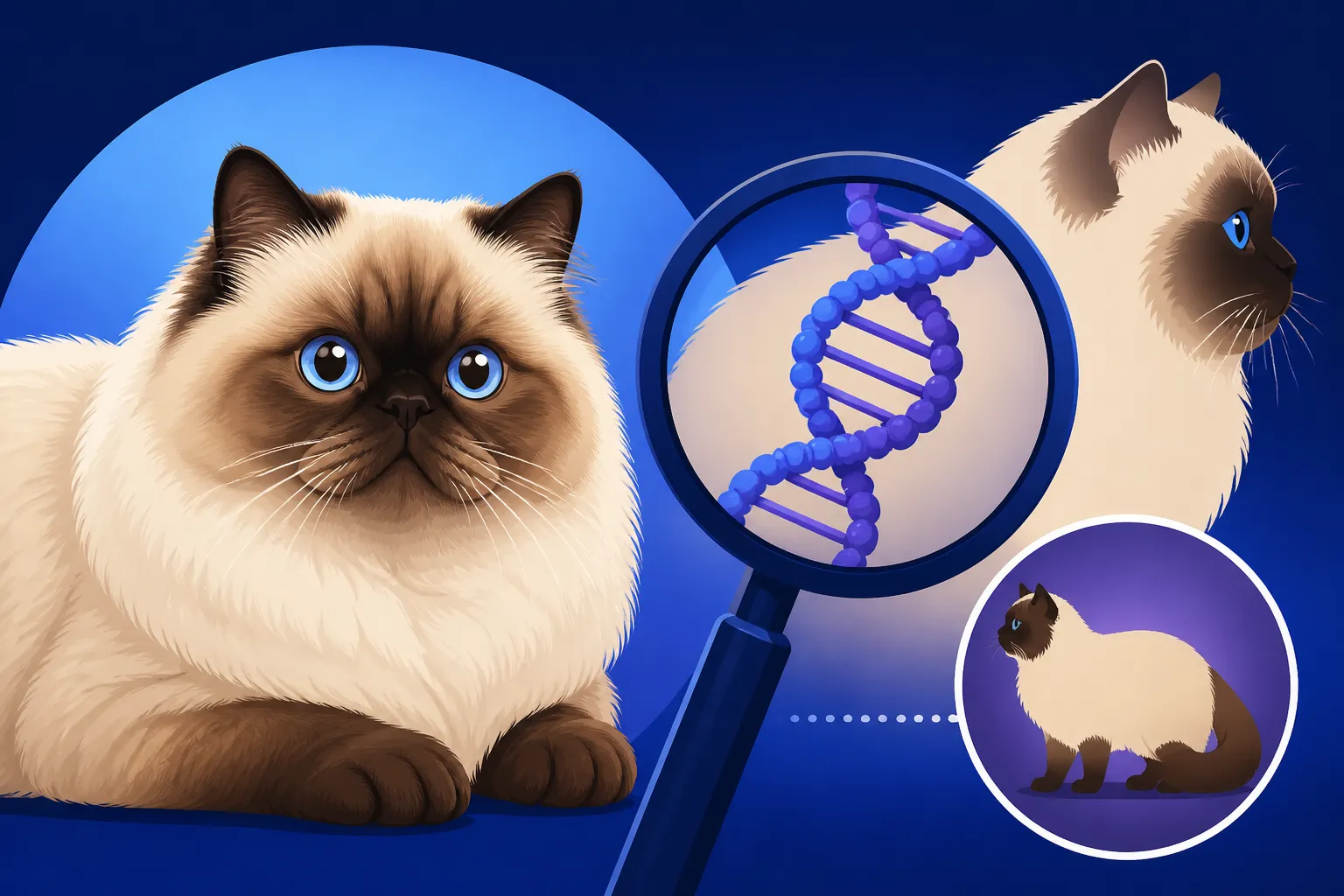
The Himalayan pattern is a form of colorpoint: the cat’s body is generally pale, while cooler areas such as the face, ears, legs, and tail develop darker color. The pattern is associated with a temperature-sensitive form of the tyrosinase gene, often called the point gene. Because pigment develops differently at warmer and cooler parts of the body, a kitten’s points may become more noticeable as it grows.
“Himalayan gene” is a familiar shorthand among breeders, but it can be confusing. It does not mean that every Persian with Himalayan ancestry looks pointed, nor does it necessarily mean the cat belongs to a separately registered breed. A Persian may carry one copy of the point variant and still have a solid-colored coat. That hidden-carrier possibility is a major reason the gene matters in Persian breeding.
The pattern is also not always fully visible in a young kitten. Himalayan kittens are born very pale, and their points develop over time. A breeder trying to identify a carrier by appearance alone can therefore miss important information. The basics of the pattern are covered in Why a Himalayan Needs Two Copies of the Point Gene and Why the Cold Parts of a Himalayan Grow Dark Fur.
A Persian can carry the point gene without looking like a Himalayan
For the classic colorpoint pattern to appear, a cat generally needs two copies of the relevant point variant, one inherited from each parent. A Persian with just one copy can look like a non-pointed Persian while passing that variant to some of its kittens. This is why a pedigree may contain information that is invisible in the cat’s coat.
Imagine a solid-looking Persian whose parent was pointed. That Persian may have inherited one copy of the point variant and one copy associated with full color. Its appearance does not reveal the hidden copy, but a genetic test or reliable family records may. The distinction between a visibly pointed cat and a carrier is explained in How a Persian Can Carry the Himalayan Gene Hidden.
A breeder should not assume that every Persian with a pointed relative is a carrier, either. The likelihood depends on which genes the cat inherited from both parents, and pedigree notes can be incomplete or mistaken. When a breeding decision depends on the answer, a suitable genetic test and carefully checked parentage records are more useful than guesswork. A pointed coat, a color label, or a breeder’s recollection is not the same thing as a documented genotype.
Why Persian breeders keep track of the gene
To understand which kittens a planned mating could produce
Tracking the point gene helps a breeder estimate possible coat-pattern outcomes before a mating. The table below shows simplified examples for the classic recessive inheritance pattern. It assumes the parents’ genotypes are known and that no other relevant genetic factors alter the result.
| Parent combination | Possible pointed kittens | Other possible kittens |
|---|---|---|
| Two non-carrier, non-pointed cats | None expected from this gene combination | Kittens would not inherit the point variant from these parents |
| A non-carrier and a carrier | None expected to be pointed | Some kittens may inherit one copy and become carriers |
| Two carriers | Some kittens may inherit two copies and be pointed | Others may be carriers or inherit neither copy |
| A pointed cat and a carrier | Some kittens may be pointed | Others may inherit one copy and appear non-pointed carriers |
| A pointed cat and a non-carrier | None expected to be pointed | Kittens may inherit one copy and become carriers |
These are inheritance possibilities, not promises about a particular litter. Each kitten inherits genes independently, so a small litter may not match the percentages people expect from a larger theoretical sample. A mating between two carriers can produce pointed kittens, but it does not guarantee that any kitten in that litter will be pointed. Likewise, a mating that can produce pointed kittens may also produce non-pointed kittens.
The practical details of possible outcomes are discussed in Whether Two Persians Can Produce a Himalayan. Breeders who keep clear records can explain why a pointed kitten appeared, or why a pairing did not produce one, without treating coat color as a surprise or a fault. Those records are especially useful when a cattery plans several generations of matings rather than making a single pairing in isolation.
To preserve accurate pedigrees and avoid assumptions based on appearance
A pedigree records ancestry; it does not automatically reveal every hidden genetic variant. When a breeder records known carrier status or test results alongside family information, future breeding decisions become easier to interpret. Without those notes, a later breeder may see a pointed kitten in a Persian litter and have no clear way to determine which parent passed along the relevant variant.
This does not mean every Persian breeder is trying to produce Himalayan-patterned kittens. Some may want to avoid producing pointed kittens in a particular breeding program; others may work with colorpoint lines and want to understand the expected pattern. In either case, the goal is informed planning. A breeder should be clear about the intended outcome and should not present a kitten’s color as proof of health, quality, or breeding suitability.
The term used for a cat can also vary by registry and breeding context. A Persian carrying one copy of the point gene may still be described as a Persian, while a pointed cat may be referred to as a Himalayan, a colorpoint Persian, or another registry-specific term. For clarity about this naming, see What a Persian Carrying the Himalayan Gene Is Called and How the Himalayan Is Registered by CFA Today.
How breeders can track the Himalayan gene responsibly
Combine test results with parentage and pedigree records
A breeder who needs to know whether a cat carries the point variant can ask a veterinary professional or an appropriate genetic-testing laboratory about a test for the relevant gene. Before ordering a test, confirm that it identifies the variant relevant to the cat’s breed and intended breeding question. Keep the result linked to the correct cat using reliable identification and parentage records; a report is only useful if it is clear which animal was tested.
It is also important to distinguish a test result from a prediction about every feature of a kitten. A result may help identify whether a cat carries a particular variant, but coat appearance and registration decisions involve more than a single line on a lab report. Breeders should keep the original documentation, note the test date and identity details, and share relevant information with future owners or other breeders when appropriate.
Pedigree records can help flag questions, but they should not be treated as conclusive genetic proof. If a record says a cat is “clear,” ask what was tested and how the result was documented. If it says “carrier,” clarify which variant the statement refers to. This kind of careful recordkeeping supports the broader questions addressed in What a Persian Standard Asks of a Himalayan and Which Point Colors the Standard Lists for a Himalayan.
Explain the results to kitten buyers without overstating them
A breeder should be able to explain what a kitten’s likely coat pattern means, what is known about the parents, and whether any relevant test results are available. Buyers can ask whether either parent is pointed or known to be a carrier, whether testing was performed, and whether the result applies to the specific cat named in the paperwork. A responsible answer should make the distinction between appearance, ancestry, and confirmed genetic information easy to understand.
It is equally reasonable for buyers to ask how the breeder uses the information. A breeder who tracks the gene should be able to describe the purpose of doing so, whether that is predicting coat patterns, maintaining accurate pedigrees, or making planned breeding choices. Vague claims such as “the line is clear” are less useful than an explanation of what was tested and what the result means.
The Himalayan gene itself is not a diagnosis of illness. It describes coat-color inheritance; it should not be confused with health screening for other conditions. A kitten’s colorpoint pattern does not establish that the kitten is healthy, and a non-pointed Persian is not automatically free of inherited risks. Buyers should consider health history and appropriate veterinary care separately from coat genetics.
What the gene means for future Persian litters
Track the gene for planning, not as a substitute for broader breeding care
Keeping track of the point gene allows breeders to make more informed predictions, maintain useful records, and avoid being caught off guard by a pointed kitten in a litter. It can also help breeders communicate accurately with other catteries when a cat is sold or considered for a future mating. Those benefits depend on honest documentation: an unverified assumption copied from one pedigree to another can create confusion for years.
The gene should be considered as one part of a breeding plan, not the whole plan. Breeders still need to weigh health, temperament, structure, pedigree diversity, and the goals of their program. A mating should not be considered responsible simply because the expected coat colors are attractive or predictable. Nor should a carrier be treated as automatically unsuitable; the decision depends on the breeding goal, the other parent’s genotype, and the breeder’s wider responsibilities.
If a breeder wants a pointed kitten, both sides of the mating need to be considered so the necessary inheritance can occur. If the breeder does not want pointed kittens, knowing whether either parent carries the variant can help inform the pairing. In both situations, testing and transparent records are more reliable than trying to infer genotype from a solid-looking coat.
Keep color terminology separate from registration and buyer expectations
The word “Himalayan” can refer to a recognizable colorpoint type, but registration terminology is not identical across cat organizations. Some registries treat Himalayan cats as a separate breed, while others place them within a Persian division or use the term colorpoint Persian. Buyers may therefore encounter different wording on pedigrees, depending on the registry and the breeder’s practices.
This variation makes plain-language explanations valuable. A breeder can state that a kitten is pointed, explain the parents’ known genetic status, and clarify how the kitten is recorded by the relevant organization. That avoids implying that one label alone confirms the kitten’s ancestry or test results. A buyer comparing paperwork can also review What a Himalayan’s Certificate Actually Says to understand why the wording may differ.
For Persian breeders, the central reason to track the Himalayan gene is straightforward: it can be hidden in a cat that does not look pointed, yet influence the coat patterns of future kittens. Recording what is known, testing when the answer matters, and explaining the limits of the information gives breeders and buyers a much clearer picture than appearance alone.
Disclaimer
This article is for general informational purposes only and does not constitute professional advice. Laws, prices and regulations vary by location and change over time. Consult a qualified professional for guidance on your specific situation.