How to Tell a Himalayan From a Persian
A fluffy pointed cat can look unmistakably Himalayan in one photo and simply Persian in another, especially before its coat colors finish developing. The most reliable clues are the pattern of the coat and the eye color—not the cat’s fluff, build, or expression. This guide explains how to tell a Himalayan from a Persian, what can confuse the comparison, and when registration terminology matters.
Start with the coat pattern and eye color
Look for color on the face, ears, legs, and tail
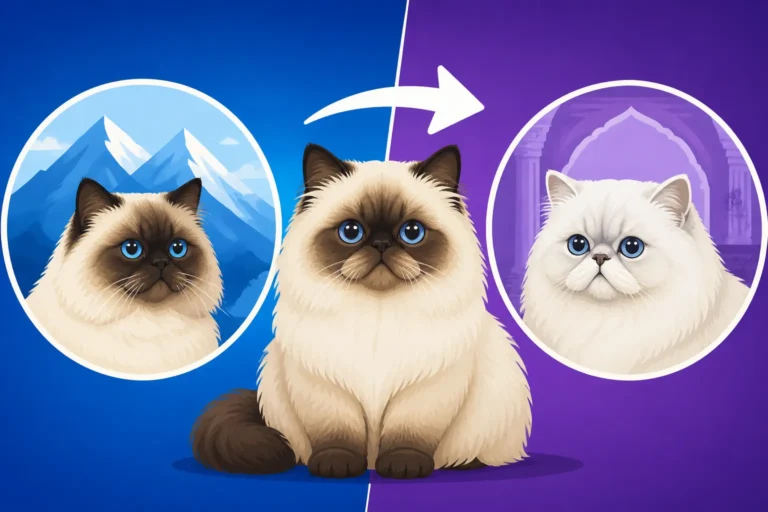
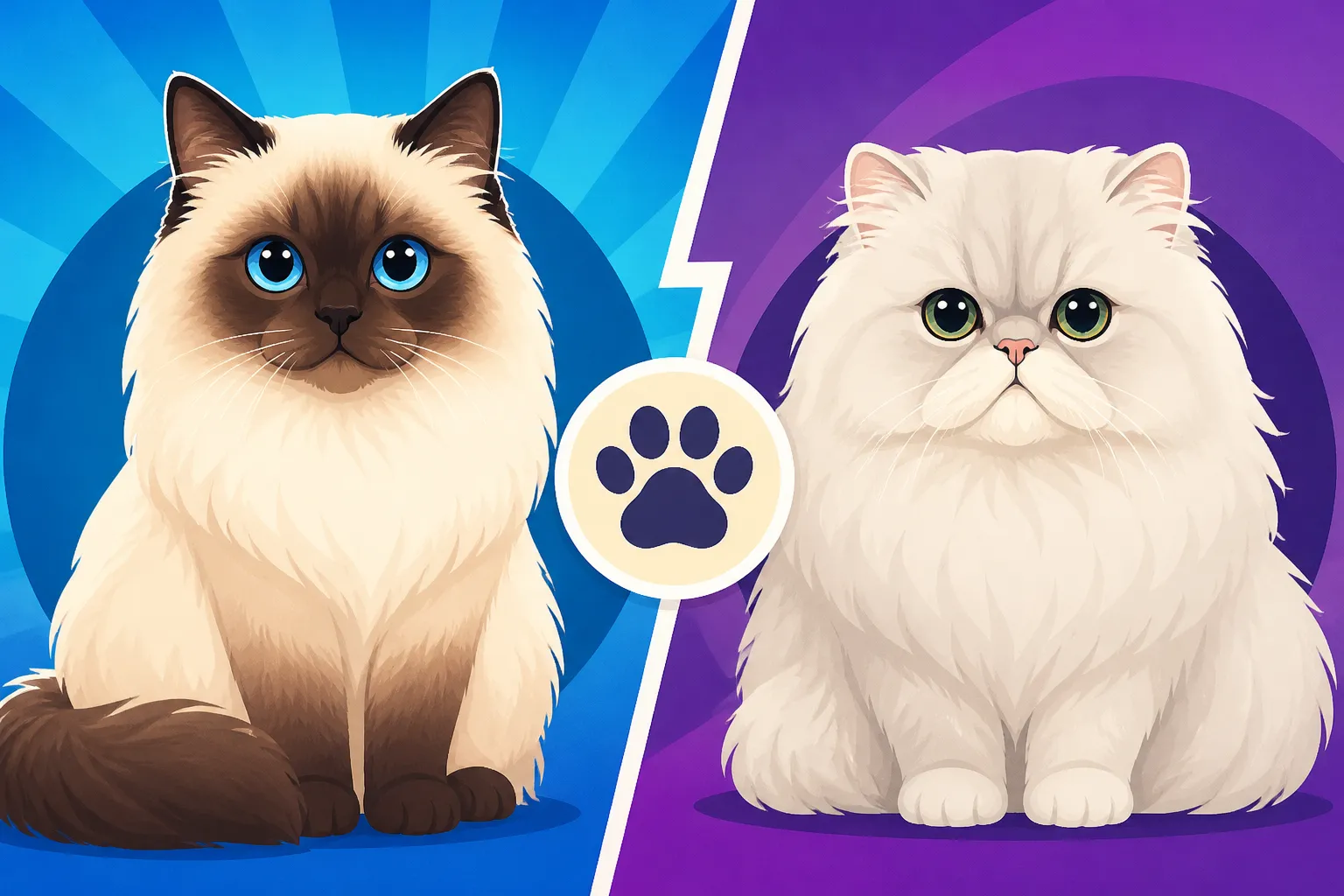
A Himalayan is a colorpoint cat: its body is usually pale, while the cooler parts of its coat—the face, ears, feet, and tail—carry darker color. The darker areas are called points. A seal-point Himalayan, for example, has deep brown points; other cats may have blue, chocolate, lilac, red, or patterned points.
A Persian can have many coat colors and patterns, including solid, shaded, tabby, and bicolor coats. A Persian with a uniform coat color or a non-pointed pattern is generally easier to distinguish from a Himalayan. The tricky cases are Persians that carry the colorpoint pattern: depending on the registry and breeding context, a Himalayan may be recorded as a Persian variety or division rather than as a separate breed.
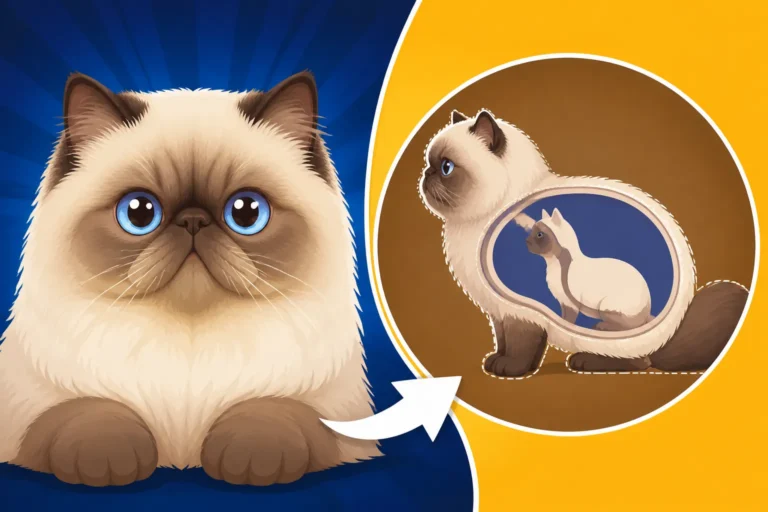
The point pattern may not look strongly defined on a young kitten. Himalayan kittens are born very pale, and their points develop gradually. If you are identifying a kitten, don’t decide from a few early photos alone. Ask about the parents, the kitten’s registration, and how its color has changed as it has grown. The title Why Every Himalayan Kitten Is Born Almost White explores why that early coat can be misleading.
Check the eyes, but don’t use them alone
Himalayans have blue eyes. That is a useful clue, particularly when paired with a pale body and darker points. However, blue eyes on their own do not establish that a cat is Himalayan. Other cats can have blue eyes, and a photograph can make eye color difficult to judge.
Persians may have different eye colors depending on their coat color and pattern. Some Persians have blue eyes, including colorpoint Persians; others have copper, green, or other permitted eye colors. So the useful question is not simply, “Are the eyes blue?” It is, “Do the blue eyes appear together with the Himalayan colorpoint pattern and supporting paperwork?”
Blue eyes are part of the Himalayan’s expected appearance, not a flaw. For a closer look at the relationship between the pattern and eye color, see Why Only Blue Eyes Are Allowed on a Himalayan. If the cat is an adult with blue eyes but no visible points, consider other explanations as well: lighting, a very pale point color, or a coat that has not been described accurately.
Compare the cats’ overall appearance carefully
Expect a great deal of Persian resemblance
Himalayans and Persians share much of the same general look: a long, dense coat, a rounded head, large eyes, a short nose, and a compact, sturdy body. That resemblance is not a mistake. The Himalayan is commonly described as a Persian with the point gene, and many people use “Himalayan” to refer to a colorpoint Persian type. You can read more in Why a Himalayan Is a Persian With the Point Gene.
Because the body type overlaps so much, body shape alone is a poor way to tell them apart. A cat’s size, coat fullness, or round face might make it look Persian, but those traits don’t rule out Himalayan. Likewise, a pointed coat doesn’t mean the cat has a noticeably different frame from a Persian.
Face shape can vary from one individual to another. Some cats have a more visible nose and less extreme facial profile; others have a flatter face. That variation is worth noticing for health and comfort, but it does not replace the coat pattern and registration as identification clues. The article What a Himalayan’s Profile Should Look Like Side On explains how the profile is assessed.
Don’t mistake a similar pointed breed for a Himalayan
Several breeds can have colorpoint coats, so a pale body and darker face are not exclusive to Himalayans. Ragdolls and Birmans, for instance, can also have points, but they have their own breed characteristics and histories. A Ragdoll often has a longer, less compact outline, while a Birman is known for white “gloves” on its feet. Neither distinction is a guarantee when looking at a single photo, but they can help you know what questions to ask.
A pointed Exotic Shorthair may also resemble a Himalayan in the face and coat pattern, but its coat is short rather than long. If you are comparing lookalikes, How to Tell a Himalayan From a Colorpoint Exotic Shorthair covers that specific distinction, and Why a Ragdoll Is Longer and a Himalayan Rounder explains another common comparison.
| Feature | Himalayan | Persian |
|---|---|---|
| Coat pattern | Pale body with darker points on the face, ears, legs, and tail | Many colors and patterns; may also be colorpoint |
| Eye color | Blue | Varies with coat type; colorpoint Persians also have blue eyes |
| Coat length | Long and dense | Usually long and dense |
| General build | Often compact and rounded | Often compact and rounded |
| Identification challenge | May be registered as a Persian variety or division | Can include colorpoint cats, depending on registry terminology |
| Best clues | Point pattern, blue eyes, breeder records, and registration | Coat pattern, records, and registration |
The table is a guide, not a substitute for reliable records. Individual cats vary, and the word “Himalayan” may be used differently across registries and countries.
Use records and terminology to confirm what you see
Ask what the registration actually says
One of the most confusing parts of identifying a Himalayan is that the breed name may not appear consistently on paperwork. Some registries treat the Himalayan as a separate breed, while others place it within the Persian breed or list it as a colorpoint variety or division. That means two cats with very similar appearances may have different wording on their certificates without either being mislabeled.
If you are speaking with a breeder, ask which registry issued the paperwork and what the breed or variety line says. Ask to see the registration or pedigree rather than relying on an online listing, a social media caption, or a verbal description. A seller calling a kitten “Himalayan” is not the same thing as documentation explaining how that kitten is registered.
This distinction matters most when you are buying a kitten, entering a show, or trying to understand a pedigree. If the paperwork says Persian, that does not automatically mean the cat lacks the Himalayan colorpoint pattern. For background on the registry difference, see Why CFA Made the Himalayan a Persian Division in 1984 and What a Himalayan Buyer Should Ask About Registration.
Ask about the parents and the kitten’s development
Photos of both parents can help you understand what coat pattern and facial features to expect. Request clear pictures taken in natural light, including a side view and a full-body view. A close-up of the face alone may show points but hide the body’s color, while a heavily edited image can distort both coat shade and eye color.
For a kitten, ask how its color has developed over time. A responsible explanation should make sense alongside the kitten’s age, visible points, and family history. If the breeder cannot tell you how the kitten is registered or what its parents are, pause before treating the label as confirmed. A written pedigree and clear answers are more useful than claims about rarity or appearance.
The same care applies if you are adopting an adult cat. Rescue records may be incomplete, and a cat’s exact breed background may be uncertain even when its appearance strongly suggests a Himalayan or Persian. In that situation, describing the cat as “Himalayan-looking” or “colorpoint” may be more accurate than claiming a verified pedigree.
Make a confident identification without overreading one clue
Follow a practical checklist
When you are trying to tell a Himalayan from a Persian, work through the clues in order rather than relying on a single feature:
- Look at the full coat. Is the body pale with darker points on the face, ears, legs, and tail, or does it have another Persian coat color or pattern?
- Check the eyes in good light. Blue eyes support a Himalayan identification when they appear alongside the point pattern, but they are not proof by themselves.
- Notice the coat length and build. These may confirm a Persian-type appearance, but they are shared traits and are not decisive.
- Consider the cat’s age. A young kitten’s points may still be developing.
- Ask for records. Check the pedigree or registration and find out which registry issued it.
- Compare the whole cat, not just a face photo. A full-body view can show coat pattern and proportions that a close-up hides.
This approach also keeps you from getting stuck on one confusing detail. A blue-eyed cat with a pale coat might be a Himalayan, a colorpoint Persian, or another pointed breed. A round-faced longhair could resemble both Persian and Himalayan. The pattern, the records, and the context together provide a much more dependable answer than appearance alone.
Keep breed identification separate from shopping and care choices
You may see products described as suitable for Persians, Himalayans, or longhaired cats. Those labels can be a handy starting point, but they do not confirm a cat’s breed, and they should not replace checking whether an item fits your individual cat. For example, a long coat may need regular combing regardless of whether the cat’s paperwork says Himalayan or Persian.
If you are comparing grooming tools through retailers such as Chewy, look at the product’s design and intended use rather than treating a breed label as a guarantee that it will suit your cat. A comb that reaches through the coat without pulling is more important than the wording on the listing. Chewy listings or other retail pages can help you compare product details, but your cat’s coat condition and tolerance should guide the choice.
The same principle applies to bowls, litter boxes, and face-cleaning supplies. A cat with a short muzzle or a coat that tangles easily may need adjustments based on its individual needs. If you are browsing options on Chewy, use the measurements and material descriptions to check whether an item is practical; the retailer’s category does not establish whether your cat is a Himalayan or Persian. Breed identification comes from pattern and reliable records, while day-to-day care should be tailored to the cat in front of you.
Ultimately, the simplest distinction is this: a Himalayan has the Persian-type long coat and build along with a colorpoint pattern and blue eyes, while “Persian” covers a wider range of coat colors and patterns. Because colorpoint Persians may be called Himalayans in one context and Persians in another, paperwork and registry terminology are the best way to settle the label when it matters.
Disclaimer
This article is for general informational purposes only and does not constitute professional advice. Laws, prices and regulations vary by location and change over time. Consult a qualified professional for guidance on your specific situation.