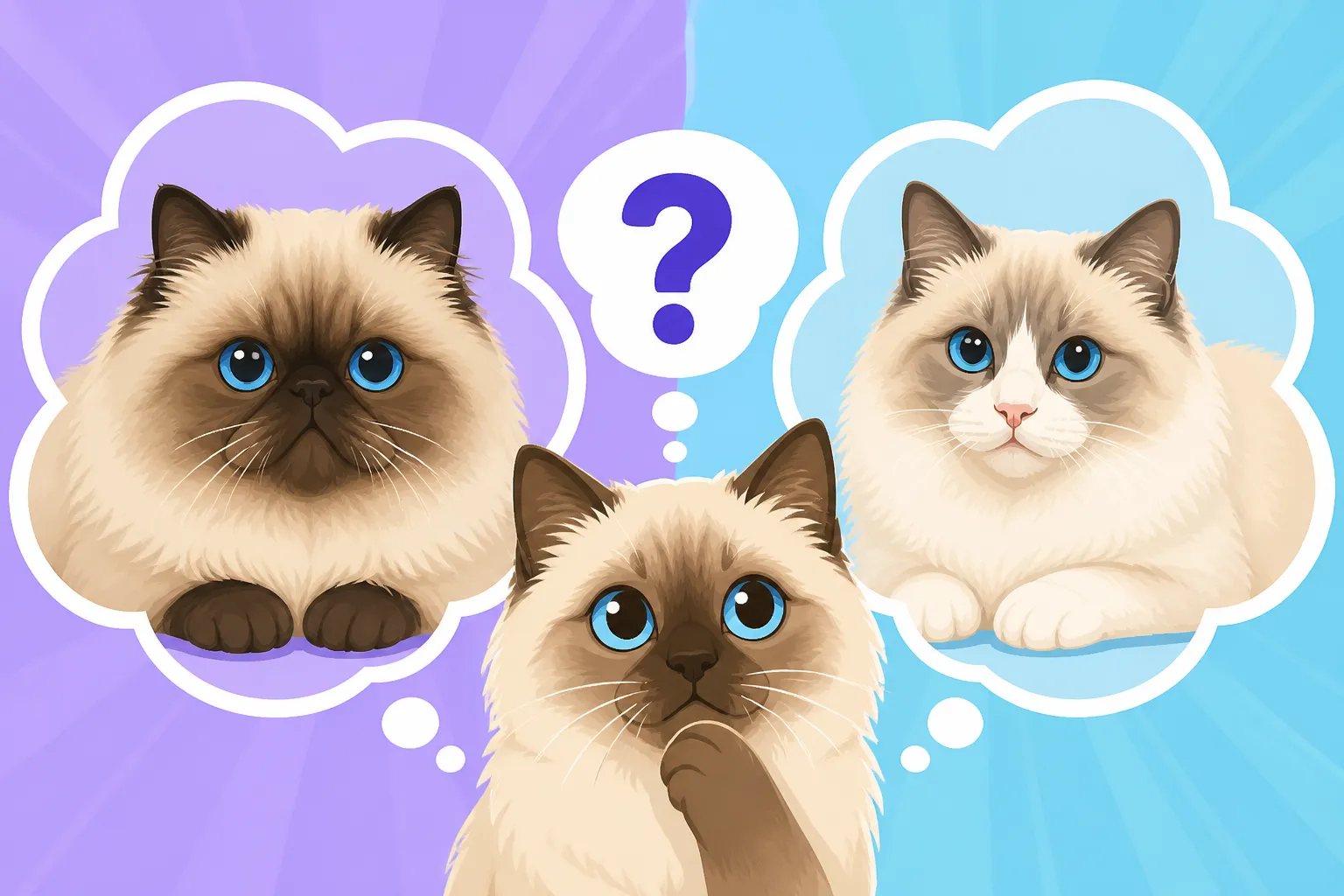
Why a Himalayan Is Confused With a Ragdoll
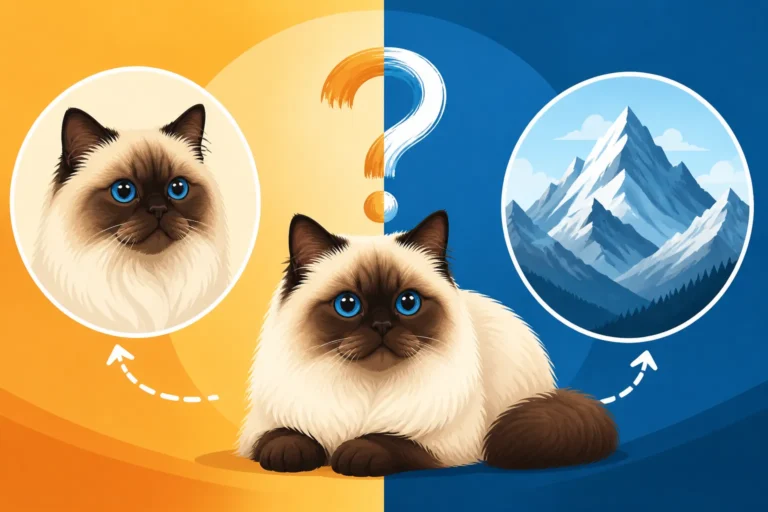
A fluffy, blue-eyed colorpoint cat can look like a Himalayan in one photo and a Ragdoll in the next. The confusion is understandable: both breeds may have pale coats, darker points, and long fur. This guide explains the differences in body shape, face, coat, pattern, and typical care, while showing why appearance alone cannot prove a cat’s breed.
Why Himalayans and Ragdolls Look So Similar
Both can have blue eyes and dark points
The most obvious overlap is their colorpoint pattern. Both cats can have a lighter body with darker fur on the face, ears, legs, and tail. Both are also typically blue-eyed. If you are looking at a photo of a young cat, or one with a thick coat that hides its outline, those shared features can make the two breeds hard to tell apart.
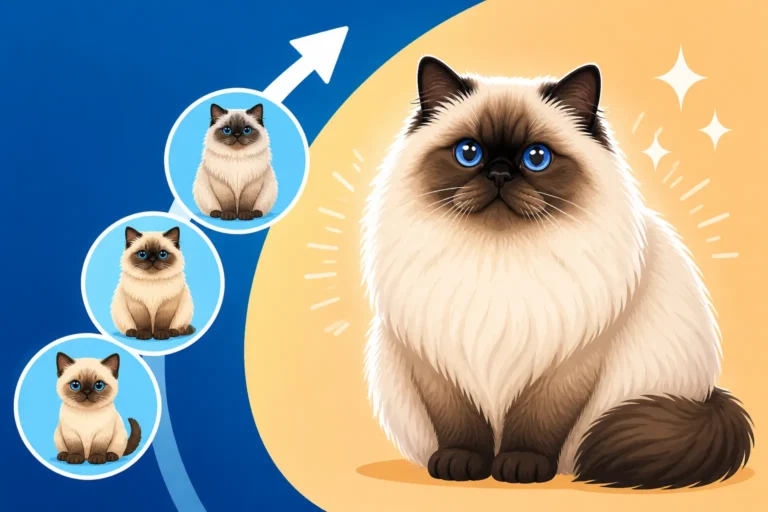
Colorpoint markings develop because of a temperature-sensitive pigment gene: cooler areas of the body tend to grow darker fur than warmer areas. Kittens may be born very pale, with their points becoming clearer as they grow. A Himalayan’s points can also deepen over time, so a young cat may not yet show the strong contrast you expect from an adult. For more on the pattern, see How Temperature Decides a Himalayan’s Point Color.
Long coats blur the body outline
A Himalayan’s coat is long and dense, with a full undercoat and a prominent ruff. A Ragdoll’s coat is also semi-long, but it is generally described as silky and less woolly, with less of the dense undercoat associated with a Persian-type coat. In practice, coat condition, season, age, and grooming can change what you see. A freshly groomed Ragdoll may look sleek; a Himalayan with a full winter coat may look much bigger than its frame.
Photographs add another wrinkle. A cat sitting down, viewed from the front, may look round and compact regardless of its underlying build. A side-on photo that shows the legs, back, and profile is often more useful. Even then, a fluffy coat can conceal whether the cat has the Himalayan’s shorter, cobby proportions or the Ragdoll’s longer frame.
If you’re comparing cats in person, look past the fur and consider the whole silhouette. Breed history and standards also explain why these cats are shaped differently: Why the Himalayan Is a Persian With the Point Gene and Why a Ragdoll Is Longer and a Himalayan Rounder.
The Most Reliable Differences to Look For
Face and head shape
A Himalayan has Persian ancestry, and that usually shows in its broad, round head, small ears, and relatively short nose. Some Himalayans have a more moderate profile, while others have a much flatter face. The degree of flatness can affect how the cat looks from the side, and may also be relevant to breathing and eye care. Not every Himalayan has severe facial features, so a short nose alone is not enough to identify one.
A Ragdoll’s head is generally more wedge-shaped, with a longer profile and a less compressed muzzle. Its face often looks less round than a Himalayan’s, even when the coat is thick. When comparing two adult cats, look at the relationship between the forehead, nose, cheeks, and chin—not just whether one has a “flat” face.
A head-on snapshot can hide these differences. If possible, view the cat from the side and at eye level. For a closer look at the Himalayan’s profile, see What a Himalayan’s Profile Should Look Like Side On. Facial shape is a useful clue, but individual variation and mixed ancestry mean it should not be treated as proof.
Body shape, size, and movement
Himalayans are typically compact and cobby, with a broad chest, shorter legs, and a rounded overall outline. Their heavy coat can make them look even more solid. They may prefer lower resting spots or steps rather than repeated high jumps, although activity and mobility vary from cat to cat.
Ragdolls are generally longer-bodied and larger-framed, with a more stretched-out appearance. Their legs and tail may look longer in proportion to the body, and many have a less compact stance than a Himalayan. A Ragdoll lounging across a sofa can seem especially elongated, while a Himalayan tends to look more like a round, plush bundle.
| Feature | Himalayan | Ragdoll |
|---|---|---|
| Typical outline | Compact, rounded, cobby | Longer, larger, more elongated |
| Face | Rounder head; short to flatter profile | Wedge-shaped head; longer profile |
| Coat | Long, dense, often with substantial undercoat | Semi-long, usually silky with less dense undercoat |
| Common color features | Colorpoint coat and blue eyes | Blue eyes; colorpoint, mitted, or bicolor patterns |
| Grooming considerations | Frequent combing and regular face care may be needed | Regular brushing is still important, especially around the ruff and hindquarters |
| Best way to confirm breed | Reliable pedigree or breeder records | Reliable pedigree or breeder records |
These are typical breed traits, not a checklist every individual cat will satisfy. A Ragdoll can have a rounder-looking face, and a Himalayan’s coat can obscure its compact frame. The comparison is most useful when you consider several traits together rather than deciding from one feature.
Pattern, Coat, and Everyday Care
Their markings do not work the same way
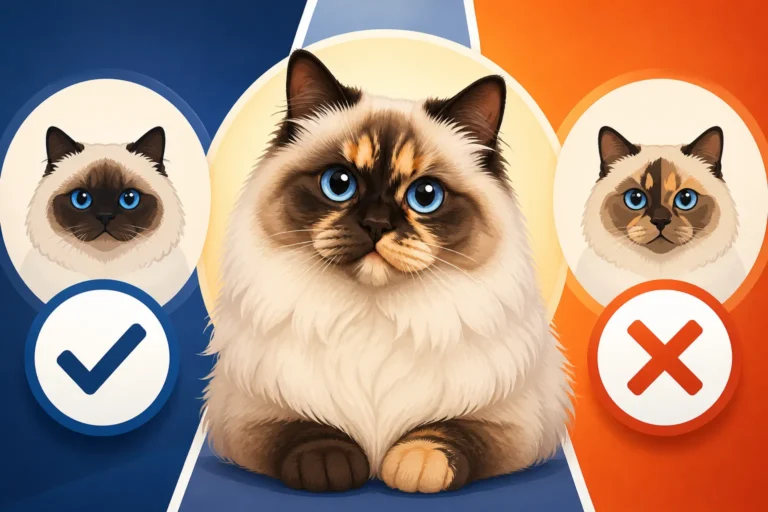
Himalayans are pointed cats, with darker color on the cooler parts of the body and a lighter body coat. Common point colors include seal, blue, chocolate, lilac, flame, tortie, and lynx variations, depending on the registry and breeding line. A Himalayan generally does not have the white gloves associated with a mitted Ragdoll.
Ragdolls can be colorpoint too, but they may also be mitted or bicolor. Mitted Ragdolls have white feet, and bicolor Ragdolls have additional white markings, often including white on the face and underside. Those patterns can make a Ragdoll look quite different from a Himalayan, even though the two can share blue eyes and dark points.
Look at the legs, chest, face, and underside rather than focusing only on the mask and tail. White “mittens” or a clear bicolor pattern may point toward a Ragdoll, while a more uniformly pointed coat may fit a Himalayan. But coat pattern is not a substitute for paperwork: mixed-breed cats can inherit combinations of traits that do not neatly match either breed’s usual appearance. How a Himalayan’s Points Are Judged explains the pointed pattern in more detail.
Grooming needs are not interchangeable
A Himalayan’s dense coat can mat close to the skin, especially in the armpits, behind the ears, under the collar area, and around the britches. A quick brush over the top may make the coat look tidy while leaving tangles underneath. A metal comb that reaches through the coat is often more useful than relying on a surface brush alone. Himalayans may also need regular attention to tear tracks and facial folds, depending on their face shape and how much their eyes water.
Ragdolls are not “no-grooming” cats. Their coat can tangle, particularly around the ruff and hindquarters, and routine combing helps catch knots before they tighten. Their coat texture may make grooming feel different from working through a dense Himalayan undercoat, but skipping care can still lead to discomfort and mats.
Start slowly if you are choosing supplies for a cat whose coat type you do not yet know. A gentle comb, a calm short session, and a check of the skin beneath the fur are more helpful than pulling hard at a knot. Retailers such as Chewy can be one place to compare comb styles, but choose a tool that suits the individual cat’s coat and introduce it gradually. For Himalayan-specific routines, see The Daily Comb a Himalayan Cannot Skip.
Temperament, Identification, and Choosing With Confidence
Breed stereotypes are only starting points
Himalayans are often described as calm and affectionate, with a quieter style of interaction than the Siamese side of their ancestry might suggest. Many enjoy sitting near their people or settling into a familiar chair. They may still be playful, vocal, or energetic at certain times; “laid-back” does not mean that every Himalayan behaves the same way.
Ragdolls are often known for being sociable and people-oriented. Some follow family members from room to room or enjoy being handled, while others are more reserved. The popular idea that every Ragdoll goes limp when picked up is an oversimplification, not a reliable breed test. A cat’s early socialization, individual personality, age, and experience all shape how it responds to people.
Temperament can help you decide whether a cat suits your household, but it cannot confirm breed. If your priority is a calm companion, spend time with the individual cat and ask how it behaves during ordinary routines: grooming, visitors, play, and being alone. For the Himalayan’s blend of companionship and independence, see The Himalayan Is a Lap Cat That Answers Back.
How to tell what a cat is when the history is unclear
Use appearance as a starting point, not a final answer. Check several traits together: head and nose profile, body proportions, coat texture, markings, and adult size. A compact build and a rounder, shorter face may suggest a Himalayan. A longer frame, wedge-shaped head, and mitted or bicolor pattern may suggest a Ragdoll. None of these observations can establish pedigree on its own.
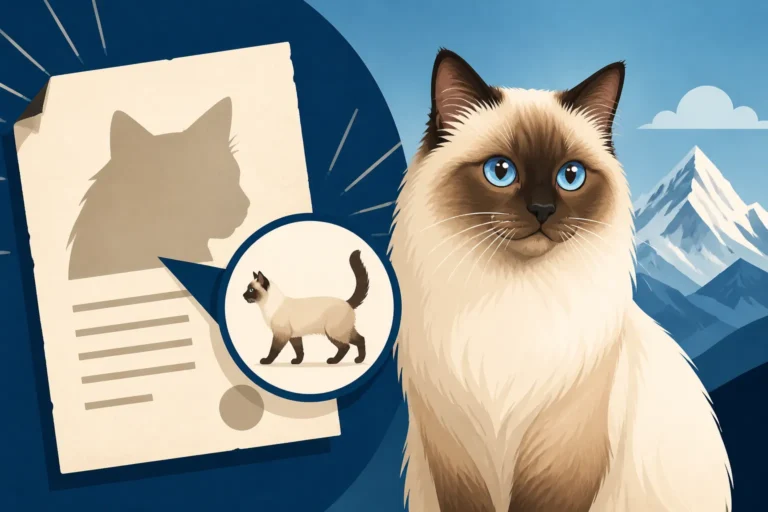
Ask for breeder or rescue records if breed identity matters to you. A pedigree from a recognized registry is stronger evidence than an online listing, a verbal claim, or a resemblance to breed photos. If a cat is being adopted through a shelter or rescue, its background may be unknown; in that case, it is more accurate to describe it as a domestic longhair with Himalayan-like or Ragdoll-like features unless documentation says otherwise.
A kitten can be especially difficult to identify because its coat, body proportions, and points are still developing. Ask for clear photos of the parents and records that support the claimed breed, and be cautious if someone insists a cat is purebred based only on color or eye color. This guide may also help when evaluating a specific listing: How to Tell a Himalayan From a Persian and What Nobody Tells You Before Buying a Himalayan.
If grooming tools, shallow dishes, or other care items are part of your preparation, Chewy is one retailer you can use to compare product options; check that a bowl is comfortable for the cat’s face and that a comb reaches through the coat without scraping the skin. If the cat has a very flat face, frequent tearing, noisy breathing, or difficulty eating, discuss those signs with a veterinarian rather than assuming they are simply breed quirks. Chewy may help you browse basic supplies, but product choice cannot replace advice tailored to the cat’s health and build.
Disclaimer
This article is for general informational purposes only and does not constitute professional advice. Laws, prices and regulations vary by location and change over time. Consult a qualified professional for guidance on your specific situation.