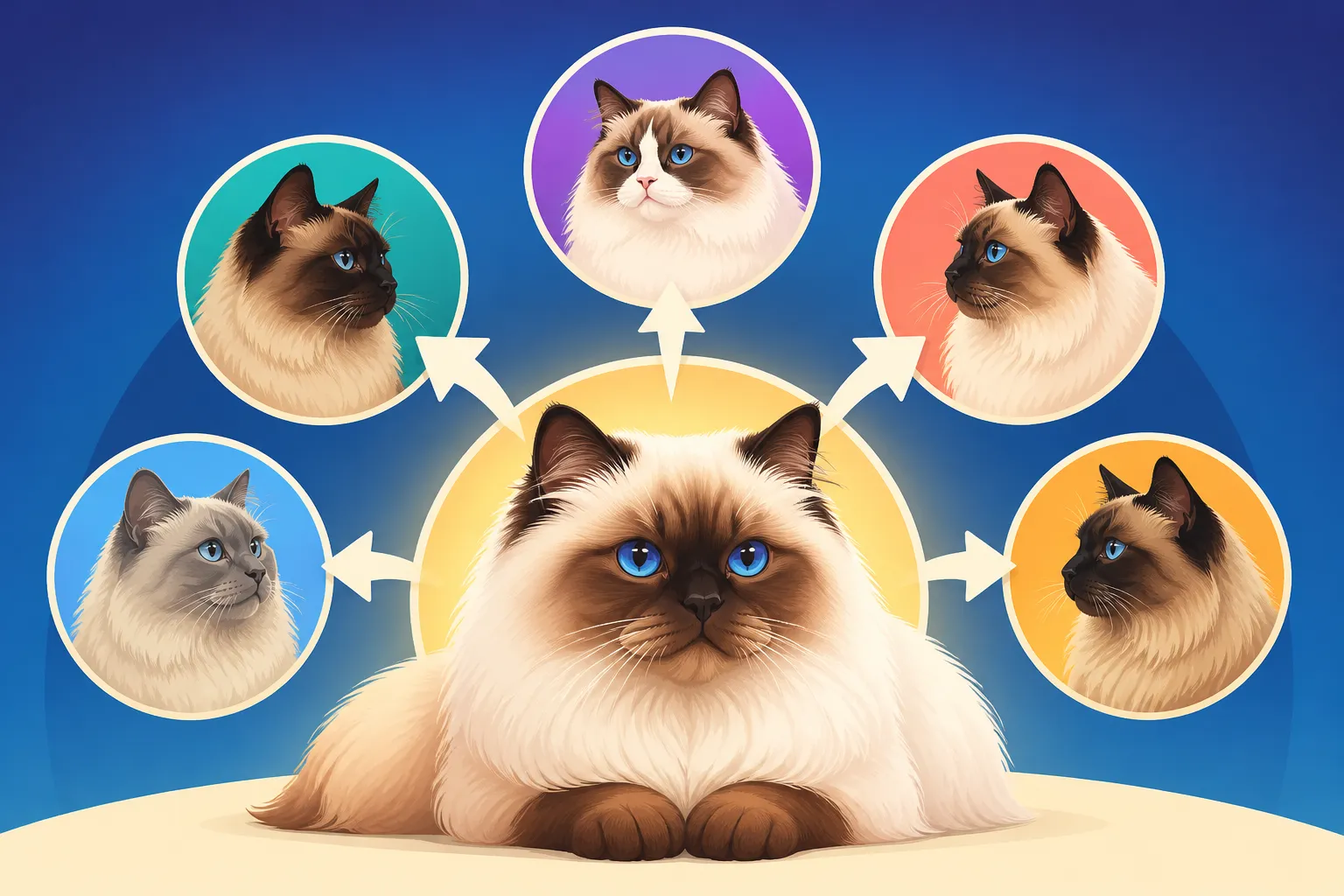
Why Every Modern Pointed Longhair Owes the Himalayan
A pointed longhair’s dark ears, mask, legs, and tail may look like a Himalayan signature, but the history is more layered than a simple family tree. The Himalayan helped establish the Persian-style colorpoint cat and brought the point pattern into wider longhair breeding. This guide explains what that influence means, where it stops, and how to distinguish shared coloring from direct ancestry.
What the Himalayan contributed to pointed longhair cats
A Persian coat and body with a colorpoint pattern
The Himalayan was developed by deliberately combining Persian and Siamese traits. The aim was to create a cat with the Persian’s long coat and rounded type, alongside the Siamese’s contrasting points and blue eyes. The result was a pointed cat with a distinctly Persian look—not simply a longhaired Siamese.
That combination mattered because it gave breeders a clear model for a longhaired, Persian-type colorpoint. The Himalayan’s appearance made the pattern visible in a new context: a full coat and compact, cobby body rather than the shorter coat and more elongated shape associated with Siamese cats. For more on this breed’s origins, see The Himalayan Was Made at Harvard in the 1930s and The 1936 Paper That Started the Himalayan.
The breed also helped connect a striking look with an explanation grounded in inheritance. The pointed pattern was not a coat dye or a separate dark-fur gene. It came from a genetic variant that affects pigment production differently in warmer and cooler parts of the body. The Himalayan became one of the best-known examples of how that pattern could be combined with long hair and Persian features.
A highly visible example of the point gene
In a colorpoint cat, the face, ears, paws, and tail are typically darker than the body. These areas are cooler than the cat’s central body, and the temperature-sensitive pigment process allows more color to develop there. The body remains paler, though the contrast can shift with age, environment, and individual genetics.
The same basic colorpoint pattern appears in multiple cats and breeds. The Himalayan did not invent it, and it did not create every pointed longhair that followed. Its importance is that breeders intentionally incorporated the pattern into a Persian-type longhair and helped make that combination a recognizable, established type. Why the Himalayan Is a Persian With the Point Gene explains that relationship in more detail.
This distinction is useful when looking at a cat’s appearance. Two cats can both have blue eyes, pale bodies, and dark extremities without one being a direct descendant of the other. A shared pattern points to a genetic trait; it does not, by itself, prove a particular breed history.
How the pointed pattern is inherited
The temperature-sensitive pigment pattern
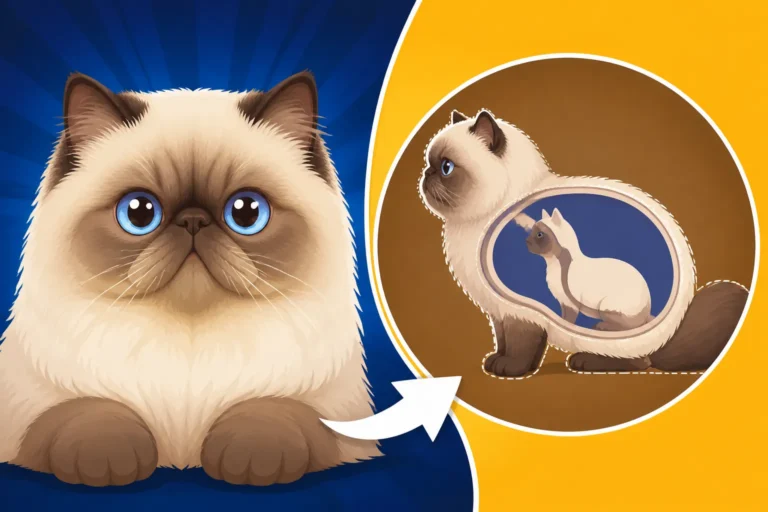
The colorpoint pattern is associated with a temperature-sensitive form of the tyrosinase gene, which is involved in producing pigment. In warmer parts of the body, pigment production is reduced. In cooler areas, it can proceed more effectively, so darker color develops on the extremities.
That is why a kitten may be born very pale and develop more obvious points as it grows. It is also why a shaved patch can regrow darker than the surrounding coat: skin exposed to cooler conditions may produce more pigment in the new hair. The pattern can deepen with age, too, making an adult Himalayan’s body look less starkly pale than it did when young. For a closer look at the underlying trait, see Which Gene Makes a Himalayan Pointed.
A cat generally needs two copies of the relevant recessive colorpoint variant to show the classic pointed pattern. A cat with only one copy may carry the variant without looking pointed. This is one reason a pointed kitten can appear in a litter even when a parent does not have obvious points: a non-pointed-looking cat may carry the gene.
Why sharing the gene does not prove direct descent
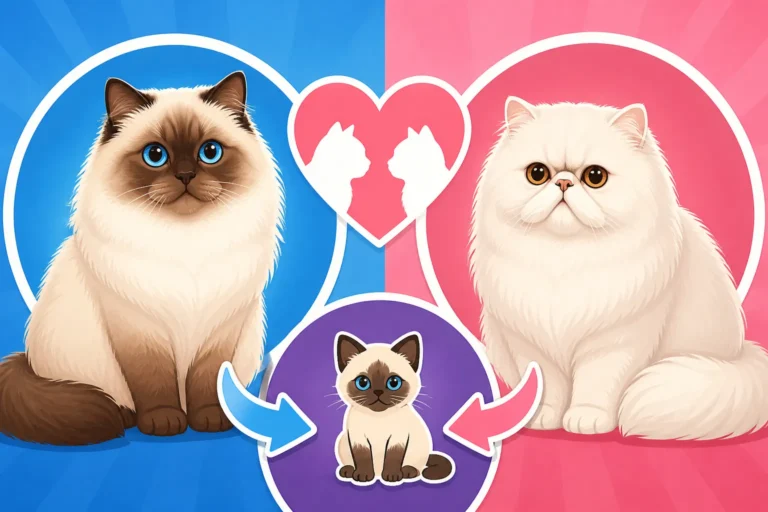
When breeders plan a pairing, they need to consider both visible traits and hidden genetic inheritance. A Persian may carry the point variant without showing the Himalayan’s pattern, and a Himalayan crossed with a Persian may produce kittens with different appearances depending on which variants each kitten inherits. The exact outcome depends on the parents’ genetic makeup, not just their breed labels.
That makes “this cat has Himalayan ancestry” a more specific claim than “this cat is pointed.” A pedigree can document known parentage and breeding decisions. Coat pattern alone cannot establish a family connection. Even when two breeds share the same colorpoint trait, their breed histories may be different.
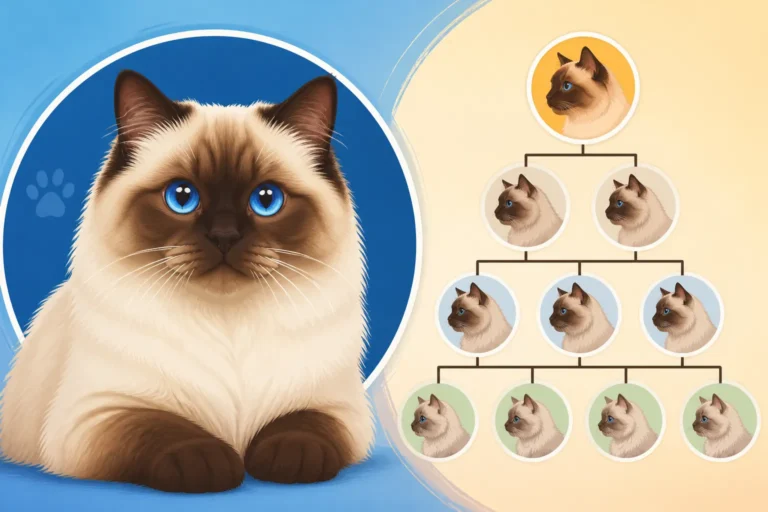
The Himalayan’s role is therefore best understood as influential rather than universal. It helped make a Persian-type pointed longhair an established breeding goal. It did not originate every colorpoint line, and not every modern pointed longhair is simply a Himalayan under another name. Which Breeds Took the Point Gene From the Himalayan offers a useful companion topic for tracing the pattern’s movement between breed programs.
Where other pointed longhairs fit in
Similar appearance, different breed histories
Several longhaired or semi-longhaired breeds can show colorpoint patterns, but they are not interchangeable. Breed histories, body shape, coat texture, eye color, and registry standards can differ, even when the dark mask and pale body look familiar at first glance.
| Breed or type | What it shares with the Himalayan | Why it is not automatically the same |
|---|---|---|
| Himalayan or Colorpoint Persian | Persian-type features and a colorpoint coat | Registry terminology varies, but the type is closely tied to Persian breeding |
| Birman | Long hair, blue eyes, and pointed coloring | Birmans have characteristic white gloves and a distinct breed history |
| Ragdoll | Long hair, blue eyes, and pointed patterns in some varieties | Ragdolls have their own development and standards |
| Balinese | Pointed coloring with a longer coat than a Siamese | It is associated with the Siamese type rather than the Persian body type |
| Neva Masquerade | Colorpoint pattern in a longhaired cat | It is treated as a Siberian-related variety in some breed contexts |
The Birman is a particularly helpful comparison. Its white gloves are a defining feature, while a Himalayan does not have the same required glove pattern. Both can have long coats, blue eyes, and dark points, but those shared features do not make them one breed. See Why a Birman Has White Gloves and a Himalayan Does Not for a closer comparison.
Ragdolls are another frequent source of confusion because they can also have long coats, blue eyes, and colorpoint patterns. Their development and breed standard are distinct from the Himalayan’s Persian-based type. Balinese cats, meanwhile, are pointed and longer-coated than Siamese cats, but their build and lineage are associated with the Siamese type. The name “pointed longhair” describes a combination of coat length and pattern, not a single shared breed identity.
The importance of registry language
Breed names can become confusing because cat registries do not always classify the same cats in the same way. Some organizations treat the Himalayan as a separate breed, while others place it within the Persian breed or a Persian division. In Britain, the term Colorpoint Persian may be used where a North American buyer expects “Himalayan.”
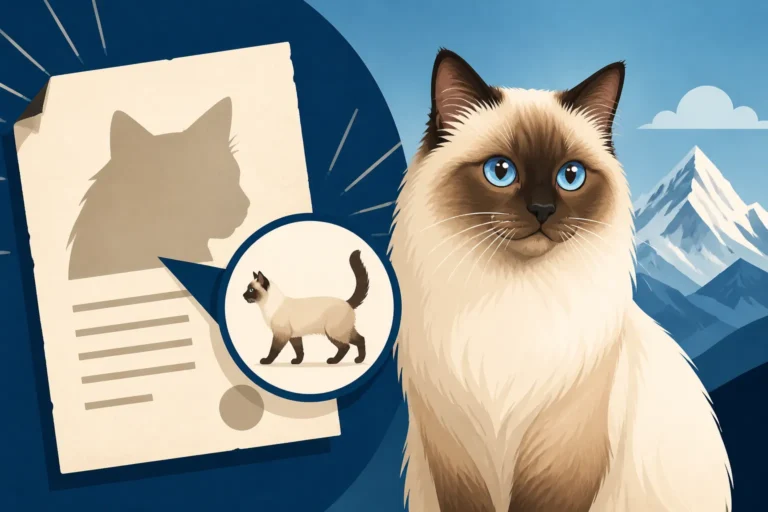
That paperwork difference does not mean the cat’s coat or ancestry suddenly changes. It does mean buyers, breeders, and exhibitors should check the exact terminology used by the relevant registry. A pedigree might list Persian, Himalayan, or Colorpoint Persian depending on the organization and the lines involved. If you are comparing records, Why CFA Made the Himalayan a Persian Division in 1984 and TICA Still Registers the Himalayan as a Breed of Its Own provide context for the registry split.
For everyday owners, the practical lesson is simple: ask what a breeder means by “Himalayan,” and ask to see the pedigree and health information rather than relying on a label in an advertisement. If you are trying to identify a pointed longhair from appearance alone, look at the whole cat and its documentation—not just its mask and coat.
What Himalayan influence means for owners today
Looking beyond the coat pattern
A pointed coat can catch your eye, but it does not tell you whether a cat will need the Himalayan’s level of grooming or have the same facial structure. A longhaired cat with a less dense coat may be easier to comb than a Himalayan with a thick Persian coat. Likewise, a cat with a more open muzzle may have different care considerations from a very flat-faced individual.
If you are choosing a cat, ask about coat maintenance, face care, breathing, and the parents’ health history. A breeder should be able to explain what grooming the kitten will need and how its parents are screened. For Himalayans specifically, the Persian background is relevant to questions about kidney health, eye care, and facial structure. Why a Himalayan and a Persian May Be Mated offers more context on how those breeding relationships can work.
It also helps to watch the kitten in person when possible. Notice whether it breathes comfortably at rest, moves freely, and tolerates gentle handling. A brief video can be useful, but it cannot replace observing the cat’s breathing and behavior in a calm setting. The point pattern may be the first thing you notice; the cat’s comfort and long-term care needs deserve equal attention.
Caring for a pointed longhair at home
Long coats need regular combing to prevent tangles from tightening into painful mats, particularly under the arms, behind the ears, around the collar, and beneath the tail. A metal comb that reaches through the coat is often more useful than a quick surface brush. Start gradually, use short sessions, and pause if the cat becomes stressed rather than trying to force through a knot.
For a new owner comparing tools, a retailer such as Chewy can be one place to review comb shapes and sizes, but the right tool depends on the individual coat. Ask a groomer or veterinary team to demonstrate safe technique, especially around the face and delicate skin. Avoid cutting close to the skin with household scissors; mats can pull the skin up into them, making accidental cuts more likely than many owners expect.
Face care and feeding arrangements can matter as well, especially for cats with shortened muzzles. A shallow, wide dish may be easier to use than a deep narrow bowl, and gentle daily cleaning can help keep the face comfortable. Chewy may also help owners compare basic shallow bowls or grooming supplies, while a veterinarian can advise if watery eyes, skin irritation, or noisy breathing seem more than routine. For general coat and care topics, see The Daily Comb a Himalayan Cannot Skip.
What the Himalayan’s legacy does and does not mean
The Himalayan helped make the Persian-style pointed longhair familiar and established. Its influence is visible in how breeders think about combining coat, body type, and colorpoint pattern. It also gave cat enthusiasts a vivid example of temperature-sensitive coloring: a pale body, darker extremities, and blue eyes in a longhaired Persian-type cat.
But the history of pointed longhairs is not one straight line. Birman, Ragdoll, Balinese, and other pointed cats have their own histories and standards. Some share genetic traits; some may have links through particular breeding programs; and some simply resemble one another in ways that can mislead a casual observer. The Himalayan’s contribution is substantial, but the phrase “owes the Himalayan” is most accurate when describing the popularity and development of the Persian-type colorpoint longhair—not every modern pointed longhair as a direct descendant.
If you are considering a Himalayan or another pointed longhair, focus on reliable pedigree information, health screening, temperament, and realistic grooming needs. A beautiful pattern is a wonderful part of the cat, but it is only one piece of its story. Chewy can be a practical place to compare everyday supplies once you know what your cat needs, while your breeder and veterinarian are the better people to answer questions about lineage and individual health.
Disclaimer
This article is for general informational purposes only and does not constitute professional advice. Laws, prices and regulations vary by location and change over time. Consult a qualified professional for guidance on your specific situation.