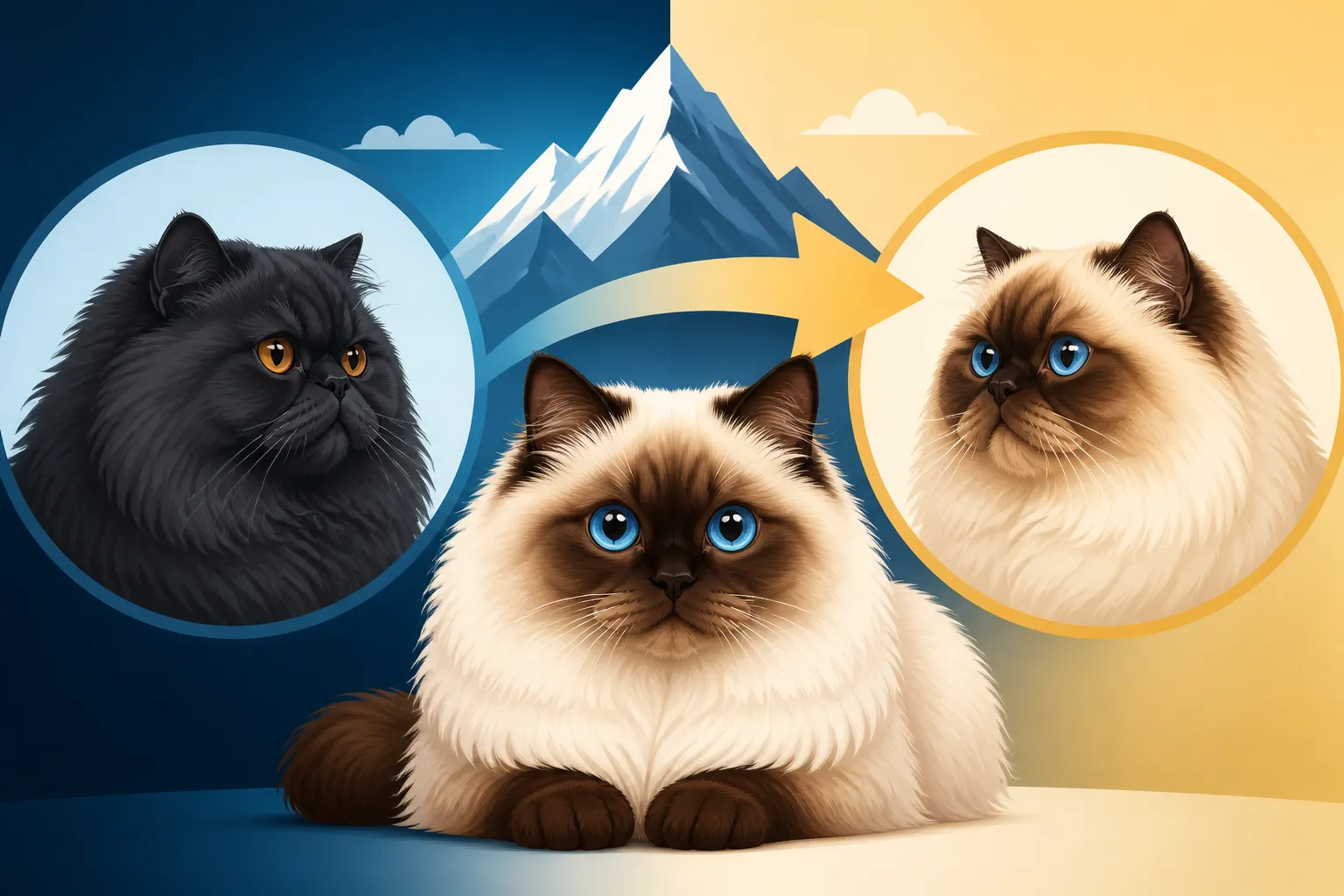
How the Himalayan Changed Persian Breeding
The Himalayan did more than add blue eyes and dark points to the cat world: it helped establish a pointed Persian type that breeders and registries would eventually treat as part of Persian breeding. If the names, pedigrees, and breed classifications feel confusing, this guide explains what changed, what stayed the same, and why the Himalayan’s influence still matters.
How the Himalayan brought the point pattern into Persian breeding
A Persian-Siamese cross created a new combination
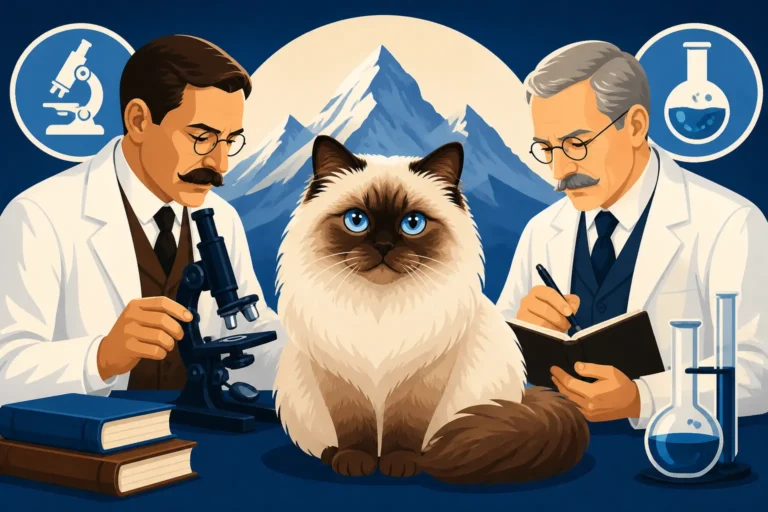
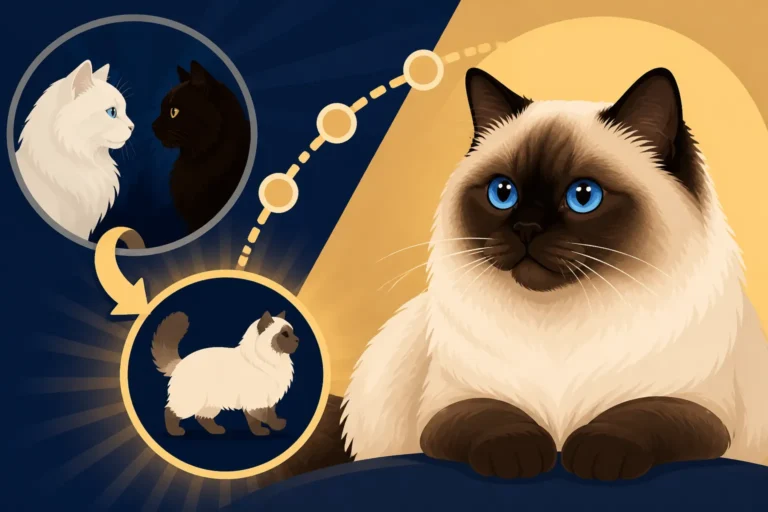
The Himalayan began with a deliberate cross between Persian and Siamese cats. Breeders wanted to combine the Persian’s long coat and rounded body with the Siamese’s colorpoint pattern: a pale body with darker coloring on the face, ears, legs, and tail. The result was a distinctive cat that looked Persian in outline but wore the pointed coloring associated with Siamese ancestry.
That pattern comes from a temperature-sensitive form of pigment production. Cooler areas of the body tend to develop darker fur, while warmer areas stay paler. It is why a Himalayan’s extremities often show more color than its torso, and why the pattern may become more pronounced as a cat matures or spends time in a cooler environment. For more about the original cross, see Why Harvard Crossed a Persian With a Siamese to Make the Himalayan.
The point gene did not replace the Persian coat or body type. Rather, breeders worked to preserve Persian traits while adding the new coloring. That distinction matters: the Himalayan’s identity came from a combination of inherited features, not from a simple coat-color change applied to an otherwise unrelated cat.
The point gene became part of the Persian gene pool
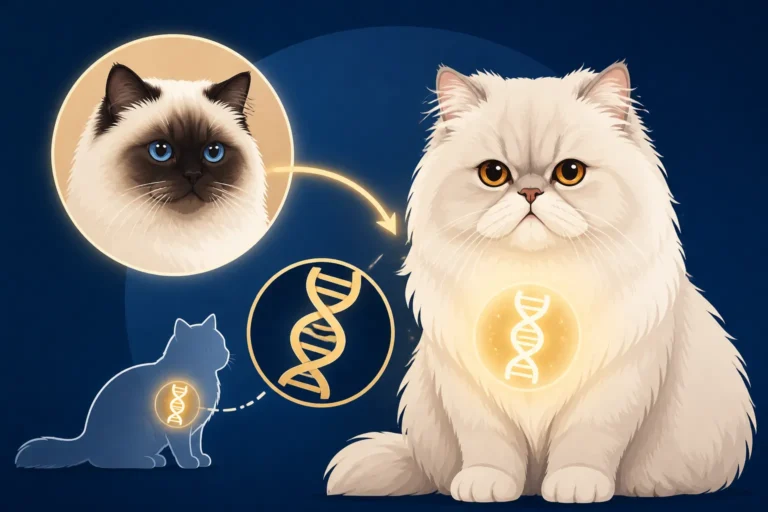
The colorpoint pattern is recessive. A cat generally needs two copies of the point-associated gene variant to display the classic pointed pattern. A Persian that carries one copy may look solid-colored, but it can pass that copy to its kittens. If two carrier cats are paired, some kittens may inherit two copies and show colorpoints. The details depend on each parent’s genetic makeup, so appearance alone cannot tell a buyer whether a cat carries the gene.
This made the Himalayan relevant to Persian breeding beyond its own pointed coat. Himalayan and Persian lines could be connected through breeding programs, and pointed cats could be bred to cats with Persian type to maintain the desired combination. A Persian carrying the point gene might not look Himalayan at all, but the gene could still appear in a later generation. How a Persian Can Carry the Himalayan Gene Hidden explains why pedigrees can reveal something a cat’s coat does not.
The broad effect was a wider range of coat patterns within Persian-type breeding. The Himalayan did not make every Persian pointed, nor did it turn every Persian into a Himalayan. It added a specific inherited pattern that breeders could preserve and express through careful pairing.
How registries folded the Himalayan into Persian classification
CFA changed the breed category
The Himalayan was recognized as a distinct breed by some organizations, but classification did not remain consistent across registries. In 1984, the Cat Fanciers’ Association placed the Himalayan within the Persian breed as a division. That means CFA treats the Himalayan as a Persian type distinguished by its colorpoint pattern rather than as a completely separate breed on its own paperwork. The history behind that decision is covered in Why CFA Made the Himalayan a Persian Division in 1984.
For breeders, this changed how cats could be registered, shown, and described. A kitten might be called a Himalayan by its breeder and household, while its CFA registration identifies it as a Persian in the Himalayan division. That is not necessarily a disagreement about what the cat looks like; it reflects different systems for organizing breeds and varieties.
It also made the Himalayan’s influence on Persian breeding more direct. Once the Himalayan became a Persian division in CFA, pointed cats were explicitly grouped within the larger Persian category. The breed name remained meaningful to owners and breeders, even where the official paperwork used Persian classification.
Other registries retained a separate identity
Not every registry made the same choice. TICA, for example, has continued to recognize the Himalayan separately from the Persian. As a result, a buyer may encounter different breed wording depending on the registry named on a cat’s papers. Why TICA Kept the Himalayan Separate offers more detail on that distinction.
This split can be confusing when comparing pedigrees or asking whether a cat is “really” a Himalayan. The practical answer is to check which registry issued the papers and how that organization defines the breed. A registry’s classification affects formal registration and show categories; it does not change the cat’s ancestry, coat, or everyday needs.
| Breeding or registry change | What it meant | What it did not mean |
|---|---|---|
| Persian and Siamese ancestry combined | Persian type and colorpoint pattern could appear together | Every Himalayan is genetically identical |
| Point gene entered Persian-type lines | Some non-pointed cats could carry the gene unseen | Every Persian carries the point gene |
| CFA placed Himalayan in the Persian breed | Himalayan cats were grouped as a Persian division in that registry | The Himalayan name disappeared from everyday use |
| TICA retained separate recognition | The breed may be listed separately on TICA records | All registries use the same classification |
If you are checking a kitten’s paperwork, ask for the registry name, the exact breed or division listed, and a pedigree that identifies parentage. What a Himalayan Buyer Should Ask About Registration is a useful companion when those terms start to blur together.
What changed in Persian breeding and what did not
Persian-type cats gained a recognized pointed variety
The clearest change was the introduction and preservation of a Persian-looking cat with colorpoints. Breeders could work toward a pointed coat while maintaining traits associated with Persian type, such as a long coat, substantial ruff, round head, and compact body. The colorpoint pattern became a defined variation within Persian breeding rather than merely an unusual coat seen in an isolated litter.
That does not mean the Himalayan created every feature now associated with Persians. Body shape, coat, and facial structure are influenced by many genes and by generations of selection. The point gene governs the color pattern; it does not by itself determine whether a cat has a flatter face, a particular jaw shape, or a specific body build. Those traits are shaped by other inherited factors and by breeding choices. Why a Himalayan Is a Persian With the Point Gene helps separate the color-pattern question from the broader question of breed type.
The Himalayan also gave breeders a visible way to track the point pattern. A pointed kitten is easy to identify as carrying the pattern, while a solid-looking cat may carry one copy without showing it. That makes pedigree information and appropriate genetic testing more useful than appearance alone when planning a breeding program.
The Himalayan did not single-handedly create the modern Persian face
It is tempting to connect the Himalayan’s distinctive face with every change in Persian appearance, but that oversimplifies the history. Persian cats were already being selected for particular head and facial traits, and standards have guided those choices over time. The Himalayan was bred within Persian-type traditions, so the same kinds of selection pressures could influence both groups. But the point gene itself does not flatten a muzzle.
This distinction matters for health and responsible breeding. A buyer should look at a cat’s actual breathing, nostril openings, eyes, and overall comfort rather than assuming that a coat pattern predicts facial structure. The same applies to breeders: preserving colorpoint markings should not come at the expense of sound breathing, healthy eyes, or practical grooming needs.
The Persian standard has been important to how Himalayan cats are evaluated in some settings, particularly where the Himalayan is treated as a Persian division. To understand which features are tied to Persian type rather than point color, see What the Persian Standard Asks of a Himalayan. The bigger lesson is that breed appearance is built from several inherited traits and human preferences, not one defining gene.
What the Himalayan’s influence means for today’s buyers and breeders
Ask about the pedigree as well as the coat
A pointed kitten’s appearance tells you that it expresses the colorpoint pattern, but it does not tell you the full story of its health or ancestry. Ask the breeder which registry the cat is recorded with, what its parents are registered as, and whether the pedigree shows the relevant Persian and Himalayan lines. If the breeder uses “Himalayan” and the paperwork says “Persian,” ask how that fits the registry’s rules rather than treating the difference as an automatic red flag.
Also ask what health screening is appropriate for the family line. Himalayan cats share important ancestry with Persians, so health questions should not stop at coat color or registration wording. A responsible breeder should be willing to explain the records and tests they use, and to distinguish a documented result from a general assurance. Why Persian Breeders Track the Himalayan Gene explores the role of inherited traits in Persian breeding.
For everyday preparation, remember that a Himalayan’s long coat and facial care needs remain part of the ownership picture, regardless of which breed label appears on a certificate. A steel comb, suitable bowls, and gentle face-cleaning supplies are practical basics. You can compare options at a local pet shop or through retailers such as Chewy, but choose tools based on the cat’s coat and comfort rather than a product label alone.
Keep the historical change in perspective
The Himalayan changed Persian breeding by helping establish a lasting pointed variety within Persian-type cats and by making the point gene part of broader breeding conversations. Its registry status also influenced how breeders recorded and presented pointed cats. Those are meaningful changes, but they do not mean the Himalayan replaced the Persian or that every Persian descended directly from a Himalayan.
For a potential owner, the most useful takeaway is simple: a breed name can describe a recognized look, a registry category, or a familiar tradition, and those meanings do not always line up exactly. Ask what the paperwork says, learn how the breeder uses the term, and evaluate the individual cat’s health and temperament.
If you are setting up for a kitten, focus on needs that will matter every day: combing, a comfortable feeding setup, regular veterinary care, and a home routine that makes handling feel calm rather than like a wrestling match. Chewy and other pet-supply retailers can be one place to compare basic grooming or feeding items, while your veterinarian can help you choose what fits your cat. The Himalayan’s history is about breeding and classification; living well with one is about caring for the actual cat in front of you.
Disclaimer
This article is for general informational purposes only and does not constitute professional advice. Laws, prices and regulations vary by location and change over time. Consult a qualified professional for guidance on your specific situation.