How Many Calories an Adult Himalayan Burns a Day
It's a common misconception that our beautiful, fluffy Himalayan cats are just glorified sofa cushions, right? You see them draped elegantly across a pillow, barely stirring, and you might think, "How many calories can this magnificent creature possibly burn in a day?" The truth is, while they might not be chasing laser pointers up the walls like a Siamese, an adult Himalayan still has specific caloric needs to maintain that luxurious coat, those soulful blue eyes, and that charmingly placid demeanor. This guide will unravel the mystery of your Himalayan's daily energy expenditure, helping you understand their unique metabolism and how to feed them just right.
The Himalayan's Energy Budget: More Than Meets the Eye
You might look at your Himalayan and think they spend most of their day in a state of Zen-like repose, and you wouldn't be entirely wrong! They are, after all, largely derived from the Persian, a breed known for its calm and somewhat less energetic disposition. This relaxed lifestyle often leads owners to underestimate their cat's caloric needs, or conversely, to accidentally overfeed them when they confuse inactivity with lack of appetite. Understanding their baseline energy burn is the first step to ensuring they stay healthy and happy.
Why Himalayans Seem Less Active
Let's be real, a Himalayan isn't typically tearing through the house like a Bengal. Their Persian ancestry gives them that distinctive cobby body, short legs, and incredibly dense, long coat. All of these physical traits contribute to a somewhat more sedentary lifestyle. That thick coat, while stunning, can make them overheat quite easily, discouraging prolonged bouts of vigorous play. Imagine trying to run a marathon in a fur coat – it's just not practical! This means their playful bursts are often shorter, and they might prefer a quiet spot by the window over an intense game of chase. While they certainly enjoy interaction, it's usually on their own terms and at a more measured pace. You might find them engaging in a gentle bat at a dangling toy from their favorite perch rather than a full-on pounce across the room. How Much More Play a Himalayan Wants Than a Persian
Subtle Activity and Hidden Energy Burn
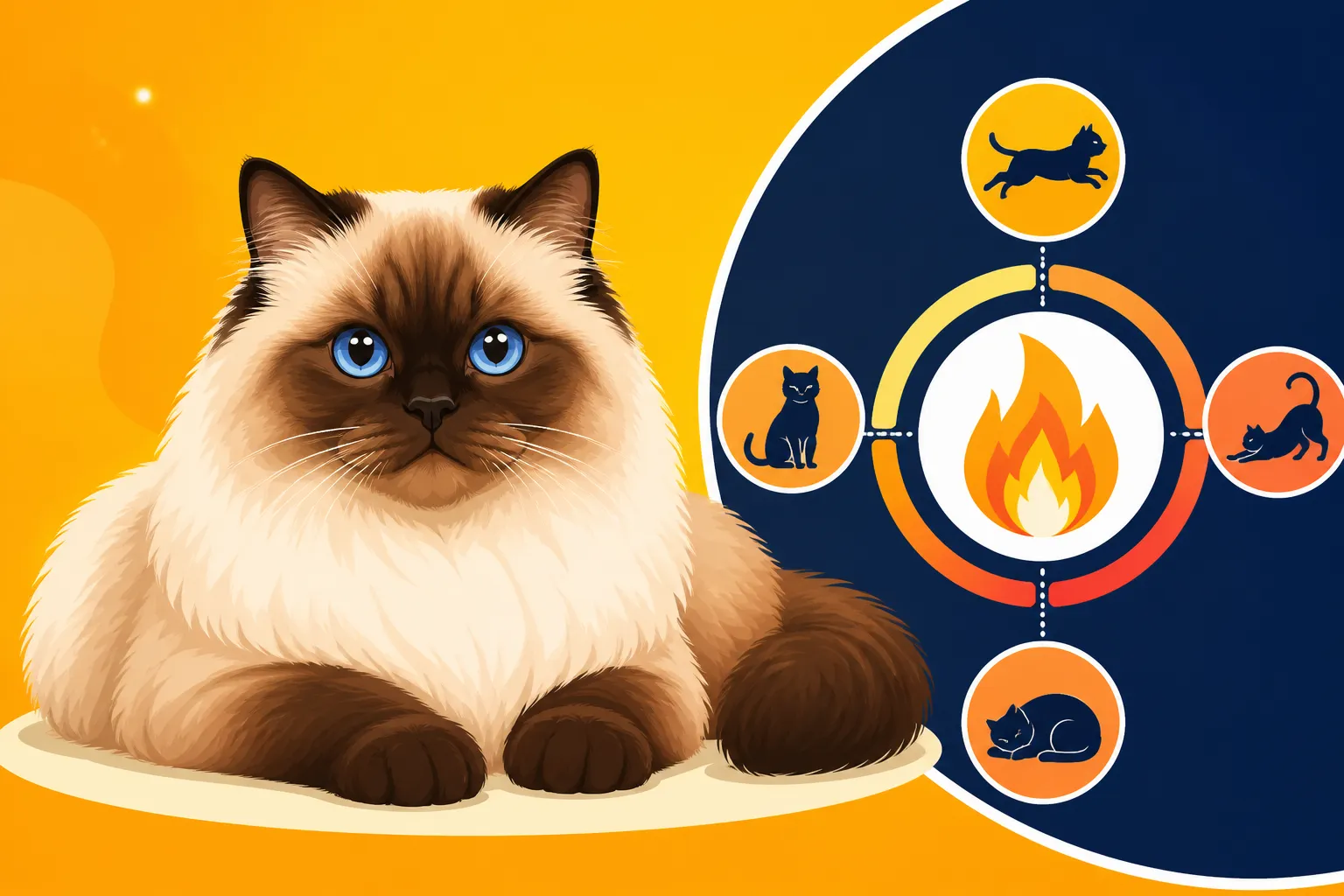
Just because your Himalayan isn't scaling curtains doesn't mean they aren't burning calories. Even during their many naps, their body is constantly working. Breathing, maintaining body temperature, digesting food, and simply existing all require energy. Beyond that, they have subtle periods of activity: a leisurely stretch, a slow walk to the food bowl, or a meticulous grooming session. That magnificent coat requires a lot of upkeep, and all that licking and preening adds up! Plus, mental stimulation, even if it's just watching the birds outside or processing household sounds, also expends a small amount of energy. It's not always about overt zoomies; sometimes, the most significant energy burn happens quietly, behind those beautiful blue eyes.
Key Factors Influencing Your Himalayan's Calorie Needs
Determining an exact calorie count for your Himalayan isn't a one-size-fits-all equation. Just like people, cats have individual needs based on a variety of factors. What might be perfect for one cat could lead to weight gain or loss in another. It’s a delicate balance that requires observation and sometimes, a little trial and error, always under veterinary guidance.
Age and Life Stage
A kitten's energy demands are significantly higher than an adult's. They're growing rapidly, developing bones and muscles, and exploring their world with boundless (if sometimes clumsy) energy. An adult Himalayan, generally between one and seven years old, will have a more stable caloric need focused on maintenance. Once they enter their senior years, typically around eight to ten years old, their metabolism might slow down, requiring fewer calories. However, some senior cats, especially if they develop certain medical conditions like hyperthyroidism, might actually need more calories. It's crucial to adjust their diet as they transition through these life stages, always keeping an eye on their body condition.
Activity Level and Lifestyle
While Himalayans are generally less active than, say, a Siamese, there's still a spectrum within the breed. Some Himalayans are true lap ornaments, moving only for food and the litter box. Others might enjoy short bursts of play with a wand toy, or even a leisurely stroll around a secured catio. An indoor-only cat that primarily lounges will naturally burn fewer calories than one who engages in 15-20 minutes of active play daily. Consider how much effort your cat puts into its day. Do they chase toys with genuine enthusiasm for a few minutes? Or do they mostly just observe the world from their chosen armchair? Which Toys Get a Himalayan Off the Sofa Even subtle differences in their daily routine can impact how many calories they need to maintain a healthy weight.
Weight, Body Condition, and Spay/Neuter Status
This is a big one. An underweight cat needs more calories to gain weight, while an overweight cat needs fewer to shed pounds. The goal is to maintain an ideal body condition where you can easily feel their ribs without seeing them, and they have a discernible waistline when viewed from above. It's surprisingly easy for a Himalayan to become overweight due to their cobby build and a propensity for inactivity, especially if free-fed. [What a Cobby Himalayan Should Weigh]
Furthermore, spaying or neutering significantly impacts a cat's metabolism. Sterilized cats often have a slower metabolism and a tendency to gain weight more easily, requiring a reduction in caloric intake compared to their intact counterparts. This is why many cat food brands offer specific formulations for "adult indoor" or "spayed/neutered" cats, which are typically lower in calories.
Health Status and Genetics
Underlying health conditions can dramatically alter a cat's metabolic needs. A cat recovering from surgery or illness might need extra calories for healing. Conversely, certain conditions, such as kidney disease (which Himalayans can be genetically predisposed to due to their Persian heritage), might require a reduced-protein, calorie-controlled diet. Every Himalayan Inherits Two Disease Lists, Not One It's vital to have regular veterinary check-ups to catch any health issues early. Your vet is the best resource for tailoring a diet to your cat's specific health profile. They might recommend specific prescription diets that cater to particular medical needs, where calorie content is carefully controlled.
Calculating and Meeting Your Himalayan's Calorie Requirements
Now that we understand the variables, how do we actually figure out the numbers? While a vet is always the best guide, there are some general principles we can follow.
Basal Metabolic Rate and Resting Energy Requirement
At its most basic, every living creature has a Basal Metabolic Rate (BMR) – the energy needed to simply exist at rest, without any activity or digestion. For cats, we more commonly talk about the Resting Energy Requirement (RER), which is the number of calories needed for a cat lying quietly at room temperature, fasting for a short period. This RER is calculated based on their weight in kilograms. For an average adult cat, a common calculation is: RER = 70 x (body weight in kg)^0.75. This gives you a foundational number.
Daily Energy Requirement Calculation
The Daily Energy Requirement (DER) takes the RER and multiplies it by a factor that accounts for the cat's activity level, age, and spay/neuter status. These factors can range from 0.8 for a very sedentary, overweight cat on a weight loss program, to 1.0 for a spayed/neutered adult maintaining weight, up to 1.6 or more for an active kitten or a pregnant/nursing queen. For a typical, relatively inactive, spayed/neutered adult Himalayan, a factor of 1.0 to 1.2 is often appropriate for maintenance.
Here's a simplified example for an adult, spayed/neutered Himalayan weighing 10 pounds (approx. 4.5 kg):
- Convert weight to kg: 10 lbs / 2.2 lbs/kg = 4.5 kg
- Calculate RER: RER = 70 x (4.5)^0.75 ≈ 70 x 2.78 ≈ 195 calories/day.
- Calculate DER (using a factor of 1.0 for sedentary adult): DER = 195 calories x 1.0 = 195 calories/day.
This is a rough estimate! Always consult your veterinarian for a precise recommendation tailored to your specific cat. They can help you determine the correct DER factor and adjust as needed.
Decoding Food Labels and Portion Control
Once you have a target calorie count, the next step is to translate that into actual food portions. This is where food labels come in. Look for the "caloric content" or "ME (Metabolizable Energy) kcal/kg" on the packaging. Most labels will also give you a caloric content per cup (for dry food) or per can/pouch (for wet food).
For example, if a dry food has 400 kcal per cup, and your cat needs 200 kcal/day, they would need 0.5 cups of that food daily. If a wet food has 80 kcal per 3 oz can, and your cat needs 160 kcal/day, they would need two cans. It sounds simple, but many owners eyeball portions, which can quickly lead to over or underfeeding. Invest in a digital kitchen scale to measure dry food accurately – it makes a huge difference! Many online retailers like Chewy and Amazon also list the caloric content prominently on their product pages, making it easier to compare foods. How Much Wet Food a Flat Faced Himalayan Gets Through
Monitoring and Adjusting
Feeding isn't a set-it-and-forget-it task. Your Himalayan's needs can change. Regularly assess their body condition score (BCS). This involves feeling their ribs, spine, and waist. Ideally, you should be able to feel their ribs with light pressure, and they should have a visible waist. Keep a log of their weight, perhaps weighing them once a month at home if they're cooperative, or during vet visits. If they start gaining or losing weight unintentionally, it's time to adjust their portions or consult your vet. Don't be afraid to tweak the amount by 10-20 calories up or down, then observe for a few weeks before making further changes.
Here's a simplified guide to typical calorie ranges:
| Life Stage / Condition | Body Weight (kg) | Approximate Daily Calorie Range (kcal) | Notes |
|---|---|---|---|
| Kitten (Growing) | 0.5 – 4 | 200 – 400+ | Varies wildly by age; highest demand during peak growth. Consult vet! |
| Adult (Ideal Weight, Spayed/Neutered, Sedentary) | 4 – 6 | 180 – 250 | Most common for typical adult Himalayans. |
| Adult (Ideal Weight, Intact) | 4 – 6 | 200 – 280 | Higher metabolism than spayed/neutered. |
| Adult (Weight Loss) | 5 – 8 | 150 – 200 | Restricted diet, under vet supervision. Gradual loss is key. |
| Senior (Healthy, Sedentary) | 4 – 6 | 160 – 220 | Often lower, but some conditions might increase needs. Monitor closely. |
| Pregnant/Nursing Queen | Varies | 300 – 600+ | Very high demands. Specific formulation needed. |
Note: These are general ranges for informational purposes only. Individual needs vary greatly. Always consult your veterinarian for precise dietary recommendations.
Common Pitfalls and Special Considerations for Himalayans
Even with the best intentions, feeding a Himalayan can come with its own unique set of challenges. Their specific breed characteristics, from their flattened faces to their heavy coats, often require a thoughtful approach to nutrition.
Overfeeding and Weight Gain
This is probably the most common issue for Himalayan owners. Their low-activity lifestyle combined with that gorgeous, fluffy coat can easily mask creeping weight gain. It's truly shocking how quickly a few extra calories a day can turn into an overweight cat. An overweight Himalayan isn't just a fluffy companion; they're at a higher risk for diabetes, joint problems, heart disease, and a decreased ability to groom themselves properly, leading to mats and skin issues. Why a Cobby Himalayan Gains on a Portion Another Cat Burns It’s a vicious cycle: excess weight leads to less mobility, which leads to even more weight gain. Strict portion control and regular monitoring are paramount to avoid this. If you free-feed, consider switching to measured meals twice a day. Many premium cat foods offer precise portioning guidelines.
Environmental Factors
The temperature of your home can actually play a small role in your Himalayan's caloric expenditure. In colder environments, their body might burn slightly more calories to maintain core body temperature. Conversely, in a very warm home, they might be even less active to avoid overheating, potentially burning fewer calories. While this isn't a huge factor for most indoor cats in climate-controlled homes, it's worth considering if you live in an unusually cold or hot climate without consistent heating or air conditioning. Remember, a Himalayan's heavy coat makes them particularly susceptible to overheating.
The Flat Face Challenge
Ah, the charmingly flat face of a Himalayan! While adorable, it presents some practical feeding difficulties. Many standard cat bowls are too deep or narrow for them to comfortably eat from without bending their sensitive whiskers or making a mess. This can lead to frustration, or even less food intake if they find it too difficult. Food often ends up pushed out of the bowl or smudged onto their beautiful ruff.
To combat this, opt for wide, shallow bowls or even flat plates. Ceramic or stainless steel bowls are generally preferred over plastic for hygiene. Look for specific "flat-faced cat bowls" on Chewy or Amazon; these are designed with their unique facial structure in mind. Some Himalayans even prefer to eat wet food using their paw, scooping it out, which can be messy but effective. Ensure their water bowl is also wide and shallow, preventing their ruff from becoming soaked. Which Bowl Shape a Flat Faced Himalayan Can Use
Remember, managing your Himalayan's calorie intake is a crucial part of being a responsible pet parent. It's about more than just keeping them slim; it's about supporting their overall health, longevity, and quality of life. Work closely with your vet, pay attention to food labels, and be diligent with portion control and body condition monitoring. Your fluffy friend will thank you for it!
Disclaimer
This article is for general informational purposes only and does not constitute professional advice. Laws, prices and regulations vary by location and change over time. Consult a qualified professional for guidance on your specific situation.