What the Persian Standard Asks of a Himalayan
It's incredibly frustrating when you're trying to understand what makes a Himalayan cat a Himalayan cat, only to find their identity wrapped up in another breed's rulebook. Many prospective owners and even current ones get a bit lost when cat fancy associations merge breed standards, leaving you wondering what exactly constitutes a "good" Himalayan. This comprehensive guide is here to unravel the intricate demands of the Persian breed standard as it applies to the beautiful, colorpoint Himalayan, helping you understand not just the aesthetics but also the practical implications for these magnificent felines.
The Historical Blending: Himalayan and Persian Standards
To truly grasp what the Persian standard asks of a Himalayan, we first need to take a little trip back in time to understand why these two breeds, so distinct in their coloration, became intertwined in the first place. It wasn't always this way, and the journey is a fascinating blend of genetics, show ring politics, and the sheer adoration for these long-haired beauties.
How the Persian Standard Became the Himalayan's Blueprint
Initially, when breeders successfully developed the Himalayan by crossing Persians with Siamese cats to introduce the "point" coloration, it was considered a distinct breed. For a while, the Himalayan had its own standard, celebrated for its unique blend of Persian luxuriance and Siamese mystique. However, the genetic reality is that Himalayans are essentially long-haired, blue-eyed Persian cats with the colorpoint gene. They inherited their body type, coat length, and temperament largely from their Persian ancestors. This genetic closeness eventually led cat registries to reconsider their classification. The logic was that if a Himalayan possessed all the physical characteristics of a Persian, with the sole exception of its color pattern and eye color, why should it be judged separately? This was a big question that sparked a lot of debate among breeders and cat fanciers alike.
The tipping point for many registries, most notably the Cat Fanciers' Association (CFA), came down to the desire for a unified standard and the recognition that the fundamental "type" of the cat was Persian. They reasoned that breeding programs often involved crossing Himalayans back to solid Persians to maintain genetic diversity and refine the Persian body type. This continuous cross-breeding meant that the lines were, in many ways, indistinguishable apart from the color. For those who loved the Himalayan, this decision felt like a loss of identity, but from a purely genetic and structural standpoint, the argument held water. The goal was to ensure that the Himalayan, despite its striking points, maintained the robust, cobby body and distinctive head shape that defined the Persian. If you're curious about the specific history, you might find Why CFA Folded the Himalayan Into the Persian in 1984 really insightful.
The Impact of CFA's Decision on Himalayan Identity
The decision by organizations like CFA to incorporate the Himalayan into the Persian breed as a "Colorpoint Persian" division had profound implications for how these cats are bred, shown, and even perceived. Suddenly, breeders of Himalayans weren't just aiming for beautiful points; they were striving to produce a cat that, under its striking color, was an exemplary Persian. This meant a renewed focus on achieving that extremely round head, broad skull, tiny ears, and compact, heavy-boned body – all hallmarks of the traditional Persian standard. It wasn't enough to just have blue eyes and dark points; the cat needed to be a Persian in every other aspect.
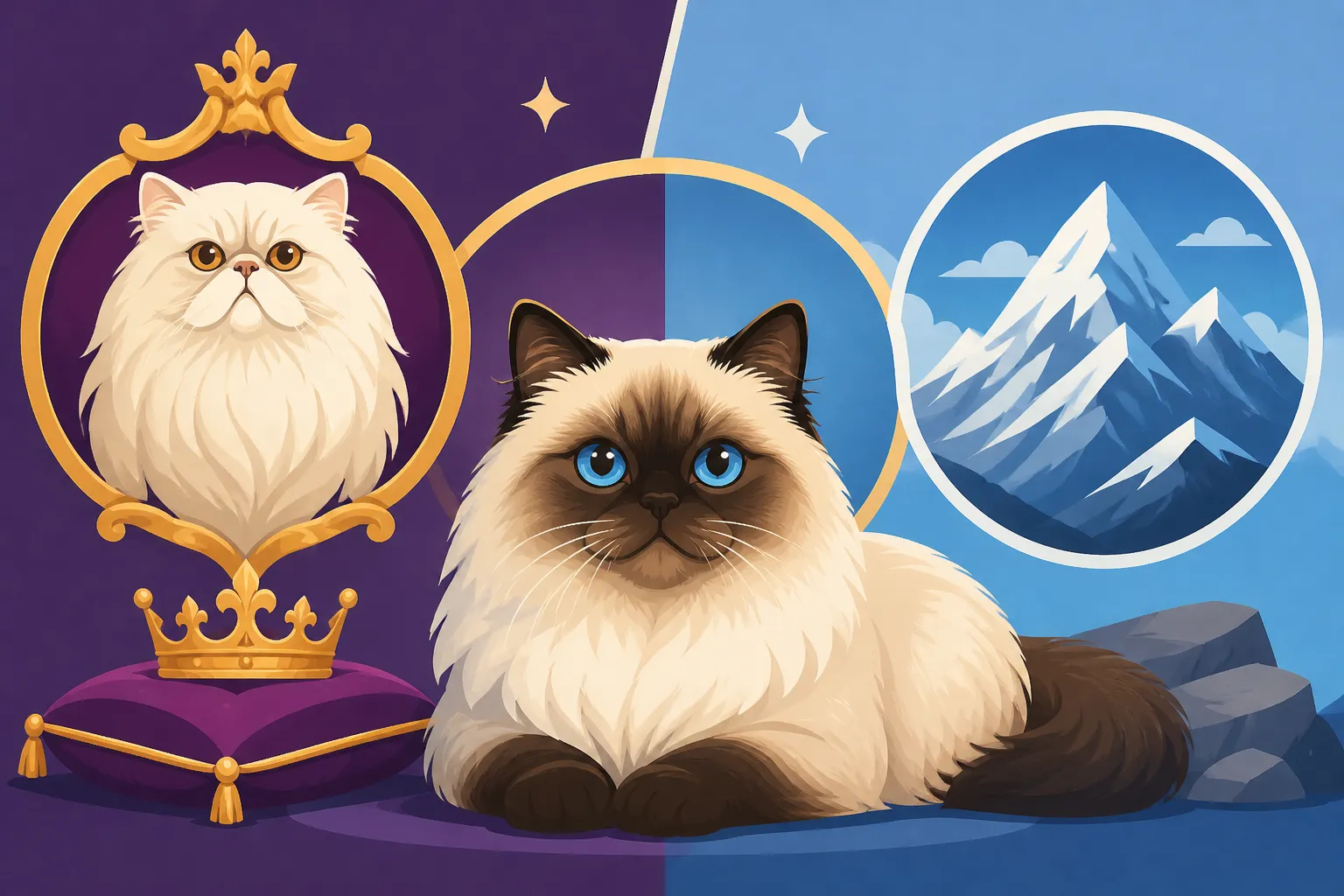
This shift meant that if you enter a Himalayan into a CFA show, it's not competing against other Himalayans as a separate breed; it's competing as a Persian, just in a specific color class. Judges apply the same stringent criteria for conformation that they would to a solid-colored Persian. This can be a bit confusing for new owners or those unfamiliar with cat shows, as their cat's papers might say "Persian" even if they proudly call their feline a Himalayan. Understanding this administrative detail is key to appreciating why certain physical traits are so highly valued. If you want to dive deeper into this topic, checking out Why CFA Made the Himalayan a Persian Division in 1984 can give you more context. Essentially, the standard ensures that the Himalayan remains true to its Persian lineage while celebrating its unique color palette.
The Ideal Persian "Type" Demanded of a Himalayan
When judges evaluate a Himalayan, they are looking for a cat that embodies the very essence of the Persian breed, adorned with the beautiful colorpoint pattern. This "type" is a very specific, carefully cultivated aesthetic that has been refined over decades. It's not just about being pretty; it's about meeting a detailed blueprint for feline perfection.
Roundness is King: The Head, Eyes, and Ears
The head is arguably the most critical feature when it comes to the Persian standard, and by extension, the Himalayan. "Roundness is king" is a phrase you'll often hear because every aspect of the head is supposed to contribute to an impression of perfect sphericality. Imagine looking at your cat's head from the front – the ideal is a broad, perfectly round skull, full cheeks, and a rounded forehead. There should be no flat spots or angles. This contributes to that sweet, open expression that Persian and Himalayan cats are famous for.
The eyes are an extension of this round ideal. They must be large, round, and full, set far apart to maintain the breadth of the face. For Himalayans, the eye color requirement is exceptionally strict: they must be brilliant, vivid blue. Any hint of green, yellow, or dullness will be penalized. The nose is another defining feature, needing to be short, snub, and broad, with a distinct "break" – a deep indentation – between the eyes. This "break" is what gives the flat-faced varieties their characteristic profile. Finally, the ears must be small, round-tipped, and set low on the head, far apart, and tilted forward. They should blend seamlessly into the rounded contour of the skull, almost disappearing into the luxuriant ruff. If you're interested in the nuances of how these facial features are judged, How a Himalayan's Head Is Judged as a Persian's provides an excellent breakdown.
The "Cobby" Body: Structure and Substance
Beyond the head, the Persian standard demands a very specific body type that is often described as "cobby." This means the cat should be compact, low on its legs, and well-balanced. Think of a brick – dense, solid, and substantial. The body should be short and well-rounded, with a broad chest and a level back. There's no room for a long, lean, or svelte physique here; those traits belong to other breeds. The overall impression should be one of immense substance and strength, not delicate elegance.
This cobby body extends to the boning and musculature. Himalayans, under the Persian standard, should have heavy boning, meaning thick, strong bones throughout their frame. Their muscles should be firm and well-developed, contributing to their substantial weight for their size. When you pick up a well-typed Himalayan, they should feel surprisingly heavy and solid. The legs are short and thick, ending in large, round paws with well-tufted toes – another Persian hallmark. The tail is also short and in proportion to the body, carried low and adorned with a full plume of fur. Every single element of the body, from the tip of the nose to the end of the tail, contributes to this overall impression of a luxurious, substantial, and impeccably balanced animal.
The Distinctive Himalayan Traits Within the Persian Frame
While the general "type" is Persian, the Himalayan brings its own unique set of characteristics to the table, specifically its striking color pattern and captivating blue eyes. These traits are not just tolerated within the Persian standard; they are celebrated and held to equally rigorous scrutiny.
The Iconic Blue Eyes and Their Strict Requirements
The blue eyes of a Himalayan are not just a feature; they are the defining optical characteristic and a point of immense beauty. Within the Persian standard, as applied to Himalayans, the requirement for eye color is uncompromising: they must be blue, and not just any blue. Judges are looking for a brilliant, deep, vivid blue that truly stands out against the cat's face. The intensity of the blue is paramount, contributing significantly to the cat's overall expression and allure.
Any deviation from this vibrant blue is considered a fault. Even a slight greenish tint, a pale washed-out blue, or eyes that appear dull rather than brilliant, will result in deductions in the show ring. This strict adherence to brilliant blue eye color stems directly from the Siamese ancestry that gave the Himalayan its point coloration. The gene responsible for the colorpoint pattern is also linked to blue eyes. Thus, a truly exceptional Himalayan must not only have the perfect Persian conformation but also possess those piercing, unforgettable blue eyes. The importance of this specific trait is why we have discussions like Why Only Blue Eyes Are Allowed on a Himalayan, emphasizing its non-negotiable nature in the standard.
Point Coloration: Defining a Himalayan's Identity
The point coloration is, of course, what makes a Himalayan a Himalayan. This unique pattern means that the color is restricted to the "points" of the body – the face (mask), ears, paws, and tail – while the body remains a much lighter shade, ideally a clear, uniform cream or white. The contrast between the dark points and the light body is crucial and a major component of the standard.
The standard recognizes several specific point colors, such as Seal Point (a deep, rich brown-black), Blue Point (a slate blue-gray), Chocolate Point (a warm, milk chocolate brown), Lilac Point (a frosty gray with pinkish undertones), Flame Point (a vivid orange-red), Cream Point (a soft, warm cream), and various Tortie and Lynx Points, which combine these colors with tabby markings or tortoiseshell patterns. Each color has its own ideal shade and intensity. The points should be well-defined, evenly colored, and in strong contrast to the body color. A mottled or smudged appearance, or a body color that is too dark and reduces the contrast, will be penalized. The quality of the points is a huge part of a Himalayan's appeal and is extensively judged. How a Himalayan's Points Are Judged goes into great detail about what judges look for in this critical area.
Grooming and Coat: The Persian Legacy's Demands
The Persian standard, applied to Himalayans, places immense importance on the coat. It's not just about length; it's about texture, density, and how it flows over the cat's cobby body, demanding a significant commitment to grooming from owners. This luxurious coat is both a blessing and a challenge.
The Luxurious, Yet Demanding, Long Coat
The Himalayan's coat is one of its most defining and beautiful features, directly inherited from its Persian lineage. The standard demands a long, thick, flowing coat with a fine texture. It should feel soft and silky to the touch, not coarse or cottony. A full, dense undercoat provides volume and helps the outer coat stand away from the body, giving that characteristic plush appearance. The length of the coat should be uniform over the body, except for the ruff and britches, which are naturally longer.
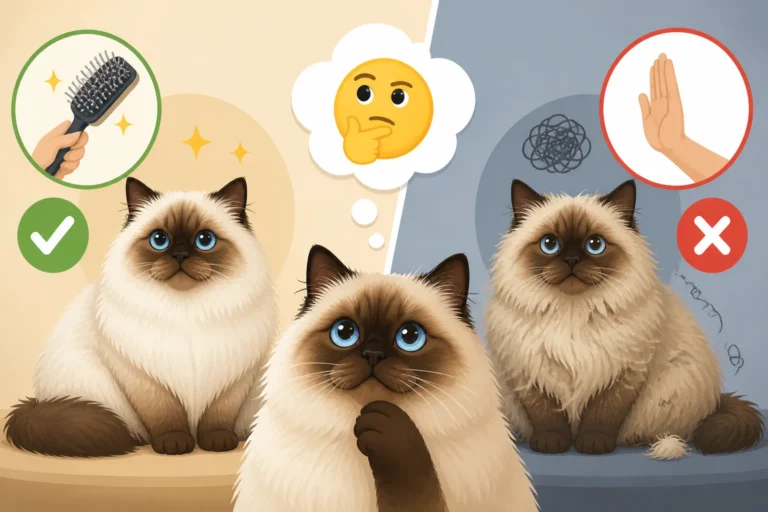
This magnificent coat, however, is not low-maintenance. In fact, it's one of the most demanding coats in the feline world. To meet the standard, a Himalayan's coat must be impeccably groomed, free of mats, tangles, and debris. Daily combing is not just recommended; it's essential. Even a single day missed can lead to tangles, especially in high-friction areas like the armpits, behind the ears, and in the britches. For show cats, the grooming routine can be hours long, involving special brushes, combs, and even powders to enhance volume and remove oil. Even for a beloved pet Himalayan, a consistent grooming schedule is non-negotiable to prevent painful matting that can necessitate shaving. Having a good, sturdy metal comb, perhaps one you picked up from Chewy, is an absolute must-have in every Himalayan owner's toolkit.
Maintaining Point Contrast and Overall Presentation
Beyond the general condition of the coat, the standard also focuses heavily on maintaining the distinct contrast between the dark points and the light body color. Environmental factors, genetics, and even diet can influence this. A body coat that is too dark or "smudgy" reduces the desired contrast and is considered a fault. Judges want to see a clear delineation between the points and the pale body, showcasing the unique genetic expression of the colorpoint gene.
Presentation also includes the overall cleanliness and health of the coat. While bathing isn't an everyday occurrence, a show cat will be meticulously bathed and dried to ensure the coat is sparkling clean, free of oil, and fluffed to perfection. For pet Himalayans, while less rigorous, regular grooming helps distribute natural oils, keeping the coat healthy and shiny. Tear staining, which is common in flat-faced breeds, also needs to be carefully managed to prevent unsightly discoloration on the pale fur around the eyes. The goal is an immaculate, flowing coat that enhances the cat's cobby type and beautifully highlights its point coloration. As discussed in Why a Poor Contrast Himalayan Loses Points, maintaining this contrast is vital for any Himalayan aiming for the show ring.
Health and Conformation: When the Standard Poses Challenges
While the Persian standard defines a beautiful ideal, some of its demands, particularly concerning facial structure, can unfortunately lead to health challenges for Himalayans. A responsible owner needs to be aware of these potential issues and how to manage them, regardless of whether their cat is destined for the show ring or simply a beloved family member.
The Flat Face and Breathing Considerations
The extreme "peke-face" or ultra-typed face, with its very short, snub nose and deep "break" between the eyes, is highly prized in the show ring for Persians and Himalayans. This exaggerated flat face, while aesthetically unique, can lead to a condition known as Brachycephalic Airway Syndrome (BAS). This syndrome is a collection of anatomical abnormalities that obstruct the upper airway, making breathing difficult. These can include stenotic nares (pinched nostrils), an elongated soft palate, a hypoplastic trachea (narrow windpipe), and everted laryngeal saccules.
A Himalayan with a severely flat face might exhibit loud breathing, snoring, snorting, or even open-mouth breathing, especially during play or in warm weather. They can overheat quickly and are often less tolerant of exercise. Owners often notice their cats panting after only a few minutes of gentle play, which is a clear signal that their respiratory system is working harder than it should. While some breeders are striving for a slightly less extreme, "doll-face" profile for improved health, the show standard still often rewards the flatter face. Understanding What a Doll Face Himalayan's Profile Measures and Why Show Himalayans Drifted Toward the Flatter Face can shed light on the differences and the history behind these facial types. It's a critical area where aesthetics and health intersect, requiring vigilant care and sometimes veterinary intervention.
Eye Care and Tear Staining as a Standard Consequence
Another common consequence of the flat-faced Persian standard for Himalayans is the challenge of eye care and managing tear staining. The large, round eyes set within a very flat face, coupled with a shortened tear duct system, often means that tears cannot drain properly through the tear ducts. Instead, they overflow onto the fur around the eyes, leading to chronic dampness and tear staining.
This constant moisture creates a breeding ground for yeast and bacteria, which can cause the characteristic reddish-brown stains, especially noticeable on the pale body fur of a Himalayan. It can also lead to skin irritation or even infection in the deep facial folds. Daily cleaning is essential to prevent these issues. Many owners use soft cotton pads and warm water, or specialized pet eye wipes available from retailers like Chewy, to gently clean the area around the eyes every morning. Some vets may recommend specific ophthalmic solutions to help keep the area clean and reduce bacterial growth. While tear staining is largely an aesthetic concern, persistent dampness and irritation can lead to more serious problems like dermatitis if not managed diligently.
Navigating the Show Ring: Faults and Disqualifications for Himalayans
For those aspiring to show their Himalayan, understanding what constitutes a fault or a disqualification is paramount. Judges meticulously evaluate every aspect against the Persian standard, and even minor deviations can cost points, while certain traits can completely remove a cat from contention.
Common Faults That Deduct Points
Judges have a keen eye for details, and many traits, while not outright disqualifying, will lead to point deductions. These often relate to deviations from the ideal "roundness," "cobby" body, or coat perfection.
Here’s a breakdown of common faults:
- Head Faults: A flat top to the head, a narrow or long head, a pinched muzzle, or a lack of full cheeks will all result in lost points. The perfect roundness is key, and any angularity or lack of breadth is noted.
- Eye Faults: Beyond not being brilliant blue, eyes that are small, almond-shaped, or set too close together are penalized. A dull eye color, even if blue, is also a fault.
- Nose Faults: A nose that is too long, too narrow, lacks a distinct "break," or has a shallow "break" is a common fault. The ideal is a short, broad, snub nose with a pronounced indentation.
- Ear Faults: Ears that are too large, pointed, or set too high on the head will detract from the overall score. They should be small, round, and low-set.
- Body Faults: A body that is long, narrow, high on legs, or lacks heavy boning is a significant fault. The cobby, substantial body is fundamental to the Persian type.
- Coat Faults: A thin, cottony, sparse, or matted coat will be heavily penalized. The texture, density, and length must meet the standard. Poor grooming, lack of a full ruff, or thin britches also count against the cat.
- Point Color Faults: Any mottling, smudged points, or a body color that is too dark and lacks sufficient contrast with the points are considered faults. The clarity and distinctness of the points are crucial.
These faults highlight how rigorously the Persian standard is applied to Himalayans, emphasizing the importance of a holistic approach to breeding and presentation. Many of these issues are discussed in depth in Which Faults Put a Himalayan Out of the Ring.
Absolute Disqualifications from the Persian Standard
While faults deduct points, disqualifications mean a cat cannot place in the show, regardless of its other qualities. These are usually severe deviations from the standard or signs of ill health.
For a Himalayan, common disqualifications under the Persian standard include:
- Wrong Eye Color: Any eye color other than brilliant blue (e.g., green, yellow, copper eyes) is an immediate disqualification. This is one of the most non-negotiable aspects for Himalayans.
- Poor Health or Condition: Any evidence of illness, lameness, extreme emaciation, or obesity that impairs movement will result in disqualification. The cat must be in prime physical condition.
- Kinks or Abnormalities of the Tail: A kinked or abnormally short tail is a disqualifying fault.
- Incorrect Number of Toes: Polydactyly (extra toes) is a disqualification.
- White Toes or Patches: Except for specific pattern variants like a Bi-color or Van pattern (which are not typical point colors for Himalayans, but can occur in Persians), white toes or random white patches on the body (that aren't part of the point pattern) are usually disqualifying.
- Any Evidence of Deafness: As blue eyes can sometimes be linked to deafness, any sign of this would be a disqualification.
- Undershot or Overshot Jaw: A severely misaligned jaw or bite is a disqualification.
- Aggression or Extreme Timidity: Cats must be tractable and cooperative with the judges. Extreme shyness or aggression can lead to disqualification.
Understanding these stringent rules underscores the high bar set for Himalayans in the show ring. Breeders work tirelessly to produce cats that not only avoid these disqualifications but also embody the ideal Persian type with their distinct colorpoint beauty. The health aspects are paramount, and any condition that compromises a cat's well-being is rightly taken seriously.
| Feature | Ideal (Per Standard) | Common Faults | Disqualifications |
|---|---|---|---|
| Head | Extremely round, broad skull, full cheeks | Flat top, narrow skull, pinched muzzle | Extreme asymmetry, absence of "break" |
| Eyes | Large, round, full, set far apart, brilliant blue | Small, almond-shaped, green/yellow tinges, close-set | Any color other than blue (e.g., green, copper) |
| Nose | Short, snub, broad, with "break" between eyes | Long, thin, Roman profile, shallow "break" | Severely blocked nostrils (impairing breathing) |
| Ears | Small, round-tipped, low-set, tilted forward | Large, pointed, high-set | Grossly malformed |
| Body | Cobby, low on legs, broad chest, heavy boning | Long, narrow, light boning, high on legs | Extreme emaciation or obesity, lameness |
| Coat | Long, thick, flowing, full ruff/britches, fine | Sparse, cottony, poor texture, lacking fullness | Mats causing skin lesions, severe balding |
| Point Color | Clear, distinct, well-defined contrast to body | Mottled, uneven, smudged, poor contrast | White patches on body (not associated with points) |
| Tail | Short, proportional, full plume | Long, whip-like, bare | Kinked tail, abnormally short tail |
| General | Excellent health, docile temperament | Evidence of poor health, nervous disposition | Aggression, extreme timidity, polydactyly |
Living Up to the Standard: Daily Life with a Show-Quality Himalayan
Bringing a show-quality Himalayan into your home means embracing a lifestyle that prioritizes their unique needs, stemming directly from the demands of the breed standard. It's a commitment to daily care that ensures your cat remains healthy, happy, and stunningly beautiful.
Balancing Aesthetics with Practical Care
The demands of the Persian standard, while creating a visually magnificent cat, also dictate a very specific approach to daily care. For example, that dense, flowing coat needs daily attention. You can't just admire it; you have to actively maintain it. This means setting aside time each day for a thorough combing session. Neglecting this will inevitably lead to painful mats that can pull on the skin and even require veterinary intervention to shave off under sedation. Many owners find a designated grooming spot, perhaps a table, helps establish a routine. Having the right tools, like a good quality steel comb (available from Chewy, among other places), is crucial.
Beyond the coat, the distinctive flat face and large eyes mean an extra commitment to facial hygiene. Daily wiping of the tear stains is necessary not only for aesthetics but to prevent skin irritation and infections. This isn't a task to be rushed; it's a gentle ritual to keep their delicate faces clean and comfortable. And then there's the consideration of their breathing. While a cobby body is desired, it's also important to manage their weight carefully, as excess pounds can exacerbate any existing breathing difficulties from their brachycephalic structure. Maintaining a cool, calm environment, especially in warmer months, is also essential for these cats. It's about finding that balance where your cat's beauty is maintained without compromising their comfort or health.
Finding Breeders Who Prioritize Health and Type
If you're considering adding a Himalayan to your family, particularly one bred to the standard, it's absolutely vital to find a reputable breeder who understands and prioritizes both "type" (adherence to the standard) and, more importantly, health. A truly ethical breeder will not chase extreme features at the expense of a cat's well-being. They will breed for sound structure, good temperament, and robust health, all while striving for the beautiful characteristics of the breed.
When you're speaking with a breeder, ask them about their breeding goals. Do they focus solely on winning in the show ring, or do they also emphasize health screening? Reputable breeders will be transparent about genetic testing for conditions like Polycystic Kidney Disease (PKD) and Progressive Retinal Atrophy (PRA), which can affect Persian and Himalayan lines. They should be able to provide documentation for both parent cats. They should also be able to discuss the nuances of their cats' facial structure, explaining how they balance the desired "break" and nose placement with good open nostrils for breathing. Look for a breeder who openly talks about potential health challenges associated with the breed and how they mitigate them. A responsible breeder understands that the standard is a guide, but the cat's health and quality of life always come first. They'll also typically provide guidance on the grooming and care routines, making sure you're prepared for the commitment.
Disclaimer
This article is for general informational purposes only and does not constitute professional advice. Laws, prices and regulations vary by location and change over time. Consult a qualified professional for guidance on your specific situation.