Which Journal Carried the First Himalayan Paper
It's easy to look at a Himalayan cat with their glorious flowing coats and striking blue eyes and simply adore them for their beauty. But have you ever stopped to wonder about the fascinating story behind their creation, especially the scientific curiosity that led to their very existence? Many people are surprised to learn that this beloved breed wasn't just a happy accident in a backyard, but the result of deliberate academic pursuit. This guide will take you on a journey back to the very beginning, exploring the groundbreaking research that brought the Himalayan into being and uncovering which pivotal journal first introduced this magnificent cat to the scientific community.
The Genesis of the Himalayan: An Academic Endeavor
Before the Himalayan became the fluffy, affectionate lap cat we know today, it was an ambitious scientific project. Imagine a time when understanding genetics, especially coat color inheritance in mammals, was still very much a frontier. Researchers weren't just trying to make a pretty cat; they were genuinely delving into fundamental biological questions, using cats as their living laboratories. This wasn't about aesthetics initially, but about proving genetic principles that would have broader implications for animal breeding and genetics as a whole.
The Harvard Connection and Early Experiments
The story of the Himalayan truly begins in the hallowed halls of Harvard University in the 1930s. It sounds almost unbelievable, doesn't it? When we think of Harvard, we might picture groundbreaking medical research or economic theories, not necessarily the creation of a new cat breed. But indeed, it was here that Dr. Clyde Keeler and Virginia Cobb embarked on their fascinating journey. They were primarily interested in studying hereditary traits, specifically focusing on the Siamese pattern (what we now call "points") and long hair, and how these traits were passed down through generations.
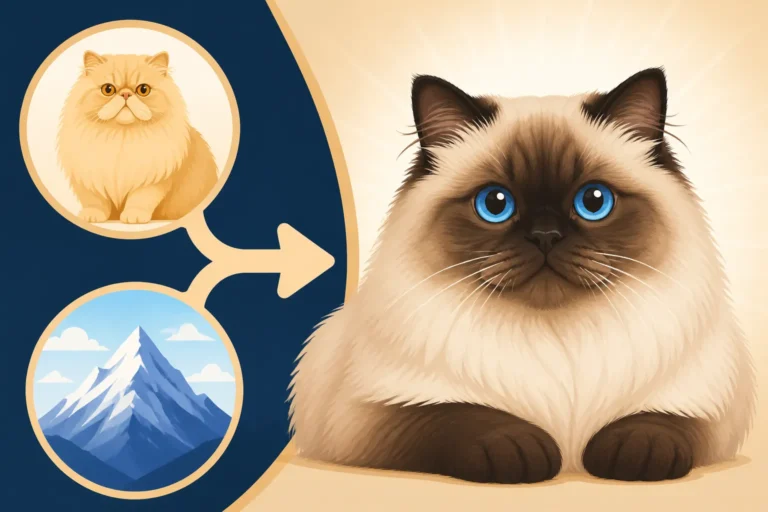
Their method was precise: they took a purebred Siamese cat, known for its distinctive color points, and crossed it with a purebred Persian, famous for its luxurious long coat. The idea was to combine these two very distinct genetic blueprints and observe the outcomes. It was a rigorous, meticulous process, far removed from casual breeding. They weren't just hoping for a cute kitten; they were collecting data, tracking phenotypes, and analyzing patterns. This careful, almost clinical approach set the stage for what would become the Himalayan. It was a clear demonstration of Mendelian inheritance at work in a complex organism, proving that specific traits could be intentionally combined and expressed. You can dive deeper into this fascinating beginning by reading The Himalayan Was Made at Harvard in the 1930s and learning about the individuals involved in Clyde Keeler, Virginia Cobb and the First Himalayan.
The Scientific Goal Behind the Cross
So, why go to all this trouble? What was the big scientific question they were trying to answer? Their primary objective was to understand how the Siamese colorpoint gene interacted with the Persian's longhair gene. They hypothesized that these traits were inherited independently, and they wanted to demonstrate this empirically. Think of it like a complex puzzle where each gene is a piece, and they wanted to see how those pieces fit together to create a whole new picture. They meticulously documented the coat colors, lengths, and eye colors of each kitten produced in their crosses.
The point wasn't to create a "designer cat" in the modern sense. Instead, it was to illustrate fundamental principles of genetic inheritance using mammalian models. The fact that the resulting cats were incredibly beautiful was almost a serendipitous bonus! This research laid crucial groundwork for future studies in feline genetics and helped consolidate the understanding that specific, predictable patterns govern how physical traits are passed from parents to offspring. It was a testament to the power of controlled breeding for scientific discovery, a far cry from simply crossing two pretty cats and seeing what happens. For more context on their specific research, check out What Keeler and Cobb Were Studying When They Made the Himalayan.
The Landmark Publication: Sharing the Discovery
Any significant scientific discovery needs to be shared with the broader academic community, and the creation of the Himalayan was no exception. This wasn't just a private experiment; it was research meant to contribute to the collective knowledge of genetics. Publishing their findings was the crucial step that moved the Himalayan from a university laboratory to a recognized scientific phenomenon.
Identifying the Original Scientific Journal
The groundbreaking results of Keeler and Cobb's work were first published in a prestigious scientific journal. For those of us who appreciate the history of cat breeds, knowing where this seminal paper appeared is like uncovering a hidden gem. The original paper, which detailed their meticulous breeding experiments and the resulting analysis, was published in the Journal of Heredity in 1936.
This wasn't a pet magazine or a breed club newsletter; it was a peer-reviewed scientific publication dedicated to genetics and heredity. This fact alone underscores the serious academic intent behind the Himalayan's creation. The Journal of Heredity is well-respected in the scientific community, and its pages have hosted many important genetic discoveries over the decades. To have the very first account of the Himalayan appear there speaks volumes about its scientific significance at the time. It wasn't just about showing off a new kind of cat, but about presenting robust data and analysis that supported genetic principles. You can find more information on this specific publication in Which Journal Carried the First Himalayan Paper.
What the 1936 Paper Revealed About the Himalayan
The 1936 paper wasn't a fluffy article about cute kittens. It was a detailed, data-driven report. It outlined the crosses, the genetic ratios observed, and the conclusions drawn about the inheritance of the Siamese point pattern and long hair. Essentially, it provided the blueprint for how to create a cat with the Persian's long coat and the Siamese's distinctive coloration and blue eyes. The paper detailed how the traits for long hair and color points were recessive, meaning that a kitten needed to inherit two copies of each gene (one from each parent) to express them.
This meant that initial crosses between a purebred Persian (long-haired, non-pointed) and a purebred Siamese (short-haired, pointed) would produce kittens that looked like ordinary short-haired, solid-colored cats. It was only in subsequent generations, by breeding these "carrier" cats together, that the long-haired, pointed kittens – the proto-Himalayans – would emerge. This intricate dance of genes was precisely what Keeler and Cobb elucidated in their work. The paper proved that a cat could indeed possess both the long coat and the pointed pattern, establishing the genetic foundation for the breed. If you're curious about the specific findings, reading What the 1936 Paper Said About the Himalayan Cross offers a deeper dive into the technical aspects.
Here's a simplified look at the traits they were tracking:
| Trait Type | Persian Contribution | Siamese Contribution | Himalayan Result (Desired) | Genetic Basis (Simplified) |
|---|---|---|---|---|
| Coat Length | Long, flowing | Short, sleek | Long, flowing | Recessive (long) |
| Color Pattern | Solid, non-pointed | Pointed (dark extremities) | Pointed (dark extremities) | Recessive (pointed) |
| Eye Color | Copper/Green/Blue (solids) | Blue (often intense) | Blue (intense) | Linked to point gene |
| Body Type | Cobby, heavy boned | Svelte, athletic | Cobby, heavy boned | Dominant Persian influence |
| Temperament | Calm, docile | Vocal, active | Mix (often 'lap cat') | Mix of influences |
Beyond the Lab: From Science to Show Cat
While the Journal of Heredity provided the scientific validation, it wasn't long before cat fanciers and breeders saw the immense potential in these "Persian-Siamese" crosses. The leap from a research subject to a beloved household pet and show ring contender required a different kind of dedication, one driven by passion for the animal itself, not just its genetics.
Early Breeders Taking Up the Mantle
Once the scientific world had seen the possibility, it was the dedicated breeders who took the reins. Individuals like Marguerita Goforth in the United States, alongside others in Canada and Britain, were instrumental in transitioning these experimental cats into a recognized breed. They weren't scientists; they were cat lovers with a vision. They understood that these cats possessed a unique combination of traits – the serene temperament and luxurious coat of the Persian, fused with the striking point coloration and blue eyes of the Siamese.
Their task was to stabilize these traits, ensuring that litters consistently produced cats that looked like Himalayans. This involved careful selective breeding, sometimes spanning many generations, to cement the desired appearance and temperament. It required a keen eye, meticulous record-keeping, and a deep understanding of cat genetics, albeit often learned through practical experience rather than formal academic study. This period was crucial, moving the breed from a genetic proof-of-concept to a viable, reproducible lineage. For a closer look at a key figure in this transition, consider Marguerita Goforth and the Himalayan's 1957 Recognition.
The Initial Challenges of Breed Recognition
Getting a new breed officially recognized by cat registries is no small feat. It's a rigorous process that demands consistency in appearance, a clear genetic history, and sufficient numbers of cats to ensure a healthy gene pool. The early Himalayan breeders faced considerable hurdles. There was often debate about whether the Himalayan was truly a new breed, or simply a color variety of the Persian. This debate, as you might imagine, could get quite heated among passionate fanciers!
Registries like the Cat Fanciers' Association (CFA) eventually recognized the Himalayan, but often after years of provisional status and careful evaluation. In fact, the breed's journey through various registries is quite complex, with some, like CFA, eventually folding the Himalayan into the Persian breed as a "Himalayan Division" later on. This reflects the ongoing discussion about its identity – a Persian with point coloration, or a distinct breed entirely? Despite these bureaucratic challenges, the dedication of early breeders ensured the Himalayan's place in the cat fancy, solidifying its identity and growing its popularity among pet owners worldwide. For more on the number of generations it took to establish consistency, see How Many Generations the First Himalayan Took.
The Himalayan's Lasting Scientific Legacy
While the immediate goal of Keeler and Cobb's research was to understand gene inheritance, the long-term impact of their work extends far beyond the creation of a beautiful cat. The Himalayan, in its very existence, became a living testament to genetic principles and has continued to inform our understanding of animal breeding and inheritance.
Contributions to Understanding Coat Genetics
The work with the Himalayan fundamentally contributed to our understanding of coat color genetics in mammals. Specifically, it elucidated how the "point" coloration works – a form of temperature-sensitive albinism. This means the gene responsible only allows full color to develop in cooler parts of the body (ears, paws, tail, face), while warmer areas (the core body) remain paler. This mechanism was a fascinating discovery and is now well-understood not just in cats, but in other animals like Himalayan rabbits and certain types of mice.
The research also clarified the recessive nature of long hair, demonstrating how two short-haired cats could produce long-haired offspring if both carried the recessive gene. This kind of hands-on, observable proof was invaluable for the burgeoning field of genetics. It showed that breeders could, with careful planning, predict and produce specific traits, forever changing how we approach animal breeding. It highlights how the Himalayan, at its core, is a living example of genetic principles in action. Understanding Why a Himalayan Needs Two Copies of the Point Gene further clarifies this genetic dance.
How the Himalayan Influenced Modern Cat Breeding
The success of creating the Himalayan had a ripple effect across the entire world of cat breeding. It demonstrated that deliberate, scientific crosses could yield stunning, stable new breeds, opening the door for other "designer" cat breeds. Breeders saw that by understanding genetics, they weren't just breeding by chance, but by design. This spurred interest in genetic testing and understanding pedigrees, not just for appearance but for health.
Furthermore, the Himalayan's unique combination of traits proved incredibly popular, leading other breeders to incorporate the point gene into existing breeds or use Himalayan lines to create new ones. It taught us about the power of selective breeding to enhance desirable characteristics while, in some cases, inadvertently introducing or concentrating less desirable ones, which is a lesson cat breeders are still learning and adapting to today. The early scientific approach underscored the importance of responsible breeding practices, a topic that continues to evolve, as discussed in Why the Himalayan Argument Is About Paperwork, Not Cats.
Understanding the Himalayan Today: A Product of its Past
Even today, the Himalayan cat carries the echoes of its scientific beginnings and the traits of its Persian and Siamese ancestors. Understanding this history helps us appreciate the unique characteristics of the breed and informs responsible ownership and care.
Traits Inherited from the Early Crosses
When you look at a Himalayan, you're essentially seeing a living embodiment of that original Harvard experiment. From the Persian side, they inherited their magnificent, dense long coat, their sturdy, cobby body type, and their generally docile, placid temperament. They are true lap cats, often content to observe the world from a comfortable perch. However, the Siamese influence is unmistakable in their brilliant blue eyes and the striking point coloration – the darker fur on their face, ears, paws, and tail. This combination creates a cat that is both regal and distinctly charming.
The Siamese heritage also endowed them with a more vocal nature than their Persian counterparts, though usually not as loud or insistent as a purebred Siamese. This means a Himalayan might "talk" to you with soft chirps and trills, letting you know its thoughts without demanding attention. Their playful side also often comes from the Siamese, meaning they might enjoy a good wand toy session, albeit usually for shorter bursts before they're ready for a nap. These inherited traits are what make the Himalayan truly unique, a perfect blend of two beloved breeds.
Modern Perspectives on Himalayan Health and Care
Understanding the Himalayan's origins is crucial for appreciating their specific care needs today. Their Persian heritage means they require extensive grooming due to their long, dense coat. Daily combing isn't just for beauty; it's essential to prevent painful mats and keep their skin healthy. Products from trusted retailers like Chewy can make this routine much easier, providing a wide selection of brushes and combs specifically designed for long-haired cats. Their brachycephalic (flattened) face, inherited from the Persian lines that were favored in showing, also necessitates daily cleaning around their eyes to manage tear stains and prevent skin irritation. Again, online pet stores often have specialty wipes and gentle cleansers.
Their heritage also means potential predispositions to certain health issues, such as Polycystic Kidney Disease (PKD), which came from the Persian side, and respiratory issues due to their facial structure. This is why good breeders today perform genetic testing and offer health guarantees. It's vital for prospective owners to research these conditions and understand the commitment to preventative care. Being informed about the breed's health history, which is rooted in its genetic makeup, empowers owners to provide the best possible life for their Himalayan. When considering supplies, whether it's specialized food bowls for flat faces or grooming tools, checking out resources like Chewy can help you find products tailored to their unique needs.
Disclaimer
This article is for general informational purposes only and does not constitute professional advice. Laws, prices and regulations vary by location and change over time. Consult a qualified professional for guidance on your specific situation.