What Siamese Persian Meant Before the Name Himalayan
Have you ever looked at a beautiful Himalayan cat, with its gorgeous color points and striking blue eyes, and wondered about its origins? It’s not uncommon for people to be confused by its name, or even by older, more informal terms that were used to describe it. Before the beloved Himalayan cat officially earned its unique name, it was often referred to by a descriptive, yet unofficial, moniker: "Siamese Persian." This guide will delve into the fascinating history behind this early designation, exploring why it was used, the era it represented, and how our beloved pointed longhairs eventually came to be known as Himalayans.
The Early Days: The Concept of a Pointed Persian
Imagine a time when the idea of a long-haired cat with the striking color pattern of a Siamese was nothing more than a breeder's dream, a whispered aspiration. This wasn't just about creating a pretty cat; it was a serious undertaking, driven by genetic curiosity and a passion for feline aesthetics. The journey to what we now know as the Himalayan began long before formal recognition, in the careful, often tedious, work of combining two very distinct feline worlds.
The Vision for a New Type of Cat
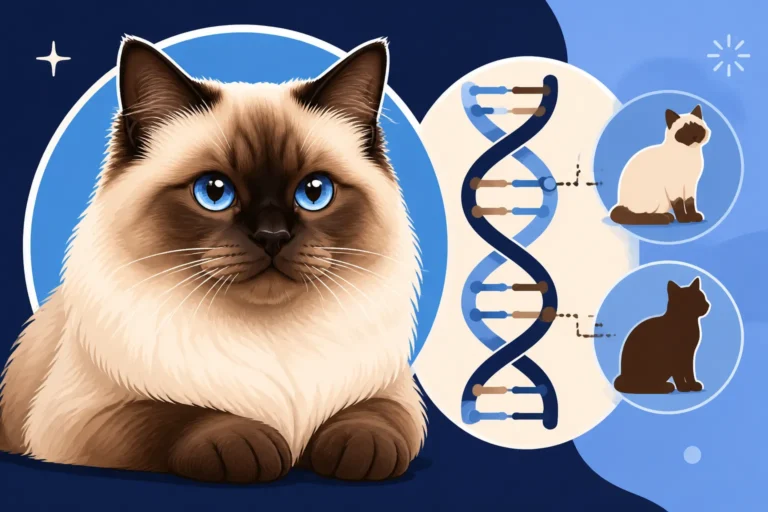
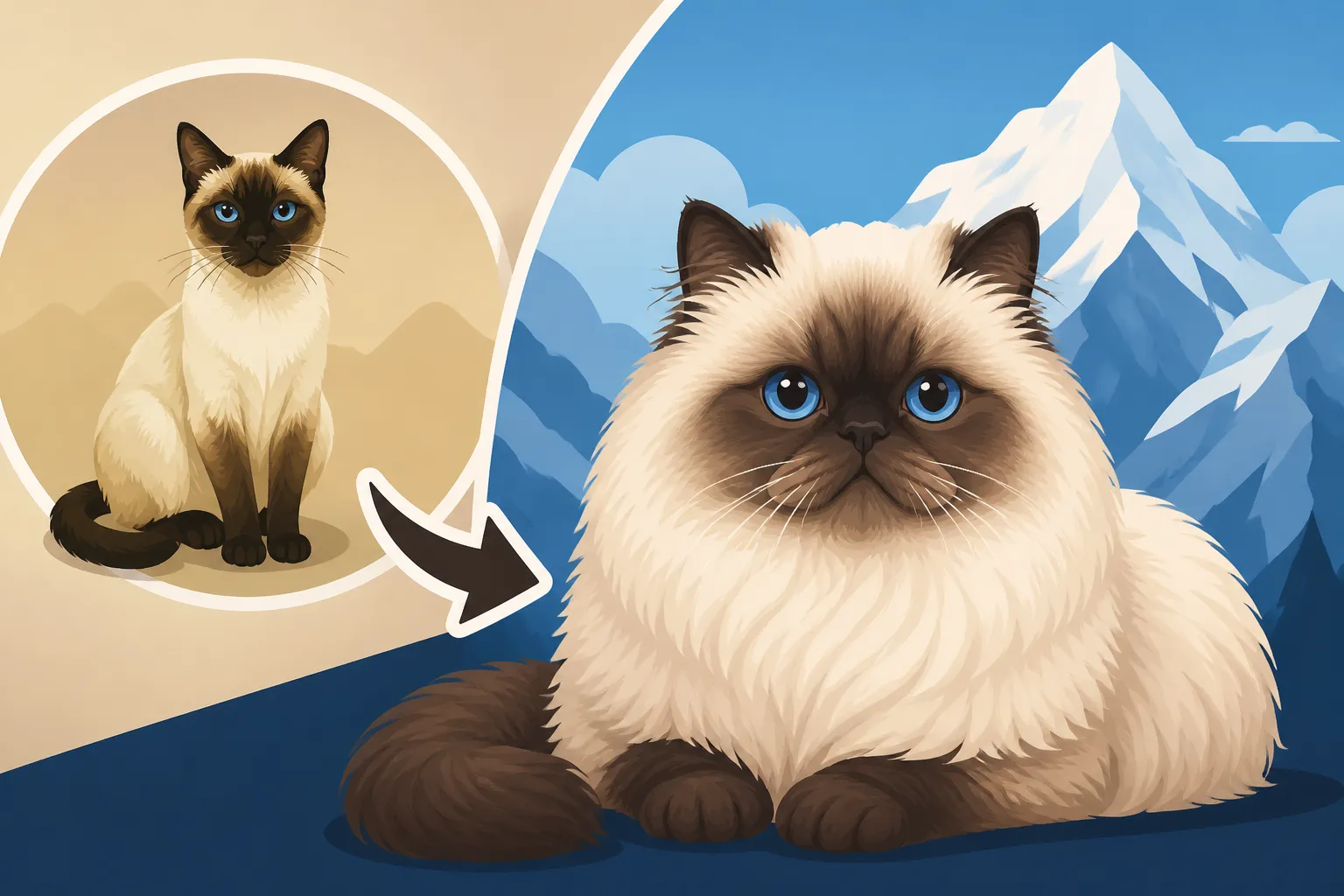
The initial vision was remarkably clear, though incredibly ambitious: to merge the luxurious, flowing coat and docile temperament of the Persian with the distinctive colorpoint pattern and piercing blue eyes of the Siamese. This wasn't simply a matter of breeding two cats together and hoping for the best; it required a deep understanding of genetics and a steadfast commitment across many generations. Breeders weren't just looking for a cat with some points; they wanted a true Persian type—meaning the same cobby body, round head, small ears, and plush, dense coat—but with the contrasting "points" (ears, face, paws, and tail) that make a Siamese so recognizable. It was a quest to combine beauty and distinctiveness in a way no cat had before. They imagined a cat that would capture the best of both worlds, creating something entirely new and captivating.
Initial Breeding Experiments and Challenges
The first concerted efforts to bring this vision to life really took off in the 1930s, notably through the scientific work led by Dr. Clyde Keeler at Harvard University and later by Virginia Cobb. Their primary goal wasn't just to make a new pet; they were actually studying the genetics of coat color and pattern inheritance. This meant meticulous record-keeping and a scientific approach to breeding that was groundbreaking for its time. You can learn more about this in The Himalayan Was Made at Harvard in the 1930s. The challenge was immense because the traits they wanted to combine—long hair and colorpoints—are both recessive. This means a kitten needs to inherit the gene for long hair from both parents and the gene for colorpoints from both parents to express those traits. If even one dominant gene for short hair or solid color was present, the desired outcome wouldn't appear in that generation.
This often meant many litters producing cats that looked like ordinary Persians or Siamese, or even cats that were solid-colored longhairs, before the desired combination finally emerged. Imagine the patience required! It wasn't uncommon for early breeders to encounter setbacks, with generations of kittens showing only a hint of the desired outcome. There was a fair bit of trial and error, cross-breeding, and then breeding back to Persians to maintain the physical type, all while trying to lock in that elusive colorpoint gene. It was a true labor of love, requiring a deep understanding of feline genetics, as discussed in Why Harvard Crossed a Persian With a Siamese to Make the Himalayan.
"Siamese Persian": A Descriptive, Not Official, Name
Before our gorgeous Himalayans had their proper name, they were often simply referred to as "Siamese Persians." This wasn't an official breed name recognized by any major cat registry, but rather a wonderfully descriptive label that perfectly captured what these cats were at a glance. It made perfect sense to those who saw them, even if it lacked the formal recognition we're used to today.
Why the Hybrid Name Made Sense Then
When people encountered these early, unique cats, their minds immediately went to the two most obvious influences: the stately Persian, known for its opulent long coat, flat face, and calm demeanor, and the sleek, vocal Siamese, famous for its striking masked face, dark points, and bright blue eyes. So, calling them "Siamese Persians" was a natural, straightforward way to describe their appearance. You could see the Persian's luxurious fluff and robust build, but then your eye would catch those distinctive dark ears, mask, paws, and tail, undeniably reminiscent of a Siamese. The name was pragmatic, simple, and instantly communicated the cat's visual characteristics without needing a long explanation. It perfectly conveyed the hybrid nature of their lineage, directly linking them to their genetic predecessors.
This descriptive term also served a practical purpose in the early days of breeding. It clearly indicated the genetic heritage and the intended goal of the breeding program. If you said "Siamese Persian," fellow enthusiasts immediately understood you were talking about those gorgeous longhairs with the colorpoint pattern, setting them apart from solid-colored Persians or short-haired Siamese. It was a conversational shorthand, a way for people to categorize and discuss these fascinating new felines without an official nomenclature.
The Confusion for Early Enthusiasts and Buyers
While "Siamese Persian" was descriptive, it also led to its fair share of confusion, especially for new enthusiasts or potential buyers. Without an official name, it was hard to truly define the breed, which often made it difficult to discuss standards or distinct characteristics. Was it a Persian that looked like a Siamese, or a Siamese with a Persian coat? This ambiguity could be frustrating. People might expect a cat with the vocal tendencies of a Siamese but the laid-back nature of a Persian, or vice-versa, only to find the new breed had its own unique personality traits and health considerations.
Furthermore, without a formalized name and clear breed standard, there was less consistency in breeding. Different breeders might have slightly different ideas about what constituted an ideal "Siamese Persian," leading to variations in type and appearance. This lack of uniformity could make it challenging for buyers to know exactly what they were getting. Imagine trying to explain to someone today that you're looking for a "Golden Retriever Labrador" without a recognized breed standard for a Goldador! The informal name, while helpful, highlighted the need for the cat fancy to eventually give this magnificent hybrid its own distinct identity.
The Role of Early Breeders in Stabilizing the Look
The true heroes of this era were the dedicated early breeders who, despite the lack of official recognition and the descriptive but vague "Siamese Persian" label, worked tirelessly to stabilize the breed's appearance and temperament. These pioneers were instrumental in meticulously selecting breeding pairs, ensuring that the desired Persian body type and the Siamese colorpoint pattern consistently appeared in successive generations. They weren't just making pretty cats; they were actively working to create a genetically stable and predictable feline, one that would consistently express the characteristics we now associate with the Himalayan.
Their commitment involved careful line breeding and outcrossing to established Persian lines to strengthen the Persian physical attributes while retaining the point coloration. They had to pay close attention to the nuances of coat quality, eye color, and overall conformation, gradually refining the "Siamese Persian" into a recognizable and consistent type. These breeders laid the groundwork for the breed's future, ensuring that when the time for official recognition came, there was a robust and distinct population of cats that truly embodied the vision of a pointed longhair. Their dedication, often without much fanfare, cemented the cat's unique place in the feline world, paving the way for its eventual, enduring name.
The Himalayan Rabbit and the Perfect Naming Inspiration
It's fascinating how inspiration for something as beloved as a cat breed can come from an entirely different animal! The journey from "Siamese Persian" to "Himalayan" was sparked by a parallel in the animal kingdom, one that offered a clear, evocative, and universally understood descriptor for the very specific color pattern these cats displayed. It wasn't just about finding a new word; it was about finding the right word that resonated with the breed's most distinguishing feature.
What the Rabbit Had in Common with the Cat
The key to the new name lay in the humble Himalayan rabbit. This particular breed of rabbit is famous for its striking appearance: a pristine white body with dark points on its ears, nose, paws, and tail. Sound familiar? It's the exact same temperature-sensitive albinism gene that creates the colorpoint pattern in cats, earning it the moniker "Himalayan pattern" across various species. When breeders and fanciers saw this identical pattern in the newly developed Persian-Siamese crosses, the connection was undeniable and immediate. The rabbit already bore the name, and applying it to the cat was a logical, elegant solution. Why the Himalayan Is Named After a Rabbit explores this connection in more detail.
This shared genetic trait meant that using "Himalayan" for the cat instantly communicated its most striking visual characteristic—the colorpoint pattern—without needing to reference its parent breeds. It was a clear, concise, and scientifically accurate way to describe the coat coloration. Furthermore, the name had a certain exotic flair, evoking images of cold, high altitudes where such a temperature-dependent gene might naturally thrive. It elevated the cat from being a mere hybrid to a distinct entity with its own unique identity, much like its lagomorphic counterpart.
The Appeal of a Distinct, Recognizable Name
Adopting "Himalayan" as the official name had immediate and profound appeal. Firstly, it finally provided these magnificent cats with their own identity, moving beyond the somewhat clunky and confusing "Siamese Persian." A unique name signifies a unique breed, solidifying its place in the cat fancy and making it easier for the public to identify and appreciate. This distinct name helped to establish the Himalayan as a true breed in its own right, rather than simply a crossbreed or variant.
Secondly, the name "Himalayan" was instantly recognizable and understood globally, thanks to the rabbit. This eliminated much of the earlier confusion about its origins and appearance. When you said "Himalayan cat," people immediately conjured an image of a long-haired, pointed feline, just as they did with the rabbit. This consistency was crucial for establishing breed standards, promoting the cats, and making them more accessible to a wider audience. It was a name that celebrated their defining characteristic and gave them a place of honor among the established breeds. You can explore Which Other Animals Carry the Himalayan Pattern to understand how widespread this genetic trait is.
The Official Recognition and the Name Change
The journey from being informally known as "Siamese Persian" to officially being called the Himalayan was a long and dedicated one, driven by passionate individuals on both sides of the Atlantic. It wasn't a single event, but a series of efforts that eventually brought this beautiful new breed into the spotlight and earned it its well-deserved recognition within the cat fancy.
Marguerita Goforth's Influence and the American Story
In the United States, a pivotal figure in the Himalayan's recognition was Marguerita Goforth. She was a dedicated breeder who, alongside her husband, tirelessly worked to refine the "Siamese Persian" into a consistent and magnificent breed that could stand on its own. Goforth understood the importance of standardization and official recognition for the long-term viability and acceptance of these cats. She championed the cause, tirelessly presenting her animals to various cat associations and advocating for their unique qualities.
It was largely through her efforts and the consistent quality of the cats she produced that the American cat fancy began to take serious notice. She helped establish a distinct breed standard, outlining the ideal physical characteristics and temperament that future Himalayans should embody. Her persistence paid off, leading to significant steps towards formal recognition in the mid-20th century. Her story is a testament to the dedication required to establish a new feline breed, highlighted further in Marguerita Goforth and the Himalayan's 1957 Recognition.
Brian Sterling-Webb's Contributions in the UK
Across the pond, in the United Kingdom, similar dedication was being shown by breeders like Brian Sterling-Webb. Much like his American counterparts, Sterling-Webb recognized the immense potential of these pointed longhairs. He pursued his own breeding programs, focusing on the genetic consistency and type necessary for formal recognition. His work was crucial in developing the breed within the British cat fancy, which often had its own unique standards and preferences.
The British journey to recognition for the "Himalayan" (though they sometimes used other names like "Colorpoint Persian" or "Masked Persian" initially) ran parallel to the American efforts, sometimes influencing, and sometimes independently developing the breed. Sterling-Webb, like Goforth, spent years carefully selecting cats, understanding their genetics, and working towards a cohesive vision for the breed. His contributions ensured that the Himalayan's genetic lineage and physical characteristics were strong and well-defined in the UK, paving the way for eventual international acceptance. You can find out more about his work in Brian Sterling Webb and the British Himalayan.
The Formal Acceptance by Cat Fancier Associations
The culmination of all these dedicated efforts came in the mid-1950s when major cat fancier associations began to formally recognize the Himalayan as a distinct breed. The Cat Fanciers' Association (CFA), one of the largest registries in the world, granted preliminary recognition to the Himalayan in 1957, with championship status following later. This was a monumental achievement, marking the official transition from an experimental crossbreed or a descriptively named hybrid to a fully acknowledged and pedigreed cat.
This recognition meant that Himalayans could now compete in cat shows, earn titles, and have their pedigrees officially registered. It provided a clear framework for breeders, ensuring consistency in type and a focus on health and genetic integrity. While the name "Himalayan" became widely accepted, the breed's close ties to the Persian continued, and some registries, notably CFA, later reclassified the Himalayan as a color division of the Persian breed in 1984. This decision, while controversial for some, cemented the Himalayan's identity as a Persian in every way, except for its striking colorpoint pattern. Understanding what the Persian standard asks of these cats is important, which you can read about in What the Persian Standard Asks of a Himalayan.
The Lasting Legacy of "Siamese Persian" Terminology
Even after the official adoption of the name "Himalayan," the descriptive term "Siamese Persian" didn't vanish overnight. Like an old habit or a fond memory, it lingered, particularly in regions where the new name was slower to catch on or among those who appreciated the directness of its description. It speaks to the powerful visual impact of these cats and the immediate association they formed with their foundational breeds.
How the Old Name Lingered in Popular Culture
For many years, especially among the general public who weren't deeply immersed in the nuances of cat fancy terminology, the name "Siamese Persian" continued to be used informally. It was an easy way to explain what kind of cat you had: "Oh, she's a Siamese Persian!" People understood instantly that you meant a fluffy, long-haired cat with those distinctive dark points and blue eyes. This descriptive term was often more intuitive than learning a new, somewhat exotic name like "Himalayan." It often popped up in classified ads, casual conversations, and even in older pet care books long after the official name had been established.
Even today, you might occasionally hear someone refer to a Himalayan as a "Siamese Persian," particularly if they're older or not deeply involved in the cat community. It's a charming echo of the breed's origins and a testament to how effectively that original description communicated the cat's unique combination of traits. It also shows that popular culture sometimes moves slower than official bodies, holding onto terms that, while technically outdated, are still perfectly understandable. It's like calling all tissues "Kleenex"—a brand name that became a generic term. For our Himalayans, "Siamese Persian" was the descriptive equivalent that stuck around due to its clarity.
Understanding the Himalayan's Dual Heritage
The lingering presence of "Siamese Persian" in the Himalayan's historical narrative serves as an important reminder of its dual heritage. It emphasizes that this breed isn't just a Persian with a fancy coat, nor is it merely a long-haired Siamese. It is a deliberate and successful blend of both, meticulously bred to capture the most desirable traits from each parent breed. The Persian contributed the opulent long coat, the cobby body, and the sweet, placid temperament, while the Siamese brought the iconic colorpoint pattern, the striking blue eyes, and often a more interactive and vocal personality than a typical Persian.
This dual heritage is what makes the Himalayan so unique and beloved. It's why they can be quiet lap cats one moment and surprisingly playful the next. Recognizing their "Siamese Persian" past helps us appreciate the genetic artistry involved in their creation and understand the rich tapestry of traits that make them who they are. When you look at your Himalayan, whether you call them by their official name or nod to their origins, you're seeing the result of decades of careful breeding that truly merged two distinct feline worlds into one magnificent package. You can explore how this blend impacts their personality in The Himalayan Is a Lap Cat That Answers Back, or learn more about the initial breeding efforts in The 1936 Paper That Started the Himalayan.
How Registration and Pedigree Reflect the Past
Even in modern registration practices, the Himalayan's dual heritage is often evident. While many registries, like TICA (The International Cat Association), recognize the Himalayan as a distinct breed, others, most notably CFA (Cat Fanciers' Association), list it as a Colorpoint Persian. This means that a cat known as a "Himalayan" is effectively a Persian in terms of its breed standard and genetics, but with the specific colorpoint gene that differentiates its appearance. This historical decision by CFA in 1984 to integrate the Himalayan into the Persian breed group means that when you look at a CFA pedigree, you'll see "Persian" listed as the breed, even for a Himalayan.
This distinction can sometimes be a point of confusion for new owners or those unfamiliar with cat fancy politics. However, it’s a direct callback to the cat’s origins, acknowledging that the Himalayan is, fundamentally, a Persian with the added genetic trait for points. It underscores the success of those early breeders in retaining the Persian type while incorporating the Siamese color. When considering a Himalayan, it’s always wise to understand how the particular registry a breeder uses defines the breed, and to ask about the specific lineage and genetic health testing, which you can learn about in What a Himalayan Buyer Should Ask About Registration. A good breeder, like those who might list their supplies on Chewy, will be transparent about their cats' pedigrees and history.
The Evolution of Breed Standards and Appearance
The transition from "Siamese Persian" to "Himalayan" also coincided with the evolution and refinement of the breed standard. In the early days, when the cats were informally known, there might have been more variation in their appearance. Some might have leaned more towards a Siamese body type with a longer coat, while others were very much Persian-bodied but with less consistent point coloration. As the name "Himalayan" gained traction and formal recognition followed, so too did a more precise and detailed breed standard.
This standard emphasized the Persian type: a cobby body, short legs, a broad, round head, small, rounded ears, and large, round, blue eyes. The point coloration had to be distinct and well-defined, with a clear contrast between the body color and the darker points. This standardization helped ensure that all cats officially recognized as Himalayans shared a consistent and recognizable look, moving away from the more variable "Siamese Persian" era. Breeders continually strive to meet this standard, often stocking their catteries with top-quality food and enrichment products from places like Chewy to ensure their cats thrive. This constant refinement helps maintain the Himalayan's distinct beauty and health, and is a process that has been ongoing since the very first crosses were made, influencing even how modern Persians are bred, as explored in How the Himalayan Changed Persian Breeding.
| Aspect | "Siamese Persian" (Early/Informal) | "Himalayan" (Formal/Current) |
|---|---|---|
| Status | Descriptive Term | Recognized Breed/Division |
| Origin | Hybrid Cross (Persian x Siamese) | Established Lineage from Persian x Siamese |
| Primary Identifier | Combined Parentage | Unique Name (after Himalayan rabbit) |
| Consistency of Type | Variable, dependent on breeder | Standardized, consistent physical characteristics |
| Formal Recognition | None | Yes, by major cat registries |
| Focus of Breeding | Exploration & initial combination | Refinement, health, adherence to specific breed standard |
| Public Understanding | Intuitive, but often confusing | Clear, distinct identity, though historical ties may need explanation |
Disclaimer
This article is for general informational purposes only and does not constitute professional advice. Laws, prices and regulations vary by location and change over time. Consult a qualified professional for guidance on your specific situation.