Why a Himalayan Has No Gloves and a Birman Does
A Himalayan’s dark face, ears, legs, and tail can make its pale paws look as if they ought to have white gloves—but that is a different coat pattern. The Himalayan’s colorpoint coloring and the Birman’s white feet come from separate traits. This guide explains what each pattern does, why a Himalayan usually has no gloves, and how to interpret a white patch on an individual cat.
The short answer is two different coat traits
Himalayan points are not white markings
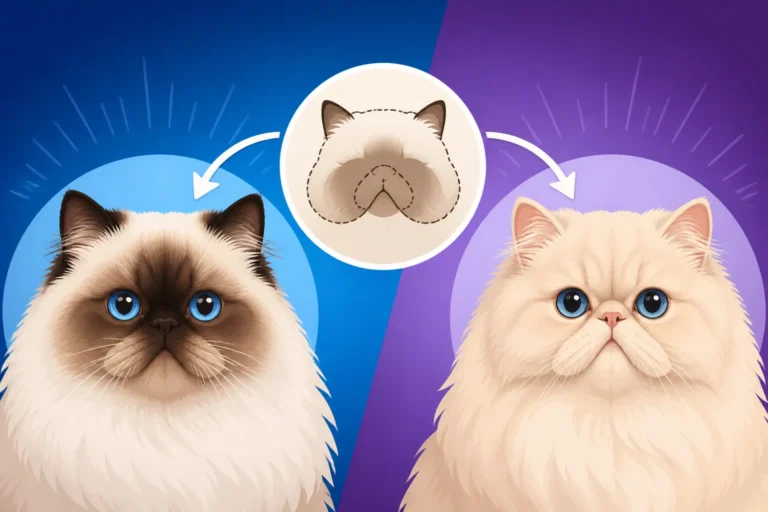
A Himalayan’s familiar pattern comes from colorpoint coloring. The fur is darker on cooler parts of the body—typically the face, ears, legs, and tail—while the warmer trunk stays lighter. The colorpoint gene affects pigment production in a temperature-sensitive way, so the contrast reflects where the cat’s body is cooler, not a set of white markings painted onto its paws.
That distinction matters when you look at the feet. A Himalayan’s paws are part of its points, so they generally carry the point color rather than a separate white “glove.” A seal point, for example, may have dark brown points that continue down the legs and over the feet. The exact shade and contrast vary with the cat’s point color, coat, age, and individual development. Why the Cold Parts of a Himalayan Grow Dark Fur
White gloves are a different kind of pattern: white areas on the feet that contrast with the rest of the coat. They are not a necessary part of being pointed. A cat can have a pointed pattern without white feet, just as a cat can have white paws without having Himalayan-style points.
A Birman combines points with white feet
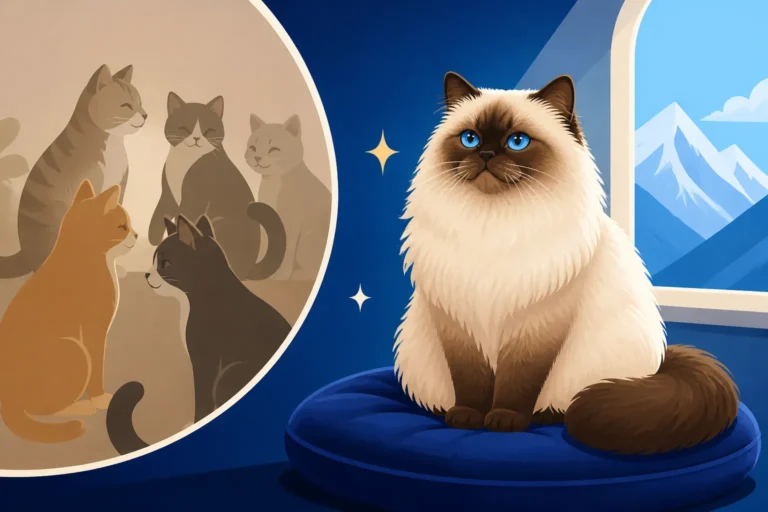
Birmans are also pointed cats, but their customary appearance includes white feet. The front paws are described as gloves, while the white on the back feet extends farther up the leg and is often called a gauntlet. Breed descriptions emphasize the shape and placement of those markings, so a Birman’s white feet are not simply an accidental contrast against its darker legs.
That combination can be confusing in photographs. A Birman may have a pale body and darker points much like a Himalayan, yet its white feet make a striking difference. The key is that the pointed coloring and the white foot markings are separate features. One does not automatically produce the other. Why a Birman Has White Gloves and a Himalayan Does Not
The genetic details behind the Birman’s characteristic gloves are not as simple as looking at a paw and naming a single gene. Breed-specific patterns can involve inheritance and careful selection across generations, and the exact biological explanation for the Birman’s gloves should not be reduced to “the point gene makes white feet.” The practical distinction is clearer: the Himalayan pattern calls for colored points, while the Birman’s traditional look includes white gloves and rear gauntlets.
Why the names can add to the confusion
People sometimes use “Himalayan” to describe a pointed cat broadly, especially when they are comparing pictures or searching for a kitten. Breed and registry terms are more specific, though, and they do not always line up across countries or cat organizations. In some settings, Himalayan refers to a particular Persian-type colorpoint cat; in others, related cats may be described under a Colorpoint Persian category. Why a Himalayan Is a Persian With the Point Gene
That naming overlap does not make the Birman and Himalayan the same breed, nor does it mean they should have identical markings. If you are assessing a particular cat, look at the whole pattern and the cat’s papers rather than relying on one feature in a photo. A pointed coat alone cannot tell you whether the cat is a Himalayan, a Birman, or another pointed breed or mix.
What the patterns look like in real life
A Himalayan’s feet usually match its points
On a Himalayan, the legs and feet are generally part of the colored point pattern. The paws may look darker than the body because they are farther from the warmer core, but they are not expected to have the Birman’s tidy, contrasting white gloves. The point shade depends on the cat’s color variety: a blue point has blue-gray points, while a seal point has much darker brown points.
Kittens can be especially hard to assess from a quick glance. Himalayan kittens are born very pale, and their points develop over time. A kitten’s paws may not yet show the full contrast an adult will have, so early photos can be misleading. Why Every Himalayan Kitten Is Born Almost White
Lighting also changes what you think you see. A pale paw photographed against a dark blanket may look white; a warm indoor bulb may make cream fur appear whiter or more yellow. Check the coat in daylight and compare the feet with the cat’s body and points before deciding that the cat has white gloves.
A Birman’s gloves have a recognizable placement
A Birman’s white markings are assessed by where they sit and how they appear on each foot. The front gloves are white on the paws, while the rear markings extend farther up the hind legs. Ideally, the white areas are distinct and balanced rather than irregular patches that climb unpredictably.
In everyday life, you do not need to judge a pet Birman against a show standard to understand the difference. The useful clue is that the white is a deliberate, characteristic part of the Birman’s appearance, not merely a pale area caused by lighting or a young kitten’s developing points. The pattern is meant to sit against darker legs and feet.
When comparing cats, look at all four paws, not only the front pair. A cropped photo may hide the rear gauntlets or make an ordinary white toe look like a full glove. A clear side view and a view of the underside of the paws can help, but a photograph is still not proof of breed identity.
White paws do not automatically make a Himalayan a Birman
A Himalayan may have a small white spot or a few white toes. That does not turn it into a Birman. White markings can appear as an individual variation, a nonstandard marking, or a sign that the cat is not a purebred Himalayan as described by a particular registry. The cat’s pedigree and breeding records are more informative than a single patch of fur.
Likewise, a cat with white feet and pointed coloring is not automatically a Birman. Other breeds and mixed-breed cats can have pointed coats, white paws, or both. The name of a coat pattern is not the same as proof of ancestry.
This is one reason it helps to separate three questions: What does the cat look like? What pattern is it showing? What breed or registration does its documentation support? A cat can be beautiful and beloved regardless of the answers, but the questions are not interchangeable.
| Feature | Himalayan | Birman |
|---|---|---|
| Main coat pattern | Colorpoint pattern with darker areas on cooler parts of the body | Colorpoint pattern combined with characteristic white feet |
| Typical feet | Colored as part of the points | White gloves on the front feet and longer white markings on the rear feet |
| Does the point pattern itself create white gloves? | No | No; the white feet are a separate feature |
| What to check in a photo | Whether the feet match the point color and whether the coat may still be developing | All four feet, especially the placement of the rear markings |
| What confirms breed identity | Reliable pedigree or registration details, not coat color alone | Reliable pedigree or registration details, not white paws alone |
Why a Himalayan’s standard does not call for Birman gloves
Breed descriptions preserve different looks
Breed standards describe the appearance expected for a particular breed or division. For a Himalayan, the focus includes the Persian-type body and coat, colorpoint pattern, and required blue eyes. White gloves are not a defining part of the Himalayan look. How the Himalayan Standard Divides Its Points
For a Birman, the white feet are part of the familiar breed identity. That is why a Birman’s gloves are not simply an optional decoration that happens to be common in some cats. The standard appearance distinguishes the Birman’s white feet from the Himalayan’s colored paws, even though both cats can have dark points and pale bodies.
Standards are written for describing and evaluating cats, not for deciding whether a pet is worthy of affection. A Himalayan with a small white marking may still be a wonderful companion. The marking may affect whether the cat fits a particular show description or registration category, but it does not change the care the cat deserves.
Point color and blue eyes are connected features
Himalayans’ blue eyes are closely associated with their colorpoint pattern. The same broad colorpoint inheritance that shapes where pigment appears is why the breed is recognized for blue eyes, rather than for white feet. Why Only Blue Eyes Are Allowed on a Himalayan
This can make the two patterns easy to mix up in people’s minds: both involve noticeable color contrasts, and both can appear on cats with pale bodies. But blue eyes and white gloves are not two parts of one marking system. A Himalayan’s blue eyes do not mean its paws should be white, and a Birman’s white paws do not explain its point color.
If a kitten’s eyes or points seem to change as it grows, that can be part of normal development. If you are worried about cloudiness, squinting, discharge, or a sudden change in vision, treat that as a health question rather than a coat-pattern question and contact a veterinarian. How Deep a Himalayan’s Blue Should Be
A show mismatch is not a health diagnosis
It is easy to hear terms such as “fault,” “mismatch,” or “nonstandard” and assume something is medically wrong. In cat shows, those words usually refer to how closely a cat’s appearance matches a written standard. A white toe on a Himalayan, by itself, does not diagnose illness.
The same goes the other way: a cat that looks exactly like a breed description is not guaranteed to be free of health concerns. Coat color and paw markings do not replace health records, appropriate veterinary care, or responsible breeding practices. If you are choosing a kitten, ask about health screening and veterinary history as well as appearance.
For prospective buyers, it is sensible to ask a breeder to explain the kitten’s registration, pedigree, and any markings that differ from the expected pattern. A responsible answer should be clear and consistent rather than relying on vague claims such as “rare gloves” to make an animal sound more valuable. What a Himalayan Buyer Should Ask About Registration
How to assess a cat with unexpected white paws
Start with a calm, thorough look
If you are trying to identify a cat from a photo or in person, look at the entire coat in natural light. Note the color of the face, ears, legs, and tail; compare the feet with the legs; and check whether the white is a few hairs, one toe, or a clearly defined area on each paw. A quick phone photo can make cream fur look white and dark fur look almost black.
For a kitten, remember that point contrast develops over time. Do not make a firm identification from pale paws alone. Ask for photos taken at different ages if you are evaluating a kitten’s developing coat, and look for details about its parents and littermates.
Do not try to “correct” a marking with dye, bleach, or whitening products. These can irritate skin or be unsafe if licked, and they cannot change the genetic pattern. If the paws are stained, irritated, swollen, or persistently damp, that is a grooming or health concern to discuss with a veterinarian—not a reason to alter the coat color.
Ask for documents rather than a confident label
A seller or breeder should be able to explain how the cat is registered and what the paperwork says. Registry terminology can vary, so read the breed line and ask what it means rather than assuming every certificate will use the same wording. The term “Himalayan” may be handled differently by different organizations. Why a Himalayan’s Papers May Never Say Himalayan
If white paws are being presented as a special Himalayan feature, ask what that claim means in the breeder’s program and whether the cat is being represented as a pet or as a show prospect. A striking marking is not, by itself, evidence of rarity, quality, or pedigree. Be cautious if someone uses unusual color claims to discourage basic questions about health, parentage, or registration.
For an adopted or rescue cat with unknown history, you may never be able to confirm breed with certainty from appearance alone. That is perfectly fine. You can describe the cat as a pointed, longhaired cat with white paws without assigning a pedigree label you cannot substantiate.
Keep coat care separate from coat identity
Himalayans and Birmans both have coats that may need regular attention, though coat texture and individual grooming needs vary. For a longhaired cat, gentle, consistent combing helps you notice tangles, debris, or skin changes early. A wide-toothed steel comb and a calm routine are more useful than trying to solve a mat by pulling at it.
If you are assembling basic supplies, Chewy is one place owners may browse for combs, shallow dishes, or other routine cat-care items; choose tools that suit your own cat and ask a groomer or veterinarian for guidance when needed. Chewy product listings can also help you compare the shape of grooming tools, but the right choice depends on the coat and the cat’s tolerance.
The daily routine should be based on the cat in front of you, not on a label. A Himalayan with white toes still needs the same patient coat care as another Himalayan, and a Birman’s white gloves do not require a special treatment to remain “correct.” For gentle face and coat care, use products intended for cats and avoid getting cleaners near the eyes. Chewy may offer cat-specific grooming supplies, but check product directions and ask your veterinary team before using a product on irritated skin.
If your cat resists combing, start with very short sessions and reward calm behavior rather than forcing a long grooming session. Chewy can be a convenient source for combs and other ordinary supplies, but no product replaces a slow introduction or professional help when mats are tight against the skin.
The simple distinction is this: a Himalayan’s paws generally carry the color of its points, while a Birman’s signature white gloves are a separate breed-associated marking. White feet on an individual cat may be a variation or a clue to mixed ancestry, but they do not establish breed on their own. Look at the full coat, the cat’s age, and reliable paperwork before drawing conclusions.
Disclaimer
This article is for general informational purposes only and does not constitute professional advice. Laws, prices and regulations vary by location and change over time. Consult a qualified professional for guidance on your specific situation.