What Ninety Years Have Done to the Himalayan’s Face
A Himalayan’s face can look dramatically different from that of an early cat of the same type: some have a visible nose and gentler profile, while others have a very short muzzle and a flattened face. That change reflects generations of selective breeding, shifting show preferences, and individual variation. Here’s what has changed, what hasn’t, and why facial shape matters for health as well as appearance.
How the Himalayan’s face developed
From a Persian and Siamese cross to a Persian-type face
The Himalayan was developed through planned crosses between Persian and Siamese cats. Breeders sought the Persian’s long coat and rounded, sturdy build alongside the Siamese colorpoint pattern: a pale body with darker fur on the face, ears, legs, and tail. The point pattern comes from temperature-sensitive pigmentation, not from a particular facial shape.
Over time, breeders selected cats that carried the desired coat, points, eye color, and body type. The Persian influence became especially important in the face. A Himalayan was expected to have the rounded head, full coat, and short muzzle associated with Persian type, although the degree of muzzle shortening has varied among cats and breeding lines.
The story is not as simple as “the first Himalayans had long noses and later ones became flat-faced.” Breeding populations are not uniform, and surviving descriptions or photographs do not provide a perfect record of every generation. Still, the Himalayan’s history is closely tied to changing ideas about the Persian face. The breed’s appearance developed alongside those preferences, rather than along a single, tidy path. For a broader look at the relationship between the two breeds, see Why a Himalayan Is a Persian With the Point Gene.
Why show preferences influenced the profile
Cat-show standards help define which features breeders aim to reproduce. When a standard prizes a rounded head, a short nose, and a particular profile, breeders may give more weight to those traits when choosing cats for future litters. Over many generations, that can shift the average appearance of a population, even though it does not make every cat look alike.
The Himalayan is judged according to Persian-type expectations in some registries, while other organizations handle it differently. That paperwork distinction can shape how a breeder describes a cat, but it does not change the cat’s anatomy. If you are comparing pedigrees or show descriptions, What a Persian Standard Asks of a Himalayan explains the kind of Persian features that may influence how a Himalayan is assessed.
Show selection is only one influence. Breeders also make decisions about health, temperament, coat, color, and the traits present in their particular lines. A face that looks more extreme in a photograph may not tell you how the cat breathes, eats, or copes with heat. If you are looking at kittens, ask about the parents’ faces and breathing, and try to see them in person when possible. A flattering front-facing photo can conceal the length and shape of the muzzle.
Why there is no single Himalayan face
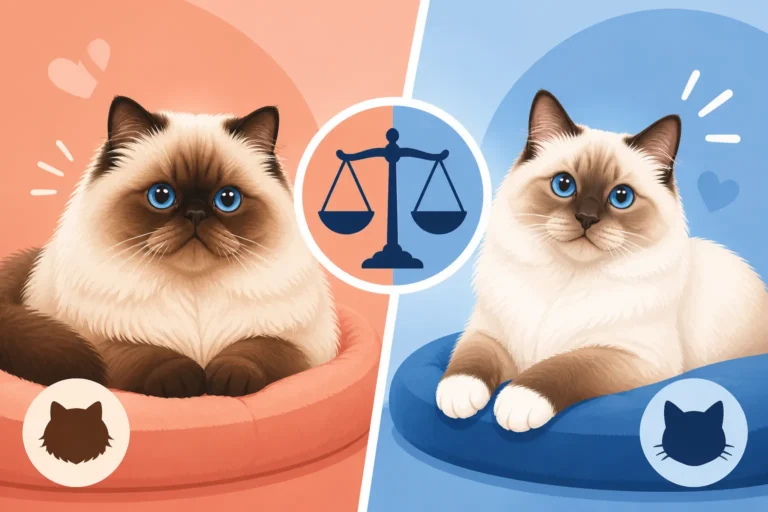
You may hear the terms “doll face” and “Peke face” used to describe different Himalayan profiles. They are informal labels people use to distinguish a more visibly muzzled face from a flatter, shorter one. They can be helpful shorthand, but they do not guarantee a cat’s health, breathing ability, or show eligibility.
A cat with a visible nose can still have an individual airway or dental concern, and a flat-looking face does not reveal the full structure inside the skull. Two cats may appear similar in a photo but differ in nostril size, jaw alignment, tear drainage, and soft-tissue anatomy. Profile and function need to be considered together.
If you are trying to understand what these labels mean in practice, compare What a Doll Face Himalayan’s Profile Measures with What a Peke Face Himalayan’s Profile Measures. The useful question is not simply which label applies, but whether the cat can breathe comfortably, close its mouth, eat without difficulty, and remain active without distress.
What changed and what stayed the same
The profile shifted through selection, not overnight
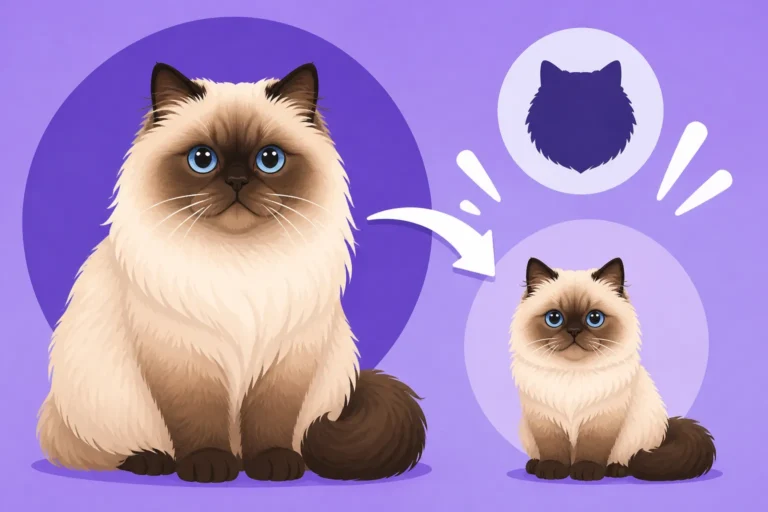
A breed’s appearance changes through repeated choices about which cats are bred. When breeders favor a particular head shape, that preference can become more common in a line over time. This is gradual, and different breeders may make different choices. As a result, Himalayan cats today do not all share one identical profile.
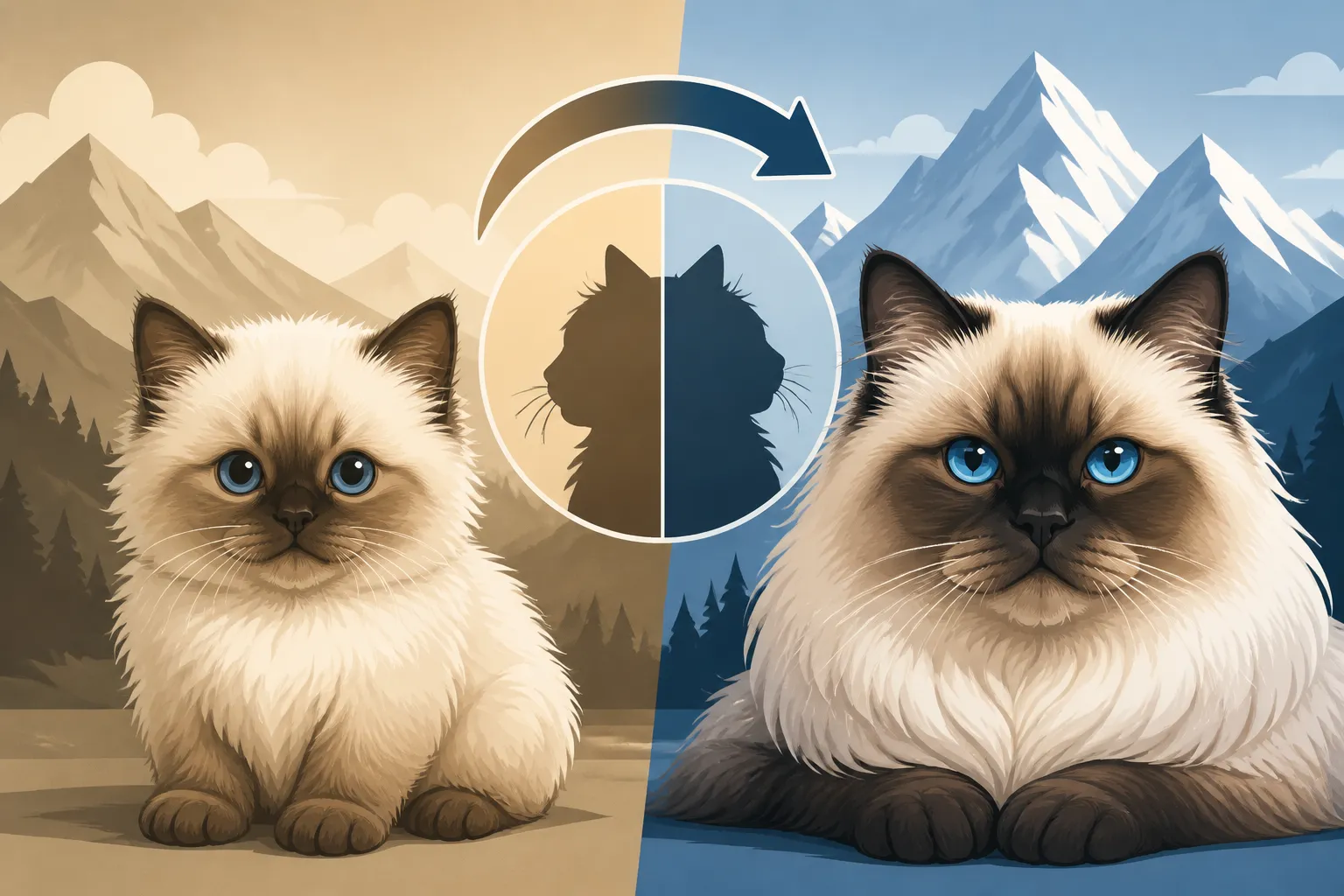
The flatter-faced look became more prominent in some show-oriented Persian-type lines. That does not mean every breeder pursued the same degree of facial shortening, or that all cats from earlier generations had a longer muzzle. Historical photographs can be useful, but they also vary in angle, lighting, age of the cat, and image quality. A side-by-side comparison can suggest a trend without proving exactly how every line changed.
For a closer look at the show influence, read Why Show Himalayans Drifted Toward the Flatter Face. The important distinction is between a change in the look breeders may select for and a claim that every Himalayan’s face has changed in the same way. Individual variation remains substantial.
The colorpoint pattern is separate from facial shape
The Himalayan’s points and its face shape are often discussed together because both are visually striking. But they are different traits. The colorpoint pattern is connected to temperature-sensitive pigment production, while facial structure reflects the shape and proportions of the head and the soft tissues around the nose and mouth.
This distinction matters when you are choosing or caring for a cat. A darker mask does not mean a flatter face, and a pale body coat does not indicate a particular airway shape. A kitten’s points can deepen as it grows, but the face should be assessed on its own. For an explanation of the relationship between temperature and color, see How Temperature Decides a Himalayan’s Point Color.
A breeder may talk about eye color, coat contrast, nose placement, or head shape as part of a kitten’s expected appearance. Ask them to explain each trait separately. If your priority is a cat that breathes comfortably, focus on what you can observe and what the breeder can tell you about the parents’ health—not just on coat color or a label used in an advertisement.
Face shape is more than a cosmetic detail
A shortened muzzle can be associated with crowded teeth, tear overflow, and reduced space in the upper airway. The degree of concern varies from cat to cat, and appearance alone cannot diagnose a problem. Still, facial shape is worth taking seriously because it can affect everyday tasks such as breathing through the nose, keeping the face clean, and chewing comfortably.
Some Himalayan owners become accustomed to snoring, noisy breathing, or watery eyes and assume these are simply part of the breed. A sound that is new, worsening, or paired with visible effort should not be dismissed as a quirk. A veterinarian can assess the nostrils and other parts of the upper airway; How a Vet Grades a Himalayan’s Nostrils describes one part of that evaluation.
The most urgent warning signs are signs of respiratory distress, including open-mouth breathing, pronounced effort, or a sudden inability to settle. Those symptoms call for prompt veterinary attention. For help distinguishing an emergency from ordinary breathing sounds, see When a Himalayan’s Open Mouth Breathing Needs a Vet. A routine exam is also a good time to raise concerns about persistent tear overflow, eye irritation, or difficulty eating.
How to assess a Himalayan’s face responsibly
Look at the cat in profile and at rest
A front-facing picture can make it hard to judge how far the nose projects or how the face is shaped. If you are visiting a breeder, look at the kitten and, if possible, its parents from the side. Observe the cat while it is relaxed rather than only during play or handling. Notice whether the nostrils appear open, whether the mouth stays closed comfortably, and whether breathing seems quiet and unforced.
A quick look is not a medical examination. A cat may appear calm for a few minutes and still have an issue that becomes obvious during activity or in warm weather. Ask how the parents behave after gentle play, whether they snore when awake, and whether they have needed veterinary care for breathing, eyes, teeth, or facial folds. Direct, specific answers are more useful than a general assurance that a particular face type is “fine.”
Do not press on the nose, try to open the cat’s mouth, or handle a kitten roughly to inspect its face. A breeder or veterinarian can show you relevant features safely. If you adopt an adult Himalayan, bring your observations to a veterinary appointment, especially if the cat has noisy breathing, frequent eye discharge, or trouble eating.
Ask about health across the family line
A kitten inherits more than its visible profile. Himalayan cats can be affected by conditions associated with their Persian and Siamese ancestry, and facial structure is only one part of a responsible health discussion. Ask what health screening has been done in the family, what issues have appeared in close relatives, and whether the breeder can provide records rather than relying on verbal descriptions.
It can help to approach the conversation as a set of practical questions:
- Do the kitten’s parents breathe comfortably while resting and after ordinary activity?
- Have either parent needed veterinary treatment for airway, eye, dental, or facial-fold problems?
- What health screening has been completed, and can you review the documentation?
- What signs should prompt a veterinary visit after the kitten comes home?
- Which registry will appear on the kitten’s paperwork?
The last question matters because registry terminology can differ, even when people are describing cats of a similar type. What a Himalayan Buyer Should Ask About Registration explains why those differences can cause confusion. For a wider view of inherited health questions, see Which Diseases a Himalayan Inherits From Each Parent Breed.
Choose function and comfort over an extreme look
It is understandable to be drawn to a particular appearance. People often fall for the round eyes, full cheeks, and dramatic colorpoint mask before they have met the cat. But a responsible choice should account for day-to-day comfort, not just how striking a face looks in a photograph.
When comparing kittens, look beyond a single feature. Consider whether the cat breathes quietly at rest, moves comfortably, eats without obvious difficulty, and has eyes and facial folds that can be kept clean. Ask what the breeder prioritizes when selecting cats. A thoughtful answer should include health and function, not only show appearance or rare coat traits.
If a seller discourages questions, will not let you see the kitten’s parents when that is reasonably possible, or treats obvious breathing difficulty as normal, take that seriously. You do not need to decide on the spot. A well-matched Himalayan is not simply the cat with the flattest face or the most dramatic mask; it is a cat whose needs and structure you can understand and support.
Caring for the face a Himalayan has
Keep the eyes and facial folds clean without irritation
Some Himalayans have tear overflow that leaves damp fur beneath the eyes. Regular, gentle cleaning can help keep the area comfortable, but persistent discharge, redness, swelling, squinting, or a noticeable change in one eye deserves veterinary attention. Avoid household cleaners, scented products, and anything that could get into the eye.
A simple routine works best when it is calm and consistent. Use a soft, clean material dampened with water or a product your veterinarian has recommended. Wipe gently, use a fresh area for each eye, and dry the skin afterward. If a facial fold stays damp, becomes irritated, smells unusual, or develops a sore area, ask a veterinarian to assess it rather than trying several products in succession.
For routine supplies, some owners compare options at retailers such as Chewy, but the label matters more than the store. Check that a product is intended for use around a cat’s eyes, and ask your veterinarian before applying anything to irritated skin. A product marketed for tear stains should not be used to mask a symptom that has not been evaluated.
Make food and water easy to reach
A shortened face can make some deep or narrow bowls awkward to use. A wide, shallow dish may be more comfortable for a cat whose whiskers or muzzle bump the sides of a bowl. Watch how your Himalayan eats: pushing food out, dropping it repeatedly, or seeming unable to pick it up may point to a bowl mismatch, but dental or jaw discomfort can also be involved.
Place food and water where the cat can reach them without stretching or struggling. Clean the chin and ruff if food or water gets trapped in the coat, and keep an eye out for redness or persistent dampness. If the cat’s eating habits change, or it suddenly avoids its usual food, arrange a veterinary check rather than assuming the bowl is the only issue.
If you are comparing dishes through Chewy or another retailer, focus on dimensions, stability, and ease of cleaning instead of claims that a bowl will correct a facial problem. A bowl can make mealtimes more comfortable, but it cannot treat dental crowding, airway obstruction, or other medical concerns.
Keep grooming gentle and predictable
A Himalayan’s long coat needs consistent care, and facial cleaning is easier when the cat is comfortable being handled. Start with brief, quiet sessions and reward calm behavior. If the cat pulls away, pause rather than turning grooming into a daily struggle. Forcing the routine can make future care harder for both of you.
Keep separate clean cloths for the eyes and other parts of the face. Avoid tugging at mats near the eyes or nose; if fur is tangled close to the skin, ask a groomer or veterinarian for help. Chewy may be one place to compare combs or basic grooming supplies, but choose tools that suit the cat’s coat and introduce them gradually.
A useful routine is one you can maintain without irritating the skin or frightening the cat. Check the face regularly, note changes in breathing or eye discharge, and bring concerns to a veterinarian early. The goal is not to make every Himalayan look identical. It is to help the individual cat stay comfortable in the face it has.
Disclaimer
This article is for general informational purposes only and does not constitute professional advice. Laws, prices and regulations vary by location and change over time. Consult a qualified professional for guidance on your specific situation.