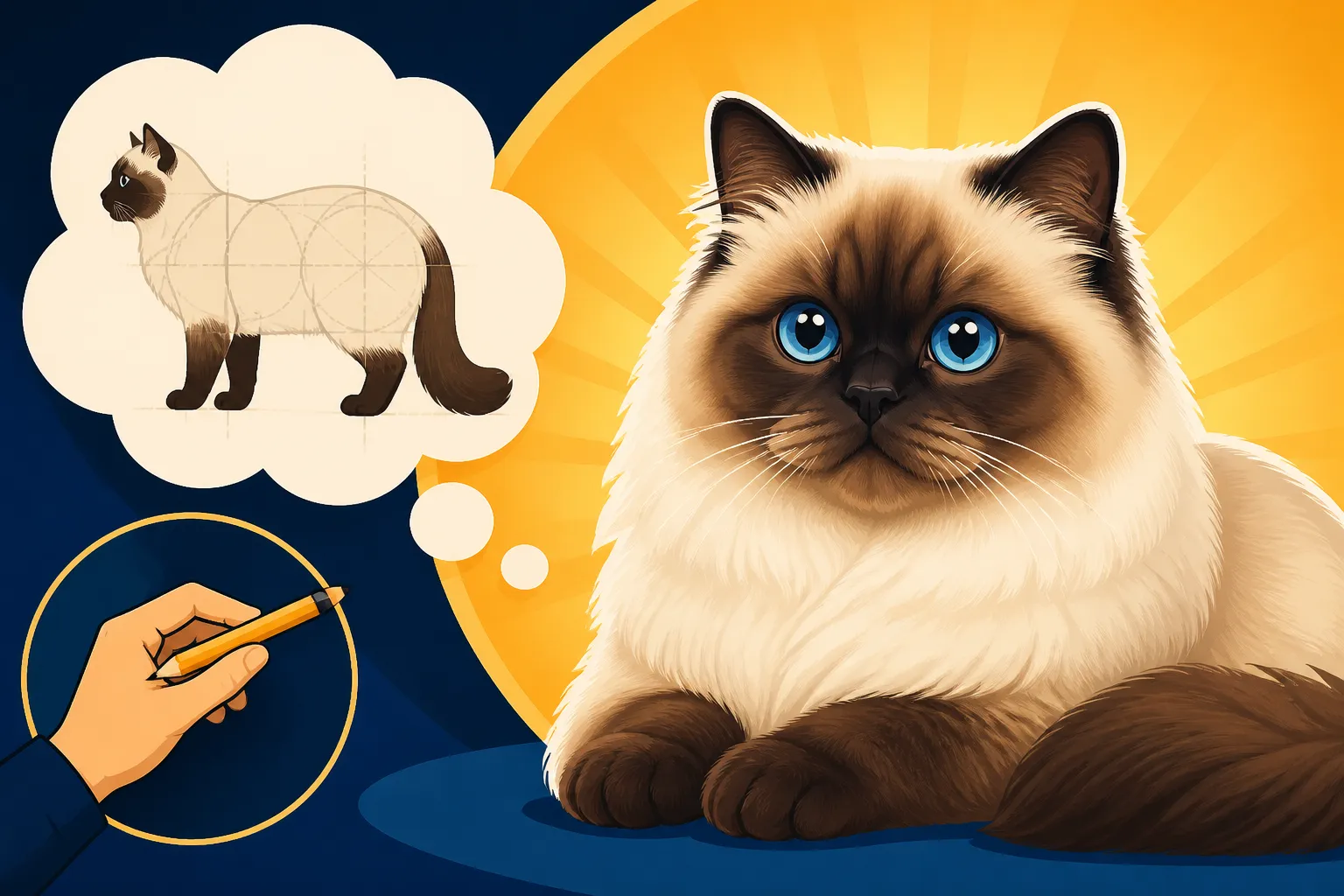
Whether the Himalayan Was the First Deliberately Designed Cat
A cat breed can be intentionally developed without being the first cat ever shaped by human choice. The Himalayan is a striking example: breeders planned crosses between Persians and Siamese cats, but the early work also served a scientific purpose. This guide separates the history of that experiment from the broader claim that the Himalayan was the first deliberately designed cat.
What “deliberately designed cat” can mean
Selective breeding came long before the Himalayan
People have influenced domestic cats through selective breeding for generations. They have chosen cats for traits they liked, such as coat color, body shape, temperament, or ability to thrive in a particular setting. Over time, those choices helped establish recognizable types and breeds. That history makes the phrase “first deliberately designed cat” difficult to defend: deliberate selection did not begin with one twentieth-century breeding project.
There is also a difference between selecting for a trait within an established population and setting out to produce a particular combination of traits through planned crosses. The Himalayan project is notable for the latter. Breeders worked toward a Persian-like cat carrying the Siamese colorpoint pattern, rather than simply noticing that a pointed kitten had appeared and building a line around it.
The word “designed” can make this sound more modern and more controlled than it was. Breeders could plan matings, observe the kittens, and select which cats continued in the program, but they could not guarantee that every kitten would have the intended appearance. Inherited traits do not follow a designer’s sketch. A planned breeding program means people deliberately chose parents and goals, not that they could dictate every result.
A planned breeding project is not the same as the first designed breed
The Himalayan is often described as a deliberately created breed because its development involved purposeful Persian–Siamese crosses. That is fair in a broad sense. But calling it the first deliberately designed cat makes a much larger historical claim, and the phrase has no single agreed definition. Does “designed” mean any human-directed breeding, a formal breed-development program, a planned cross between distinct breeds, or a project aimed at studying inheritance?
Those definitions produce different answers. If the term includes any intentional selection, cats had been shaped by people long before the Himalayan. If it means a documented, systematic cross intended to produce a defined type, the Himalayan’s early history is especially well documented—but that still does not automatically prove it was the first such effort anywhere.
It helps to separate three ideas: a cat’s appearance, the breeding program that produced it, and the purpose behind that program. The Himalayan’s distinctive appearance was deliberately pursued. The breeding work was systematic. But the early work was closely connected to studying how coat-color traits were inherited, not simply to creating a fashionable companion animal. The title Whether the First Himalayan Was Meant as a Pet explores that distinction in more detail.
What the early Himalayan project set out to do
The Persian–Siamese cross had a scientific purpose
In the 1930s, Virginia Cobb and Clyde Keeler worked on a planned cross between Persian and Siamese cats. The project examined inherited traits, including the colorpoint pattern associated with Siamese cats. The goal was not merely to make a cat that looked unusual. The cats provided a way to observe how certain visible characteristics appeared across generations.
That scientific context matters when judging the “designed cat” claim. The researchers were deliberately arranging matings and tracking results, which makes the project unusually purposeful. At the same time, it was not a modern laboratory process in which a precise outcome could simply be switched on. Breeders and researchers worked with inherited variation, selected animals, and repeated the process over generations.
The result that later became the Himalayan combined the Persian’s long coat and body type with the Siamese colorpoint pattern. The cross and its purpose are discussed in Why Harvard Crossed a Persian With a Siamese to Make the Himalayan and What Keeler and Cobb Were Studying When They Made the Himalayan. The original work is also part of the story behind The 1936 Paper That Started the Himalayan.
The familiar breed developed over time
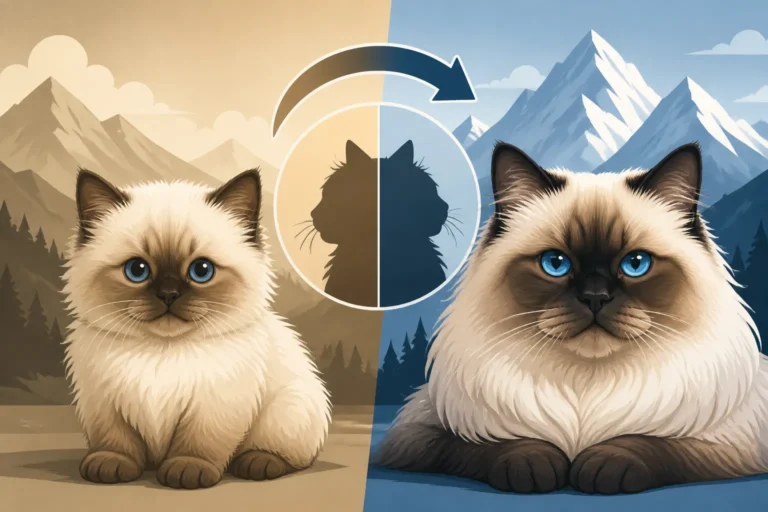
It is tempting to imagine that the modern Himalayan appeared fully formed from the first Persian–Siamese pairing. In practice, producing a consistent type takes time. A first-generation kitten may carry some desired traits but not all of them. Breeders must choose which offspring to mate, assess how traits recur, and continue selecting toward the appearance they want.
This is why the history of a breed is better understood as a process than as a single “creation” date. The planned cross began an important line of work, but the cat people recognize today emerged through subsequent breeding and refinement. The number of generations involved and the path from experimental crosses to a more established type are covered in How Many Generations the First Himalayan Took.
The eventual Himalayan was not only a coat pattern placed on a Persian. Breeders selected for an overall look, including a long coat, a rounded build, and a colorpoint pattern. Different registries later handled the cat’s classification in different ways, which can make the breed’s identity seem more settled—or more disputed—than its history actually is. The later registry story is not proof that the cat was or was not “designed”; it is a separate question about how organizations classify breeds.
Why the “first” claim is hard to prove
“First” depends on the definition and the evidence
Historical claims about the first deliberately designed cat run into two problems. First, “deliberately designed” is not a precise historical category. Second, written records of breeding practices are uneven. People may have selected cats for particular traits long before anyone recorded the process in a way that would satisfy modern standards of documentation.
The Himalayan’s advantage in this discussion is that its early development is tied to a known, documented research project. A written account can help explain what the people involved were trying to learn and how they approached the crosses. But strong documentation for one project does not establish that no earlier project existed. It tells us what is well recorded, not necessarily what was the first instance of intentional cat breeding.
A careful answer is therefore more useful than a dramatic one: the Himalayan was an early and well-documented example of a planned cross intended to combine specific traits, and its development had a clear scientific dimension. It is not safe to call it the first deliberately designed cat without defining “designed” and comparing the claim against the much longer history of human selection in cats.
| Claim | What can reasonably be said | What the claim does not prove |
|---|---|---|
| The Himalayan came from planned Persian–Siamese crosses | Its development involved deliberate matings aimed at combining recognizable traits | That no one intentionally bred cats before this project |
| Early work studied inherited traits | The crosses had a scientific purpose as well as a visible outcome | That the project was only a pet-breed design exercise |
| The Himalayan has a distinctive, selected appearance | Breeders worked toward a Persian-type cat with colorpoint markings | That every kitten could be bred to match a precise plan |
| The early project is documented | Its history is easier to describe than many older breeding practices | That documentation alone establishes it as the first |
Purposeful breeding does not mean complete control
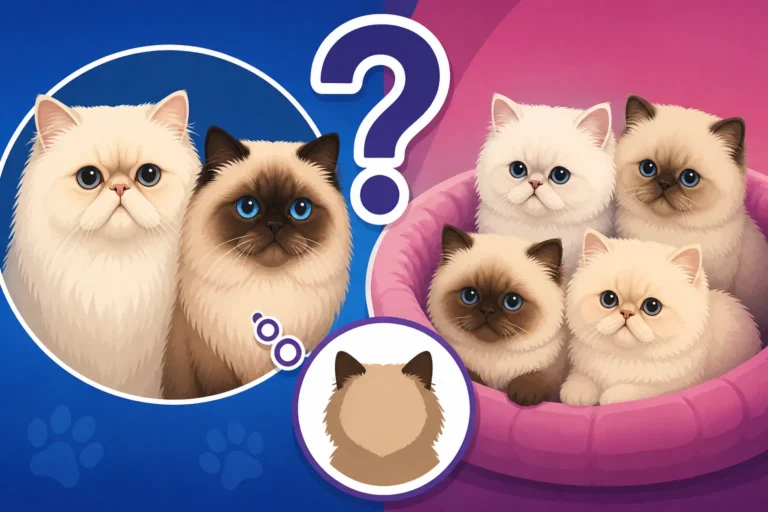
A planned breeding project can sound like a blueprint: choose two types, combine them, and produce the desired cat. Real breeding is less tidy. Parent cats pass on combinations of genes, and kittens from the same litter can differ. Some traits may be visible while others remain hidden and reappear later. Each generation gives breeders more information, but it does not make inheritance perfectly predictable.
That distinction is useful beyond the history question. When a breed is described as “designed,” it can imply that the animal’s traits were invented from nothing or that the breeders could control every health and structural outcome. Neither implication is accurate. The Himalayan’s traits came through inherited variation, and selection shaped which cats contributed to later generations.
The breed’s history also connects to a broader discussion of how coat genetics became better understood. For that angle, see What the Himalayan Proved About Coat Genetics. Its name, meanwhile, refers to a color pattern associated with other animals rather than proving any geographic origin in the Himalayan region; The Himalayan Is Named After a Rabbit explains that naming connection.
What the history means for Himalayan cats today
A breed’s origin does not settle its present-day classification
People sometimes use “designed” as shorthand for “not a real breed.” That does not follow. All breeds have histories, and many involve human choices about which traits to preserve. The Himalayan’s Persian and Siamese ancestry tells us how its characteristic combination developed; it does not make the cat imaginary or erase the breed identity recognized by breeders and owners.
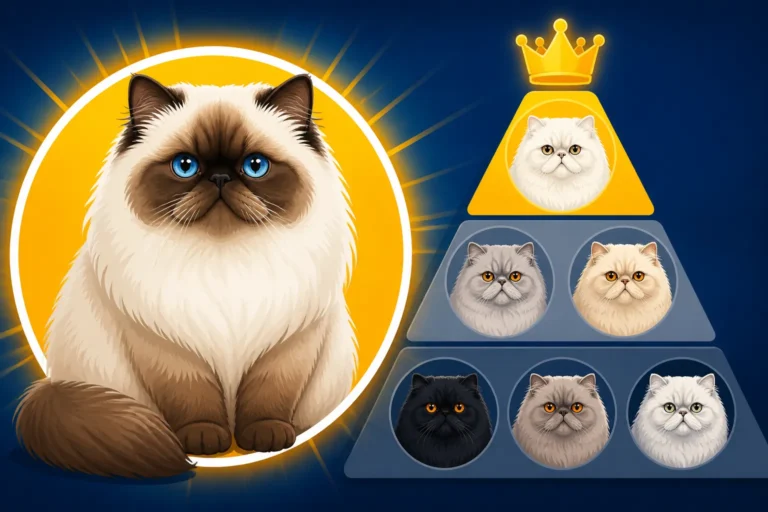
Registration can be confusing because organizations have not always treated the Himalayan in the same way. Some classify it as its own breed, while others place it within a Persian grouping or division. That paperwork difference is separate from the historical fact that breeders deliberately worked toward the Himalayan’s recognizable colorpoint Persian type. For more context, see Why the Himalayan Argument Is About Paperwork, Not Cats.
The breed’s look has also changed through continued selection. A modern Himalayan may not resemble every early cat in profile, coat, or overall type. Breed standards and breeder preferences can shift over time, so “the Himalayan” is not a frozen image from the 1930s. The changes in appearance are explored in What Ninety Years Have Done to the Himalayan’s Face.
Responsible ownership matters more than the “designed” label
For someone considering a Himalayan, the history is interesting, but it does not replace practical questions about care, health, and daily routines. A long coat needs regular combing, and the face may need gentle cleaning. Before bringing one home, ask how the kitten has been raised, what health screening has been done, and what grooming habits the breeder has already introduced.
A practical shopping frustration is that grooming tools are often marketed broadly, while a Persian-type coat needs a comb that reaches through the undercoat. Chewy’s product listings can be one place to compare comb styles, but check tooth spacing and handle comfort rather than choosing by a “cat brush” label alone. A slicker brush may smooth the topcoat without working through a developing tangle close to the skin.
The same care applies to bowls and face-cleaning supplies. At Chewy, product descriptions can help you compare shallow dishes and grooming items, but a product’s marketing language is not a substitute for checking whether its shape suits your individual cat. If tear discharge becomes heavy, the skin looks irritated, or the cat seems uncomfortable, ask a veterinarian rather than relying on wipes or stain removers.
Chewy can be useful for comparing routine supplies as you plan, especially if you are trying to assemble a grooming kit before a kitten comes home. Still, the more important preparation is learning how to introduce combing calmly and checking that the breeder has started handling the coat and face. That everyday experience says more about whether the care routine is manageable than the word “designed” ever could.
The fairest answer
The Himalayan was deliberately developed through planned Persian–Siamese breeding, and its early history is unusually connected to the study of inherited traits. That makes it a compelling example of a cat developed with a clear human purpose. But the Himalayan cannot confidently be called the first deliberately designed cat without a precise definition of “designed” and evidence that rules out earlier intentional breeding.
The most accurate phrasing is that the Himalayan was an early, documented, systematically developed cat type—not necessarily the first cat shaped by deliberate human choice. That answer preserves what is genuinely remarkable about the breed’s history without turning a complex record into a simple, unsupported “first.”
Disclaimer
This article is for general informational purposes only and does not constitute professional advice. Laws, prices and regulations vary by location and change over time. Consult a qualified professional for guidance on your specific situation.