What a Himalayan Weighs at One on a Persian Frame
Many first-time Himalayan cat parents often find themselves wondering if their precious feline friend is growing "just right," especially around that crucial one-year mark. It's a common concern because Himalayans have such a distinctive, cobby build, often inherited from their Persian lineage, which can make it tricky to eyeball their ideal weight. This guide will help you understand what a healthy, one-year-old Himalayan typically weighs, what influences that number, and how to assess if your beloved companion is thriving.
Understanding the Himalayan's Unique Persian Frame
It’s easy to look at a Himalayan and think they’re simply a fluffy version of a regular cat. But anyone who’s had the pleasure of living with one knows that their build is truly unique, largely thanks to their Persian ancestry. This "Persian frame" dictates a lot about their natural weight and body shape, leading to a perfectly healthy, substantial feline.
The "Cobby" Build and What It Means for Weight
When we talk about a Himalayan's "cobby" build, we're referring to a very specific body type that is characteristic of the Persian breed and, by extension, the Himalayan. Imagine a cat with a broad chest, a sturdy, well-muscled body, short, thick legs, and a generally rounded appearance. That's cobby! It’s not about being fat; it's about bone structure and musculature designed for substance and power, not for a lithe, slender look.
This dense, compact frame naturally means a Himalayan will carry more weight than a lean, athletic breed of similar height. New owners sometimes look at their one-year-old Himalayan and worry they're getting chunky, when in reality, they're just conforming to their breed's natural, sturdy build. It’s crucial to understand that their weight isn't just distributed along a long, elegant body; it’s concentrated in a compact, powerful form. You might be surprised at how much solid muscle and bone is packed under that glorious coat!
How Persian Genetics Influence a Himalayan's Stature
The Himalayan cat is, genetically speaking, a Persian with the colorpoint gene – the gene responsible for their stunning blue eyes and darker "points" on their extremities. This means that when we talk about their physical stature, we're talking about pure Persian genetics. From their robust bone structure to their dense musculature, everything about their build stems directly from their Persian side.
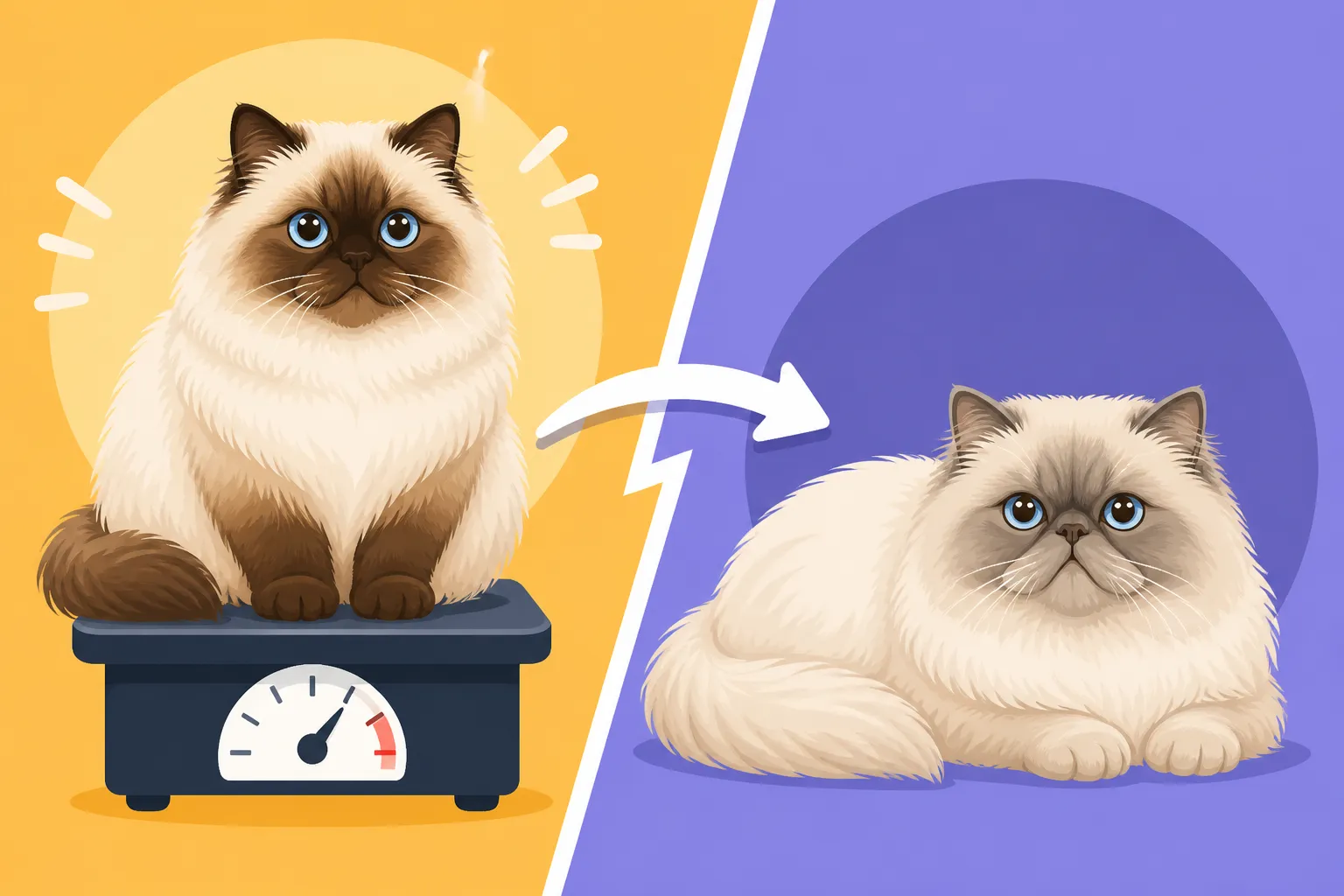
Persians are known for being substantial cats. They are not delicate creatures. This means your Himalayan is inherently built for substance, not for being petite or wispy. This is why male Himalayans are typically much heavier and more imposing than females, a common trait in many substantial breeds. At one year old, a male Himalayan will likely feel significantly heavier than a female of the same age, simply due to this genetic predisposition. To further complicate things for an owner trying to gauge weight, their incredibly dense, flowing coat makes them appear even larger and rounder than they truly are, often masking their actual body condition. It’s like wearing a huge, fluffy winter coat all the time – it adds visual bulk that isn't true body mass. It’s a common misconception, and understanding What a Persian Coat Makes a Himalayan Look Heavier can really help set expectations.
Typical Weight Ranges for a One-Year-Old Himalayan
When your Himalayan cat hits its first birthday, it’s a milestone! They're officially an adult, even if they still have some kittenish antics. At this age, you might be wondering if their weight is where it should be. While every cat is an individual, there are general ranges that can serve as a helpful guide.
Expected Weight for Males vs. Females
Generally speaking, you can expect a one-year-old male Himalayan to weigh somewhere between 9 and 14 pounds. Often, at their first birthday, they're already on the higher end of that range, as their growth spurts have largely concluded. Female Himalayans tend to be a bit daintier, typically weighing in at 7 to 11 pounds at the one-year mark. It’s important to remember that these are ranges, not rigid rules. Just like people, cats come in various sizes, and a healthy Himalayan could fall slightly outside these averages and still be perfectly fine.
For example, my own male Himalayan, Jasper, was a very solid 11 pounds at his first birthday. I remember thinking he was huge, but my vet assured me he was perfectly proportioned for his frame. He continued to fill out slowly, eventually reaching a stately 13 pounds by the time he was two. While their height and length growth might largely be completed by 12 months, many Himalayans will still "fill out" a bit, adding muscle and girth, up until they are two or even three years old. This isn't necessarily fat gain, but rather a maturation of their musculature and bone density, further solidifying their impressive presence.
When a Himalayan's Growth Plateaus
By the time your Himalayan celebrates its first birthday, much of its rapid growth in terms of skeletal size is behind it. They've likely reached their adult height and most of their length. However, it's not uncommon for them to continue to mature and "fill out" over the next year or two. This isn't about getting taller, but about developing more muscle mass and settling into their full adult proportions.
During this period, you might notice their coat becoming even thicker and more luxurious, and their point coloration continuing to deepen. How Long a Himalayan Takes to Finish Its Coat and Points is a common question, and it's interesting to note how their physical development ties into their appearance. This final stage of filling out might add an extra pound or two to their weight without indicating that they are becoming overweight. It's simply the natural progression of a cobby, substantial breed reaching its peak maturity. Keep an eye on their overall body condition, which we'll discuss next, rather than focusing solely on the number on the scale.
Factors That Influence Your Himalayan's Weight
Understanding your Himalayan's ideal weight at one year old involves more than just knowing a number. It's about recognizing the lifestyle, dietary needs, and genetic predispositions that all play a role in their overall physique. These factors can make a significant difference in whether your cat maintains a healthy weight or struggles with being a bit too heavy or too light.
Diet and Caloric Intake
One of the biggest factors influencing your Himalayan's weight is, predictably, what and how much they eat. Himalayans are generally known for their serene, laid-back demeanor. They're often content to spend their days napping in sunbeams or observing the world from a comfortable perch, rather than zooming around the house like some more high-energy breeds. This lower activity level means they simply don't burn as many calories. How Many Calories an Adult Himalayan Burns a Day is usually less than you might expect for such a substantial-looking cat.
It’s incredibly easy to overfeed a Himalayan, even slightly, which can quickly lead to unwanted weight gain. Those extra treats or a few too many kibbles add up fast when their metabolism isn't revving high. When choosing food, look for high-quality options formulated for indoor or less active cats. Fresh, pre-portioned meals can be a fantastic way to ensure your cat is getting precisely what they need without overdoing it. Alternatively, many reputable dry kibble options are available on sites like Chewy or Amazon, often with formulas specifically designed for weight management or for cats with lower energy needs. The key is strict portion control, measuring out their food accurately, and sticking to a consistent feeding schedule to prevent grazing throughout the day.
Activity Levels and Lifestyle
The typical Himalayan lifestyle is one of quiet elegance and comfortable leisure. They are not known for scaling curtains or performing acrobatic feats. They are, for the most part, content to be lap cats or sofa ornaments, preferring to watch the action rather than participate in it directly. How Little a Himalayan Asks For in a Day in terms of intense activity is often a surprise to new owners coming from more boisterous breeds.
Their indoor-only lifestyle, which is essential for their safety and the integrity of their magnificent coats, means that opportunities for vigorous exercise are limited. This isn't a bad thing, but it does mean owners need to be proactive about encouraging gentle play. Short, consistent play sessions with a feather wand or a laser pointer can help keep them moving, maintain muscle tone, and burn a few extra calories. Even five to ten minutes of interactive play a couple of times a day can make a big difference in preventing sedentary weight gain. Remember, their short legs and cobby bodies aren't built for marathons, so gentle encouragement is key.
Genetic Predispositions and Health
Beyond diet and activity, genetics play a significant role in your Himalayan's natural body type and propensity for weight gain or loss. Just like people, some cats are simply predisposed to be a bit larger or smaller within their breed standard, irrespective of their food intake. If you purchased your Himalayan from a reputable breeder, asking about the size and build of the kitten's parents can give you an excellent indication of what to expect for your own cat's mature size. This insight can help you understand if your cat is naturally on the larger or smaller end of the Himalayan spectrum.
While less common at just one year old, underlying health conditions can also impact a cat's weight. Changes in appetite or metabolism due to conditions like thyroid issues (more common in older cats) or even early kidney issues can affect their weight. This is why regular veterinary check-ups are so important, even for seemingly healthy young cats. Your vet can perform routine physical exams and, as they get older, blood work to ensure everything is functioning as it should. Keeping track of What a Himalayan's Yearly Bloods Should Cover After Eight becomes even more critical for long-term health monitoring. If you notice any sudden or significant changes in your Himalayan's weight, either up or down, it's always best to consult your veterinarian to rule out any health concerns.
Assessing Your Himalayan's Body Condition
When you're trying to figure out if your one-year-old Himalayan is at a healthy weight, simply relying on the number on the scale can be misleading, especially with all that glorious floof! A dense Persian coat can make even a perfectly proportioned cat look like a fluffy marshmallow. That's why veterinarians use a more comprehensive approach known as the Body Condition Score (BCS).
Beyond the Scale: The Body Condition Score
The Body Condition Score (BCS) is a universally recognized system that helps you assess your cat's fat reserves and muscle mass through visual observation and gentle palpation (feeling). It's a much more accurate way to gauge their health than just a number on the scale, particularly for breeds like Himalayans where their cobby build and voluminous fur can hide their true shape. The BCS typically ranges from 1 (emaciated) to 9 (severely obese), with 5 being the ideal.
To perform a BCS assessment, you need to feel for your cat's ribs, spine, and hip bones. It also involves looking at their overall silhouette, specifically the presence (or absence) of a waist. This method helps you determine if your cat is underweight, at an ideal weight, or carrying too much extra padding. Understanding Finding a Himalayan's Waist Under a Persian Ruff is key here – it's often more about feel than sight!
How to Feel for Ribs and Spine Under a Dense Coat
Feeling for your Himalayan's ribs and spine might sound a bit daunting given their thick coat, but it's a crucial part of the BCS assessment. Here’s how you do it:
First, gently run your hands along your cat's sides, just behind their front legs. You should be able to feel their ribs without pressing too hard, almost like feeling the knuckles on your hand when your palm is open and flat. If you have to really dig through a layer of padding to feel the ribs, your Himalayan might be carrying too much weight. Conversely, if the ribs protrude sharply and feel prominent with little to no padding, your cat might be too thin. An ideal condition means you can feel the ribs distinctively, but they have a thin, smooth layer of fat over them.
Next, move your hands along their spine, from their shoulders down to their tail. You should be able to feel the individual bumps of the vertebrae, but they shouldn't feel sharp or distinct like a row of beads. Again, a thin layer of muscle and fat should cover them. When you look at your Himalayan from above, even with their long fur, you should be able to discern a slight taper or "waist" where their abdomen tucks in, just before their hips. If they look like a continuous, unbroken cylinder, it might be a sign of excess weight. That dense coat can be incredibly deceptive, making a perfectly healthy, well-proportioned cat look much heavier than they actually are. It's why this hands-on approach is so vital.
When to Consult Your Veterinarian
If you've gone through the process of assessing your Himalayan's body condition and you're still unsure about whether they're at an ideal weight, or if you have any concerns at all, don't hesitate to reach out to your veterinarian. They are the ultimate experts and can provide a professional, unbiased assessment tailored specifically to your cat. They can help you interpret the Body Condition Score, weigh your cat on a calibrated scale, and discuss any concerns you might have.
There are significant health risks associated with both underweight and overweight cats. An underweight cat might be suffering from malnutrition, dental issues, or an underlying illness that needs to be addressed. On the other hand, an overweight Himalayan faces increased risks of joint problems, diabetes, and even exacerbated breathing difficulties, especially for those with a flatter face structure. Why a Cobby Himalayan Gains on a Portion Another Cat Burns is a very real concern, as their low activity levels make weight gain easy. Your vet can also help adjust their feeding plan, recommend specific prescription diets if necessary (which you can often find easily on Chewy, delivered right to your door), or suggest ways to increase their activity safely. For instance, a vet might recommend certain wet foods for cats with Which Bowl Shape a Flat Faced Himalayan Can Use and crowded mouths, as these are often easier to eat. A vet can be your best partner in ensuring your Himalayan lives a long, healthy, and happy life at their ideal weight.
Here’s a quick guide to understanding your Himalayan's body condition:
| Body Condition Score | Appearance (Visual) | Palpation (Feel) | Recommendation |
|---|---|---|---|
| Too Thin | Ribs, spine, hip bones easily visible/prominent. | No fat cover; bones sharp to touch. | Consult vet; increase caloric intake cautiously. |
| Ideal | Well-proportioned; visible waist (gentle tuck). | Ribs easily felt with slight fat cover; smooth spine. | Maintain current regimen. |
| Overweight | Rounded appearance; no discernible waist. | Ribs difficult to feel; heavy fat cover. | Reduce calories, increase gentle activity. |
| Obese | Abdominal distention; large fat deposits. | Ribs very difficult to feel; extensive fat cover. | Vet consultation, strict diet, structured exercise plan. |
Disclaimer
This article is for general informational purposes only and does not constitute professional advice. Laws, prices and regulations vary by location and change over time. Consult a qualified professional for guidance on your specific situation.