What a Himalayan’s Profile Should Look Like Side On
A Himalayan’s side profile can look dramatically flat in one photograph and noticeably softer in another, which makes it hard to tell what is normal. This guide explains the features to assess, how show standards and everyday variation differ, and when a short muzzle may be affecting a cat’s comfort rather than appearance alone.
What to look for in a Himalayan side profile
Start with the whole outline, not just the nose
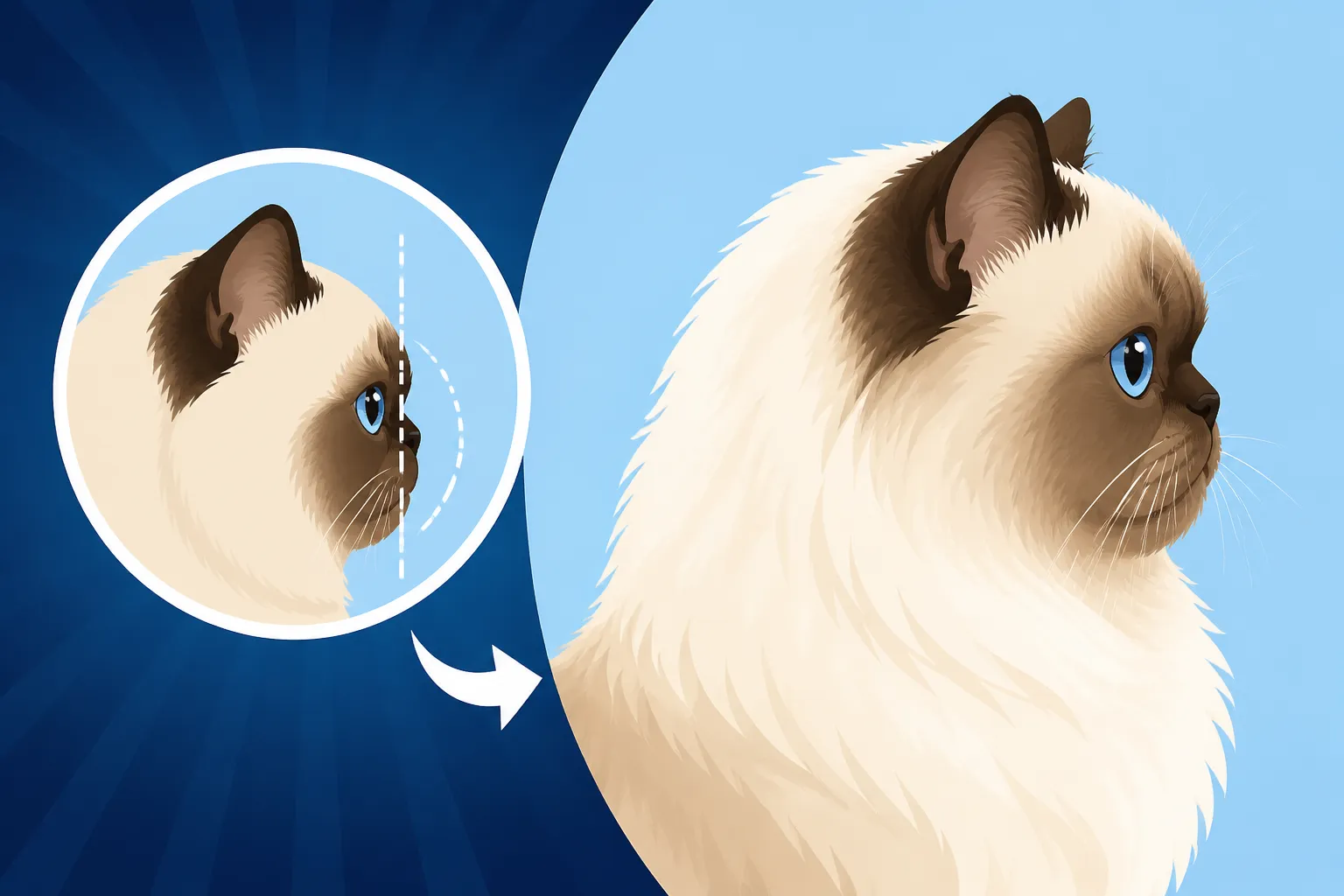
A side view is useful because it shows how the forehead, nose, muzzle, and chin relate to one another. A Himalayan is a longhaired, colorpoint cat developed from Persian and Siamese ancestry, and its head is generally expected to have the rounded, compact look associated with Persian type. The profile should be considered as a whole rather than judged by how far the nose projects.
Look at the forehead as it curves toward the nose, where the nose sits beneath the eyes, and how the lower face meets the chin. A short nose by itself does not tell you whether the profile is balanced. The proportions around it matter too: a very small-looking muzzle, a pronounced dip, or a chin that seems to sit far behind the nose can change the appearance substantially.
Coat can make this assessment trickier. A thick ruff and cheek coat may soften the visible outline, while a wet or recently groomed face may show the contours more clearly. If you are comparing photographs, try to use side-on images taken at a similar angle, with the cat looking straight ahead rather than lifting or lowering its head. A slight change in head position can make the nose look shorter or longer than it is.
Notice the nose break, muzzle, and chin together
The point where the forehead transitions into the nose is often called the break. In a Himalayan with a Persian-style profile, that transition is typically distinct rather than forming a long, straight slope from forehead to nose tip. Still, “distinct” does not mean that every cat should have an identical dip. The exact look depends on the individual cat and on which registry’s breed standard is being applied.
Next, notice the muzzle and chin. The lower face should be viewed in relation to the nose, not as an isolated feature. A chin that looks tucked back can contribute to an unbalanced profile, while a very compressed muzzle can make it harder to judge the mouth and jaw from a photograph. Breed descriptions and breeder language may not use these terms consistently, so it helps to ask for clear, unfiltered pictures from both the side and the front.
For more detail on how profile features are assessed, see What a Doll Face Himalayan’s Profile Measures and What a Peke Face Himalayan’s Profile Measures. Those terms describe commonly discussed profile types, but they are not a substitute for looking at the individual cat’s proportions, breathing, and overall comfort.
Use a consistent viewing angle
To assess a cat at home or compare a kitten with an adult, take a profile photo when the cat is calm and standing or sitting naturally. Keep the camera at roughly head height and avoid aiming upward from the floor or downward from above. A wide-angle phone lens held very close can distort proportions, so step back and use a modest zoom if available.
Try to include the forehead, nose, chin, and neck in the frame. A tight crop around the nose hides the relationship between the features. If the cat turns slightly toward the camera, one side of the face may appear more prominent; wait for a genuine side view rather than trying to hold the head in place.
Do not press on the nose, pull the lips back, or hold the cat’s head in an uncomfortable position to get a better look. A calm, brief observation is more useful than a forced pose. If a kitten becomes restless, stop and try again later. Handling should stay gentle, particularly around the face and eyes.
Breed standards and natural variation
Why standards do not make every Himalayan look identical
A breed standard describes the traits expected in a show cat; it does not mean every pet Himalayan will have the same profile. The Himalayan is treated as a Persian division by some registries and as a separate breed by others. The relevant standard can therefore depend on the registry and the setting in which the cat is being evaluated. For background, What the Persian Standard Asks of a Himalayan explains the Persian connection, while Why the Himalayan Is Named After a Rabbit is a separate look at the breed’s name and pattern.
Even within a litter, kittens can differ in head shape and the apparent depth of the nose break. Age, coat development, posture, and facial expression also affect what you see. A kitten’s proportions are still changing as it grows, so a very young cat’s profile should not be treated as a final adult result. When a Himalayan Kitten’s Face Finishes Developing covers why patience matters when evaluating a young Himalayan.
Show preference is another part of the picture. A show ring emphasizes conformity to the standard being used, while a family choosing a companion may put more weight on health, temperament, and fit with their household. Why Show Himalayans Drifted Toward the Flatter Face explores how show preferences have influenced the look people associate with the breed.
Doll face and peke face are descriptive labels
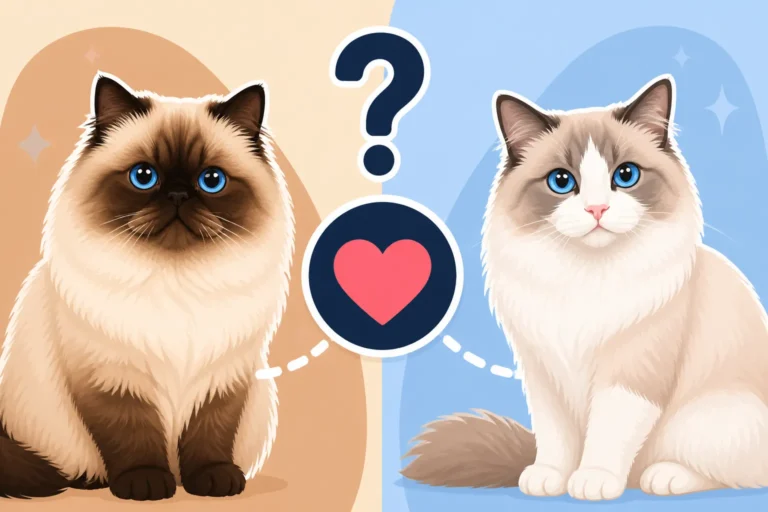
People often use “doll face” for a Himalayan whose nose appears more prominent and whose profile looks less compressed, and “peke face” for one with a flatter-looking profile. These labels can be helpful shorthand, but they are not precise measurements. Two breeders may use the same label differently, and a kitten described one way may look different as its head and coat mature.
If a breeder uses either term, ask what they mean in practical terms. Request a natural side photograph, a front view, and a short video showing the kitten resting and breathing. Ask whether the kitten’s parents have similar profiles and whether the breeder has discussed any breathing or eye concerns with a veterinarian. Good questions focus on the actual cat, not on the label alone.
A comparison can help keep the terms in perspective:
| Feature to assess | What to observe | What not to assume |
|---|---|---|
| Forehead and nose | Whether the transition is clearly visible and balanced with the rest of the head | That a deeper-looking break automatically means a healthier or better profile |
| Nose and muzzle | How the nose sits in relation to the muzzle and chin | That the shortest nose is the ideal choice for every home |
| Chin | Whether it appears aligned with the lower face rather than markedly recessed | That a photo alone can establish jaw function |
| Breathing | Whether breathing appears quiet and comfortable at rest | That snoring or noisy breathing is harmless because the cat is flat-faced |
| Overall expression | Whether the features look balanced from the side and front | That coat fullness or camera angle accurately shows bone structure |
For a wider comparison of facial types, How to Tell a Himalayan From a Persian and Why the Himalayan Is a Persian With the Point Gene can help explain why the two are so closely related in appearance.
Keep appearance separate from health
A profile photograph can describe appearance, but it cannot diagnose airway function. If a Himalayan has persistent noisy breathing, struggles during ordinary activity, breathes with its mouth open, or seems unusually distressed in warm conditions, contact a veterinarian. A cat’s individual history and examination matter more than a label like doll face or peke face.
It is also worth paying attention to the nostrils. From the front, notice whether they appear open rather than pinched, but do not try to grade them yourself from a single image. A veterinary professional can assess the nose and breathing in context. The article How a Vet Grades a Himalayan’s Nostrils explains why a clinical assessment is different from simply judging a photograph.
How to assess a kitten or adult cat responsibly
When choosing a kitten, ask for evidence rather than promises
If you are considering a Himalayan kitten, ask the breeder for current pictures of the kitten and its parents, including side and front views taken in ordinary light. A quick video of the kitten resting can offer useful context, although it cannot replace an in-person assessment or veterinary check. Avoid relying on heavily edited images, extreme close-ups, or photos where the cat’s head is tilted.
Ask about the kitten’s routine veterinary care and whether any concerns about breathing, eyes, or facial structure have been noted. A responsible conversation should leave room for honest answers. If every question about the kitten’s face is redirected toward show terminology or color, bring the discussion back to comfort and health.
You can also ask how the breeder distinguishes a kitten’s current appearance from its likely adult profile. A young cat may change as the head matures and the coat fills out. For a focused look at one practical feature, read How to Judge a Himalayan Kitten’s Nostrils at Twelve Weeks. It is still only one part of evaluating the whole kitten.
Make a simple, repeatable observation
You do not need special equipment to make useful observations. Choose a calm moment, let the cat settle, and look from the side and front without restraining it. Note whether the breathing sounds easy at rest, whether the cat can close its mouth comfortably, and whether normal movement seems to trigger obvious distress. These observations are not a diagnosis, but they can help you describe a concern clearly to your veterinarian.
If you are documenting a change over time, take photographs from the same distance and angle. Write down the date and any relevant context, such as whether the cat had just been playing or had been sleeping. Comparing a relaxed resting photo with one taken immediately after activity can be misleading, so keep the circumstances as similar as possible.
For routine handling, a stable, nonslip surface can make a short visual check less stressful. If you need basic grooming supplies or a mat, retailers such as Chewy may be one place to look; choose equipment that is easy to clean and appropriate for your cat’s size. The important part is not the brand or setup, but allowing the cat to move away and keeping the check brief.
Know when to involve a veterinarian
Some features that look unusual in a photograph may simply reflect angle, coat, or individual variation. But changes in breathing, repeated eye watering, discharge, or obvious difficulty eating deserve more than a profile comparison. A veterinarian can examine the cat’s face, eyes, teeth, and airway and consider its full health history.
Seek prompt veterinary guidance for open-mouth breathing, labored breathing, sudden worsening of noisy breathing, or signs of distress. Do not wait for a better photograph or try to solve a breathing problem with home grooming products. If you have noticed a persistent concern, a short video recorded from a comfortable distance may help you explain what happens, but it should not delay care.
For everyday grooming, gentle handling and suitable tools matter because long facial hair can obscure the area you are trying to observe. Chewy and other pet retailers carry general grooming supplies, but avoid putting products near the eyes or nostrils unless your veterinarian has confirmed they are appropriate. If you are unsure whether a stain, odor, or discharge is ordinary, ask the clinic rather than treating it as a cosmetic issue.
Common profile-reading mistakes
Treating “flatter” as a complete quality measure
A flatter-looking face may be closer to a particular show ideal, but it does not by itself tell you whether the cat is healthy, comfortable, or a good match for your home. Conversely, a more visible nose does not guarantee that a cat has no airway issues. Health and appearance are related in some ways, but one photo cannot establish the full picture.
It is more useful to assess several things together: facial balance, nostril appearance, breathing at rest, comfort during gentle activity, and the cat’s veterinary history. If you are choosing a kitten, ask about the parents as well as the kitten. If you already live with a Himalayan, focus on what is normal for that cat and pay attention to meaningful changes.
Assuming one photograph tells the whole story
Lighting, camera distance, head tilt, coat length, and facial expression can all affect how a Himalayan’s profile appears. A photo taken from below can make the nose seem higher; a close phone image can exaggerate the central features; a full ruff can make the muzzle look smaller. These are ordinary photographic effects, not reliable evidence of a particular type.
When comparing cats, look for multiple views and ask how each image was taken. A seller or breeder who provides only one polished angle may simply be sharing a flattering picture, but you still need more information to make a thoughtful decision. Ask for natural images and calm video, and keep your expectations realistic: an image is a starting point for questions, not a substitute for examining the cat.
Confusing routine care with a substitute for medical advice
Wiping a face or keeping facial hair tidy can make it easier to see the skin and eyes, but grooming does not correct a structural breathing concern. If the cat’s nose fold stays damp, develops a persistent odor, or looks irritated, contact a veterinarian. The same applies to repeated eye discharge or a sudden change in how the cat breathes.
It can be tempting to focus on cosmetic fixes, especially when stains or a wet face are visible in photographs. But a Himalayan’s comfort should come before achieving a particular look. Keep observations simple, avoid unapproved products near the eyes and nose, and share specific examples with your veterinarian. A well-considered profile assessment includes the face you can see and the way the cat functions day to day.
Disclaimer
This article is for general informational purposes only and does not constitute professional advice. Laws, prices and regulations vary by location and change over time. Consult a qualified professional for guidance on your specific situation.