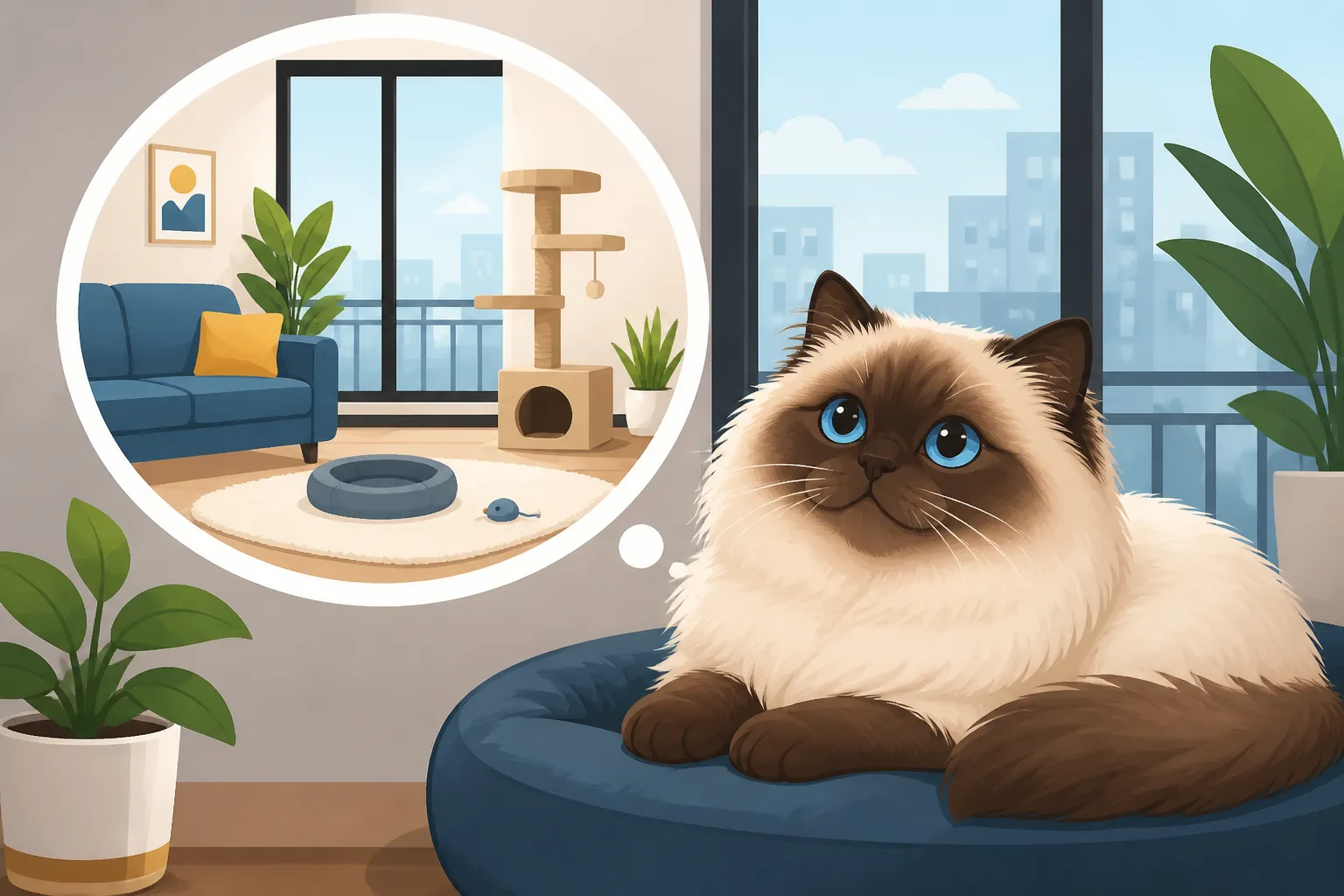
Why an Apartment Suits a Himalayan
A Himalayan can be a good apartment cat because it often prefers a comfortable chair, familiar people, and a predictable indoor routine to roaming outdoors. But a small home is not automatically an easy home: this longhaired, flat-faced cat still needs daily grooming, room to move, and careful attention to heat and breathing. Here’s how to make apartment life work well for both of you.
Why a Himalayan can fit apartment life
A smaller home can suit a cat that prefers familiar comforts
Himalayans are often content to spend time near their people, settle into a favorite spot, and watch household life unfold. They don’t usually need a large yard or a tall climbing setup to feel occupied. In an apartment, a sunny patch, a broad sofa, and a few low, sturdy places to rest may matter more than square footage.
That doesn’t mean every Himalayan is quiet or inactive. Individual cats vary, and a Himalayan may still ask for play, companionship, and attention. The advantage is that you can meet many of those needs indoors without building an elaborate cat gym or arranging outdoor access. A window perch or a comfortable chair near a window can make a small home feel more interesting.
A steady routine can also be reassuring in close quarters. Keep meals, grooming, and play around familiar times where possible. If you work in a small apartment, set aside a cozy resting area away from the busiest part of the room. For more on this breed’s preferred home environment, see Why an Apartment Suits a Himalayan is not available as a link here, but related guidance appears in The Household a Himalayan Was Effectively Bred For.
Indoor living avoids several outdoor hazards
For a Himalayan, apartment living often makes it easier to keep the cat safely indoors. The breed’s long coat can collect dirt and debris, and its shortened face can make heat and strenuous activity harder to manage. Outdoor roaming adds risks such as traffic, unfamiliar animals, parasites, and sudden changes in weather. A secure indoor routine removes many of those variables.
Indoor doesn’t have to mean unstimulating. Rotate a few toys rather than leaving every toy out all the time. A short wand-toy session, a food puzzle the cat can comfortably use, or a perch that looks onto a quiet courtyard can provide variety without demanding a large room. Watch your cat’s breathing and energy as you play, and pause if it seems uncomfortable or starts breathing with its mouth open.
If you’re considering a balcony, treat it as an area that needs secure screening, shade, and supervision—not as a substitute for a safe indoor environment. A cat can slip through surprisingly small gaps, and a railing alone is not protection. The same caution applies to open windows, particularly in upper-floor apartments. Read Why a Himalayan Must Never Be an Outdoor Cat for more on keeping this breed safe.
A calmer household can be a better match than a bigger one
Apartments are not all alike. One may be quiet and predictable; another may have hallway noise, frequent visitors, and a dog that barks whenever the elevator opens. A Himalayan that enjoys routine may find the second setting more challenging than a larger home with a calmer rhythm.
Give your cat somewhere to retreat when the doorbell rings or guests arrive. This might be a bed in a bedroom, a covered resting nook, or a familiar chair in a quieter corner. Make sure the retreat stays available rather than turning it into storage or a passageway. Children and visitors should be encouraged to let the cat approach them instead of reaching into its resting spot.
If you share walls, consider how sound travels. A Himalayan may vocalize to get attention, and a new home can bring a period of extra calling while it settles in. Keep basic routines consistent, and avoid scolding for ordinary communication. How a Himalayan Asks Without Raising Its Voice explores the breed’s quieter ways of asking for attention.
Set up an apartment around the Himalayan’s needs
Choose low, stable routes instead of tall climbing furniture
A Himalayan often does better with accessible resting places than with a very tall, narrow cat tree. Its sturdy build and shorter legs can make broad platforms, low steps, and stable furniture easier to use. A sofa with a nearby step or a waist-high cat tree can give the cat a little height without making every climb a major jump.
Think about the routes your cat uses each day. Can it get from its bed to the sofa without leaping onto a slippery surface? Is its favorite window spot reachable without climbing over a cluttered desk? As a Himalayan gets older, arthritis or reduced mobility may make these small routes more important. A step that seems unnecessary when your cat is young can become a welcome option later.
Avoid placing a perch beside an open window or an unsecured balcony door. Also check that shelves and furniture are stable before inviting the cat to use them. For ideas tailored to this breed’s movement and build, see Why a Cobby Himalayan Needs Wide Platforms, Not Tall Ones and Why a Himalayan Uses Steps Rather Than Jump.
Make room for grooming and face care
The apartment may be compact, but grooming supplies need a convenient home. A comb, cloths for face care, nail clippers, and any products recommended by your veterinarian are easier to use when they’re together and easy to reach. Chewy can be one place to look for routine pet-care supplies, but check that any product is suitable for your cat and follow veterinary guidance around the eyes.
Daily combing is important because a Himalayan’s long coat can tangle, especially where the legs meet the body, under the arms, and around the britches. A short, calm session is often easier than waiting until the coat has formed a difficult mat. If your cat resists, try a stable surface and brief pauses rather than holding it down for a long grooming session.
Face care also matters. Tear tracks and damp folds can irritate the skin if they are left dirty or wet. Use a soft cloth and gentle handling, and ask your veterinarian what is appropriate if the skin looks red, sore, or unusually smelly. The Daily Comb a Himalayan Cannot Skip and The Morning Face Routine Every Himalayan Needs offer more detailed care guidance.
Place food, water, and litter where the cat can reach them easily
A small floor plan can make a litter box, food bowl, and water bowl feel crowded together. Whenever possible, give each resource its own usable space. Keep the litter box away from the feeding area, and choose a location the cat can reach without squeezing past a noisy appliance or a frequently opened door.
For a flat-faced cat, a wide, shallow dish can be more comfortable than a deep, narrow bowl. Watch how your Himalayan eats and drinks: if food gets pushed out, the whiskers press against the sides, or the cat seems to struggle to reach the contents, try a different shape. Chewy carries a range of pet bowls and litter supplies, but the best choice is the one your cat can use comfortably and your space can accommodate.
The litter box should be large enough for your cat to turn around in, with an entry that is not unnecessarily difficult to step over. Long coat can pick up litter, so a mat outside the box may help contain loose pieces. If the cat stops using the box, don’t assume it is being fussy; discomfort, stress, or a medical problem can be involved. Why a Himalayan’s Box Needs a Cutaway Front and Which Bowl Shape a Flat Faced Himalayan Can Use cover useful setup considerations.
| Apartment feature | What usually helps a Himalayan | What to watch for |
|---|---|---|
| Resting areas | Broad, stable chairs and low platforms | Narrow shelves or tall jumps |
| Windows | A secure view with a comfortable perch | Unscreened openings or direct heat |
| Grooming station | Supplies stored together in a calm spot | Long sessions that lead to resistance |
| Food and water | Accessible, shallow dishes | Deep bowls that make eating awkward |
| Litter area | A reachable box with clear space around it | A high entry or a noisy, busy location |
| Play | Short indoor sessions and easy-to-follow toys | Overexertion, panting, or distress |
Manage heat, noise, and daily activity
Keep the apartment comfortable without overheating the cat
A Himalayan’s dense coat and shortened face make temperature management worth taking seriously. An apartment can heat up quickly, especially in a sunny top-floor unit or a room with large south-facing windows. Provide access to a cooler area, fresh water, and shade. Don’t leave the cat in a hot room or assume that a fan alone makes an overheated space safe.
Notice how your cat behaves as the temperature rises. Seeking cool tile, becoming unusually quiet, or abandoning play may be a sign to make the room more comfortable. Open windows only when they are securely screened, and be cautious with balconies, even if the cat usually stays close to you. If you’re unsure whether a change in breathing or energy is serious, contact a veterinarian rather than trying to assess it from appearance alone.
Fans, air conditioning, and shaded resting spots can help keep an indoor environment comfortable, but no single setup suits every apartment. Pay particular attention to rooms that trap heat, such as enclosed sunrooms. Why a Himalayan Struggles in a Warm Climate explains why this breed can find hot conditions especially challenging.
Give the cat small, regular chances to play
Himalayans may not need vigorous exercise for long stretches, but they still benefit from movement and interaction. Try a few short play sessions across the day, using a wand toy or a toy that moves slowly enough for your cat to follow. Leave room for the cat to stop, observe, and choose whether to join in. A brief, enjoyable session is better than pushing a cat that is already tired.
In an apartment, you can build activity into ordinary routines. Move a toy from the living room to a hallway, or offer a small food puzzle in a safe spot. Make sure any puzzle feeder is physically easy for your cat to use; a very narrow opening may be frustrating for a flat-faced cat. Chewy may help you find general enrichment supplies, but inspect the design and watch your cat try it before making it part of the routine.
Learn your cat’s normal pace. Some Himalayans enjoy chasing a toy; others prefer watching it and batting at it from a comfortable spot. End play if your cat seems distressed, begins panting, or has trouble catching its breath. Why a Himalayan Stops Playing When It Gets Warm and Which Toys Get a Himalayan Off the Sofa provide further ideas for safe indoor activity.
Help the cat settle into apartment sounds and changes
Apartment life often involves sounds that are hard to control: footsteps in the hall, a neighbor’s television, plumbing, or a delivery at the door. A Himalayan may need time to adjust, particularly after a move. Give it a familiar bed, food and water in predictable places, and a quiet room where it can retreat while it learns the new layout.
When you first bring a Himalayan into an apartment, resist the urge to introduce the whole home at once. Start with one comfortable room, then let the cat explore more of the space at its own pace. Keep the litter box and other familiar items easy to find. If you rearrange furniture, try not to change every key resource location at the same time.
Routine can be especially helpful when apartment life gets busy. If you expect maintenance workers or visitors, make sure your cat has a secure place away from the open front door. For a detailed look at this breed’s adjustment period, see How Many Weeks a Himalayan Takes to Accept a New House and How a Himalayan Reacts When Its Routine Breaks.
Decide whether your apartment is the right fit
Ask whether you can meet the daily care needs
The most useful question is not simply, “Is my apartment big enough?” It’s whether your home and schedule allow you to meet the cat’s daily needs. Can you make time for coat care? Is there a safe place to keep the litter box? Can you maintain a comfortable temperature and provide some company and gentle play?
A Himalayan may suit a smaller home well, but coat maintenance can be demanding for someone who travels often or works long hours away from home. If you regularly leave for several days, arrange a reliable caregiver who understands the grooming routine, feeding schedule, and signs that should prompt a call to the veterinarian. It’s worth teaching a sitter the cat’s usual habits rather than assuming any pet sitter will know what to watch for.
Consider your own mobility and comfort, too. Grooming a longhaired cat can involve repeated handling and bending, and supplies need to be stored somewhere practical. Choosing an apartment-friendly cat is not only about floor space; it’s about whether the whole routine is manageable for years.
Look at the building as well as the apartment
Before bringing a cat home, review your lease or building rules and make sure you understand any pet requirements. Check for practical details, too: Are there safe screens? Does the entrance open directly onto a busy corridor? Can a litter box fit in a quiet, ventilated area? Is there a nearby veterinary clinic you can reach without a complicated trip?
A first-floor apartment near a busy street can present different safety concerns from a quiet upper-floor unit, but upper floors need secure windows and balcony protection. Think through what happens during maintenance visits, fire alarms, or a move. A carrier should be easy to access, and your cat should have a familiar place to hide while activity is going on.
If you want a cat that can safely enjoy outdoor air, consider whether you can provide a properly enclosed, shaded space and supervise its use. Never rely on an ordinary balcony railing or an open window. The goal is not to make the apartment resemble a large house; it is to make the available space safe, comfortable, and predictable.
Weigh apartment living against the breed’s other needs
A Himalayan can be a lovely apartment companion for someone who wants a gentle, people-oriented indoor cat and is prepared for regular care. It may be a poor match if you want a pet that can roam freely, manage its coat with little help, or tolerate long stretches without interaction. A quiet home helps, but the cat still needs attention, suitable play, and ongoing health care.
Think about the life you actually lead rather than the home you hope to have later. If your apartment is small but stable, cool, and thoughtfully arranged, it can work very well. If it is hot, noisy, full of unsafe openings, or difficult to keep clean around grooming and litter, adding more square footage elsewhere may not solve the real problem.
For a broader comparison of this breed’s temperament and household fit, see Who the Himalayan Actually Suits and What Nobody Tells You Before Buying a Himalayan. The right apartment is less about having a particular number of rooms and more about creating a safe routine that respects the Himalayan’s coat, face, comfort, and individual personality.
Disclaimer
This article is for general informational purposes only and does not constitute professional advice. Laws, prices and regulations vary by location and change over time. Consult a qualified professional for guidance on your specific situation.