Which Puzzle Feeder a Himalayan Can Get Its Face Into
It's incredibly frustrating, isn't it, when you want to offer your beloved Himalayan some engaging enrichment, perhaps a puzzle feeder to slow down their eating or stimulate their clever little minds, only to watch them struggle? Many standard cat puzzle feeders just aren't designed with our flat-faced friends in mind, leading to more frustration for both you and your cat than actual fun. This guide is here to walk you through the unique challenges a Himalayan faces with these devices and help you discover the types of puzzle feeders that truly work for their distinct facial structure.
The Unique Challenges of a Himalayan's Face with Puzzle Feeders
Let's be honest, our Himalayans are utterly adorable with their sweet, squishy faces. But that endearing flat face, a trait inherited from their Persian lineage, comes with some very real anatomical quirks that profoundly affect how they eat and interact with things like puzzle feeders. It's not just a cosmetic difference; it's a structural one that requires thoughtful consideration in their daily care.
Understanding the Brachycephalic Structure
The term "brachycephalic" refers to animals with shortened skulls, leading to that distinctive flattened appearance we adore in our Himalayans. While it makes for an undeniably cute face, it means their entire facial anatomy is compacted. Their noses are pushed back, their jaws are often shortened, and their teeth can be crowded. This isn't just about breathing; it's about how they approach and manipulate food.
Imagine trying to eat from a deep, narrow jar with your nose pressed against the opening – that's often what a standard puzzle feeder feels like to a Himalayan. Their short snouts mean they can't easily reach into deep cavities or scoop kibble from small, confined spaces. The angle of their mouth, coupled with a shortened lower jaw that can sometimes protrude slightly, makes it difficult to grasp individual pieces of kibble that are tucked away. They might try to use their paws, but even that can be awkward if the feeder isn't designed for it. This physical limitation can quickly turn an enriching activity into a source of stress. You might even notice that traditional round bowls are a challenge, which is why we often suggest specific Which Bowl Shape a Flat Faced Himalayan Can Use.
The Whiskers: A Silent Obstacle
Beyond the direct challenge of the shortened jaw and recessed nose, our Himalayans also contend with their magnificent whiskers. These aren't just for show; whiskers are highly sensitive sensory organs that help cats navigate their environment, detect changes in air currents, and gauge the proximity of objects. For a Himalayan, whose face is already compact, their whiskers can easily brush against the sides of deep or narrow puzzle feeders.
This constant contact can lead to something commonly known as "whisker fatigue." It's not a medical diagnosis, but it's a real phenomenon where the overstimulation of their whiskers becomes uncomfortable or even painful. When a cat experiences whisker fatigue, they'll often avoid the source of the discomfort. So, if your Himalayan pushes their face into a puzzle feeder and their whiskers are constantly bumping the sides, they might simply give up, walk away, and look at you as if to say, "Can't you just put it in a normal bowl?" This is particularly true if the feeder requires them to plunge their entire face into a confined space. It's a subtle but significant factor that often gets overlooked when choosing enrichment tools for our flat-faced companions.
Types of Puzzle Feeders That Might Work (And Why They Often Don't)
The market is flooded with all sorts of puzzle feeders, and it's easy to be swayed by clever designs or flashy packaging. However, for a Himalayan, many popular styles are simply not practical. Understanding why they don't work can save you a lot of money and your cat a lot of unnecessary frustration.
The Problem with Traditional Labyrinth and Ball-Type Feeders
Think about those common puzzle feeders that involve a labyrinth of pathways or require the cat to bat a ball around to dispense kibble. On paper, they seem brilliant for mental stimulation and slowing down eating. However, for a Himalayan, these designs present significant hurdles.
Labyrinth feeders often have deep channels or high walls that the kibble must be pushed through. Our Himalayans, with their compact faces, struggle to get enough leverage to push food along these intricate paths. They can't easily dip their heads down into the channels, and their front paws might not be effective at navigating the twists and turns. The result? Kibble gets stuck, and your cat quickly loses interest. They might give it a few half-hearted attempts, pawing at the food, but the sheer effort required for minimal reward will likely lead them to abandon the game entirely.
Ball-type feeders, where kibble is released as a ball rolls, also pose an issue. These often require a certain level of physical exertion and dexterity that might not suit a typically more laid-back Himalayan. While they certainly have their playful moments, our cobby companions sometimes prefer a more sedate approach to problem-solving. Constantly batting a ball can lead to overheating, especially for cats with compromised airways, so you'd have to monitor them carefully for When a Himalayan's Open Mouth Breathing Needs a Vet. If the kibble holes are small, they also face the familiar problem of not being able to retrieve the food easily once it's dispensed. They might successfully get the kibble out, only to find they can't actually pick it up without a struggle. This is similar to the challenges they face with certain wet food dishes, leading some Himalayans to Why a Himalayan Drops Food Onto Its Ruff.
Elevated Bowls and Slow Feeders: A Partial Solution
You might have already explored elevated bowls, particularly if your Himalayan has some neck or back stiffness, or simply struggles to lean down comfortably with their brachycephalic face. Elevated bowls can absolutely help reduce strain on their neck and joints, making eating a generally more comfortable experience. They lift the food closer to your cat's mouth, which is a definite plus.
However, an elevated bowl isn't necessarily a puzzle feeder. Some elevated designs incorporate "slow feeder" elements, often in the form of ridges, bumps, or partitions within the bowl itself. These are designed to make the cat eat around obstacles, thereby slowing down their consumption. While these can be a step in the right direction, they still need careful selection for a Himalayan. Many slow feeders are designed primarily for dogs, and their internal structures might be too deep or have too-tightly spaced ridges for a cat's smaller mouth and short snout. Your Himalayan might still struggle to navigate the internal landscape of the bowl, pushing food around rather than actually eating it, or simply becoming frustrated. You want something that provides some challenge, not an insurmountable obstacle. The goal is engagement, not exasperation.
Top Picks: Puzzle Feeders Designed for Flat-Faced Cats
The good news is that as more people adopt flat-faced breeds, manufacturers are starting to recognize these unique needs. There are indeed options out there that can provide mental stimulation and slow feeding without causing undue stress or whisker fatigue for your Himalayan. When you're browsing for a puzzle feeder, either online or at your local pet store, keep your Himalayan's distinct face firmly in mind.
Wide, Shallow Mazes and Flat Trays
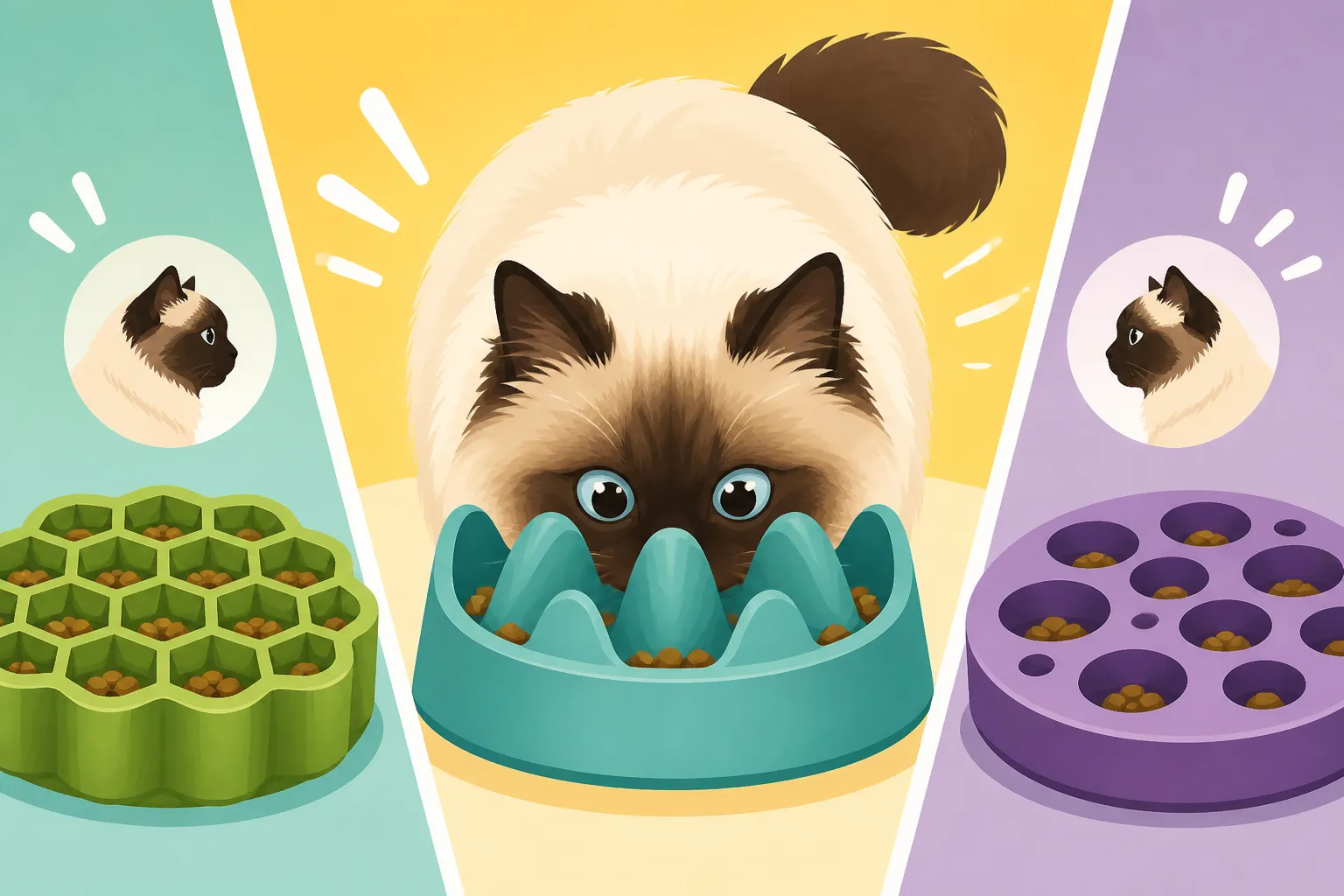
This category is often the safest bet for our Himalayans. These feeders prioritize accessibility and minimize the need for deep digging or awkward reaching. Look for designs that feature wide, shallow channels or a flat tray with numerous small, low-profile divots.
- Key Features to Look For:
- Low Sides: The feeder itself should not have high walls that your Himalayan has to peer over or reach into. A low profile is essential.
- Wide, Gradual Channels: Instead of narrow, deep labyrinths, opt for designs with broad, open channels that food can be pushed along with a paw or gently nudged with their nose. The goal is for them to be able to access the food easily once it moves.
- Textured or Bumpy Surfaces: Some flat tray feeders have gentle bumps or ridges that simply spread out the food, forcing your cat to pick up individual pieces rather than gulping down a mouthful. This naturally slows them down without being too challenging.
- Non-Slip Base: Important for any cat, but especially one who might be pawing at a feeder – you don't want it sliding all over the floor.
Think of it like a very shallow dish with a few gentle hills inside. Your Himalayan can use their paw to bat a piece of kibble out of a dip or simply pick it up from a slightly elevated spot without plunging their face deep into the feeder. Brands often describe these as "whisker-friendly" or "flat-faced cat approved." You can often find these types of feeders on Amazon, and they’re definitely worth seeking out.
Interactive Boards with Removable Pegs or Cups
Another excellent option falls into the "interactive board" category. These often look like a flat board with various small components attached, like pegs, small covers, or shallow cups. The premise is that your cat has to manipulate these components to reveal or access the food.
- Key Features to Look For:
- Lift or Push, Not Dig: Look for feeders where the action required is to lift a lid, slide a cover, or bat at a peg. Avoid anything that demands your cat dig deep or use their nose in a confined space.
- Shallow Compartments: If there are cups or holes where food is hidden, ensure they are very shallow. The food should be easily visible and accessible once the cover is moved.
- Sturdy Construction: Since your cat will be batting and nudging, you want components that won't easily break or become choking hazards.
- Variety of Challenges: Some boards offer different types of puzzles on one surface, allowing you to vary the difficulty. For instance, some sections might involve lifting a peg, while others require sliding a disc.
These feeders can be incredibly engaging for a Himalayan, tapping into their natural curiosity without overtaxing their physical limitations. They enjoy the mental exercise of figuring out how to get to the treats. Sometimes, these are even marketed as "activity feeders" or "cat intelligence toys" on sites like Amazon. Remember that a cat who engages with toys and mental stimulation tends to be a happier cat overall.
DIY Options: Simple and Effective
You don't always need to buy an expensive, specialized feeder. Sometimes, the best solutions are the simplest ones you can whip up at home. These DIY options are fantastic for testing what your Himalayan responds to and for supplementing more elaborate feeders.
- Muffin Tins: This is a classic for a reason! A standard muffin tin has shallow, wide cups perfect for a Himalayan's face. Place a few pieces of kibble in each cup. Your cat will have to move from cup to cup, picking out a few pieces at a time. To increase the challenge slightly, you can place a small, clean golf ball or a crumpled piece of paper over some of the kibble, forcing them to dislodge it first.
- Cardboard Tubes (Toilet Paper or Paper Towel Rolls): Cut several cardboard tubes into shorter sections (about 1-2 inches tall). Stand them upright in a shallow box or an empty shoebox. Scatter kibble among the tubes. Your cat will have to fish the kibble out from between the tubes, or nudge the tubes aside. This provides a gentle barrier without being too restrictive.
- Scattering Food: The simplest "puzzle" of all! Instead of putting all their food in one bowl, scatter portions of their meal across a clean, non-carpeted floor, or on a wide, flat baking sheet. This forces them to walk around, sniff, and pick up individual pieces, naturally slowing down their eating and engaging their hunting instincts. For a more sedentary cat, this might be all the "puzzle" they need. It also encourages them to get up and move around a bit, which is important for our Why a Cobby Himalayan Is Weighed at Every Visit.
These DIY methods are fantastic for gradual introduction and for owners who want to get creative. They're low-cost, easy to clean, and allow you to tailor the challenge specifically to your Himalayan's capabilities and patience level.
Introducing a Puzzle Feeder to Your Himalayan
Bringing any new item into your cat's routine can be a bit of an adjustment, and puzzle feeders are no exception. Our Himalayans, in particular, can be creatures of habit and prefer their comforts. Patience is truly key here. Don't expect instant success, but celebrate every small victory!
Starting Simple and Building Confidence
The absolute worst thing you can do is introduce a puzzle feeder that's too difficult right from the start. This will only lead to frustration and a negative association with the feeder. Think of it like teaching a child to read – you start with basic letters, not Shakespeare!
- Make it Easy to Start: For the very first few times, make the puzzle incredibly simple. If it's a multi-compartment feeder, leave some compartments completely open or only partially covered. If it's a maze, put the kibble right on top of the most accessible paths. The goal is for your Himalayan to succeed quickly and easily, building their confidence.
- Use High-Value Treats: Don't just put their regular kibble in it if they're not highly motivated by it. Use small pieces of their favorite freeze-dried chicken, a few highly palatable treats, or even a bit of their preferred wet food if the feeder allows. The higher the reward, the more incentive they have to figure out the puzzle. This helps them understand that the feeder is a source of good things. You can always transition to their regular kibble later.
- Show, Don't Just Tell: Gently demonstrate how it works. You might use your finger to nudge a piece of kibble along a path or lift a small lid to reveal a treat. Let them watch you. Don't force their face into it or push their paw, but simply model the behavior. Many Himalayans are observant, and they learn by watching.
Remember, the initial stages are all about positive reinforcement and making the experience enjoyable, not a chore. A well-adjusted Himalayan will typically be willing to try new things, even if it's with a little caution.
Placement and Supervision
Where you place the puzzle feeder and how you supervise your cat during its use can make a big difference in their willingness to engage with it.
- Quiet, Familiar Space: Introduce the feeder in a quiet, low-traffic area where your Himalayan feels safe and comfortable. Their favorite spot on the floor, near their usual feeding area, or perhaps on a stable, low table where they feel secure. Avoid placing it in a noisy hallway or a busy part of the house, especially at first.
- Monitor for Signs of Frustration or Overheating: Watch your Himalayan carefully. Are they intently trying to solve it, or are they batting at it aggressively? Are they grumbling or just walking away? These are signs of frustration. Also, pay close attention to their breathing. Because of their brachycephalic airway, Himalayans can overheat more quickly than other cats, especially if they're exerting themselves. Why a Himalayan Overheats Twice as Fast as a Siamese. If you notice heavy panting, open-mouth breathing, or a sudden loss of interest after a short burst of activity, it's time to stop the session and let them rest. You can offer a few pieces of kibble by hand as a reward for their effort.
- Keep it Clean: Especially with a flat-faced cat, food can sometimes get smushed around or left behind. Regularly clean the puzzle feeder according to the manufacturer's instructions. A dirty feeder can deter your cat and also become a breeding ground for bacteria.
Consistency is key. If you decide to incorporate puzzle feeding into their routine, try to do it at similar times each day, or as part of their regular meal. This helps them anticipate and get used to the activity.
The Long Game: Patience and Adaptation
It's tempting to want your Himalayan to instantly love their new puzzle feeder and start happily solving it like a pro. But often, it's a journey, not a sprint. Some cats are naturally more curious and will take to it quickly, while others, particularly our more dignified Himalayans, might need a lot more time and encouragement.
- Don't Give Up Too Soon: If your cat isn't interested after the first few tries, don't immediately throw the feeder out. Try it again a day or two later, perhaps with a different, even higher-value treat, or by making it even simpler. Sometimes, it just takes repeated, low-pressure exposure for them to come around.
- Modify as Needed: Is the feeder still too deep? Can you prop it up slightly? Is there a component they particularly dislike? See if you can adapt the feeder or the way you use it. For instance, if it has too many small compartments, only use a few. If it's too tall, place it on a blanket to raise the floor level slightly.
- Celebrate Small Achievements: Even if your Himalayan only gets one piece of kibble out, praise them! A gentle pet, a soft word, or even another treat offered by hand can reinforce the positive experience. They may not show it with overt enthusiasm like a dog, but our Himalayans respond to our approval. Learning how to gauge How a Himalayan Behaves as Its Sight Goes is useful for adapting to any new challenges in their environment.
Ultimately, the goal is enrichment and engagement, not perfection. If a puzzle feeder becomes a source of stress or discomfort, it defeats its purpose. The journey to finding the right puzzle feeder for your Himalayan might involve some trial and error, but with understanding, patience, and the right approach, you can provide them with a stimulating and enjoyable way to eat.
Disclaimer
This article is for general informational purposes only and does not constitute professional advice. Laws, prices and regulations vary by location and change over time. Consult a qualified professional for guidance on your specific situation.