Why a Himalayan’s Cat Tree Should Be Waist High at Most
As Himalayan cat owners, we adore our fluffy companions, but sometimes the sheer volume of "cat stuff" out there feels like it's designed for completely different creatures. If you've ever found yourself wondering why your gorgeous, plush cat doesn't seem to "get" the towering cat tree you painstakingly assembled, or if you've worried about them struggling to reach those high perches, you're not alone. This guide is here to shed light on why those sky-scraping cat condos are often a poor fit for Himalayans and to help you discover safer, more appropriate vertical enrichment that celebrates their unique physique and gentle nature, keeping your beloved furball happy and healthy.
Understanding the Himalayan's Unique Physique and Its Impact on Climbing
It’s easy to look at a majestic Himalayan, lounging regally, and assume they’re just naturally a bit lazy. While they certainly appreciate a good nap, their preference for ground-level activities isn't just about temperament; it's fundamentally tied to their physical build. These beautiful cats carry a heritage that makes scaling great heights a challenge, and often, an uncomfortable endeavor.
The Cobby Body and Short Legs: A Natural Limitation
One of the most defining characteristics of the Himalayan, inherited directly from its Persian lineage, is its "cobby" body type. Imagine a sturdy, compact frame with a broad chest, set upon short, thick legs. This isn't the lithe, athletic build of a Siamese or an Abyssinian, built for acrobatic leaps and bounding climbs. Instead, the Himalayan's structure is designed for quiet contemplation and relaxed lounging, not for Olympic-level gymnastics. Their legs, while strong, simply aren't engineered for explosive vertical jumps that require sustained effort or precarious balance on narrow platforms.
When a Himalayan tries to launch itself upwards, that dense, compact body means more weight to lift against gravity. Their short legs offer less leverage for pushing off, and their relatively short stride makes running starts to gain momentum less effective. Think about it: if you had to jump onto a kitchen counter every day with shorter, heavier limbs, you'd probably start opting for the floor after a while too. This isn't a sign of weakness; it's just a pragmatic choice based on their physical mechanics. Trying to force a cat with this build into constant high-rise adventures can put undue strain on their joints and spine, something we definitely want to avoid as they age. This is why it's so important to understand how to handle their unique build, such as by Lifting a Cobby Himalayan Without Straining Its Back.
The Flat Face and Breathing Challenges
Beyond their sturdy frame, the Himalayan's distinctive flat face, or brachycephalic structure, significantly impacts their ability to engage in strenuous activities like climbing. This facial type, while charming, often comes with shortened airways and sometimes narrowed nostrils. While a well-bred Himalayan should have good clear breathing, any exertion can quickly lead to increased respiratory effort. When they push themselves physically, such as jumping repeatedly or climbing several tiers of a tall cat tree, their breathing can become labored.
You might notice your Himalayan panting, breathing heavily through an open mouth, or making more audible sounds than usual during play. This is their body struggling to get enough oxygen. Compared to a cat with a longer muzzle, a flat-faced cat has to work much harder to cool itself down and to breathe efficiently when active. This isn't just uncomfortable; it can be genuinely distressing and, in severe cases, even dangerous. Imagine trying to run a marathon while breathing through a straw – that's a bit like what intense climbing might feel like for a Himalayan. It's why things like Why a Himalayan Snores Louder Than Its Siamese Ancestors or How Soon a Himalayan Starts Panting During Play are common discussions among owners. They simply aren't built for activities that demand prolonged or intense bursts of oxygen.
Why Tall Cat Trees Pose Risks for Your Himalayan
It's natural to want to provide our cats with stimulating environments, and cat trees are often seen as the ultimate cat enrichment. However, for a Himalayan, a towering structure can inadvertently become a source of stress and potential danger rather than a playground. Understanding these risks is crucial for making informed choices about their living space.
Risk of Falls and Injuries
One of the most immediate concerns with tall cat trees for Himalayans is the increased risk of falls and subsequent injuries. Their cobby build and short legs mean they're not as agile or graceful when navigating complex, multi-tiered structures as some other breeds. Their balance might not be as finely tuned for precarious leaps, and their depth perception can sometimes be subtly affected by their facial structure, making it harder to accurately judge distances for jumps.
Picture a scene: your Himalayan, perhaps motivated by a fleeting sunbeam or a bird outside the window, attempts a jump to a higher platform. Instead of landing cleanly, a slight miscalculation due to their heavier body or a less-than-perfect push-off from those short legs can lead to a clumsy landing, or worse, a fall. Such incidents can result in painful sprains, strains, or even fractures. Given their stocky build, any fall means a heavier impact on their joints and bones. It's a heartbreaking thought to imagine your serene cat suffering a preventable injury simply because the furniture wasn't suited to their physical capabilities. We want to prevent any situation where they might need to go to the vet for something that could have been avoided. This is one of the reasons why Why a Himalayan Rarely Reaches a Counter is observed in their behavior.
Exacerbating Respiratory Distress
As we've discussed, the Himalayan's brachycephalic facial structure can make breathing more challenging, especially during physical exertion. A tall cat tree, with its multiple levels and opportunities for jumping and climbing, inherently encourages such exertion. While a short burst of play is generally fine, prolonged or repeated climbing sessions can push a Himalayan's respiratory system to its limits.
Imagine your Himalayan making its way up several levels of a cat tree. Each jump, each stretch, each scramble for purchase demands more oxygen. For a breed already prone to noisy breathing or panting under normal play, this elevated activity can quickly lead to more severe respiratory distress. You might observe them panting heavily, open-mouth breathing for extended periods, or even exhibiting a bluish tinge to their gums in extreme cases (which warrants immediate veterinary attention). The stress this places on their heart and lungs is considerable, potentially exacerbating any underlying cardiovascular conditions or leading to overheating, a particular concern for a long-haired, flat-faced cat. It's similar to the issues that make Why Airlines Refuse a Flat Faced Himalayan for cargo travel, emphasizing the need for easy breathing. Their comfort and long-term health depend on minimizing unnecessary respiratory strain.
Neglecting Lower Perches: A Wasted Investment
Many tall cat trees, while boasting impressive height, often feature multiple levels. You might think, "Well, my Himalayan can just use the lower levels!" And while that's true in theory, the reality is that for a significant portion of their price, you're paying for vertical space your cat will likely never utilize. Himalayans, by nature, are creatures of comfort and efficiency. They tend to gravitate towards the easiest, most comfortable spots. If a perch requires too much effort to reach, they'll simply bypass it.
This means that towering cat trees often end up being underutilized, with your Himalayan contentedly napping on the very lowest platform or, more commonly, simply preferring a plush bed on the floor or a favored armchair. The top tiers become unused real estate, collecting dust, while your cat continues to seek out simpler, more accessible spots. It's a wasted investment in terms of both money and space when you could be providing genuinely beneficial enrichment elsewhere. When shopping for cat furniture, consider platforms like Amazon for a wide selection of lower, more appropriate options that truly serve your Himalayan's needs rather than just looking impressive in your living room.
Designing a Himalayan-Friendly Vertical Space: The Waist-High Standard
So, if towering structures are out, what does a truly Himalayan-friendly vertical space look like? The key is to think "outward" and "low-rise" rather than "upward." We're aiming for enrichment that provides varied levels without demanding strenuous vertical leaps, ensuring safety and comfort are paramount.
Defining "Waist-High": Practical Measurements and Examples
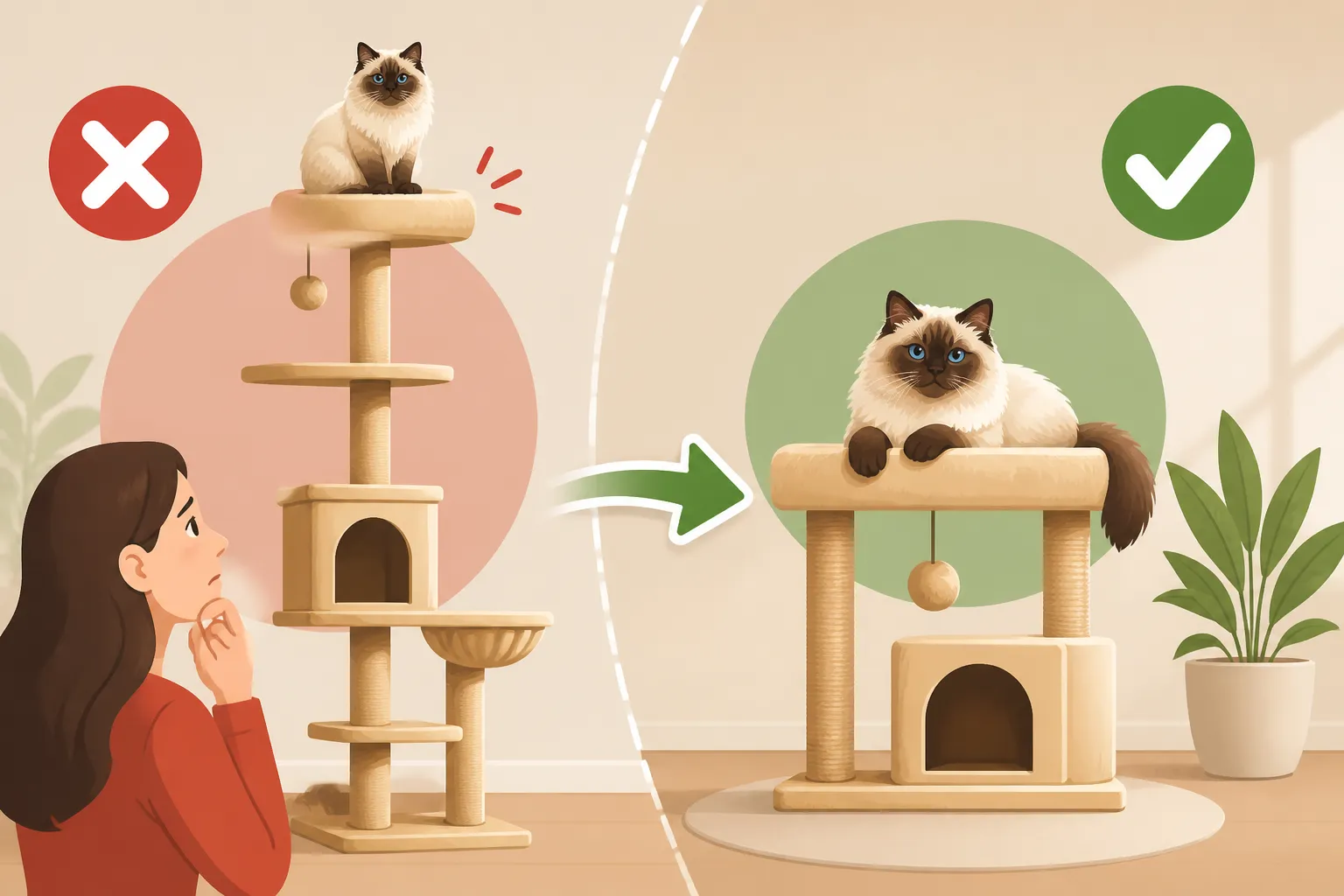
When we talk about a "waist-high" cat tree, we're generally referring to structures that reach about 2 to 3 feet in height for an average adult. This isn't a hard and fast rule, of course, as everyone's "waist-height" differs, but it gives you a good visual benchmark. Think of it as a piece of furniture your Himalayan can comfortably step onto, or perhaps take one very easy jump to reach the highest point, rather than a multi-story scramble. The goal is accessibility.
Consider these practical examples:
- Two-Tiered Cat Cubes or Condos: These often feature a cozy enclosed den on the bottom and a flat platform on top. The total height rarely exceeds 24-30 inches, making the top easily reachable.
- Pet Steps or Ramps Leading to a Window Perch: Instead of a complex tree, you can use sturdy pet steps or a gentle ramp to allow your Himalayan to access a favorite window perch or even a comfortable armchair. This eliminates jumping altogether.
- Low, Wide Platforms: Some cat furniture is designed with broad, stable platforms that are only 12-18 inches off the ground, sometimes with a second platform at about 24-30 inches. These are perfect for lounging and observing without excessive climbing. This concept aligns perfectly with Why a Cobby Himalayan Needs Wide Platforms, Not Tall Ones.
The idea is to give them elevated spots for observation and security, without challenging their physical limitations. Remember, The Height a Himalayan Decides Is Not Worth It is often quite low, so don't overdo it!
Features to Look For in a Low-Rise Cat Tree
When you're browsing for the ideal cat tree or furniture for your Himalayan, keep these essential features in mind. It's not just about height, but also about the quality and design that supports their unique needs.
- Stability is Paramount: Because Himalayans are a dense, cobby breed, any cat furniture they use needs to be exceptionally stable. Look for a broad, heavy base that won't wobble or tip when your cat shifts their weight. This prevents falls and makes them feel secure.
- Wide, Spacious Platforms: Narrow perches are uncomfortable and can be unstable for a Himalayan's ample frame. Opt for platforms that are wide and deep enough for them to stretch out comfortably and turn around without feeling cramped.
- Gentle Ramps or Steps: Instead of relying solely on jumping, look for designs that incorporate gentle ramps or low, wide steps between levels. This makes access much easier and safer, particularly for older Himalayans or those with joint issues. This is why Why a Himalayan Uses Steps Rather Than Jump is a common observation.
- Soft, Durable Surfaces: Himalayans have luxurious, long coats that can easily snag or tangle on rough materials. Choose trees with soft, plush carpeting or faux fur that's easy to clean and comfortable for them to recline on. Remember, you'll be spending time keeping their coats in pristine condition, so easy-to-clean surfaces are a bonus.
- Appropriate Scratching Surfaces: Even if they don't climb high, Himalayans still need outlets for scratching. Ensure the cat tree includes sisal-wrapped posts at accessible heights, allowing them to stretch and manicure their claws without having to stand on their hind legs to reach.
- Consider Enclosed Spaces: Many Himalayans love a cozy, enclosed space to retreat to. Look for low-rise trees that incorporate cubbies or caves where they can feel safe and secure. You can find many options with these features on platforms like Amazon, offering a wide array of choices to suit your home and your cat's preferences.
Alternative Vertical Enrichment Solutions
Sometimes, a traditional cat tree, even a low-rise one, isn't the only answer. There are many creative ways to provide safe and stimulating vertical enrichment for your Himalayan, focusing on comfort and accessibility.
- Window Perches: A sturdy, secure window perch is often a huge hit with Himalayans. It provides a comfortable, elevated spot to observe the outside world without requiring significant climbing effort. Ensure it's wide enough for them to stretch out and stable enough to support their weight. You can even use a small set of pet steps to help them access it even more easily.
- Low Shelving Units: Consider installing a few wide, sturdy shelves at varying, but low, heights on a wall. Ensure they are securely mounted and offer enough surface area for your cat to comfortably sit or lie down. You can even connect them with a short ramp. Make sure the height difference between shelves is minimal, so it's more of a step than a jump.
- Sturdy Ottomans and Benches: Don't underestimate the power of regular furniture! A plush ottoman or a low bench placed near a window or next to your favorite armchair can become a prime vertical lounging spot for your Himalayan. These pieces are often incredibly stable and provide just the right amount of elevation.
- Modular Cat Furniture: Some brands offer modular cat furniture that allows you to configure individual cubes or platforms into a custom arrangement. This means you can build a low-rise structure perfectly tailored to your cat's abilities and your space, ensuring every piece is functional and safe.
- Focus on Horizontal Variety: While vertical space is important, also think about horizontal enrichment. Different textures, cozy beds in various locations, and plenty of ground-level toys can keep a Himalayan engaged and happy, especially since Why a Himalayan Puts On Weight Sitting Still is a concern for less active breeds. Remember that keeping them cool is also vital, so consider placing these areas on cool tile floors, or near a fan. Knowing How to Get a Himalayan Through a Heatwave is part of owning one of these magnificent cats, and their furniture plays a role.
Here's a quick comparison to help you visualize the best choices for your Himalayan:
| Feature | Tall Cat Trees (Generally) | Waist-High Cat Trees/Alternatives (Himalayan-Friendly) |
|---|---|---|
| Height Range | 4+ feet (often up to 6-8 feet) | 2-3 feet (or lower, with gradual steps) |
| Platform Size | Often narrow, compact | Wide, spacious, ample room for lounging |
| Climbing Mechanism | Primarily vertical jumps, scrambling | Gentle steps, short hops, ramps, direct access |
| Stability | Can be top-heavy, prone to wobble | Broad base, heavy construction, very stable |
| Respiratory Impact | High exertion, potential for distress, overheating | Low exertion, comfortable breathing, less risk of overheating |
| Risk of Falls/Injury | Higher, due to complex jumps and precarious landings | Much lower, due to easier access and stable platforms |
| Utilization by Himalayan | Often only lowest levels, top tiers neglected | Fully utilized, comfortable, secure |
| Ideal Use Case | Agile, athletic breeds (Siamese, Bengal) | Cobby, relaxed breeds (Himalayan, Persian) |
| Finding Options | Widespread | Requires specific searching, often found on sites like Amazon |
| Long-term Health | Potential for joint strain, respiratory issues | Supports joint health, comfortable breathing, lower stress |
Ultimately, the best environment for your Himalayan is one that respects their inherent physical traits, not one that tries to make them something they're not. By opting for cat trees and vertical enrichment that are waist-high at most, you're not limiting their world; you're tailoring it to enhance their comfort, safety, and overall happiness. Their majestic but delicate facial structure, a product of What Ninety Years Have Done to the Himalayan's Face, demands this consideration. A contented Himalayan, safely perched on a low, plush platform, is a far more joyful sight than one struggling on a towering structure.
Disclaimer
This article is for general informational purposes only and does not constitute professional advice. Laws, prices and regulations vary by location and change over time. Consult a qualified professional for guidance on your specific situation.