Why a Himalayan Combed Late Fights It Forever
It's an incredibly frustrating experience, isn't it? You get this gorgeous Himalayan cat, full of fluffy promise, only to find that every attempt at grooming turns into a wrestling match, a symphony of growls, hisses, and desperate attempts to escape. Many of us find ourselves in this exact boat because, for whatever reason, our beloved floof wasn't properly introduced to grooming when they were a tiny kitten. And sadly, once that critical window passes and negative associations set in, it feels like you're fighting a losing battle forever. This guide is here to unravel why that happens and what steps you can take, even if it feels like you've tried everything.
The Critical Window: Why Early Introduction is Everything
When it comes to grooming a Himalayan, the earlier you start, the better. It's not just about getting them used to the comb; it's about shaping their entire perception of being handled and cared for by you. Missing this foundational period can lead to a lifetime of struggle, not because your cat is "bad," but because they simply never learned to trust the process.
The Kitten's Formative Experience
Think about a kitten's first few weeks and months. This is a time of immense learning and sensory development. Every interaction, every touch, every sound shapes how they view their world and the beings in it – including you. If, during this delicate period, grooming is introduced as a gentle, positive, and consistent activity, it becomes just another normal part of their day. They learn that the comb isn't a threat, but rather a tool wielded by a trusted caregiver.
Conversely, if grooming is absent, sporadic, or worse, associated with fear or pain in these early stages, the cat's tiny brain forms strong, negative connections. A quick, rough yank through a small tangle by a well-meaning but inexperienced owner can teach a kitten that the comb hurts. This single event, especially if repeated, can quickly escalate into a full-blown phobia. It's like trying to teach a child to love vegetables by forcing them to eat something they despise; the aversion only grows stronger with each attempt.
Instinct Versus Acclimation
Cats are fastidiously clean creatures by nature, constantly bathing themselves with their rough tongues. It's an instinct that runs deep. However, a Himalayan's coat is a whole different ballgame. That luxurious, dense double coat, with its long guard hairs and thick, fluffy undercoat, is simply too much for them to maintain entirely on their own. They try to groom it, you'll see them licking and nibbling, but they often can't reach all the spots, and their efforts aren't enough to prevent tangles and mats.
This creates a fundamental conflict: their instinct says "self-groom," but their physical reality (and particularly their How Long a Himalayan's Coat Actually Grows) makes it impossible to do perfectly. So, when a human steps in, it's already an unnatural intervention. If this intervention isn't introduced gradually and positively, it immediately triggers their defensive "fight or flight" response. They don't understand that you're trying to help; they only feel restraint and discomfort. They haven't been acclimated to this necessary ritual, and without that early training, it feels like an invasion of their personal space, something to be resisted with every fiber of their being.
The Physical Discomfort: More Than Just Annoyance
Many owners, myself included, might initially think a cat's resistance to grooming is simply stubbornness or a dislike of being held. While cats certainly have their preferences, for a Himalayan, the resistance often stems from a very real, very intense physical discomfort that escalates quickly if not addressed. It’s not just an annoyance; it’s pain.
Mats as a Source of Pain
Let's be brutally honest about mats: they are not just tangled fur. A mat is a dense, compacted knot of hair that pulls constantly on the delicate skin beneath it. Imagine having a tight elastic band pulling at your scalp all day, every day, with every movement you make. Now imagine that on an animal covered in fur, with multiple such "elastic bands" forming on their body. This is what a mat feels like to a cat. It restricts their movement, causes irritation, and can even lead to skin infections if moisture gets trapped underneath.
If your Himalayan is only combed when mats have already formed, then every single grooming session immediately becomes associated with intense pain. The comb isn't a gentle massage; it's a torture device ripping at their skin. Even the most patient owner, trying to gently work out a mat, will inevitably cause some level of discomfort. This reinforces the cat's belief that grooming equals pain, solidifying their fight-or-flight response for all future attempts. Why a Missed Day Costs a Himalayan a Mat highlights just how quickly these can form.
The Sensitive Himalayan Skin
Himalayans, with their incredibly dense double coats and fine, luxurious texture, often have surprisingly sensitive skin underneath. This is compounded by their breed characteristics. The long, flowing hair means there's less direct airflow to the skin, which can sometimes make it more prone to dryness or irritation. When you're trying to work through a coat like that, especially if it's already got a few tangles, it's easy to inadvertently cause discomfort.
Using the wrong grooming tools, like a brush with stiff bristles that scratch the skin, or a comb with teeth that are too sharp or spaced incorrectly, can quickly turn a potential bonding moment into a painful ordeal. Even if you're trying to be gentle, if the tool isn't right, or if you apply too much pressure while attempting to penetrate that thick undercoat, you can cause redness, minor abrasions, or simply a dull ache that teaches your cat to dread your approach. Knowing How to Find a Himalayan's Ribs Through a Persian Coat can give you an idea of their body structure and sensitivity.
Overheating During Grooming
Here's something many people don't consider: grooming, especially for a thick-coated breed like the Himalayan, can actually be a physically demanding activity for the cat. The stress of being restrained, combined with the mild exertion of struggling, can quickly raise their body temperature. Himalayans, descended from Persians, often have shortened airways (brachycephalic features) that make them less efficient at cooling themselves through panting compared to other cat breeds.
Imagine trying to get your hair brushed while wearing a heavy fur coat in a warm room, all while someone is holding you still. It's incredibly uncomfortable and can quickly lead to overheating. This physical distress adds another layer of negative association to the grooming experience. The cat isn't just fighting the comb; they might also be fighting the feeling of being too hot and claustrophobic. Understanding Why a Himalayan Overheats Twice as Fast as a Siamese can shed light on this crucial aspect of their physiology.
Psychological Barriers: Trust and Routine
Beyond the physical discomfort, a Himalayan that fights grooming forever often has deeply ingrained psychological barriers. These aren't about being "naughty"; they're about broken trust, a disrupted sense of security, and the natural feline instinct for self-preservation. When a cat feels threatened or consistently subjected to unpleasant experiences, their emotional defenses go up, and it's incredibly hard to bring them back down.
Breaking the Trust Bond
Cats are creatures of habit and deep, often subtle, bonds. Many Himalayans, despite their calm demeanor, form incredibly strong attachments to their chosen person. They trust you for their safety, comfort, and well-being. However, if grooming sessions consistently involve fear, pain, or the feeling of being held against their will, this precious trust bond can fracture. The cat learns to associate your hands, the sight of the comb, or even your general approach with an impending unpleasant event.
They may start to hide when they see you coming with the comb, or they might become wary of your touch even outside of grooming times. This isn't defiance; it's a natural protective response. Once that trust is eroded, it becomes an uphill battle to regain it. The cat isn't fighting you; they're fighting the perceived threat that you, or rather, the grooming tools in your hand, represent. It's vital to remember that a broken bond takes immense time and patience to repair, if it can be repaired fully at all.
The Power of Predictable Routine
Himalayans thrive on predictability. Their lives are often built around a steady rhythm of meals, naps, play, and attention. They are creatures of routine, and deviations from it can cause significant stress. A consistent, daily grooming routine, introduced early and with positive associations, becomes a comforting ritual, another predictable and positive interaction in their day. Why a Himalayan Runs on Its Own Timetable beautifully illustrates their need for routine and control.
When grooming is sporadic, only happening as a crisis response to severe mats, it lacks this essential predictability. There's no comforting rhythm, no positive expectation. Instead, the grooming session becomes an unpredictable, anxiety-inducing event. The cat doesn't know when it's coming, how long it will last, or how painful it will be. This constant state of low-level apprehension only exacerbates their resistance. They can't relax into the process because it's never been allowed to become a predictable, positive part of their daily life.
Learned Helplessness and Aggression
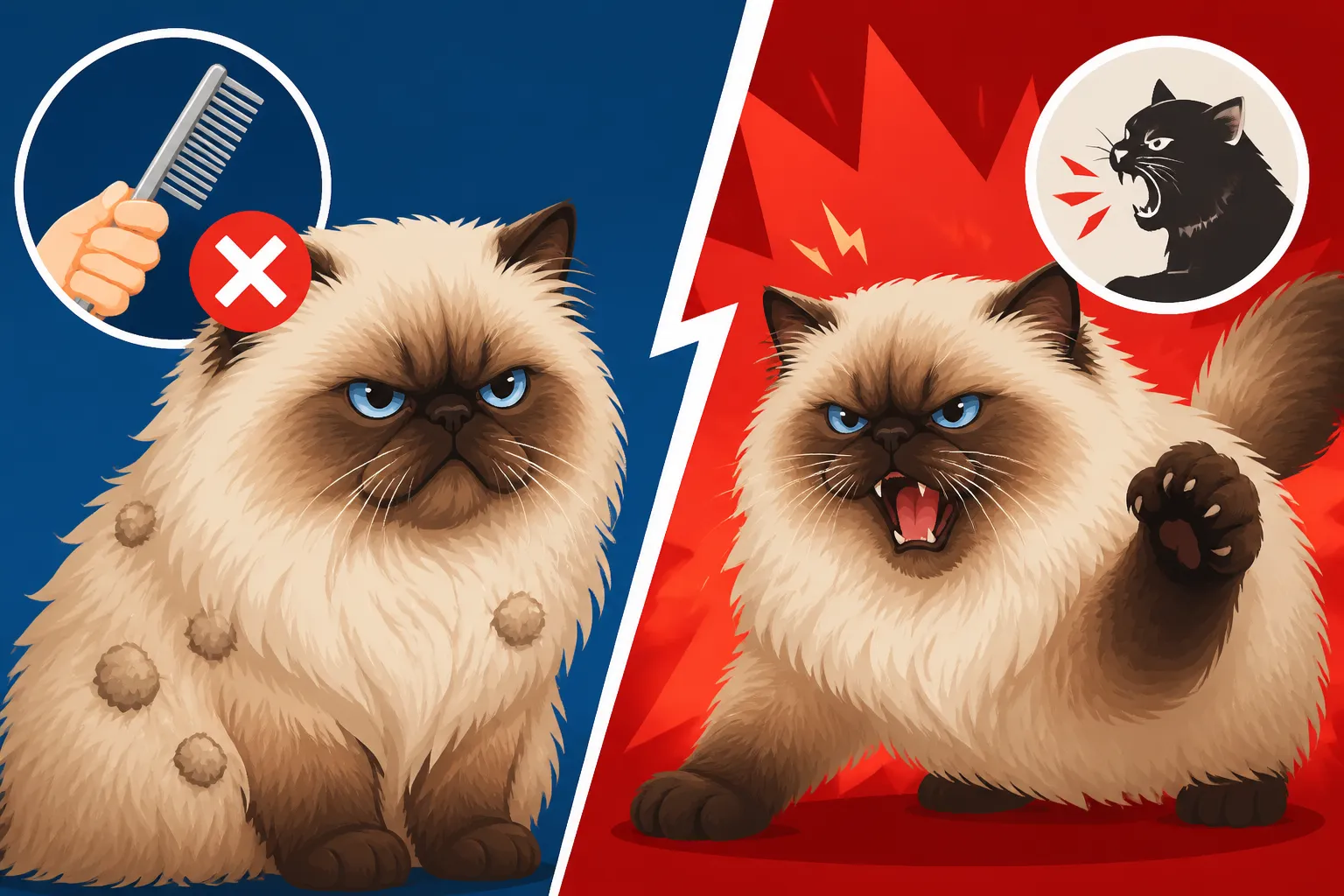
Imagine being in a situation where you feel trapped, unable to escape something that is causing you fear or pain. What do you do? Most living beings, including cats, will eventually resort to desperate measures for self-preservation. When a Himalayan feels consistently cornered and unable to escape grooming, they might first try to squirm away, then vocalize their displeasure, and finally, if those fail, they might lash out with bites or scratches.
This aggressive behavior isn't out of spite; it's a last-ditch effort to make the perceived threat stop. And here's the kicker: if biting or scratching does make you release them, even temporarily, the cat learns that aggression is an effective defense mechanism. This becomes a vicious cycle: the more they fight, the more you might feel frustrated or even hurt, making future grooming sessions even more stressful for both of you. It's a classic example of learned helplessness leading to defensive aggression, and once learned, it's incredibly difficult to unlearn. A cat's personality is shaped by these experiences; while The Himalayan Is a Lap Cat That Answers Back, they're not usually aggressive without reason.
Tools and Technique: The Right Approach Matters
Even if you have the best intentions, using the wrong tools or applying incorrect techniques can turn a Himalayan's grooming experience into an absolute nightmare. It's not enough to simply try to comb; you need to understand the unique requirements of their coat and facial structure. A battle-hardened cat will certainly fight forever if the equipment and methods cause them pain or stress.
Using the Wrong Tools
Let's be blunt: not all brushes and combs are created equal, especially when it comes to a Himalayan's magnificent (and challenging) coat. A standard slicker brush that works wonders on a shorter-haired cat, or even a human hairbrush, is almost guaranteed to fail you here. These tools either don't penetrate the dense undercoat effectively, leaving mats to form unnoticed, or their bristles are too harsh, scratching the delicate skin beneath.
A Himalayan's coat demands specific tools. You need a high-quality, long-toothed steel comb, ideally one with both wide and fine teeth. The wider teeth are excellent for general detangling and working through the bulk of the coat, while the finer teeth are essential for getting through the dense undercoat and checking for smaller knots closer to the skin. Many excellent options are available from retailers like Amazon, offering different tooth lengths and spacing to suit various coat densities. Without the right equipment, you're not just inefficient; you're likely causing unnecessary discomfort and cementing your cat's aversion to grooming. This is why it's crucial to know Which Steel Comb a Himalayan's Coat Needs.
Improper Technique and Force
Even with the best tools, poor technique can sabotage your efforts. Yanking through knots, brushing against the natural lay of the fur, or failing to support the skin while combing can be incredibly painful. Imagine someone pulling a tangle from your hair without holding the root – that sharp tug is what your cat feels. This isn't just about discomfort; it can cause skin irritation, redness, and even tears in the skin, further reinforcing negative associations.
The correct technique involves working in small sections, layer by layer. Start from the bottom of the cat's leg or flank, gently holding the skin taut at the base of the hair, and comb through to the skin, not just over the top. Use short, gentle strokes. If you encounter a mat, don't pull. Instead, gently pick at the edges of the mat with the wide-toothed part of your comb or your fingers, working patiently until it loosens. Never try to cut out mats with scissors unless you are absolutely sure what you are doing, as it's tragically easy to cut the skin. Working a Comb Through a Himalayan's Ruff is a good example of how specialized technique is.
Sedation as a Last Resort
For Himalayans who have developed a severe phobia of grooming, or those whose coats have become so matted that the grooming process is simply too painful and stressful to do while they're awake, sedation becomes a necessary and humane option. This is not a long-term solution for daily maintenance, but it can provide a critical "reset" for both the cat and the owner.
A veterinary professional or a certified professional groomer (who often collaborates with vets) can perform a "lion cut" under light sedation. This involves carefully shaving down the coat, removing all mats and starting fresh. While a lion cut can look dramatic, it instantly relieves the cat of the constant pain and pulling of severe matting. It also buys you time to re-establish a positive grooming routine with the regrowth, starting with very short, gentle sessions. This option should always be discussed with your vet, especially considering Why a Himalayan Is a Harder Anesthetic Than a Siamese. In severe cases, Why a Matted Himalayan Becomes a Medical Case underscores the importance of this intervention.
Remedial Strategies: Rebuilding Trust and Tolerance
If your Himalayan has learned to fight grooming forever, it might feel like an impossible situation. But while it requires immense patience and a complete overhaul of your approach, it's not entirely hopeless. The goal isn't necessarily to make them love grooming, but to teach them to tolerate it without fear or aggression. This involves a long-term commitment to positive reinforcement, creating a safe environment, and knowing when to call in the professionals.
Starting Fresh with Positive Reinforcement
This is where the magic (and a lot of treats) happens. You need to completely change your cat's association with grooming. Start by ditching the comb for a while. Focus on rebuilding trust through gentle, positive interactions that have nothing to do with grooming. Once that foundation is stronger, you can gradually reintroduce the idea of the comb.
Begin with tiny, almost imperceptible steps. Simply bring the comb into the room, place it on the floor, and give your cat a high-value treat or engage in a short play session with a favorite toy (many interactive toys are available on Amazon). The next step might be to touch the comb lightly to their fur for a fraction of a second, followed immediately by a treat. Slowly, over days or even weeks, increase the duration and intensity. The key is to stop before the cat shows any signs of stress, ensuring every interaction ends on a positive note. This method is slow, but it's about reteaching their brain that the comb predicts good things, not pain.
Creating a Safe Grooming Environment
The setting where grooming takes place is just as important as the technique itself. For a cat that has learned to fear the comb, the environment needs to be as stress-free as possible. Choose a quiet room where there are no sudden noises or distractions. Many cats feel more secure on a raised, stable surface, like a sturdy table with a non-slip mat, rather than on the floor where they might feel vulnerable. This also puts them at a more comfortable height for you, reducing the likelihood of you having to bend over in awkward positions, which can make you less gentle.
Ensure the room is cool, especially for Himalayans who can overheat quickly. Keep sessions incredibly short, perhaps only 30 seconds at first, gradually extending them as your cat's comfort level grows. End every session with a positive reward, like a favorite treat or a few minutes of undivided attention. The predictability of the location and the brevity of the sessions will help your cat understand what to expect, reducing their anxiety. Making One Room Comfortable for a Himalayan Left Alone can give you ideas for a safe space.
Professional Groomers and Vets as Allies
Sometimes, despite your best efforts, the psychological barriers are too high, or the matting is too severe for you to tackle alone. This is when professional help becomes indispensable. Don't view calling in an expert as a failure; view it as an act of love and responsible pet ownership.
A professional cat groomer, especially one experienced with long-haired breeds and anxious cats, can often work wonders. They have specialized tools (some of which you can then purchase for home use, often from Amazon), techniques, and an objective calm that can sometimes make a difference. They might also be able to perform a complete shave down under controlled conditions, giving you a fresh slate to start your daily combing routine. For cats with extreme fear or aggression, your veterinarian can also be a crucial ally. They might prescribe calming medications for grooming sessions, or recommend a sedative for a full groom if absolutely necessary. They can also check for any underlying skin issues or pain that might be contributing to your cat's aversion. It's about building a team to support your Himalayan's well-being.
Comparison of Grooming Approaches
Here's a quick look at the contrasting experiences of early, positive grooming versus late, reactive grooming for your Himalayan:
| Feature | Early, Positive Introduction (Kittenhood) | Late, Reactive Approach (Adult Cat) |
|---|---|---|
| Timing | Daily, short sessions from a young age (8-12 weeks) | Sporadic, only when mats form or discomfort is obvious |
| Cat's Emotion | Curiosity, tolerance, often enjoyment; sees comb as a positive cue | Fear, anxiety, aggression; sees comb as a threat |
| Physical Pain | Minimal to none; focus on gentle strokes and prevention | Frequent tugging, skin irritation, pain from mat removal |
| Trust Bond | Strengthened; cat trusts owner's touch and intentions | Eroded; cat associates owner with unpleasant experiences |
| Tools Used | Appropriate steel comb, soft brush; introduced as safe objects | Often inappropriate tools initially, leading to discomfort |
| Outcome | Generally calm, cooperative cat; easier maintenance | Lifelong struggle, potential for severe matting and behavioral issues |
| Intervention | Regular home grooming; occasional professional tidy-ups | Frequent professional grooming, potential for vet sedation for mat removal |
Disclaimer
This article is for general informational purposes only and does not constitute professional advice. Laws, prices and regulations vary by location and change over time. Consult a qualified professional for guidance on your specific situation.