The Himalayan Kept the Siamese Voice and Lost the Volume
It's a common misconception that all cats fit neatly into one of two vocalization boxes: either they're loud, chatty divas like the Siamese, or they're quiet, dignified statues like the traditional Persian. Many new Himalayan owners find themselves wondering where their furry friend fits on this spectrum, often expecting one extreme or the other. If you've been surprised by your Himalayan's subtle vocalizations – or perhaps the lack thereof – this comprehensive guide is for you. We'll delve into the fascinating genetic tapestry that created the Himalayan's unique voice, helping you understand and appreciate every soft chirp and gentle meow.
The Siamese Legacy: A Blueprint for Sound
When you look at a Himalayan, it's easy to focus on that luxurious Persian coat and the round, expressive blue eyes. But tucked away in their genetic code is a strong echo of their Siamese ancestors, particularly when it comes to communication. The Siamese cat is renowned for its vocal prowess, and while the Himalayan may have turned the volume down, the intent to communicate is still very much present.
Tracing the Ancestry: Why the Siamese is So Talkative
Imagine a bustling household, and suddenly, a Siamese cat lets out a piercing yowl. It’s not just a casual meow; it's a full-throated conversation, a demand, or a declaration of emotion. Siamese cats are famous for their distinctive, often loud and insistent voices, sometimes described as sounding like a baby crying. This isn't just a quirk; it's deeply ingrained in their breed history and personality. They are highly social, intelligent, and form strong bonds with their human companions, often "talking" to them about everything from an empty food bowl to an exciting bird outside the window. Their vocalizations are a primary tool for interaction and expressing their needs or desires, leaving no room for misunderstanding. They might follow you from room to room, chattering and voicing their opinions, ensuring they are the center of attention and that their messages are heard loud and clear. This deeply communicative nature is a cornerstone of the Siamese personality, a trait that breeders sought to preserve in part, even as they introduced new physical characteristics.
The Gene Pool Connection: How Vocalization Traits are Passed On
The genetic journey of the Himalayan is a story of careful selection and blending. When breeders first crossed the Siamese with the Persian, they weren't just looking for color points and long fur; they were also inadvertently mingling behavioral traits, including vocalization. The propensity for a cat to be vocal can be influenced by multiple genes, and while we don't think of "loudness" as a single gene, the drive to vocalize certainly has a genetic component. The Himalayan inherited the vocal tendency from its Siamese side – that innate desire to engage and communicate with its humans through sound. However, the Persian side contributed a moderating factor, acting like a genetic volume knob. It's as if the blueprint for a sophisticated communication system was passed down, but the amplifiers from the Siamese were replaced with much gentler ones from the Persian. This fascinating interplay is why Himalayans want to talk, but they do so in a far more subdued manner than their Siamese forebears. It's a testament to the complex inheritance patterns that shaped this unique breed, creating a cat that speaks its mind without shouting. The specific origin of this vocal trait is something cat enthusiasts have long debated, delving into the very foundations of the breed's creation, as explored further in Where the Himalayan's voice came from.
The Persian Influence: Quieting the Chorus
While the Siamese lineage provided the vocal spark, the Persian half of the Himalayan's ancestry acted as a serene, calming force, significantly impacting the overall volume and intensity of their vocal expressions. This blending of two distinct temperaments resulted in a cat that is both communicative and composed.
The Persian's Silent Allure: A Quieter Disposition
Contrast the boisterous Siamese with the classic Persian. Persians are renowned for their quiet, dignified demeanor. They are often described as ornamental, content to survey their surroundings from a comfortable perch or a soft lap, communicating more through their expressive eyes and subtle body language than through sound. A Persian might gently nudge your hand for attention, blink slowly to show contentment, or simply sit patiently by their food bowl, trusting you to eventually notice their silent plea. They are not prone to frantic meowing or loud demands. Their temperament is generally calm and serene, preferring a peaceful environment. This quiet nature is an integral part of their charm, appealing to owners who seek a less vocally demanding companion. It's a far cry from the energetic, attention-seeking vocalizations of the Siamese, and this inherent stillness played a crucial role in shaping the Himalayan's quieter voice.
Blending the Traits: The Himalayan's Unique Vocal Profile
So, what happens when you combine the Siamese's desire to talk with the Persian's quiet disposition? You get the Himalayan: a cat that possesses the communicative drive of the Siamese but expresses it with the gentle restraint of a Persian. Instead of loud yowls, you'll hear soft chirps, delicate trills, and conversational meows that are meant to engage, not to startle. Your Himalayan might greet you with a soft "mew?" as you enter the room, rather than a full-blown announcement. They're trying to tell you something, but they've opted for an indoor voice. This unique vocal profile means that while they might talk more than a typical Persian, they will almost certainly be quieter than a Siamese. It's a lovely balance, offering a cat that interacts verbally without overwhelming the household with constant noise. This blend truly makes the Himalayan a distinctive conversationalist, a topic further explored in How Much More a Himalayan Talks Than a Persian.
The Nuances of the Himalayan Voice: More Than Just a Meow
Beyond the basic meow, Himalayans possess a charming repertoire of subtle vocalizations that speak volumes, if you only know how to listen. Their sounds are often gentle invitations to interact, rather than insistent demands.
Chirps, Trills, and Conversational Tones
Unlike the often singular, loud meow of some breeds, Himalayans tend to employ a range of softer, more melodic sounds. A "chirp" is a short, bird-like sound, often used as a greeting or when they're observing something interesting, like a fly buzzing near a window. A "trill" is a slightly longer, rolling sound, often indicating pleasure or a desire for attention, perhaps as they weave around your legs in the kitchen. These are not loud or abrupt noises; they're delicate and often require a quiet environment to truly appreciate. When a Himalayan engages in "conversational" tones, it's typically a series of soft meows, varying in pitch and length, as if responding directly to your words or asking a question. For example, your cat might look at you, let out a soft "mrrrow?" and then wait for your reply before offering another gentle sound. This creates a charming back-and-forth that's far removed from the sustained, attention-grabbing yowls of their Siamese ancestors. It's their subtle way of saying, "I see you, I'm here, and I'd love to connect," and it's a truly delightful aspect of living with this breed. To understand more about these specific sounds, you might find What a Himalayan Is Saying When It Chirps particularly enlightening.
Expressing Needs and Wants Softly
One of the beautiful, yet sometimes frustrating, aspects of a Himalayan's vocal style is their gentle approach to expressing needs. If you're used to a cat that will loudly announce their hunger or demand playtime, you might initially miss your Himalayan's subtle cues. They rarely yell for food; instead, they might sit patiently by their bowl, gaze intently at you, and offer a soft, almost hopeful "mew." If that doesn't work, they might gently tap your leg with a paw, followed by another quiet vocalization. For playtime, they might bring a favorite toy and drop it at your feet, then look up with wide, blue eyes and emit a barely audible trill.
The challenge for us humans is to be attuned to these quiet signals. It's easy to dismiss a soft chirp as just a passing sound, but for a Himalayan, it's a significant effort to communicate. If you don't respond to their gentle overtures, they might simply give up and retreat to their favorite napping spot, resigning themselves to your inattention. This can lead to frustration for both cat and owner – the cat feels unheard, and the owner might mistakenly believe their Himalayan isn't communicative or affectionate. Learning to "speak" their quiet language builds a much stronger bond and ensures their needs are met, reinforcing their natural inclination to communicate rather than making them feel they need to shout to be noticed.
Why the Volume Control: Physical and Behavioral Factors
The Himalayan's distinctive voice isn't just a matter of inherited personality traits; it's also profoundly influenced by their unique physical anatomy and the lifestyle for which they were bred. These factors combine to explain why their vocalizations are inherently softer than many other breeds.
Physical Anatomy: The Flatter Face and Shorter Airway
One of the most defining characteristics of the Himalayan, inherited directly from its Persian side, is its brachycephalic, or "flat," face. While this feature contributes to their adorable, doll-like appearance, it also has significant implications for their respiratory and vocal systems. The shortened muzzle means that the soft palate and other structures within the throat and nasal passages are compressed. This anatomical arrangement physically alters how sound resonates.
Think of it like an instrument: a longer, more open airway allows for greater resonance and projection of sound. A shorter, more compacted airway, however, naturally dampens the sound. The vocal cords themselves might not be inherently different, but the space through which the sound travels and amplifies is significantly reduced. This is partly why Himalayans, especially those with more extreme facial structures, often have a softer, more muffled vocal tone compared to a cat with a longer muzzle. It’s also a factor in other respiratory sounds; for example, many Himalayan owners notice their cats tend to snore more loudly than their Siamese ancestors, a phenomenon related to their unique airway structure, which you can learn more about in Why a Himalayan Snores Louder Than Its Siamese Ancestors. Their breathing can sometimes be more labored, and this physical constraint extends to their vocal output, making a naturally loud yowl difficult, if not impossible, to produce comfortably.
Temperament and Lifestyle: Indoor Calm
Beyond their physical makeup, the Himalayan's generally calm temperament and typical indoor-only lifestyle also contribute to their subdued vocalizations. Himalayans were specifically bred to be companions – serene, affectionate cats perfectly suited for a quiet home environment. They are not typically high-energy cats prone to racing around the house or engaging in boisterous games that might elicit excited, loud calls. Instead, they prefer to spend their days napping in sunbeams, observing the world from a comfortable lap, or engaging in gentle play.
In such a peaceful setting, there's simply less need for loud, attention-grabbing vocalizations. A contented cat in a quiet home rarely needs to shout to be heard. Their needs are often anticipated, and their calm disposition means they're less likely to experience the kind of stress or agitation that might provoke a louder outcry in other breeds. This inherent tranquility is part of their charm; they are the quintessential lap cat, happy to communicate through soft purrs, gentle chirps, and subtle body language. This easygoing nature means they thrive in environments where they don't have to compete with a lot of noise, and their voice reflects this preference for calm. You can appreciate their affectionate and conversational nature more by reading Why a Himalayan is a Lap Cat That Answers Back.
Understanding Your Himalayan's Vocal Dictionary
Decoding your Himalayan's subtle vocalizations can be incredibly rewarding, deepening your bond and ensuring you understand their needs and moods. It's all about paying close attention to the context and their body language.
Interpreting the Subtle Sounds
For a Himalayan owner, learning to distinguish between the soft sounds your cat makes is like learning a secret language. Here's a little guide to their "vocal dictionary":
- Soft Meow (Mew? / Mew!): This is their most common vocalization. A soft, rising "mew?" often indicates a question or a gentle request: "Are you going to feed me now?" "Can I have some attention?" or "Where are you going?" A soft, declarative "mew!" might be a greeting or an acknowledgement: "Hello!" "I'm here!" or "Yes, I agree." Context is key here. If they're by the food bowl, it's probably about food. If they're rubbing against your legs, it's definitely about affection.
- Chirp / Trill: These delightful, bird-like sounds are usually signs of curiosity, excitement, or a friendly invitation. You might hear a chirp when they spot a bird outside, or a soft trill as they lead you to their favorite toy, inviting you to play. It's often accompanied by a happy tail twitch or an alert posture. It's their way of saying, "Look at this!" or "Come with me!"
- Purr: This is, of course, a universal sign of feline contentment and affection. A Himalayan's purr can be surprisingly deep and resonant, despite their softer other vocalizations. They'll purr when being petted, cuddled, or simply relaxing happily on your lap. While purring is mostly a sign of pleasure, a purr can also, rarely, be a self-soothing mechanism when a cat is stressed or uncomfortable. However, in most Himalayans, a purr is pure bliss.
- Insistent (but still soft) Meow: If your Himalayan needs something more urgently, their meow might become slightly louder, more frequent, and perhaps accompanied by more persistent body language, like nudging or pawing. This could mean they're genuinely hungry, need a clean litter box, or perhaps feel a bit unwell. It's still not a shout, but it's definitely an escalation from their usual conversational tones.
Learning to associate these sounds with specific situations and your cat's accompanying body language will unlock a richer understanding of your furry friend.
Encouraging Communication Without Encouraging Yelling
The key to a happy, communicative Himalayan is to validate their soft vocalizations and respond to them in kind. You want to encourage their natural tendency to "talk" without accidentally training them to be louder than they need to be.
- Respond to Soft Cues: When your Himalayan offers a gentle meow, a delicate chirp, or a quiet trill, acknowledge it. Make eye contact, offer a soft verbal response, or a gentle stroke. This teaches them that their quiet efforts are heard and appreciated. Ignoring these subtle sounds might lead them to believe they need to be louder to get your attention, defeating the purpose of their naturally soft voice.
- Engage in "Conversations": Talk back to your Himalayan in a soft, soothing tone. Many Himalayans genuinely seem to enjoy this back-and-forth, even if they don't understand the words. It reinforces the idea that vocalizing is a way to interact with you.
- Use Interactive Play: Engage them with wand toys or feather teasers that encourage their natural hunting instincts. Sometimes a playful chase or successful "capture" can elicit happy chirps and trills. You might find a wide variety of engaging interactive toys on Amazon that can help stimulate this playful communication.
- Provide Mental Enrichment: Boredom can sometimes lead to vocalizations, even if they're soft. Puzzle feeders or rotating toys can keep their minds stimulated, reducing the need to vocalize out of sheer under-stimulation.
- Avoid Rewarding Loudness: If your Himalayan does start to get a bit more insistent or louder (which is rare for them but can happen if inadvertently reinforced), try not to immediately give them what they want. Wait for a moment of quiet, then respond. This helps them understand that a calm request is more effective than a loud one.
By consistently responding to their gentle overtures, you'll foster a wonderfully communicative relationship with your Himalayan, celebrating their unique, soft voice. This gentle approach helps them maintain their quiet dignity while still enjoying a rich, verbal connection with you. For a deeper dive into their conversational habits, consider Whether a Himalayan Answers Back When You Speak.
Distinguishing Normal From Concerning Vocalizations
While Himalayans are generally quiet, it's vital to recognize that any change in their vocal patterns can be a significant indicator of their well-being. Knowing when a sound is just typical feline chatter and when it warrants closer attention is crucial for every owner.
When a Change in Voice Signals a Problem
Given the Himalayan's generally quiet nature, any sudden or significant shift in their vocalizations should catch your attention. It's like a quiet person suddenly starting to shout or become entirely silent; it's out of character and suggests something is amiss.
- Sudden Increase in Volume or Frequency: If your normally soft-spoken Himalayan suddenly starts meowing loudly, frequently, or with an unusual intensity, this is a red flag. It could indicate pain, discomfort, or distress. Perhaps they've stepped on something, have a tummy ache, or are feeling anxious.
- Unusual Sounds: Listen for sounds that are completely new or atypical for your cat. This might include a low, mournful howl, a persistent, raspy meow, or even sounds that suggest difficulty breathing. A change in the quality of their voice – becoming hoarse or strained – could point to issues with their throat, larynx, or respiratory system.
- Crying or Whining: While rare for Himalayans, persistent crying or whining can be a clear sign of pain or fear. If your cat is vocalizing in a way that sounds genuinely distressed, it's essential to investigate immediately.
- Loss of Voice: Conversely, a sudden loss of voice or a significant reduction in their usual soft meows can also be concerning. This might indicate an upper respiratory infection, a sore throat, or a more serious underlying health issue affecting their vocal cords or general energy levels.
Always observe your cat's body language in conjunction with their vocalizations. Are they hiding, refusing to eat, showing signs of lethargy, or exhibiting any visible signs of injury or illness? If you notice any of these changes, especially accompanied by altered vocalizations, it's always best to consult your veterinarian promptly. Their physical traits, particularly their flattened faces, can predispose them to certain respiratory challenges, so paying attention to breathing and vocal changes is extra important. Learn more about critical breathing signs in When a Himalayan's Open Mouth Breathing Needs a Vet.
Behavioral Reasons for Increased Vocalization
Once medical issues have been ruled out by a veterinarian, persistent or changed vocalizations in a Himalayan can often point to behavioral or environmental factors. These gentle cats are creatures of habit and sensitive to changes.
- Stress and Anxiety: Himalayans thrive on routine and a peaceful environment. Any significant change – a new pet, a move to a new house, visitors, or even a change in your daily schedule – can cause stress and manifest as increased (though still likely soft) vocalizations. They might be seeking reassurance or expressing their discomfort with the unfamiliar.
- Boredom or Lack of Enrichment: While they are calm cats, Himalayans still need mental and physical stimulation. A bored cat, even a quiet one, might start vocalizing more to solicit attention or express their need for engagement. This could be a series of soft, repetitive meows directed at you, or pacing with soft trills. Ensuring they have appropriate toys, interactive play sessions, and access to windows for "cat TV" can help. You can find many enriching toys on platforms like Amazon.
- Attention-Seeking: Sometimes, even a Himalayan can learn that a soft meow, consistently rewarded with attention (whether positive or negative), is an effective tool. If you've unintentionally reinforced their vocalizations by immediately responding every time they make a sound, they might simply be trying to communicate their desire for your presence.
- Cognitive Dysfunction in Older Cats: As Himalayans age, some may develop feline cognitive dysfunction syndrome, similar to dementia in humans. This can manifest as disorientation, altered sleep-wake cycles, and increased vocalization, often at night. An older cat might meow softly and repeatedly, seemingly without purpose, as they wander confusedly.
- Heat Cycle (Unspayed Females): If you have an unspayed female Himalayan, loud, persistent yowling (which can be louder than their typical voice) is a clear sign she is in heat and looking for a mate. Spaying will resolve this.
Addressing these behavioral issues requires patience and understanding. Identifying the root cause is the first step, whether it's enriching their environment, slowly introducing changes, or seeking advice from a feline behaviorist. Remember, your Himalayan is trying to tell you something, even if it's in a whisper.
Comparing the Himalayan Voice to Other Breeds
To truly appreciate the Himalayan's unique vocal profile, it's helpful to see where they stand in comparison to other well-known cat breeds, particularly their parent breeds, the Siamese and the Persian. This comparison highlights the delicate balance of traits they inherited.
Himalayan vs. Siamese: The Volume Dial Difference
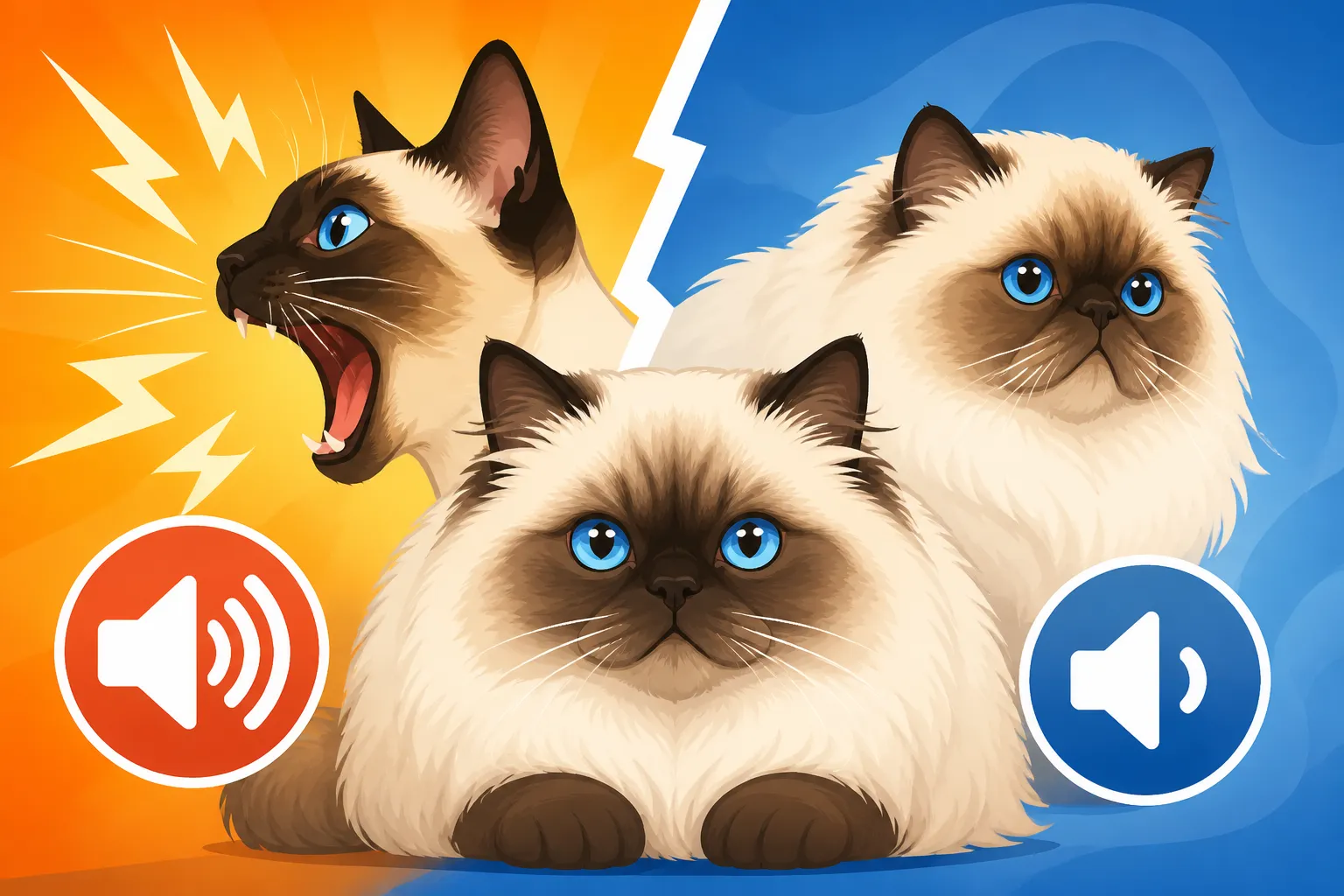
When you line up a Siamese and a Himalayan, their vocal differences are striking – it's like comparing a megaphone to a hushed conversation.
- The Siamese: Often dubbed the "Meezer" for their distinctive and often relentless "meow" or "yowl," the Siamese is undeniably one of the loudest and most vocal cat breeds. Their voices are high-pitched, resonant, and can carry throughout a house. They use their voices to express a wide range of emotions and demands: hunger, boredom, excitement, loneliness, or simply a desire for attention. If a Siamese wants something, you'll know it, and so will your neighbors. Their communication is often insistent, demanding immediate response, and they possess a remarkable stamina for vocalizing, continuing until their needs are met. Many owners describe it as a constant dialogue, where the Siamese expects and often initiates conversations.
- The Himalayan: In stark contrast, the Himalayan truly inherited the intention to communicate from the Siamese, but the volume control was turned way down by their Persian side. While a Himalayan will chirp, trill, and meow, their sounds are soft, gentle, and often require you to be in the same room, or even paying close attention, to hear them. They rarely, if ever, produce the piercing yowls of a Siamese. Their vocalizations are more of a polite suggestion or a soft greeting, an invitation to interact rather than a demanding command. They engage in conversational exchanges, but it's more like a whispered chat than a boisterous debate. If you're wondering if your Himalayan "yowls" like a Siamese, the answer is almost certainly no. You can explore this particular contrast further in Whether a Himalayan Yowls the Way a Siamese Does and Why a Himalayan Is Quieter Than Its Siamese Ancestors.
Himalayan vs. Persian: The Talkative Twist
Comparing the Himalayan to the Persian, its other foundational breed, reveals a different kind of vocal divergence. Here, the Himalayan tends to be the more talkative of the two, thanks to that enduring Siamese spark.
- The Persian: As discussed earlier, Persians are generally known for their quiet and reserved nature. While they certainly communicate – through purrs, slow blinks, and subtle body language – they are not typically a vocally expressive breed. A Persian might go for long stretches without uttering a sound, relying on their regal presence and expressive eyes to convey their feelings. They are not prone to initiating vocal "conversations" or making loud demands. Their vocal repertoire is often limited to soft purrs of contentment and perhaps an occasional, very soft meow when deeply satisfied or mildly requesting something. They embody feline grace and tranquility, often in silence.
- The Himalayan: This is where the Siamese influence truly shines through in the Himalayan. While not loud, Himalayans are generally more vocal and communicative than the average Persian. That innate Siamese desire to interact and engage through sound means a Himalayan is much more likely to chirp a greeting, trill with excitement, or offer a series of soft meows to draw your attention. They actively participate in communication, whereas a Persian might simply observe. It’s this conversational aspect, inherited from the Siamese, that sets them apart from their quieter Persian cousins. The Himalayan has retained that spark of verbal engagement, making them a delightful companion for those who enjoy a subtle, back-and-forth "chat" with their feline friend. The amount of voice left in a Himalayan compared to its Siamese ancestor is fascinating, and further discussed in What is Left of the Siamese Voice in a Himalayan.
To summarize these fascinating vocal distinctions, here's a quick comparison:
| Trait | Siamese | Persian | Himalayan |
|---|---|---|---|
| Volume | Loud, insistent, often piercing | Very quiet, often silent | Soft, gentle, moderate |
| Frequency | High, frequent, demanding | Low, infrequent, subtle | Medium, conversational, attentive |
| Types of Sounds | Yowls, loud meows, chatters | Soft purrs, rare trills/meows | Chirps, trills, soft meows, purrs |
| Purpose | Demanding attention, expressing strong needs/emotions | Contentment, mild, non-urgent requests | Conversational, greeting, expressing mild needs/curiosity |
| "Talkativeness" | Extremely talkative, expects replies | Generally very quiet, reserved | Moderately talkative, subtle communicator |
Ultimately, the Himalayan offers a delightful middle ground: a cat with an endearing voice, rich in subtle expressions, that communicates its affections and needs without ever becoming overbearing. They are a testament to how complex genetic inheritance can shape not just appearance, but personality and interaction styles.
Disclaimer
This article is for general informational purposes only and does not constitute professional advice. Laws, prices and regulations vary by location and change over time. Consult a qualified professional for guidance on your specific situation.